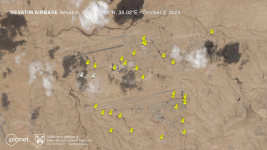
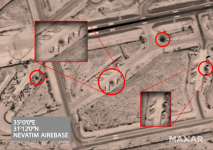
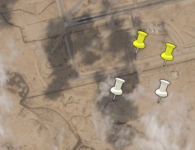
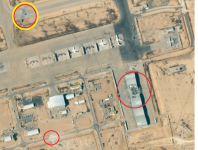
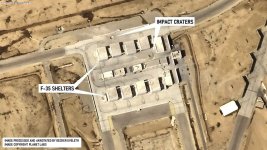
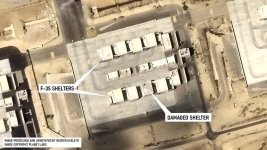
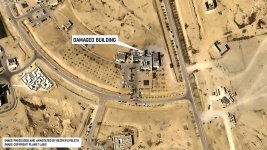
32 hits on Nevatim. I count maybe 9 accurate/semi-accurate hits.
we should accept that we cannot put these airbases out of operation with current missiles (too inaccurate, not powerful enough, airbases too big and difficult to put out of operation for any extended period of time anyway which makes trying not worth the effort)
What is the possibility that many of the missiles that have penetrated Israeli airspace that Iran has used were loaded with decoys or 'airburst' warheads, which do not leave large craters but throw shrapnel in a large radius, effective against dispersed targets such as aircraft and fighter jets?
I wonder this because in some images I did not see large explosions and the speed was low compared to other RVs that impacted the ground, which makes sense that Iran used some missiles with these payloads instead of using high explosive warheads.
In other words, Iran may have used three types of conventional payloads:
decoys
airburst
conventional warhead
Another thing to consider is that in many cases of videos, it seems that most are conventional ballistic reentry vehicles. If this is the case, the final orientation is done in space before the last stage or the “bus” makes its altitude adjustments and launches the RV, which will dive into the atmosphere, rotating to achieve stability.
The precision depends on the guidance system (whether inertial only or combined with satellite) and the quality of the inertial system and the refined attitude control of the missile by means of mini-rockets.
If it is a MaRV, that is, a maneuverable reentry vehicle, it has a guidance system in the reentry vehicle itself that uses small fins to correct the course. This correction can come from an inertial system alone, from an inertial system combined with a “GPS” or even from a seeker.
As in some cases, the RV appears to be tearing apart, it must not have a terminal seeker, otherwise it would be blind. In order to have a terminal seeker (such as a thermal or visual imaging seeker or a radar), the MaRV would have to slow down to something close to Mach 3, as the Pershing II did in the 1980s, in order to be able to “see” by clearing the plasma in front of it.
If it is a MaRV with an inertial guidance system or combined with GPS, then it could be possible since it would not need to slow down because the GPS signals can be captured by an antenna placed at the rear of the vehicle and it is in a blind spot where the plasma does not advance.
It could also refine its trajectory while still at high altitude before the plasma forms and use only inertial in the lower layers of the atmosphere.
I do not believe that what we see falling is a MaRV. Most must be ballistic RVs. And given the degree of precision of these warheads and what is left, it seems to be the case.
In fact, if it is a HGV from a “hypersonic” missile, the same considerations that are pertinent to a MaRV are pertinent to the HGV. If you have a seeker, you have to slow down. If you don't have one, you don't need to slow down and you can hit the target at a very high speed. What you can also see is that very fast vehicles, in the terminal phase, don't maneuver.


www.defenseone.com

www.businessinsider.com
www.airandspaceforces.com
www.newsweek.com