Iranian Missiles | News and Discussions

by what i get from the news it seems they upgraded HajQassem missiles not all of the missiles
It seems so. Though the upgrade packet looks to be quite universal considering that it was first tried on other shorter range missiles.

To view this content we will need your consent to set third party cookies.
For more detailed information, see our cookies page.
 
If it uses electro-optical sensor it can be really really accurate and doesnt need to rely on GPS.

Regarding threat of THAAD, possibly this missile makes maneuvers prior to hitting the target

Also EO sensor allows real-time battle damage assessment

Iran has 2 missile with EO sensor:
1) Khalije Fars anti-ship ballistic missile-300km range
2) Tankil anti-ship ballistic missile-500km range

Possibly this new missile can be adapted for hitting moving targets like ships.
Raad-500/Zoheir (500km SRBM) --> "Tankil" (Yemeni name) (500km ASBM)

Zolfaqar (700km SRBM) --> Zolfaqar-Basir (700km ASBM)

Haj Qasem (1450km MRBM) --> Qasem-Basir (1300km ASBM)
 
To view this content we will need your consent to set third party cookies.
For more detailed information, see our cookies page.


impact velocity of Qasem-Basir estimated at mach 1
 
20250506-130517.jpg

20250506-130533.jpg

To view this content we will need your consent to set third party cookies.
For more detailed information, see our cookies page.
 
Last edited:
I wonder if IRGC will use optical seeker for Kheibar Shekan

they clearly prefer their own KS missiles to the Haj Qasem (made by MODAFL). KS is a bit smaller and likely cheaper

I also wonder what the technical limitations of:

- optical seeker for large warheads (e.g., Khorramshahr's 1500-1800kg warhead)

- max velocity optical seeker can be used for

so far only shown on likely small c. 250-300kg warhead on Haj Qasem with impact velocity estimated at mach 1
 
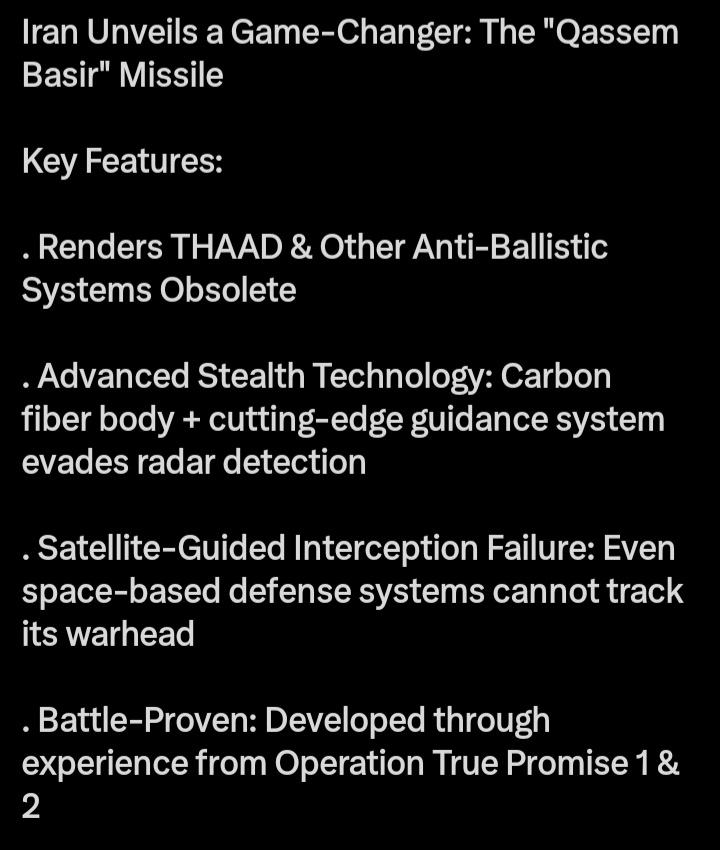
Besides the name that is absolutely hilarious and sounds like a weapon developed by some Arab country like Yemen, this new missile is far from impressive and a step that shows Iran's missile program is stagnating, if not moving backwards.

Shorter range (1200km), no payload improvement, destruction doesn't seem improved either. Yes, yes, I know they didn't use full explosives in the test but that was one of our main weakness in TP I and TP II. So, it's only normal to expect improvements in destructive power of our missiles. From the exaggerated claims of having hypersonic missiles with pin-point accuracy, we have Qassim Baseer that its terminal speed is less than Mach 2-3 and its CEP is highly unlikely to be less than 1m. Probably closer to 5m-10m. And they're advertising this as some game-changing breakthrough 😒

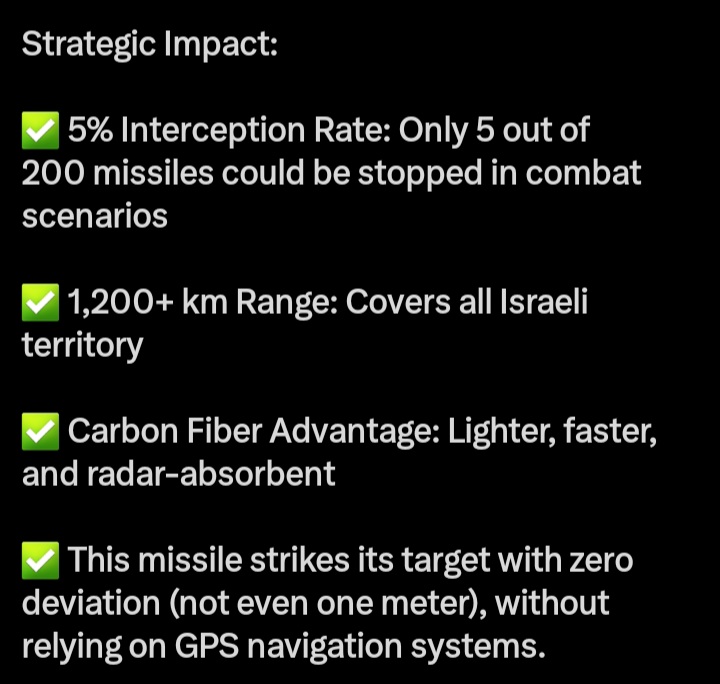
5 / 200 = 5% ? who did this maths
The same person that doesn't know what "battle-proven" means.
 
The Qassam Basir bleads a lot of speed preforming maneuvers upon re-entry allowing it to get past the ABM defenses which also allows the MARV to slow down to a speed at the end of its flight to be able to get a visual lock on target to achieve a very low CEP. The warhead might be small for some hardened targets but will still have its application for a wide range of targets.
 
Besides the name that is absolutely hilarious and sounds like a weapon developed by some Arab country like Yemen, this new missile is far from impressive and a step that shows Iran's missile program is stagnating, if not moving backwards.

Shorter range (1200km), no payload improvement, destruction doesn't seem improved either. Yes, yes, I know they didn't use full explosives in the test but that was one of our main weakness in TP I and TP II. So, it's only normal to expect improvements in destructive power of our missiles. From the exaggerated claims of having hypersonic missiles with pin-point accuracy, we have Qassim Baseer that its terminal speed is less than Mach 2-3 and its CEP is highly unlikely to be less than 1m. Probably closer to 5m-10m. And they're advertising this as some game-changing breakthrough 😒
in fairness, I think you are being too harsh.

biggest issue from TP1 and TP2 was lack of accuracy. this solves the problem (for non-hardened targets). range is 1300km which is sufficient for Israel and a big improvement for anti-ship role.

Exaggerated claims are par for the course with Iran. But this is a very welcome improvement IMO.
 
in fairness, I think you are being too harsh.

biggest issue from TP1 and TP2 was lack of accuracy. this solves the problem (for non-hardened targets). range is 1300km which is sufficient for Israel and a big improvement for anti-ship role.

Exaggerated claims are par for the course with Iran. But this is a very welcome improvement IMO.
Maybe I am being a little harsh, but I don't see how this is a game-changing weapon.

So, you want to target the USN in the Mediterranean Sea? Is that its alleged anti-ship role? Because the Israeli Navy poses no direct threat to us, except for its submarines which cannot be targeted by Al-Qassim Al-Baseer.

It's hard to predict how lethal this weapon is. And it's hard to believe that its CEP is less than 1m, per the image I posted from its test. Maybe 5m-10m. Mach 1 is not fast. It can be targeted using IR search and track. The warhead can be agile and maneuverable but it's still slow and has a heat signature due to air friction. And what do you plan to do with hardened targets, where IAF keeps their F35s? Last time we targeted Nevatim, not even a single hardened building or shelter was destroyed, not even partially.
 
Maybe I am being a little harsh, but I don't see how this is a game-changing weapon.

So, you want to target the USN in the Mediterranean Sea? Is that its alleged anti-ship role? Because the Israeli Navy poses no direct threat to us, except for its submarines which cannot be targeted by Al-Qassim Al-Baseer.

It's hard to predict how lethal this weapon is. And it's hard to believe that its CEP is less than 1m, per the image I posted from its test. Maybe 5m-10m. Mach 1 is not fast. It can be targeted using IR search and track. The warhead can be agile and maneuverable but it's still slow and has a heat signature due to air friction. And what do you plan to do with hardened targets, where IAF keeps their F35s? Last time we targeted Nevatim, not even a single hardened building or shelter was destroyed, not even partially.
it's obviously not the ultimate perfect solution to every problem, lets make that clear

it only decelerates to mach 1-2 at impact (or even for some seconds before), most of the journey is still in super/hyper sonic speeds, so it still avoids exo-atmopsheric interceptors like Arrow-3 and THAAD. but it is true that in the final descent it can be easier to intercept (e.g., by Arrow-2 or maybe David's Sling) due to deceleration.

there are always trade offs. the point is this is a new capability and before Iran did not have a ballistic missile that could reach Israel with < 5m CEP

as for USN, the further we can push them out, the better. Houthis pushed them back > 1000km away and that impacted sortie rates and today Trump backed down and announced end of that campaign.
 
it's obviously not the ultimate perfect solution to every problem, lets make that clear

it only decelerates to mach 1-2 at impact (or even for some seconds before), most of the journey is still in super/hyper sonic speeds, so it still avoids exo-atmopsheric interceptors like Arrow-3 and THAAD. but it is true that in the final descent it can be easier to intercept (e.g., by Arrow-2 or maybe David's Sling) due to deceleration.

there are always trade offs. the point is this is a new capability and before Iran did not have a ballistic missile that could reach Israel with < 5m CEP

as for USN, the further we can push them out, the better. Houthis pushed them back > 1000km away and that impacted sortie rates and today Trump backed down and announced end of that campaign.
Yes. Hence, it's not a breakthrough. Everybody knew that accuracy can be improved at the cost of reducing the speed. So, how is this some sort of breakthrough?

I highly doubt that it is hypersonic at any point in its terminal phase. Yes, it avoids exa-atmospheric interceptors, but it can be targeted during its descent. It can be made of carbon fiber and have absorbent materials and coating, but its heat signature due to maneuvering will be significant enough to allow it to be intercepted. So, it's hard to believe that 5%-10% interception rate has any solid basis.

We have had that doctrine against the USN since 2003. So, how is this a new development? And the Houthies finally managed to repel the USN attacks after nearly 3 months. It's hard to say it was because of their firepower, but probably because the US administration no longer wanted the USN to continue their pointless bombing of Yemen. Everyone knew that the US had no option but to pull back or send soldiers on the ground, and the later is exactly what the Americans can't afford at this point.

Look, I'm not saying this is useless. I'm just saying it's far from impressive. And doesn't change the existing balance of power between Iran and Israel in favor of us in any meaningful way.
 

Users who are viewing this thread

Pakistan Defence Latest

Back
Top