Just as an addendum:
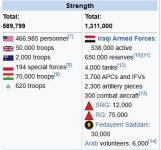
The American invasion force in Iraq was actually smaller than the defending force:
I already explained in the post below about Rumsfeld and his obsession with RMA; he actually wanted even fewer troops.
I'm sorry to inform you but the US invaded Iraq with a very low number of American troops. Rumsfeld even wanted less because he was obsessed with RMA and emphasized that they didn't need many troops to invade a country. The US almost had your Ukraine in 2003. The difference was that there was no Iraqi resistance except after the invasion, which became the asymmetric conflict that followed for several years. While American intelligence correctly assessed the disposition of Iraqi military resistance, the Russians completely misjudged their assessment of...
What the Russians did in Ukraine was exactly what the Americans did in Iraq. It was exactly the same thing.
Iraq was a gigantic nation with nearly 40 million people and a reported army of 1.3 million soldiers.
View attachment 138193
The ground invasion force was smaller than the one that invaded Ukraine; The Americans had 4.5 maneuver force divisions: 3rd Infantry Division (mechanized infantry/armored), 1st Marine Division (amphibious with almost no armor), 1st Armored Division (all armor), 2/3 of the 82nd, 2/3 of the 101st (light infantry, no armor).
To put this force in perspective, the total force was smaller than what VII Corps had during Operation Desert Storm to liberate Kuwait, which was only one of five corps-sized units. The Marine Corps command in ODS alone had 2.5 divisions. In total, that coalition force ODA had about 15 divisions, most of them mechanized infantry or armored, and this was not to take a country, but simply to expel Iraqi forces from Kuwait.
In terms of Iraq, the invasion force was VERY small. This was noted beforehand and during the invasion as being too small, but the Americans were fortunate that it worked (especially since the 4th ID didn't participate). Rumsfeld was a fanatic for the "Revolution in Military Affairs" and had even contemplated only about 1.5 divisions to topple Saddam, but was persuaded to a slightly larger ground attack package.
In terms of strategy, they followed almost the same plan in Iraq as the Russians did in Ukraine. CENTCOM and all subordinate commands were openly briefed by the White House and Pentagon (Bush, Cheney, Rumsfeld, Wolfowitz) at the top level to expect no, if any, heavy resistance. They were instructed to advance quickly on Baghdad and bypass any resistance along the way (except for the Marines in Nasiriyah, which was partially attacked only because an Army maintenance company took a wrong turn and ran into it and got screwed). They didn't reach Baghdad in three weeks because they were quick; they did it because it was the plan. Reach Baghdad and Saddam's regime fell. They were very lucky because Iraq barely fought to stop the invasion and defend the country (which only happened when the insurgency began).
A good comparison is between the OIF invasion and the Russian invasion of Ukraine in 2022; both were founded on the belief at the highest levels that the enemy wouldn't fight back. Bush/Cheney/Rumsfeld/Wolfowitz were right, which is why Saddam's government fell in 21 days. Putin and the FSB were wrong, which is why we are in the fourth year of war.
First, there was no real plan to defend Iraq because Saddam was convinced it was all a bluff by Bush and refused to allow subordinates to prepare. It didn't help that Saddam went underground and barely communicated after the assassination attempt at Dora Farm in the nick of time.
Second, they destroyed/jammed their C4I network so they couldn't radio for planning and maneuvering when the invasion began.
Third, this was further facilitated by the fact they were moving faster than their intelligence could react, with all their information often 2-3 days late. They were moving fast, bypassing resistance, and getting to Baghdad as quickly as possible.
Fourth, the Iraqi army as a whole never recovered from the beating it took at the ODS in 1991. Their equipment was poor and outdated, and sanctions prevented them from having the funds or ability to import better equipment. Even if they wanted to fight, they could never resist.
Fifth, the Iraqi people's hearts weren't in it; they wouldn't fight much, if at all, for Saddam. Almost the entire Iraqi conscript army was Shiite, who deserted en masse at the first opportunity. Occasionally, a battalion here or a brigade there would mount a partial defense or counterattack (usually by the Republican Guard), but these were defeated relatively easily. The most serious resistance was only from Saddam Fedeyeen along the supply lines, and this was largely RPG-7-based and harassing in nature.
If Russia hadn't done exactly the same thing several times in the past—an armored column blitzkrieg displaying strength against no expected opposition (1956—Hungary, 1968—Czechoslovakia, 1994—Chechnya, 2008—Georgia, 2014—Crimea), I would have said that Putin and his MOD lackeys actually copied the US model for the invasion of Iraq.
Even some military analysts were calling the invasion of Ukraine a major "Thunder Run"-type operation, which was the very non-doctrinal nickname for how the 3rd ID entered Baghdad in 2003 to "break the resistance," but could also be used to describe the overall "shock and awe" invasion plan.
The ONLY difference between the OIF and Russia's invasion of Ukraine is that the intelligence estimate of Iraqi resistance during the invasion was correct, and the Russians' was grossly inaccurate. However, the Americans completely botched the intelligence estimate of the chances of an insurgency. And they ignored the insurgency once it began at the political/strategic level for most of the year, demonstrating once again that they did not always respond well to events in theater.