
Beijingwalker
VIP Member

Is the U.S. Ready for War with China?
June 11 2026The report “Is the U.S. Ready for War with China” provides a detailed assessment of the United States’ readiness for a potential conflict with China and the key challenges involved, conducted by the Center for Strategic and International Studies (CSIS). In this summary, we will attempt to provide a concise overview of the report.
The issue
As the authors of the study note, despite progress in ramping up defense production, the U.S. military could face serious difficulties in the event of a prolonged war with China.The main challenges include a shortage of long-range munitions, air defense systems and interceptors, and an insufficient number of unmanned aerial, underwater, and surface platforms. An even more difficult scenario for the U.S. would be simultaneously deterring or conducting war on two fronts – in the Indo-Pacific region and in Europe.
Meanwhile, there are no quick solutions to these problems. Production timelines for certain critically important munitions are three to four years. This specifically applies to SM-3 IIA, SM-6, SM-3 IB missiles, as well as JASSM and Tomahawk missiles. Recent production increases by the Pentagon are considered helpful but insufficient.
The authors emphasize the need for long-term, multi-year contracts, infrastructure funding, maintaining the readiness of aircraft and ships, and rapid production of a mix of expensive, high-tech systems and cheaper, mass-produced systems under the Hellscape concept for the Indo-Pacific region.
The researchers also highlight the need to increase military assistance to Taiwan. According to estimates, the backlog of unfulfilled U.S. deliveries to Taiwan is approximately $32 billion. This includes, in particular, Harpoon coastal anti-ship missile systems, NASAMS air defense systems, PAC-3 MSE interceptors, and Altius drones.
Empty stockpiles and aging ships
The Epic Fury Operation has intensified the debate over how the war with Iran has affected U.S. readiness for a potential conflict with China. Some assessments argue that the U.S. has expended so many munitions that it would complicate the execution of Taiwan’s defense plans in the event of a Chinese invasion in the near future. On the other hand, some U.S. officials have assured that the United States has sufficient munitions stockpiles to defend its territory and conduct military operations.The study raises two main questions: what military capabilities the U.S. needs to counter China, and how the war with Iran has affected these requirements.
The first key finding is that the shortage of munitions for a prolonged conflict with China predated the Epic Fury Operation. The war with Iran has only created additional risks due to the significant use of long-range Tomahawk and JASSM missiles, as well as Patriot and THAAD interceptors.
The second key finding is that the challenge goes beyond ammunition shortages. Protecting military bases is equally important. Iranian missile and drone attacks on U.S. bases and civilian infrastructure in the Middle East have shown how vulnerable fixed installations can be. In a conflict with China, similar tactics could be used across the Indo-Pacific. U.S. bases in Japan, the Philippines, Guam, and elsewhere remain exposed to strikes from Chinese missiles and drones. Another concern is the readiness of military equipment. Many U.S. aircraft and warships have been heavily used in recent conflicts and operations, increasing maintenance demands and potentially affecting their availability in a future war.
U.S. weapon systems demonstrated high effectiveness during the war with Iran. Tomahawk missiles were used to strike Iranian radars, command centers, missile positions, and other targets. ATACMS, GMLRS, and PrSM missiles were also employed. According to General Dan Kaine, Chairman of the Joint Chiefs of Staff, U.S. artillery forces used the Precision Strike Missile in combat for the first time and employed ATACMS to sink several ships, including a submarine.
However, the main problem is that stocks of long-range offensive munitions were already low before the war with Iran. During the operation, the U.S. significantly depleted its Tomahawk and JASSM reserves, creating risks for a potential conflict with China or other unforeseen contingencies.
Air defense munitions were also limited even before the war. In 2025, during just a few days of operations against Iran, the U.S. fired more than a quarter of its THAAD interceptors. In a 2026 conflict scenario, researchers estimate that more than half of pre-war THAAD, SM-3, and Patriot interceptor stocks could have been expended.
It is also emphasized that THAAD relies on the AN/TPY-2 radar. If this radar is damaged, a THAAD battery cannot operate because it provides detection, tracking, and data guidance to the interceptors. The U.S. Army has only eight THAAD batteries, deployed between the Middle East and the Indo-Pacific region.
Production timelines for replenishing stocks remain lengthy. The SM-3 IIA requires over four years from contract signing to first delivery. THAAD, SM-6, SM-3 IB, PrSM, Tomahawk, and JASSM take around three years, while the PAC-3 MSE requires more than two years. Additional investments in factories to increase production could add another 18–24 months.
The war with Iran also highlighted problems with the readiness of aircraft and ships. The U.S. deployed over a quarter of its active surface fleet to the Western Hemisphere for operations in Venezuela, and later deployed more than 40% of its ships against Iran in 2026. This pace caused significant wear and tear. In particular, the aircraft carrier Gerald R. Ford experienced serious maintenance issues, including a fire in the main laundry, after which the ship was moved to a base in Crete for repairs.
The challenge from China
China is rapidly modernizing its armed forces across all key domains – land, air, sea, space, cyberspace, and nuclear capabilities. The Chinese defense industry produces ships, aircraft, tanks, and other weapon systems in large quantities, while also investing in artificial intelligence, quantum technologies, and other military applications.In several CSIS war exercises, U.S. forces exhausted their stocks of certain long-range missiles within the first week of a conflict over Taiwan.
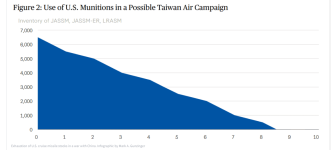
In these scenarios, Taiwan would also expend its entire stock of anti-ship cruise missiles within a week. Researchers note that without long-range weapons, sustained combat would be impossible, as Chinese defenses in the early stages of a conflict would make it difficult for U.S. aircraft and ships to approach close enough to use short-range munitions.
The U.S. forward presence in the Indo-Pacific is concentrated in Japan, South Korea, the Philippines, and Guam. In South Korea, the U.S. Army has roughly 20,000 personnel; Okinawa hosts about 20,000 Marines; another 9,000 are stationed on Guam and rotate through Australia.
The U.S. Seventh Fleet, based in Yokosuka, typically includes 50–70 surface ships and submarines. Air presence includes fighter squadrons at Kadena and Misawa Air Bases, as well as other aircraft across South Korea, Japan, and additional locations.
According to the study’s authors, these forces are vulnerable to Chinese drones, cruise missiles, ballistic missiles, and hypersonic weapons. The U.S. Air Force has developed a concept of flexible combat employment, which involves operating aircraft from dispersed and rapidly prepared locations.
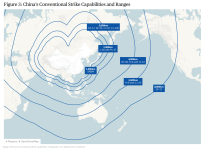
The study notes that U.S. forces are still not sufficiently dispersed and need protected fuel depots, ammunition bunkers, aircraft shelters, and active defensive systems.
Beyond the Hellscape
The Hellscape concept is designed to slow a Chinese invasion of Taiwan using large numbers of unmanned systems and other capabilities. Admiral Samuel Paparo, Commander of U.S. Indo-Pacific Command, explains that the goal is to turn the Taiwan Strait into an “unmanned hellscape,” making it extremely difficult for an adversary to operate for roughly a month—buying time for further U.S. actions.The plan relies on widespread use of drones, unmanned underwater vehicles, unmanned surface vessels, and other systems for reconnaissance, targeting, electronic warfare, mining, and strikes against Chinese ships, aircraft, submarines, air defense systems, missile silos, and other PLA assets.
This approach combines low-cost expendable systems with more advanced platforms, including high-altitude long-endurance drones, loitering munitions, and strike drones that can be launched from ships, submarines, aircraft, or land.
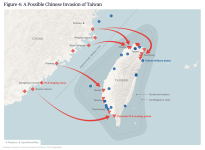
In an invasion scenario, the People’s Liberation Army of China would likely attempt to transport troops, weapons, and supplies to Taiwan or nearby areas via amphibious landings, airborne assaults, airborne drops, or a combination of these methods.
Key roles in such an operation would likely be played by Chinese ships, submarines, aircraft, missiles, long-range strike systems, and other capabilities, supported by cyber, space, and air defense assets.
To counter such a scenario, the United States, Taiwan, and their allies would need to move quickly, maximize maneuver, and pre-position platforms and munitions.
If the United States chooses to intervene directly, it would likely need to act within hours or days to prevent a rapid seizure of territory. This would require forward positioning of sufficient numbers of bombers in Australia and Alaska, hardened aircraft shelters, active missile defense systems, and stockpiles of fuel, spare parts, ammunition, and other supplies.
The second component is the rapid neutralization of the invading force’s center of gravity. In a conflict with China, this means identifying high-priority targets, including PLA ships and aircraft transporting troops, weapons, and equipment; quickly transmitting sensor data to strike systems; and accurately destroying targets essential to the invasion. Key targets include ships, transport helicopters, aircraft, air defense systems, artillery, and PLA command centers.
Key capabilities to counter China
Researchers identify five main priorities for countering China. The first is a combination of undersea capabilities, including Virginia-class nuclear submarines and cheaper unmanned underwater and surface vehicles.In CSIS war games, U.S. submarines inflicted significant losses on Chinese landing ships, escort vessels, and logistics ships. At the same time, U.S. submarine production lags behind requirements: instead of the target of two submarines per year, only about 1.2 are actually being built.
The United States also needs to increase procurement of cheaper unmanned underwater and surface vehicles capable of operating in environments with degraded communications and GPS. These systems can perform missions such as mining, reconnaissance, electronic warfare, and strikes against PLA underwater and surface platforms. Taiwan and other U.S. partners in the region also require such capabilities, including domestic production capacity.
The second priority is the integration of manned and unmanned aerial systems. Large numbers of low-cost drones are needed for intelligence, surveillance and reconnaissance (ISR), battle damage assessment, logistics, electronic warfare, and target engagement.
According to CSIS estimates, Ukraine could produce 600,000–800,000 FPV drones per month in 2026 and use 350,000–550,000 per month, while Russia could produce 250,000–300,000 and use 200,000–300,000 per month. Special attention should also be given to interceptor, long-range, and naval drones.
However, the article emphasizes that drones alone are not sufficient. The U.S. and its allies also need bombers and fighter aircraft, including the B-21, B-2, B-1B, B-52H, and F-35. Tactical aviation is likely to play a major role in a conflict with China once long-range missile stockpiles are depleted.
At the same time, manned aircraft remain dependent on ground bases and surface ships that are within range of thousands of enemy missiles, which is a major vulnerability, especially in a conflict with China.
The United States must also accelerate development of manned–unmanned teaming and collaborative combat aircraft, including the YFQ-42A and YFQ-44A.
The third priority is long-range precision missiles. According to analysts, in the first week of a Taiwan conflict, the U.S. could expend 450–1,000 LRASM, 3,500–4,000 JASSM-ER, 3,000–5,000 JASSM, 400–600 SM-6, 400–1,000 Tomahawk, 250–400 PrSM, and 400–800 Harpoon missiles.
Munitions expenditure in a prolonged conflict is likely to be very high, while conventional LRASM and JASSM missiles cost around $2.5–3 million each. Because of this, the United States needs to expand production of cheaper long-range munitions, including the Extended Range Attack Munition (ERAM), which has an estimated cost of around $250,000 per unit.
The fourth priority is air and missile defense, including defense against drones, cruise missiles, ballistic missiles, and hypersonic weapons. Required solutions include high-powered microwave systems, directed-energy weapons, low-cost interceptors, AI-based data processing, active and passive sensors, mobile air defense systems, interceptor drones, decoys, passive defenses, and gun-based anti-drone systems.
The fifth priority includes additional capabilities such as multi-domain command and control, AI-driven software systems, space and counter-space capabilities, cyber warfare tools, and electronic warfare systems.
Urgent steps
In conclusion, the authors emphasize the need for the United States to fully fund multi-year contracts for critical munitions, maintain aircraft and ship readiness, strengthen base defenses in the Indo-Pacific region, and establish a presidential initiative for national industrial mobilization.Meanwhile, the Trump administration has already announced plans to rebuild the “arsenal of freedom” and shift the U.S. defense industrial base toward a wartime footing. In particular, Deputy Secretary Steve Feinberg created a Munitions Production Acceleration Board in 2025 to increase production of various munitions—from Patriot interceptors to LRASM missiles. The administration has also sought to reform the slow procurement system, reduce regulatory constraints, and expand private-sector involvement.
The study also highlights U.S. dependence on China for critical minerals needed by the defense industry. The United States is already stockpiling these materials under the Vault program and is also securing access through agreements with other countries, including equity stakes in mining projects in the Democratic Republic of the Congo.
However, researchers argue that these measures are not sufficient for the Indo-Pacific or for a potential two-front war. They stress the need for long-term multi-year contracts that allow defense companies to lock in stable supply chains. This is especially important for solid rocket motors and other complex electronic and mechanical components, where production capacity is limited, and the supplier base is narrow.
Another key issue is maintaining the readiness of military platforms. Stealth fighters like the F-35, B-2 bombers, C-17 transport aircraft, as well as aircraft carriers, destroyers, and other naval vessels, were heavily used in operations against Iran and remain essential for potential conflicts in other regions, especially the Indo-Pacific. Ensuring their readiness requires sustained, multi-year funding for maintenance and support from both the Pentagon and Congress.
In conclusion, analysts warn that the war with Iran has once again exposed weaknesses in the U.S. defense industrial base. If these problems are not addressed quickly, the United States could face far greater costs in a future conflict with China in the Indo-Pacific.


 ...he believes china is a gift to humanity from heaven.


