Jun 30, 2026, 10:31 AM
Share
1
Please note that the posts on The Blogs are contributed by third parties. The opinions, facts and any media content in them are presented solely by the authors, and neither The Times of Israel nor its partners assume any responsibility for them. Please contact us in case of abuse. In case of abuse,
Report this post.
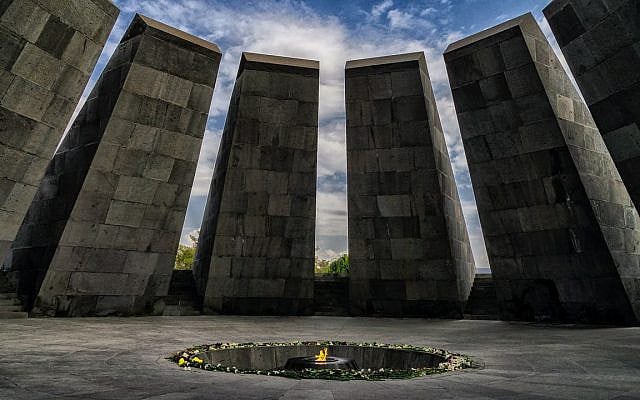
Memorial to the Armenian Genocide in Yerevan, Armenia (Unsplash)
History did not change on the day Israel’s Cabinet voted to recognize the Armenian Genocide.
Politics did.
The Armenian Genocide was a historical fact in 1915. It remained a historical fact while governments debated whether acknowledging it was politically convenient. It remained true during every decade Israel chose strategic caution over formal recognition. What changed was not the evidence. What changed was the politics.
Israel’s Cabinet has unanimously approved recognition of the Armenian Genocide, describing the decision as a moral and historical duty. The proposal still requires approval by the Knesset before becoming formal state policy. That procedural distinction is important, but it should not distract from the larger question: why did this moment arrive now rather than decades ago?
For Armenians, recognition is not simply symbolic. It is an affirmation that historical truth cannot be erased through diplomacy or denial. The genocide claimed an estimated 1.5 million Armenian lives and destroyed families, churches, schools, businesses, and centuries of cultural heritage. The pain has always extended beyond the killings themselves. Denial became a second injustice, forcing survivors and their descendants to defend history instead of simply remembering it.
The historical record has not changed. Historians have long documented the systematic destruction of the Armenian people, and many democratic nations have formally recognized those events as genocide. What changed was the geopolitical landscape.
For decades, successive Israeli governments avoided formal recognition because Turkey occupied a critical place in Israel’s regional strategy. Military cooperation, intelligence sharing, trade, and broader security interests made leaders reluctant to jeopardize an important relationship. Whether that calculation was justified remains open to debate, but it explains why recognition was repeatedly postponed despite the strength of the historical evidence.
That caution came at a moral cost. The victims of 1915 were asked to wait while diplomacy took precedence over historical truth. Justice delayed may still be justice, but delay always carries consequences.
Today, relations between Israel and Turkey have deteriorated sharply. Against that backdrop, recognition inevitably carries diplomatic significance alongside its moral importance.
It would be too simplistic to conclude that Israel acted solely to rebuke Turkey. Governments rarely make consequential foreign-policy decisions for only one reason. Moral conviction, changing leadership, public opinion, and geopolitical realities often converge. The more important question is why politics delayed recognition for so long.
If recognition is morally right today, it was morally right decades ago. Historical truth should never depend upon the state of bilateral relations or shifting strategic interests.
Recognizing the Armenian Genocide does not diminish the Holocaust. It reinforces a universal principle: no people’s suffering should be denied or erased because acknowledging it is politically inconvenient. Memory is not a competition. Truth is not a finite resource.
History did not change.
Politics did.
The Armenian Genocide did not become true because Israel’s Cabinet approved recognition. Israel acted because the historical truth had never changed.
History rendered its verdict more than a century ago. Governments are only now catching up.
Israel has taken an important step. The challenge now is ensuring that this recognition endures not because relations with Turkey remain strained, but because historical truth deserves permanent recognition regardless of changing political circumstances. If this decision reflects an enduring commitment to truth rather than the circumstances of a particular moment, it will stand not only as an important diplomatic milestone, but also as a lasting moral one.
About the Author
Mihran Kalaydjian is a devoted civic engagement activist for education spearheading numerous academic initiatives in local political forums with over twenty years’ experience in government relations, legislative affairs, public policy, community relations and strategic communications in Los Angeles, California.