The most well-documented massacre in history

www.i24news.tv
2023 Gaza Strip evacuations
From Wikipedia, the free encyclopedia
2023 Gaza Strip evacuations
During the
2023 Israel–Hamas war, the
Israeli military ordered all communities north of the
Wadi Gaza, including
Gaza City, to evacuate southward.
[4] The order resulted in hundreds of thousands of residents of northern Gaza evacuating south.
[5] Beginning on 1 December, Israel began issuing evacuation orders across the Gaza Strip, dividing the territory into 620 zones.
[6] The UN stated residents were being pushed into an area one-third the size of the total territory.
[7] Israel initially demanded the 1.1 million residents of northern Gaza to evacuate within 24 hours,
[8] which was condemned by the UN as "impossible without devastating humanitarian consequences."
[9][10][11] The UN said the order created "chaos".
[12] The order came one week after
an offensive on Israel from Gaza was mounted by
Hamas.
Israel's ground invasion of Gaza began on 27 October. As of November 4, 2023, between 800,000 and 1,000,000 people moved to the south of the Gaza Strip, while 350,000 to 400,000 remained in the north.
[13] By 1 December, 80 percent of the territory's population was in the southern Gaza Strip.
[14] Hamas instructed civilians not to evacuate, and there are multiple reports indicating that Hamas physically hindered Gazans from fleeing to the south.
[15][16][17][18][19] Multiple reports also indicated Israel
targeted Palestinians during the evacuation process and subjected them to attacks and bombardments in the southern Gaza Strip.
[20][21][22][23][24] Evacuees described the evacuation corridors as unsafe, and full of terror from Israeli soldiers and dead bodies along the road.
[25][26][27]
Paula Gaviria Betancur,
UN special rapporteur on the human rights of
internally displaced persons, condemned the forcible evacuation order as a
crime against humanity and violation of
international humanitarian law.
[28] The
displacement resulting from the evacuation was part of a broader
humanitarian crisis in Gaza.
[29] It is the largest displacement of Palestinians in 75 years.
[30] Palestinians have described the evacuation as the "second
Nakba."
[31]
Background
Tensions escalated when
Hamas launched an offensive on Israel. Israel responded with a series of airstrike attacks on Gaza. The
Israeli Defense Forces (IDF) issued a warning to residents in the northern regions to evacuate. The
United Nations initially considered this evacuation order impractical to execute safely due to the significant number of people it affected.
[32]
Evacuation of northern Gaza
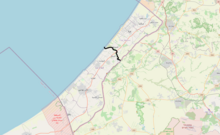
The line in black represents the IDF's boundary at Wadi Gaza for evacuation.
In the first two days following the announcement of the evacuation order, hundreds of thousands fled to
southern Gaza.
[33] Israel initially provided a six-hour window for individuals to flee south.
[34] Israel exerted force on residents to flee south.
[35] International efforts were made to open a humanitarian corridor for civilians.
[36] In early November, Israel announced a daily four-hour humanitarian corridor.
[37]
By 10 November, estimates of the number of people remaining in northern Gaza ranged from the low hundreds of thousands to at least 900,000.
[38] Those who remained had little to no access to water, food, or electricity.
[38] UNICEF noted thousands of children remained in northern Gaza, whose lives were "hanging on by a thread."
[39] On 17 November, the
Palestinian Central Bureau of Statistics estimated there were still some 800,000 civilians in northern Gaza.
[40]
On 8 November, an estimated 50,000 people evacuated northern Gaza.
[41] Civilians fled northern Gaza on foot or on donkey carts.
[42] As they passed Israeli tanks, civilians waved
white flags, though some reported Israeli soldiers firing at them and passing dead bodies along the road.
[42] Many fled on an evacuation corridor along
Salah al-Din Road, one of Gaza's two north-south highways.
[43] On 10 November, an Israeli spokesman stated 100,000 people had fled northern Gaza in the prior two days.
[44] Evacuees reported having to pass through Israeli checkpoints, where IDF soldiers made arrests.
[45] On 12 November, Israel announced a temporary four-hour "temporary tactical cessation of military activities" at the
Jabalia refugee camp to allow for residents to evacuate south.
[46] A Palestinian journalist noted the humanitarian pauses only extended to Salah al-Din Street, but not to any of the roads leading to it.
[47]
On 12 November,
CARE International noted, "The journey to the south is incredibly dangerous and hard. Many of those who have made it out have experienced and witnessed terrible suffering."
[48] The same day, the
International Committee of the Red Cross released a statement, noting it was "gravely concerned by the precarious and unsafe conditions under which civilians are evacuating."
[49] In an article in
The Intercept, Gazan journalist
Hind Khoudary compared the evacuation to the
Trail of Tears, writing, "We kept walking. As we walked, pushing each other, we saw bombed cars and dead bodies inside the cars. Flies filled the cars, feasting on the blood and the bodies inside."
[50] On 15 November,
OCHA stated Israel was arresting evacuees, reportedly beating and stripping people naked.
[51]
The
Palestinian Red Crescent documented evacuees, including children and wounded on stretchers, walking 11km (6.8-mile) from Gaza City to southern Gaza.
[52] Journalists covering the evacuation on Salah al-Din road stated men were being denied access past an Israeli checkpoint into southern Gaza.
[53] Mosab Abu Toha, a poet, was detained at an Israeli checkpoint.
[54] In the case of one family, three young brothers were apprehended, and their family was left not knowing what happened to them more than two weeks later.
[55] Palestinians were required to undergo a
facial recognition scan before passing through checkpoints.
[56] UNICEF reported unaccompanied children were evacuating south by themselves.
[57] Doctors Without Borders condemned a deliberate Israeli attack on a medical convoy evacuating northern Gaza.
[58] Evacuees described the evacuation path as full of death and horror.
[59][60] Israel issued evacuation orders on 22 December.
[61]
On 4 January 2024, Israel announced the closure of Salah al-Din Street as a humanitarian corridor and the transfer to al-Rashid Street.
[62]
Hospitals
On 14 October 2023, Israel ordered the evacuation of 22 hospitals in northern Gaza. The WHO described the order as a "death sentence" for the sick and wounded.
[63] Doctors Without Borders issued a statement calling the order "outrageous," "an attack on medical care and on humanity," and condemned it "in the strongest possible terms."
[64] The
World Health Organisation released a plea requesting Israel to rescind the orders, noting the extreme difficultly moving patients in critical care, the depletion of medical supplies, and that "the four Ministry of Health hospitals in south Gaza are already beyond capacity".
[65] Similar statements were issued by
UNICEF and
IRC.
[66][67] The WHO expressed concern about the evacuation order sent to the
al-Quds Hospital in Gaza.
[68]
On 29 October 2023,
Tedros Adhanom Ghebreyesus, the head of the World Health Organization, described reports from the
Palestinian Red Crescent that the al-Quds hospital had received an urgent evacuation warning and notice that it was "going to be bombarded" as "deeply concerning." He reiterated that it was "impossible to evacuate hospitals full of patients without endangering their lives."
[69]
Doctors across northern Gaza stated they were unable to follow Israel's evacuation order, since their patients, including newborns in the
ICU, would die.
[70] On Monday 16 October, Israel ordered the
al-Ahli Arab Hospital, and the rest of northern Gaza, to evacuate.
[71] Because of insufficient beds in the southern Gaza Strip and no means of transporting patients, such as newborns in incubators or patients on ventilators, the evacuation orders were widely regarded as impossible to comply with.
[71] On 17 October, a widely condemned
explosion in the al-Ahli courtyard resulted in significant fatalities.
[72]
On 10 November, Muhammad Abu Salmiya, the director of
Al Shifa hospital, noted that despite Israeli bombings, medical staff would stay with patients until the "last moment."
[73] Abu Salmiya stated, "There is a war against hospitals… this has never happened in any war."
[73] On 12 November, the IDF announced that it was enabling a safe passage from Al-Shifa, Rantisi, and Nasser hospitals, and opened and secured an additional one to help people to evacuate to the south.
[74] On 13 November, however, the Gaza Health Ministry stated thousands of patients were unable to evacuate, after Israel’s military encircled health facilities.
[75]
On 14 November,
Human Rights Watch noted the impossibility of evacuation from
al-Shifa Hospital, stating , "There is no reliably safe route to evacuate. Satellite imagery confirms fires, military operations, and roadblocks on every conceivable route. And many sick and injured people in the hospital wouldn’t be able to evacuate even if the roads were clear."
[76] At least 40 patients died during the
Al-Shifa Hospital siege and its subsequent evacuation.
[77]
Attempts to return north
On 22 November 2023, Israel and Hamas agreed to a
temporary ceasefire.
[78] In response, internally-displaced persons in the south attempted to return north.
[79] Israeli soldiers fired at the evacuees, killing two and wounding eleven.
[80] The IDF issued a warning telling evacuees not to attempt to return north.
[81]
On 29 November some individuals were able to return to the al-Nasr Hospital and raised claims that IDF forces had abandoned medically complex children who died and decomposed in their beds. The hospital director had told Euro-Med Human Rights Monitor he had sent an appeal to aid groups about the children after being forced to evacuate and leave them behind by IDF forces.
[82] Two independent forensic pathologists reviewed the raw footage for NBC News saying that the advanced stages of decomposition of the dead infants is consistent with the roughly two weeks from the time the infants would have been abandoned to the date the video was shot.
[83]
Attacks on evacuees
Further information:
2023 attacks on Palestinians evacuating Gaza City
Both Hamas and the IDF accused each other of preventing the evacuation of Palestinians from northern Gaza. According to Hamas, Israeli airstrikes
bombed and killed civilians complying with the evacuation order.
[84][85] According to the IDF, Hamas bombed, shot, and placed roadblocks for civilians trying to escape.
[86] Hamas told civilians that roads were unsafe, stating that Israel had attacked trucks carrying evacuees.
[87] The IDF also alleged that Hamas instructed civilians to return to the north.
[88]
On October 13, Gaza mosques broadcast messages telling Gaza Strip residents to not evacuate, stating, "Hold on to your homes. Hold on to your land."
[89] On 14 October, the IDF said Palestinians moving south were stuck in traffic caused by Hamas' roadblocks.
[90]
Missile attacks
On 13 October 2023, multiple bombings targeted Palestinians attempting to leave northern
Gaza City, killing 70 people, mostly women and children, and injuring 200.
[a][20][91] Hamas issued a statement accusing Israel of bombing civilians.
[92][93] In return, Israel accused Hamas of blocking Palestinians' evacuation, in order to use them as "human shields."
[94] Although there are disputes about the exact details of the attacks, a number of sources attribute responsibility to an Israeli missile strike.
[20][21][95]
On 3 November, fourteen people were killed by an Israeli bombardment while attempting to evacuate northern Gaza.
[96] On 11 November, the
United Nations noted several explosions had hit the evacuation corridor on Salah al-Din Road, resulting in fatalities and injuries.
[97]
Tank attacks
On 30 October, Israeli tanks blocked the roads connecting Gaza City to southern Gaza and fired on civilian vehicles complying with Israeli orders to evacuate.
[98][99] In one instance, a tank at
Netzarim attacked a car and a bus, killing three people.
[100]
Gunfire attacks
After the ground invasion of Gaza, the IDF opened protected humanitarian corridors from Gaza City to South Gaza
[101][102] According to
Ynet, Palestinian civilians were attacked attempting to flee Gaza City.
[103] Civilians reported Israeli soldiers open-firing.
[42]
Southern Gaza
After telling civilians to evacuate south, Israel continued to bomb the areas it told people to go to.
[22] On 6 November,
Al Jazeera journalist Hani Mahmoud described southern Gaza as a large
concentration camp.
[104] On 9 November, the UN estimated 30,000 northern Gazan residents had returned to the north after failing to find shelters in the south.
[105] Due to UNRWA shelters being overcrowded, many northern Gazan refugees slept in the streets.
[106] Hospitals in southern Gaza reported inadequate medical resources to deal with the volume of wounded arriving from the north.
[107] Refugees described the situation as "primitive" with "no safety."
[108] Families reported evacuating as many as five times.
[109]
On 11 November, the
Interior Ministry stated Israel launched airstrikes in "so-called safe areas" in southern Gaza.
[110] IDF Chief of Staff
Herzi Halevi stated "more and more regions" would be targeted moving forward.
[111] Following Israel's evacuation orders for Palestinians to flee northern Gaza, the IDF intensified its attacks on southern Gaza.
[112] On 18 November, Israeli defence minister
Yoav Gallant stated soon all of Gaza would feel the "IDF’s lethal force."
[113]
By 7 December, an estimated half million displaced people were in
Rafah, with many sleeping in the streets as UN shelters were completely overwhelmed.
[114] On 9 December, the UN reported extreme overcrowding at its shelters in Rafah, with rampant cases of
scabies,
lice, and
diarrhea.
[115] Internally displaced persons sheltering in
Al-Fukhari reported overcrowding and unsafe conditions.
[116] On 12 December, conditions in Rafah were reported as "catastrophic," with women and girls slept 70 people in one room, while men and boys slept in outdoor tents.
[117] Diseases, including smallpox, influenza, and intestinal diseases, were reportedly spreading in Rafah.
[118] By 13 December, the UN estimated half of Gaza's entire population was in Rafah.
[119] By 19 December, Israel was attacking areas in Rafah once considered safe zones.
[120] On 20 December, the United Nations stated Rafah was the most densely populated area in the Gaza Strip.
[121]
On 21 December, a
Sky News analysis found Israel was directly targeting areas that it was telling people to flee to.
[122] The United Nations stated that up to thirty percent of the Gaza Strip was under evacuation orders.
[123] By 2 January 2024, the United Nations reported 1 million displaced people were in Rafah, with hundreds of thousands sleeping outside.
[124]
Southern Gaza evacuations
On 16 November, the IDF dropped leaflets warning residents in southern Gaza to move to the western side.
[125][126] Mark Regev stated Israel sought to create a "safe zone" in the southwestern corner of the Gaza Strip.
[127] Tedros Adhanom Ghebreyesus, the chief of the
World Health Organization, said it was a "recipe for disaster."
[128] The chiefs of multiple
United Nations agencies stated they would not cooperate in the creation of the safe zone unless conditions were in place to ensure safety and essential needs were met.
[129][130]
Following the end of the temporary truce on 1 December, Israel released maps dividing Gaza into hundreds of numbered districts with marked "evacuation zones."
[131] The IDF dropped leaflets warning civilians in southern Gaza to evacuate to
Rafah.
[132] The IDF again recommended evacuation to a "humanitarian area" in the southwestern corner called
Al-Mawasi, though the UN stated there were no humanitarian preparations in Al-Mawasi.
[133] On 2 December, the IDF issued evacuation orders to
Bani Suheila and
Al-Qarara, near Khan Younis.
[134] One order in Khan Younis stated, "The IDF will start a crushing military offensive... For your safety, move immediately."
[135] UNOCHA warned the orders did not indicate to civilians where they should go.
[136] The warnings were distributed by leaflets with a
QR code which posed difficulties for people without internet service.
[137] Civilians stated they felt they had nowhere left to go.
[138]
On 5 December, Bushra Khalidi, a legal expert with
Oxfam, stated 1.8 million people were being pushed into an area about the same size as London's
Heathrow airport.
[139] The vice-president of the
International Rescue Committee stated people were being bombed at the places they were told to flee.
[140][141] On 5 December, Israel issued new warnings in Khan Younis stating, "Don't get out. Going out is dangerous. You have been warned."
[142] The UN estimated the number of displaced Palestinians in
Rafah was expected to rise to as many as 1 million people.
[143] Residents in Gaza stated evacuation orders came with little time before bombings began.
[144] Humanitarian organizations additionally stated Israeli evacuation orders were prone to change with almost no notice to civilians.
[145] On 6 November, Israel reportedly dropped leaflets with a Quran verse reading, "The flood overtook them as they were wrongdoers."
[146]
Residents reported significant technical and logistical issues with Israel's app-based evacuation system.
[147] People attempting to flee to Rafah from Khan Younis encountered craters from Israeli bombardments along
Salah al-Din Road.
[148] On 11 December, Khan Younis was ordered evacuated as tanks entered the city.
[149] On 20 December, Israel ordered large areas of Khan Younis to evacuate.
[150] It ordered the
Bureij refugee camp to evacuate on 22 December.
[151] A 23 December evacuation order demanded 150,000 residents of central Gaza to flee to
Deir el-Balah.
[152][153] Two days later, Deir el-Balah was hit by airstrikes.
[154] The town was reportedly overcrowded by evacuees.
[155] On 4 January 2024, another wave of displacement occurred as people fled the Bureij, Maghazi and Nuseirat camps in central Gaza.
[156]
Military action
On 18 November, former Israeli prime minister
Ehud Olmert said that the "real headquarters" of Hamas was not at
al-Shifa hospital in northern Gaza, but rather in
Khan Younis in the south.
[157] By 28 November, the Israeli government indicated it planned a military offensive in southern Gaza following the end of the
temporary ceasefire.
[158] The Guardian reported unofficial Israeli plans of evacuating villages one-by-one before beginning airstrikes.
[159] On 30 November, Israeli defense minister
Yoav Gallant reportedly suggested a ground operation in southern Gaza would kill fewer civilians.
[160]
On 1 December, Israel resumed airstrikes in the southern Gaza Strip, resulting in residents attempting to rescue people buried under rubble by hand.
[161] More than 170 died on the first day of the ceasefire's end.
[162] The offensive into southern Gaza was reportedly focused on
Khan Younis.
[14] The IDF stated it struck more than 50 targets in Khan Younis in the first day of resumed fighting.
[163] The strikes were made in advance of an expected ground invasion.
[164] According to satellite imagery analysis by
The New York Times, the IDF began their ground invasion in southern Gaza on 3 December.
[165] On 12 December,
Martin Griffiths stated, "what’s happened is the assault on southern Gaza has been no less than the north".
[166]
On 28 December, a residential building full of displaced people was bombed in Rafah.
[167] People used their bare hands to try to rescue people.
[168] On 4 January 2024, the Gaza territory government stated Israel had bombed "safe areas" forty-eight times.
[169] The Gaza media office stated the bombings killed 31 people.
[170] On 6 January, safe areas in Rafah were bombed.
[171]
Al-Mawasi
Israel declared
Al-Mawasi a "safe zone".
[172] Internally displaced persons who fled to Al-Mawasi reported no water, electricity, or buildings to shelter.
[173] The UN and relief groups do not recognize Al-Mawasi or provide services there.
[174] On 26 December, Israel bombed Al-Mawasi, killing one woman and saying it would not refrain from bombing safe zones.
[175] Israeli bombings on 4 January 2024 focused on al-Mawasi, killing 14 people from two families, mostly children under ten.
[176]
Responses
Ibrahim Fraihat, a professor at
Georgetown University, stated Israel's "very clear message is mass expulsion; everyone has to leave."
[177] In response to Israeli orders to evacuate parts of southern Gaza,
Amnesty International urged the IDF to rescind the orders, stating they violated international law and amounted to a forced displacement.
[178]
UN response
In a statement, the UN warned of "devastating humanitarian consequences" of displacing 1.1 million Palestinians.
[179] Shortly after the evacuation orders were issued, UN facilities, including
UNRWA,
[180] were instructed to move to Rafah.
[12] U.N.
Under-Secretary-General for Humanitarian Affairs and Emergency Relief Coordinator,
Martin Griffiths stated that "The United Nations cannot be part of unilateral proposal to push Palestinians into so-called safe zones."
[181] UNRWA head
Philippe Lazzarini stated a sustained military assault on southern Gaza could push as many as 1 million refugees to try to escape into Egypt.
[182] In an op-ed in the
Los Angeles Times, Lazarrinni warned Israel was attempting to push Palestinians into Egypt.
[183] Filippo Grandi, the UN high commissioner for refugees, stated Palestinians were being "pushed more and more towards a narrow corner of what is already a very narrow territory."
[184]
Israeli response
Further information:
Nakba
See also:
Policy paper: Options for a policy regarding Gaza's civilian population
In a social media post, MK
Ariel Kallner wrote, "Right now, one goal: Nakba! A Nakba that will overshadow the Nakba of 48. Nakba in Gaza and Nakba to anyone who dares to join!"
[185] On 1 November, MK
Galit Distel-Atbaryan wrote on
X, "the Gazan monsters will fly to the southern fence and try to enter Egyptian territory. or they will die."
[186][187] On 12 November, Israeli security cabinet member
Avi Dichter stated of the evacuation, "We're Rolling Out Nakba 2023."
[188] On 13 November, MKs
Danny Danon and
Ram Ben-Barak wrote an op-ed in the
Wall Street Journal calling for "relocation programs" for Palestinians.
[189] On 14 November, Israeli Finance Minister
Bezalel Smotrich stated he welcomed the "voluntary immigration of Gaza Arabs to the countries of the world."
[190] In an op-ed in
The Jerusalem Post, Israeli Intelligence Minister
Gila Gamliel wrote that rather than "funneling money" to rebuild Gaza, the international community could instead resettle Gazans in "new host countries."
[191] Settler groups held conferences to push for an Israeli resettlement of Gaza.
[192]
The Direct Polls survey published in December 2023 found that 83% of Israelis supported encouraging the voluntary emigration of residents of the Gaza Strip.
[193]
On 27 December, MK
Avigdor Lieberman stated Israel should tear down the Gaza-Egyptian border, stating, "As soon as there is no obstacle there, I estimate one-and-a-half million Gazans will leave for Sinai and we will not disturb anyone".
[194] On 31 December, Israeli Finance Minister Bezalel Smotrich called for the removal of Palestinians from Gaza.
[195] On 2 January, Minister of National Security
Itamar Ben-Gvir stated, "We will do what is best for the State of Israel: the migration of hundreds of thousands from Gaza".
[196]
Palestinian response
In the first hours following Israel's northern evacuation orders, Gazan government officials recommended Gazans not to leave the north, urging those in affected areas to ignore the order and stay in their homes.
[197][198] In a statement, the
Interior Ministry of the Gaza Strip stated Israel sought to "displace us once again from our land."
[199] The Hamas Authority for Refugee Affairs told residents in northern Gaza to "remain steadfast in your homes and to stand firm in the face of this disgusting psychological war waged by the occupation."
[200] The
Gaza Health Ministry noted it was impossible to evacuate the wounded from hospitals, stating, "We have a duty and a humanitarian mission, and we cannot evacuate hospitals and leave the wounded and sick to die."
[201] Riyad al-Maliki, the Palestinian foreign minister, stated Israel sought to "bring to an end the Palestinian people's presence on what remains of its historical land."
[202] The Palestinian UN envoy stated Israeli operations made it clear their goal was forced displacement.
[203]
International response
A spokesperson for the Egyptian
Ministry of Foreign Affairs stated Israel was obstructing aid from the
Rafah Crossing as part of a "systematic policy aimed at pushing the Palestinians to leave the strip under the weight of bombing and siege."
[204] Egyptian Foreign Minister
Sameh Shoukry described the displacement of Palestinians in Gaza as a violation of
international humanitarian law.
[205] On 4 November, Israel bombed the
Jabalia refugee camp, leading
Al Jazeera to remark Israel was "trying to eliminate all sources of survival for the civilian population to force the evacuation to the southern part of Gaza."
[206] Following an airstrike on
Nuseirat refugee camp on 21 November, Egypt stated it believed the strike had "a clear objective, and that is to force Gaza's residents to leave the Strip."
[207] The Jordanian Foreign Minister
Ayman Safadi stated Israel's aim was "emptying Gaza of its population."
[208]
The
Norwegian Refugee Council stated the UN Security Council had to prevent the forced displacement of civilians from the Gaza Strip.
[209]
Accusations of war crime
See also:
War crimes in the 2023 Israel–Hamas war § Forced evacuation
Israel's evacuation order was characterized as a
forcible population transfer by
Jan Egeland, the Norwegian former diplomat involved with the
Oslo Accord.
[210] A "forcible transfer" is the forced relocation of a civilian population as part of an organized offense against it and is considered a
crime against humanity by the
International Criminal Court.
[211] In an interview with the
BBC, Egeland stated, "There are hundreds of thousands of people fleeing for their life — [that is] not something that should be called an evacuation. It is a forcible transfer of people from all of northern Gaza, which according to the Geneva Convention is a war crime."
[210] UN Special rapporteur
Francesca Albanese warned of a mass
ethnic cleansing in Gaza.
[212] Raz Segal, an Israeli historian and director of the Holocaust and Genocide Studies program at
Stockton University, termed it a "textbook case of genocide."
[213]
On 13 October 2023, a draft document prepared by Israel's
Ministry of Intelligence proposed moving 2.3 million Palestinians from the Gaza Strip to Egypt's
Sinai Peninsula.
[214][215] On 8 November, US Secretary of State
Antony Blinken stated there should be "no forcible displacement of Palestinians from Gaza."
[216]
Israeli humanitarian claims
The
Israel Defense Forces stated the evacuation southward was for resident's safety in anticipation of an impending ground invasion of the Gaza Strip.
[217] Israeli Defense Minister
Yoav Gallant called on Palestinians to leave the northern part of Gaza, including
Gaza City, saying: "The camouflage of the terrorists is the civil population. Therefore, we need to separate them. So those who want to save their life, please go south."
[218] The call for north Gaza residents to head south of the battle zone was characterized by a former Israeli officer as a "Humanitarian Exodus" to save as many lives as possible.
[219] On October 15, Israel's chief military spokesman accused Hamas of trying to use civilians as
human shields and issued a new appeal to Gaza residents to move south of the battle zone.
[220]
An IDF officer told the
New York Times that instead of the "
roof knocking" policy, Israel is issuing mass evacuation orders and leaflets stating that "anyone who is near Hamas fighters will put their lives in danger."
[221] On 21 October 2023, the Israeli army dropped more leaflets in Gaza with the message: "Urgent warning! To the residents of Gaza: your presence to the North of
Wadi Gaza is putting your lives at risk. Anyone who chooses not to evacuate from the North of the Gaza Strip to the South of the Gaza Strip may be identified as a partner in a terrorist organization."
[222][223]
The
Jabalia refugee camp, which has been
the target of Israeli strikes since 9 October 2023, was struck again on 31 October.
[224] IDF spokesman Richard Hecht accused Hamas of "hiding, as they do, behind civilians"; when CNN host
Wolf Blitzer reminded him that there were many innocent civilians in the camp, Hecht replied, "This is the tragedy of war" and said civilians should move south.
[225]





 0
0