Israel’s Genocide in Gaza | 2023- till present

Status
Not open for further replies.
White Americans bloggers who are more Israelis than some Israelis, if they are not Jews, are generally Christian Zionists (the active Rapture Seekers!) or plain old WASPs--and I mean 'old' like 50+ old or those who fear the Muslims due to 9/11 and the images of Taliban and ISIS.

Of these, I am literally surrounded by Christian Zionists; there is no debating them as that would ruin the family relations. When they bring up 'G-D gave that land to Israel' or 'Anyone who turns against Israel will be destroyed by G-D' then you know you are talking with lunatics.
You should tell them that they got dupes by Scofield bible printed early 20th century financed by zionists, that could make them ponder if they are not to deep indoctrinated.
 
What evil entity bombs a small place for 8 months straight???? Ask yourself...

To view this content we will need your consent to set third party cookies.
For more detailed information, see our cookies page.
 
They are naked now.
White standards of rule of law are crumbling heavily.

Yeahhhhhh and once that happens,, what these countries say means BULLSHIT

It's what I'm trying to explain to the clown, that in the age of mass information they are shooting the world order because of their own hypocrisy and Zionist control over their politics
 
This is not to mention the freak’n $6 Trillion in taxpayer money wasted

For sure a waste for tax payers but big gains for the corrupt. We say how corrupt Pak is, this is a whole new level with the war lobbies and industrial complex.
 
To view this content we will need your consent to set third party cookies.
For more detailed information, see our cookies page.


IOF killing civilians with drones
 
Not that I trust a single word from the Biden regime and the Israelis but here maybe what's being planned. Doesn't look like Netanyahu is getting his way fully and does look like yesterday's ICC application to dock Netanyahu is already having some affect. It will be interesting to know what transpired in the so-called 'bilateral' meetings between the Saudis and the Americans over the last few days. Several accounts suggested that Netanyahu, if not Israel itself, was somewhat being bypassed.
But then, this so-called scaling down of the Rafah operation could be due to the mounting Israeli casualties.


Israel moves to more limited Rafah assault plan, to which US will not object – report​

Washington Post analyst says plan to send two divisions into south Gaza city has been shelved, unnamed Israeli defense officials have agreed on how ‘day after’ will look​


Israel has decided to shelve plans for a major offensive in the Gaza Strip’s southern city of Rafah, and will act in a more limited manner, after discussions with the US on the matter, Washington Post analyst David Ignatius reported Monday.

Ignatius said, based on conversations with unidentified officials with knowledge of the matter, that a previous plan to send two divisions into the city will not move forward, and operations will instead be more restrained.

Washington believes the new plans will result in fewer civilian casualties and thus is not expected to oppose them, Ignatius wrote.


He wrote that after US National Security Adviser Jake Sullivan met with Saudi and Israeli officials this week, Washington had signposted “the direction of a gradual end to Israeli combat operations and the beginning of a still-fuzzy ‘day after.'”

The report said that unspecified Israeli defense officials have also agreed on how Gaza will look at the conclusion of the war.

“[It] will include a Palestinian security force drawn in part from the Palestinian Authority’s administrative payroll in Gaza. This Palestinian force will be overseen by a governing council of Palestinian notables, backed by moderate Arab states such as Egypt, Jordan, the United Arab Emirates and Saudi Arabia,” Ignatius wrote. “Some Israeli officials — but not Prime Minister Benjamin Netanyahu — accept that this governing entity would have ties with the PA in Ramallah.”

Ignatius said additionally that Hamas has signaled that it “might” accept this outline as part of a truce and hostage deal.

However, the columnist noted that Monday’s announcement by the chief prosecutor of the International Criminal Court, Karim Khan, that he had requested arrest warrants from the court’s judges for Netanyahu and Defense Minister Yoav Gallant, along with top Hamas leaders, could have an as yet unknown impact.
 

Gazans ‘shackled and blindfolded’ at Israel hospital​


Medical workers in Israel have told the BBC that Palestinian detainees from Gaza are routinely kept shackled to hospital beds, blindfolded, sometimes naked, and forced to wear nappies – a practice one medic said amounted to “torture”.
A whistle-blower detailed how procedures in one military hospital were “routinely” carried out without painkillers, causing “an unacceptable amount of pain” to detainees.
Another whistle-blower said painkillers were used “selectively” and “in a very limited way” during an invasive medical procedure on a Gazan detainee in a public hospital.
He also said critically ill patients being held in makeshift military facilities were being denied proper treatment because of a reluctance by public hospitals to transfer and treat them.
One detainee, taken from Gaza for questioning by the Israeli army and later released, told the BBC his leg had to be amputated because he was denied treatment for an infected wound.
A senior doctor working inside the military hospital at the centre of the allegations denied that any amputations were the direct result of conditions there, but described the shackles and other restraints used by guards as “dehumanisation”.
The Israeli army said detainees at the facility were treated “appropriately and carefully”.
The two whistle-blowers the BBC spoke to were both in positions to assess the medical treatment of detainees. Both asked to remain anonymous because of the sensitivity of the issue among their colleagues.
Their accounts are supported by a report, external, published in February by Physicians for Human Rights in Israel, which said that Israel’s civilian and military prisons had become “an apparatus of retribution and revenge” and that detainees’ human rights were being violated - in particular their right to health.
A whistle-blower speaks to the BBC

Image caption,
The whistle-blowers said that Palestinian detainees had been routinely kept shackled to hospital beds and been forced to wear nappies
Concerns over the treatment of sick and injured detainees have centred on a military field hospital, at the Sde Teiman military base in southern Israel.
The field hospital was set up by Israel’s Health Ministry after the Hamas attacks specifically to treat Gazan detainees, after some public hospitals and staff expressed a reluctance to treat fighters captured on the day of the Hamas attacks.
Since then, Israeli forces have rounded up large numbers of people from Gaza and taken them to bases like Sde Teiman for interrogation. Those suspected of fighting for Hamas are sent to Israeli detention centres; many others are released back to Gaza without charge.
The army does not publish details of the detainees it is holding.

Handcuffed and blindfolded​

Patients at the Sde Teiman hospital are kept blindfolded and permanently shackled to their beds by all four limbs, according to several medics responsible for treating patients there.
They are also made to wear nappies, rather than use a toilet.
Israel’s army said in response that handcuffing of detainees in the Sde Teiman hospital was “examined individually and daily, and carried out in cases where the security risk requires it”.
It said that nappies [diapers] were used “only for detainees who have undergone medical procedures for which their movement is limited”.
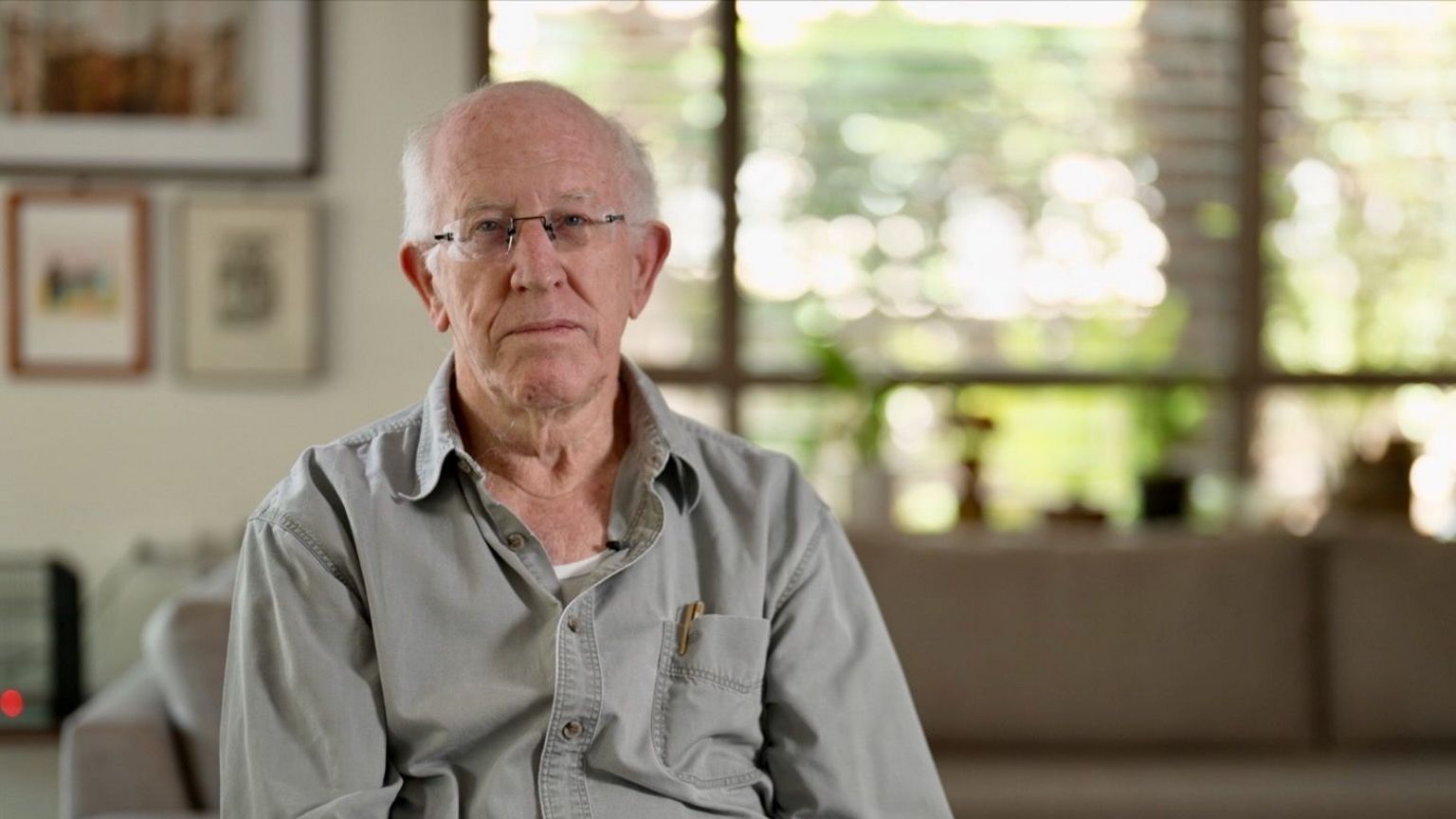
But witnesses, including the facility’s senior anaesthiologist, Yoel Donchin, say both the use of nappies and handcuffs are universal in the hospital ward.
“The army create the patient to be 100% dependent, like a baby,” he said. “You are cuffed, you are with diapers, you need water, you need everything – it’s dehumanisation”.
Dr Donchin said there was no individual assessment of the need for restraints, and that even those patients who were unable to walk – for example, those with leg amputations – were handcuffed to the bed. He described the practice as “stupid”.
Two witnesses at the facility in the early weeks of the Gaza war told us that patients there were kept naked under the blankets.
One doctor with knowledge of conditions there said prolonged cuffing to beds would cause “huge suffering, horrible suffering”, describing it as “torture” and saying patients would start to feel pain after a few hours.
Others have spoken of the risk of long-term nerve-damage.
Yoel Donchin

Image caption,
Yoel Donchin, a senior anesthesiologist, says even those unable to walk were handcuffed to their beds
Footage of Gazan detainees released after interrogation shows injuries and scarring around their wrists and legs.
Last month, Israel’s daily Haaretz newspaper published allegations made by a doctor at the Sde Teiman site that leg amputations had been carried out on two prisoners, because of cuffing injuries.
The allegations were made, the paper said, in a private letter sent by the doctor to government ministers and the attorney-general, in which such amputations were described as “unfortunately a routine event”.
The BBC has not been able to independently verify this allegation.
Dr Donchin said that amputations were not the direct result of cuffing and had involved other factors – such as infection, diabetes or problems with blood vessels.
Israeli medical guidelines stipulate that no patient should be restrained unless there is a specific security reason for doing so, and that the minimum level of restraint should be used.
The head of the country’s Medical Ethics Board, Yossi Walfisch, after a visit to the site, said all patients had a right to be treated without being handcuffed, but that the safety of staff prevailed over other ethical considerations.
“Terrorists are given proper medical treatment,” he said in a published letter, “with the aim of keeping restraints to a minimum and while maintaining the safety of the treating staff.”
Many Gazans detained by Israel’s army are released without charge after interrogation.
Dr Donchin said complaints from medical staff at the Sde Teiman military hospital had led to changes, including a shift to looser handcuffs. He said he insisted on guards removing restraints before any surgical procedure.
“It’s not pleasant to work there,” he said. “I know it’s against the ethical code to treat someone cuffed in the bed. But what’s the alternative? Is it better to let them die? I don’t think so.”
But reports suggest the attitudes of medical staff towards detainees vary widely, in both military and civilian hospitals.

'Unacceptable levels of pain'​

A whistle-blower who worked at the Sde Teiman field hospital back in October, shortly after the Hamas attacks on Israel, described cases of patients being given inadequate amounts of painkillers, including anaesthetic.
He said a doctor once refused his request that an elderly patient be given painkillers while they were opening up a recent, infected amputation wound.
“[The patient] started trembling from pain, and so I stop and say ‘we can’t go on, you need to give him analgesia’,” he said.
The doctor told him it was too late to administer it.
The witness said such procedures were “routinely done without analgesia” resulting in “an unacceptable amount of pain”.
On another occasion, he was asked by a suspected Hamas fighter to intercede with the surgical team to increase the levels of morphine and anaesthetic during repeated surgeries.
The message was passed on, but the suspect again regained consciousness during the next operation and was in a lot of pain. The witness said both he and other colleagues felt there was a sense in which it had been a deliberate act of revenge.
The army said in response to these allegations that violence against detainees was “absolutely prohibited”, and that it regularly briefed its forces on the conduct required of them. Any concrete details of violence or humiliation would be examined, it said.
A second whistle-blower said the situation at Sde Teiman was only part of the problem, which extended into public hospitals. The BBC is calling him “Yoni” to protect his identity.
In the days that followed the 7 October attacks, he said, hospitals in southern Israel were faced with the challenge of treating both wounded fighters and wounded victims, often in the same emergency departments.
Hamas gunmen had just attacked Israeli communities along the border fence with Gaza, killing about 1,200 people and kidnapping some 250 others.
“The atmosphere was extremely emotional,” Yoni said. “Hospitals were completely overwhelmed, both psychologically and in terms of capacity.”
“There were instances where I heard staff discuss whether detainees from Gaza should get painkillers. Or ways to perform certain procedures that can turn the treatment into punishment.”
Conversations like this were not uncommon, he said, even if actual instances appeared very rare.
“I have knowledge of one case where painkillers were used selectively, in a very limited way, during a procedure,” he told the BBC.
“The patient did not receive any explanation of what was going on. So, if you put together [that] someone is undergoing an invasive procedure, which involves even incisions, and doesn’t know about that, and is blindfolded, then the line between treatment and assault thins out.”
We asked the Health Ministry to respond to these allegations, but they directed us to the IDF.
Sufian Abu Salah

Image caption,
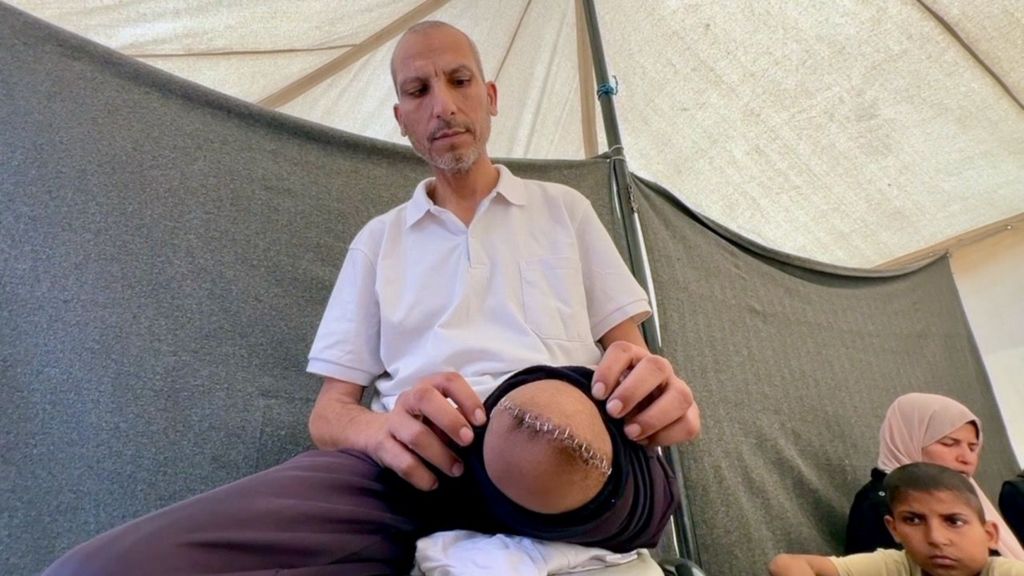
Sufian's leg was amputated and he was later released back to Gaza
Yoni also said that the Sde Teiman field hospital was not equipped to treat severely injured patients, but that some of those held there in the early months of the war had fresh gunshot wounds to the chest and abdomen.
He said at least one critically ill man was kept there because of a reluctance by public hospitals to accept his transfer for treatment, adding that doctors at the base were “frustrated” by the situation.
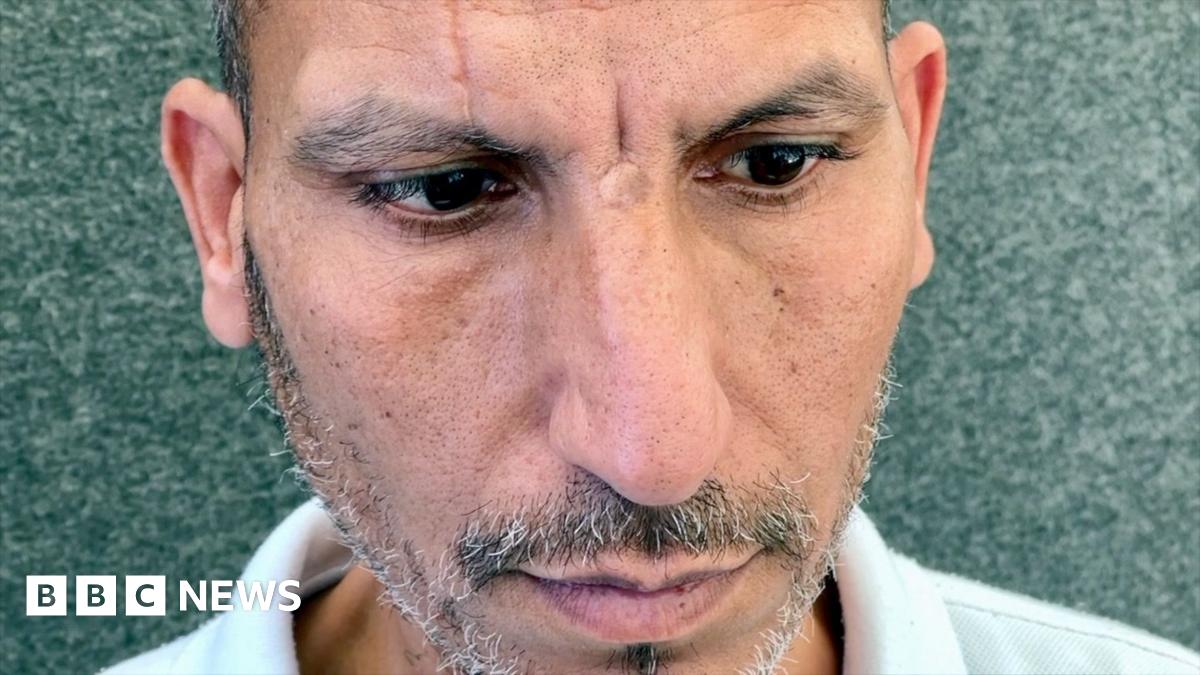
Sufian Abu Salah, a 43-year-old taxi driver from Khan Youis, was one of dozens of men detained during raids by Israel's army and taken to a military base for questioning.
He said soldiers carried out severe beatings during the journey and also on arrival at the base, where he was denied treatment for a minor wound on his foot, which then became infected.
“My leg got infected and turned blue, and as soft as a sponge,” he told the BBC.
After a week, he said, the guards took him to hospital, beating him on his injured leg on the way. Two operations to clean his wound did not work, he told the BBC.
“Afterwards, they took me to a public hospital, where the doctor gave me two options: my leg or my life.”
He chose his life. After they amputated his leg, he was sent back to the military base, and later released back to Gaza.
"This period was mental and physical torture,” he said. “I can’t describe it. I was detained with two legs and now I have only one. Every now and then, I cry.”
The IDF did not respond to the specific allegations about Sufian’s treatment, but said the claims of violence towards him during his arrest or detention “were unknown and will be examined”.
In the days after the 7 October attack, Israel’s Health Ministry issued a directive that all Gazan detainees should be treated in military or prison hospitals, with the Sde Teiman field hospital created specifically to fill this role.
The decision won the backing of many in Israel’s medical establishment, with Yossi Walfisch, praising it as the solution to “an ethical dilemma”, which would remove responsibility for treating “Hamas terrorists” from the public health system.
Others have called for the closure of Sde Teiman, describing the situation there as “an unprecedented low point for the medical profession, and medical ethics.”
“My fear is that what we’re doing in Sde Teiman won’t allow a return to the way it was before,” one doctor told the BBC. “Because things that looked unreasonable to us before, will look reasonable when this crisis is over.”
Yoel Donchin, the anaesthesiologist, said medical staff at the field hospital sometimes gathered together to cry over the situation there.
“The moment our hospital closes,” he said, “we’ll celebrate.”


Gazans ‘shackled and blindfolded’ at Israel hospital​


Medical workers in Israel have told the BBC that Palestinian detainees from Gaza are routinely kept shackled to hospital beds, blindfolded, sometimes naked, and forced to wear nappies – a practice one medic said amounted to “torture”.
A whistle-blower detailed how procedures in one military hospital were “routinely” carried out without painkillers, causing “an unacceptable amount of pain” to detainees.
Another whistle-blower said painkillers were used “selectively” and “in a very limited way” during an invasive medical procedure on a Gazan detainee in a public hospital.
He also said critically ill patients being held in makeshift military facilities were being denied proper treatment because of a reluctance by public hospitals to transfer and treat them.
One detainee, taken from Gaza for questioning by the Israeli army and later released, told the BBC his leg had to be amputated because he was denied treatment for an infected wound.
A senior doctor working inside the military hospital at the centre of the allegations denied that any amputations were the direct result of conditions there, but described the shackles and other restraints used by guards as “dehumanisation”.
The Israeli army said detainees at the facility were treated “appropriately and carefully”.
The two whistle-blowers the BBC spoke to were both in positions to assess the medical treatment of detainees. Both asked to remain anonymous because of the sensitivity of the issue among their colleagues.
Their accounts are supported by a report, external, published in February by Physicians for Human Rights in Israel, which said that Israel’s civilian and military prisons had become “an apparatus of retribution and revenge” and that detainees’ human rights were being violated - in particular their right to health.
A whistle-blower speaks to the BBC

Image caption,
The whistle-blowers said that Palestinian detainees had been routinely kept shackled to hospital beds and been forced to wear nappies
Concerns over the treatment of sick and injured detainees have centred on a military field hospital, at the Sde Teiman military base in southern Israel.
The field hospital was set up by Israel’s Health Ministry after the Hamas attacks specifically to treat Gazan detainees, after some public hospitals and staff expressed a reluctance to treat fighters captured on the day of the Hamas attacks.
Since then, Israeli forces have rounded up large numbers of people from Gaza and taken them to bases like Sde Teiman for interrogation. Those suspected of fighting for Hamas are sent to Israeli detention centres; many others are released back to Gaza without charge.
The army does not publish details of the detainees it is holding.

Handcuffed and blindfolded​

Patients at the Sde Teiman hospital are kept blindfolded and permanently shackled to their beds by all four limbs, according to several medics responsible for treating patients there.
They are also made to wear nappies, rather than use a toilet.
Israel’s army said in response that handcuffing of detainees in the Sde Teiman hospital was “examined individually and daily, and carried out in cases where the security risk requires it”.
It said that nappies [diapers] were used “only for detainees who have undergone medical procedures for which their movement is limited”.
But witnesses, including the facility’s senior anaesthiologist, Yoel Donchin, say both the use of nappies and handcuffs are universal in the hospital ward.
“The army create the patient to be 100% dependent, like a baby,” he said. “You are cuffed, you are with diapers, you need water, you need everything – it’s dehumanisation”.
Dr Donchin said there was no individual assessment of the need for restraints, and that even those patients who were unable to walk – for example, those with leg amputations – were handcuffed to the bed. He described the practice as “stupid”.
Two witnesses at the facility in the early weeks of the Gaza war told us that patients there were kept naked under the blankets.
One doctor with knowledge of conditions there said prolonged cuffing to beds would cause “huge suffering, horrible suffering”, describing it as “torture” and saying patients would start to feel pain after a few hours.
Others have spoken of the risk of long-term nerve-damage.
Yoel Donchin

Image caption,
Yoel Donchin, a senior anesthesiologist, says even those unable to walk were handcuffed to their beds
Footage of Gazan detainees released after interrogation shows injuries and scarring around their wrists and legs.
Last month, Israel’s daily Haaretz newspaper published allegations made by a doctor at the Sde Teiman site that leg amputations had been carried out on two prisoners, because of cuffing injuries.
The allegations were made, the paper said, in a private letter sent by the doctor to government ministers and the attorney-general, in which such amputations were described as “unfortunately a routine event”.
The BBC has not been able to independently verify this allegation.
Dr Donchin said that amputations were not the direct result of cuffing and had involved other factors – such as infection, diabetes or problems with blood vessels.
Israeli medical guidelines stipulate that no patient should be restrained unless there is a specific security reason for doing so, and that the minimum level of restraint should be used.
The head of the country’s Medical Ethics Board, Yossi Walfisch, after a visit to the site, said all patients had a right to be treated without being handcuffed, but that the safety of staff prevailed over other ethical considerations.
“Terrorists are given proper medical treatment,” he said in a published letter, “with the aim of keeping restraints to a minimum and while maintaining the safety of the treating staff.”
Many Gazans detained by Israel’s army are released without charge after interrogation.
Dr Donchin said complaints from medical staff at the Sde Teiman military hospital had led to changes, including a shift to looser handcuffs. He said he insisted on guards removing restraints before any surgical procedure.
“It’s not pleasant to work there,” he said. “I know it’s against the ethical code to treat someone cuffed in the bed. But what’s the alternative? Is it better to let them die? I don’t think so.”
But reports suggest the attitudes of medical staff towards detainees vary widely, in both military and civilian hospitals.

'Unacceptable levels of pain'​

A whistle-blower who worked at the Sde Teiman field hospital back in October, shortly after the Hamas attacks on Israel, described cases of patients being given inadequate amounts of painkillers, including anaesthetic.
He said a doctor once refused his request that an elderly patient be given painkillers while they were opening up a recent, infected amputation wound.
“[The patient] started trembling from pain, and so I stop and say ‘we can’t go on, you need to give him analgesia’,” he said.
The doctor told him it was too late to administer it.
The witness said such procedures were “routinely done without analgesia” resulting in “an unacceptable amount of pain”.
On another occasion, he was asked by a suspected Hamas fighter to intercede with the surgical team to increase the levels of morphine and anaesthetic during repeated surgeries.
The message was passed on, but the suspect again regained consciousness during the next operation and was in a lot of pain. The witness said both he and other colleagues felt there was a sense in which it had been a deliberate act of revenge.
The army said in response to these allegations that violence against detainees was “absolutely prohibited”, and that it regularly briefed its forces on the conduct required of them. Any concrete details of violence or humiliation would be examined, it said.
A second whistle-blower said the situation at Sde Teiman was only part of the problem, which extended into public hospitals. The BBC is calling him “Yoni” to protect his identity.
In the days that followed the 7 October attacks, he said, hospitals in southern Israel were faced with the challenge of treating both wounded fighters and wounded victims, often in the same emergency departments.
Hamas gunmen had just attacked Israeli communities along the border fence with Gaza, killing about 1,200 people and kidnapping some 250 others.
“The atmosphere was extremely emotional,” Yoni said. “Hospitals were completely overwhelmed, both psychologically and in terms of capacity.”
“There were instances where I heard staff discuss whether detainees from Gaza should get painkillers. Or ways to perform certain procedures that can turn the treatment into punishment.”
Conversations like this were not uncommon, he said, even if actual instances appeared very rare.
“I have knowledge of one case where painkillers were used selectively, in a very limited way, during a procedure,” he told the BBC.
“The patient did not receive any explanation of what was going on. So, if you put together [that] someone is undergoing an invasive procedure, which involves even incisions, and doesn’t know about that, and is blindfolded, then the line between treatment and assault thins out.”
We asked the Health Ministry to respond to these allegations, but they directed us to the IDF.
Sufian Abu Salah

Image caption,
Sufian's leg was amputated and he was later released back to Gaza
Yoni also said that the Sde Teiman field hospital was not equipped to treat severely injured patients, but that some of those held there in the early months of the war had fresh gunshot wounds to the chest and abdomen.
He said at least one critically ill man was kept there because of a reluctance by public hospitals to accept his transfer for treatment, adding that doctors at the base were “frustrated” by the situation.
Sufian Abu Salah, a 43-year-old taxi driver from Khan Youis, was one of dozens of men detained during raids by Israel's army and taken to a military base for questioning.
He said soldiers carried out severe beatings during the journey and also on arrival at the base, where he was denied treatment for a minor wound on his foot, which then became infected.
“My leg got infected and turned blue, and as soft as a sponge,” he told the BBC.
After a week, he said, the guards took him to hospital, beating him on his injured leg on the way. Two operations to clean his wound did not work, he told the BBC.
“Afterwards, they took me to a public hospital, where the doctor gave me two options: my leg or my life.”
He chose his life. After they amputated his leg, he was sent back to the military base, and later released back to Gaza.
"This period was mental and physical torture,” he said. “I can’t describe it. I was detained with two legs and now I have only one. Every now and then, I cry.”
The IDF did not respond to the specific allegations about Sufian’s treatment, but said the claims of violence towards him during his arrest or detention “were unknown and will be examined”.
In the days after the 7 October attack, Israel’s Health Ministry issued a directive that all Gazan detainees should be treated in military or prison hospitals, with the Sde Teiman field hospital created specifically to fill this role.
The decision won the backing of many in Israel’s medical establishment, with Yossi Walfisch, praising it as the solution to “an ethical dilemma”, which would remove responsibility for treating “Hamas terrorists” from the public health system.
Others have called for the closure of Sde Teiman, describing the situation there as “an unprecedented low point for the medical profession, and medical ethics.”
“My fear is that what we’re doing in Sde Teiman won’t allow a return to the way it was before,” one doctor told the BBC. “Because things that looked unreasonable to us before, will look reasonable when this crisis is over.”
Yoel Donchin, the anaesthesiologist, said medical staff at the field hospital sometimes gathered together to cry over the situation there.
“The moment our hospital closes,” he said, “we’ll celebrate.”

Note that this is being reported by the BBC - not some anti-Israeli or pro Hamas source.
 
◾Mobs of Israeli settlers attack a truck carrying aid for en route to Gaza near the town of Tarqumia in the south of the occupied West Bank.

◾Follow:
https://t.me/European_dissident


😡😡😡 those fucking Zionist Nazis broken countless human rights laws for decades. They worse than Hitler Gestapo 😡😡😡 I hate Hitler for not completing his FINAL SOLUTION
A good example of how emotions and hate can do someone act stupidly against his own interests.

No food for Gaza civilians = New recruits for Hamas.

And besides, it opens another paths to give the aid that it's not under Israel control and can be used to smuggle weapons.

They are idiots as hell.
 
You cannot have any rational debate with anyone who thinks that calling out land grabs, murder and genocide as being "anti-semitism". In effect they reserve the right for their friend to do anything without any criticism allowed.

As @PAKISTANFOREVER said there is no point trying to reason with people like that, as the only reason they understand is hard power when you can beat them through sheer force.

When they start yelling 'antisemitism', they are admitting that they can't counter with facts.
 
Status
Not open for further replies.

Users who are viewing this thread

Back
Top