Israel’s Genocide in Gaza | 2023- till present

Status
Not open for further replies.


Israeli strikes on Beirut seemed to defy US pressure

Joel Gunter
Reporting from Beirut

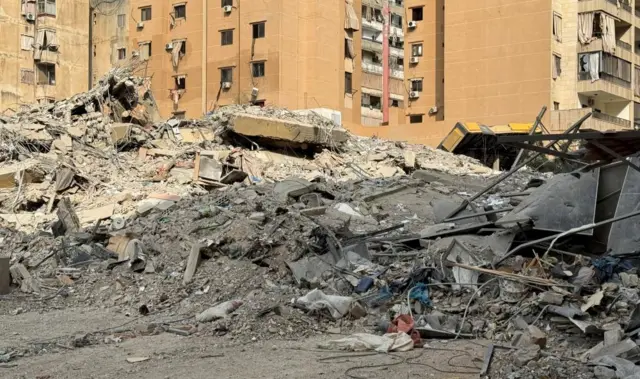
Debris lies at a damaged site in the aftermath of Israeli strikes on Beirut's southern suburbs


Image source, Reuters

The scene in southern Beirut on Wednesday, after the Israeli strikes

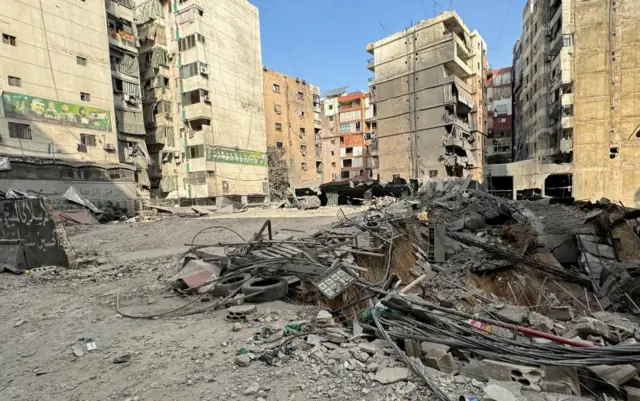
The Israeli air strikes on Beirut this morning – after five days of respite for the Lebanese capital – came just hours after the US said it opposed the "scope and nature" of Israel’s bombing campaign on the city.

State department spokesman Matthew Miller told a briefing on Tuesday that the US had expressed its concerns to Israeli Prime Minister Benjamin Netanyahu, saying they were "made clear to the government of Israel".


As my colleagues covered earlier, there had been reports that the unexpected pause in air strikes against Beirut was the result of a US intervention.

The strikes on Wednesday morning came shortly after Netanyahu rejected the idea of a ceasefire that would leave Hezbollah close to the northern Israeli border.

He told the French president Emmanuel Macron on Tuesday he was "opposed to a unilateral ceasefire which does not change the security situation in Lebanon, and which would return the country to its previous state" according to a read-out from his office.

Also on Tuesday, in a televised address, Hezbollah's deputy leader Naim Qassem said the only solution to the recent escalation was a ceasefire - while also threatening to continue targeting Israel with missiles.

Rubble lies at a damaged site in the aftermath of Israeli strikes on Beirut's southern suburbs


Image source, Reuters

Before the recent pause, Israel had hit southern Beirut on a near-daily basis
 

Nowhere in Lebanon seems safe, say people in Beirut​

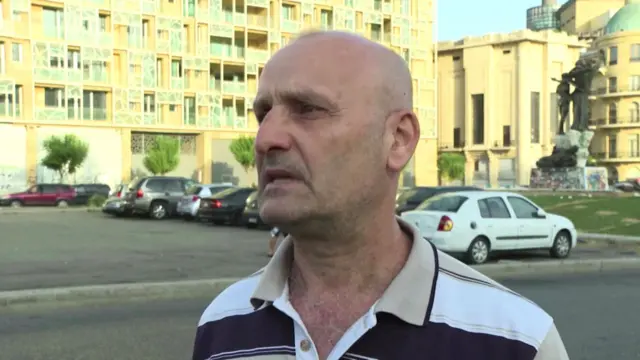
Mohamed Gradi close us. Bald man wearing black, white and beige striped polo shirt. In background is a parking lot with several parked cars, buildings illuminated by early morning sunshine


Image source, Reuters

Mohamed Gradi warns the 'situation is only getting worse' 15 days into Israel's ground operation in Lebanon

We just brought you pictures from Beirut - now we can bring you quotes from some of the people there.

Mohamed Gradi, 57, says there is no part of Lebanon where people feel safe.

"You see displacement, people not finding places to stay," he tells Reuters.

"[People] got displaced from the south, from Dahieh [Beirut’s southern suburbs], from Bekaa, and even from areas of our fellow Christians, they as well got displaced."

Meanwhile, displaced Mostafa Saleh, 48, says Israel's air strikes could increase support for Hezbollah.

"If they think that they can scare the supporting environment [of Hezbollah] this way - on the contrary...look at us... we are living not like human beings, we are homeless."
 

In pictures: Displaced people start the day on Beirut streets

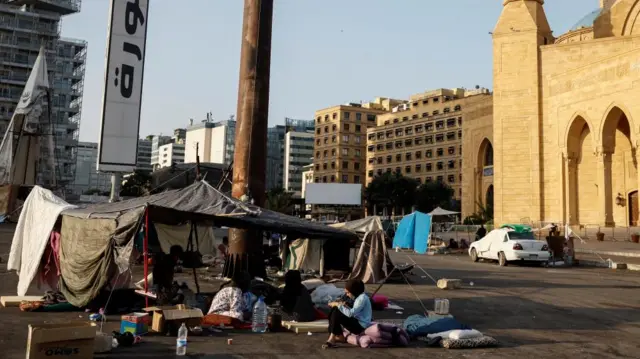
More than 1.2 million people have been displaced in Lebanon since Israel stepped up its air strikes last month, according to the Lebanese government.

Many have fled southern towns and villages and moved north to the nation's capital.

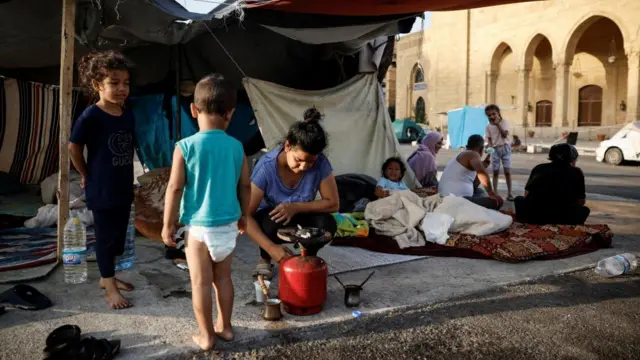
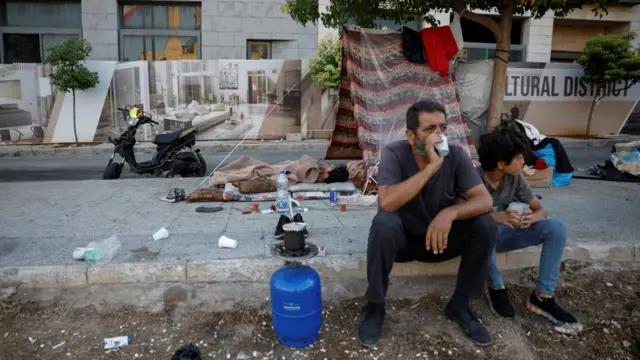
These images from this morning show displaced people who have been sleeping on rolled-out rugs or in makeshift shelters on the streets of central Beirut.

On the central Beirut streets, people sit under makeshift shelters beside a grand building


Image source, Reuters


A woman makes coffee on the streets of central Beirut while young children stand near her.


Image source, Reuters


A man and a boy drink from plastic cups while sitting on a curb in front of a makeshift tent on the streets of central Beirut


Image source, Reuters
 
Remember when western analysts said:

Mullahs are desperate for a deal. Biden should play hard ball.

Remember this one:
Taliban is tired of the war. Let’s end the never ending wars.

Where are those analysts now?
They are saying:
There is a historic window to disarm Hizbullah.
 

As Israeli strikes resume, there are no guarantees for people in Beirut

Nafiseh Kohnavard
Middle East correspondent, BBC World Service, in Beirut

The air strikes on Beirut this morning came less than 24 hours after Lebanese prime minister Najib Mikati told Al Jazeera that the US had given "some kind of a guarantee" that Israel would de-escalate in Beirut and its suburbs.

But in the same hour the interview was being broadcast, here in Beirut, Israeli surveillance drones were flying low across the city, and Israeli jets caused sonic booms that sounded like actual explosions.

There had been days of anonymous quotes from US, Israeli and Lebanese officials regarding "a guarantee to stop attacks on Beirut and its southern suburbs".

Even Israeli media reported that Prime Minister Benjamin Netanyahu ordered the pause after talking to US President Joe Biden. Although this was denied by Netanyahu himself, some Israeli channels quoted unknown officials that such agreement was in place.

As we reported earlier, Israel says its air force targeted an underground Hezbollah weapons site.

Whatever the target was, the strikes sent a message that there is no guarantee that Beirut and its southern suburb will be excluded from Israeli attacks.

People in Beirut are back to square one - with PM Mikati’s words vanishing in the air.

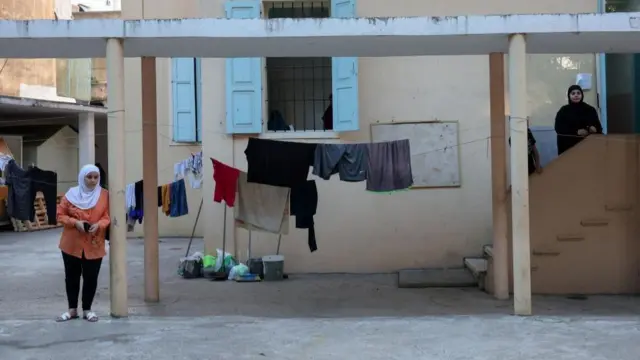
Displaced people in Beirut, in a school turned shelter


Image source, Reuters

Displaced people in Beirut, in a school turned shelter
 

Hezbollah launches rocket barrages towards Israel​

From CNN's Jessie Yeung

Hezbollah said it sent “barrages” of rockets into several areas of northern Israel overnight, while the Israeli military said it had identified dozens of projectiles launched from Lebanon.

About 50 “projectiles” were identified crossing into Israeli territory, the Israel Defense Forces (IDF) said in the early hours of Wednesday morning.

“Some of the projectiles were intercepted and fallen projectiles were identified in the area,” the IDF said.

The IDF did not report any injuries. The extent of the damage is unclear.

The attack comes a day after Hezbollah’s Deputy Secretary General Naim Qassem called on Israelis to accept a ceasefire in Lebanon or face “pain” as the group changes its strategy to strike harder and deeper into Israel.

Israel is opposed to a “unilateral ceasefire” in its war with Hezbollah in Lebanon, Prime Minister Benjamin Netanyahu said.
 
Thank God there is at least ONE person who here who can see what I have been saying here for many days!
I have been through this 'vote your conscience' thingy before during the Nader 2000 campaign and even donated $ to him. What was the result? GW Bush won as Nader's vote split the progressive vote, while Gore would have been a better President, just as Harris is the better one compared with Trump, IMO. If people still want to vote their conscience, then do so in Non Swing States--which I may end up doing by voting for Jill Stein. But don't hand over the Presidency to Trump by voting Jill in a Swing State.

If the Muslims/Arab constituency in America had some grand vision then they would, as a block, convey to Harris that we will vote for you this time given the circumstances but if you betray us then we will organize better to make sure you'd be defeated next time!

At the end of the day, Muslim votes don’t count for much. Neither do Jewish votes. Neither community makes up more than 2% of the population. What matters is the money that is given to the candidates. AIPAC I heard has a budget of over $500 million per year. They give money to all the candidates and every Congressman has an AIPAC minder who they have to report to on a regular basis. Anyone who votes against Israel faces certain defeat as they pump $10-20 million to his opponent.

Muslim Americans will only be able to counter AIPAC if they also get organized and contribute hundreds of millions of dollars to a political action committee.
 
Hezbollah is launching rockets with peanuts explosives power of 50-200kg HE while Israel is dropping 1 ton(1000kg) HE and above(2 tons-5 tons) of bombs on Lebanese civilians.

The war is not proportionate at all, so can't Hezbollah use more of their Zelzal SRBMs that Iran gave them or something with more accuracy to hit bases and ports?
 
Report: The Sickening War Crimes of the Israeli Army.

To view this content we will need your consent to set third party cookies.
For more detailed information, see our cookies page.
 

The force that isn’t keeping the peace in Lebanon: 4 scenarios for the future of UNIFIL

PM charges Hezbollah terror group uses UN peacekeepers as human shields, while ex-IDF intelligence expert Tal Beeri says it’s long been clear that the force isn’t fulfilling its mandate​

By Gianluca Pacchiani

14 October 2024, 4:46 pm
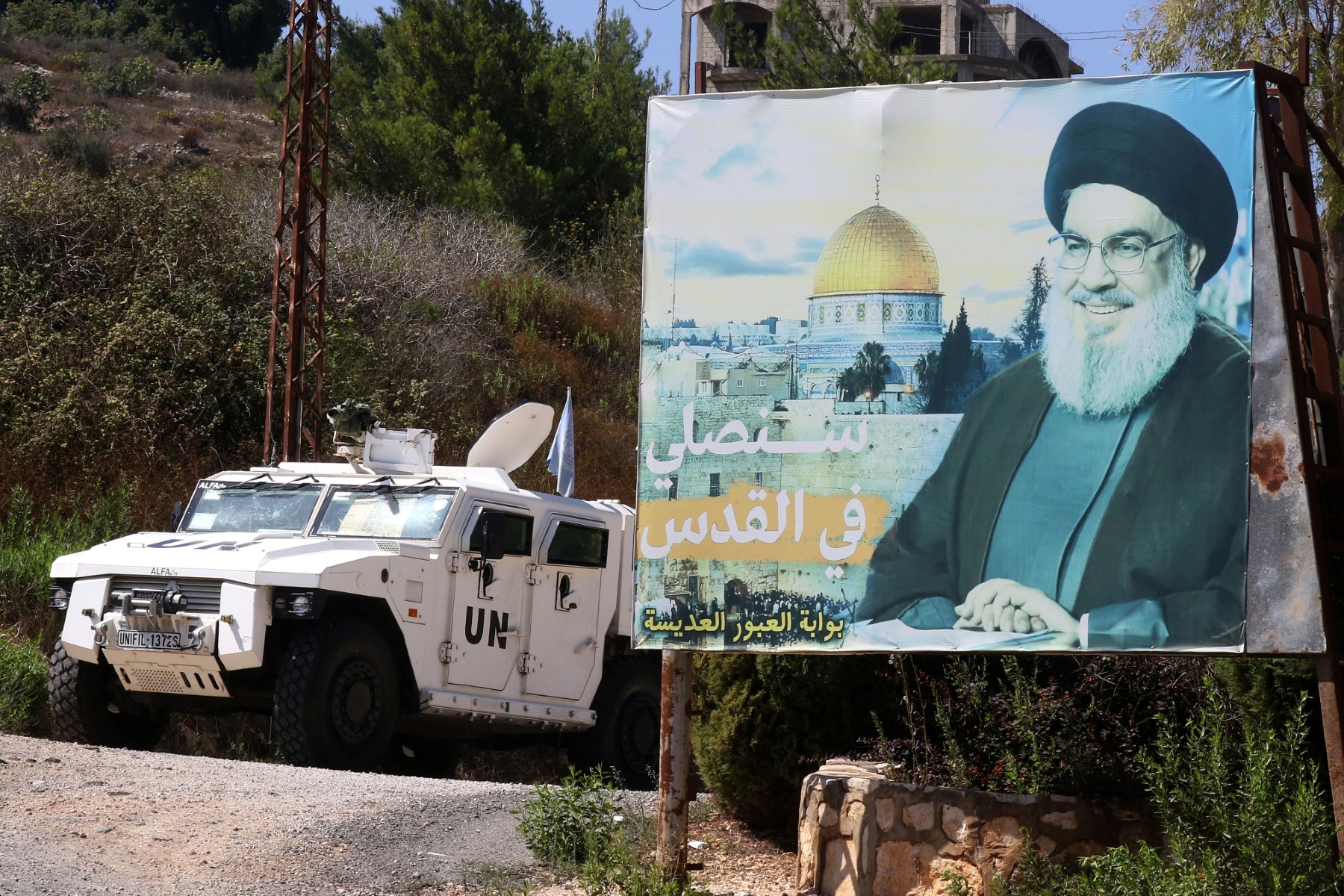
A UNIFIL vehicle patrols near a billboard with a portrait of Hezbollah chief Hassan Nasrallah, in the southern town of Adaisseh, on August 30, 2023. (Mahmoud ZAYYAT / AFP)
In recent days, at least five UNIFIL peacekeepers have been lightly wounded as Israel expands its fight against the Hezbollah terror group in southern Lebanon.

The IDF took responsibility for two separate incidents on Thursday and Friday in which four UN soldiers from Indonesia and Sri Lanka were wounded, and said that in both cases it was aiming at Hezbollah positions nearby and that it warned UNIFIL it was about to shoot. As for the fifth soldier, who was wounded on Friday night, the UN admitted it did not know the origin of the gunfire.

Still, UNIFIL — the United Nations Interim Forces in Lebanon — accused the Israeli military of firing “deliberately” on its positions, and the 40 countries that contribute troops to it unanimously condemned the incidents and highlighted the mission’s aim to bring “lasting peace in South Lebanon.”


In response to the international outcry, Israel has made the case that the UNIFIL force hinders its efforts to eradicate Hezbollah from the border and called for the peacekeepers’ withdrawal from combat areas.

On Sunday night, IDF Arabic-language spokesman Avichay Adraee said around 25 rockets and missiles were fired at Israeli towns and forces by Hezbollah from next to UNIFIL posts over the past month. One of the attacks launched from next to a UNIFIL position killed two IDF soldiers, said Adraee.

Get The Times of Israel's Daily Editionby email and never miss our top stories
Newsletter email addressGet it
By signing up, you agree to the terms
Prime Minister Benjamin Netanyahu said in a statement addressed to UN Secretary General Antonio Guterres, also on Sunday that UNIFIL soldiers were “hostages” of Hezbollah and being used as “human shields.”


Illustrative: A general view of a base of the United Nations peacekeeping forces in Lebanon (UNIFIL) at the Lebanese-Israeli border, in the southern village of Markaba, on April 7, 2023. (AP Photo/Hassan Ammar, File)
“This endangers both them and the lives of our soldiers,” the prime minister said, noting that Israel has requested their withdrawal multiple times in the past and was always met with refusal.

The terror group’s exploitation of the peacekeeping mission as cover is nothing new, according to some Israeli pundits. In the first weeks of the war, the Alma Research Center, a privately funded nonprofit that monitors security developments on Israel’s northern border, published a map showing five UNIFIL bases that had been used by Hezbollah as cover for rocket launches on Israel.

Recently, Alma followed up with a study of four potential scenarios outlining the future of the “failed” UN peacekeeping force.


Tal Beeri, Alma’s director of research, said that UNIFIL is “unwilling and unable to confront Hezbollah.” Beeri served for decades in IDF intelligence units.

“When Hezbollah places a rocket launcher next to one of UNIFIL’s positions, 99.9% of the time UNIFIL will not do anything about it. They are afraid,” said Beeri.

“If Hezbollah tells UNIFIL forces not to get into a certain area, they won’t. If they do it anyway without prior coordination, they can get physically hurt or abducted,” said Beeri. “It has happened in the past, before this war.”

Among past incidents, in May 2013, a UNIFIL base was overrun, its ammunition stolen, and three soldiers were briefly detained. In December 2022, a UNIFIL vehicle came under gunfire and an Irish peacekeeper inside it was killed. A Hezbollah official said the terror group was not involved in the shooting but noted that the vehicle had taken an “unusual route.”
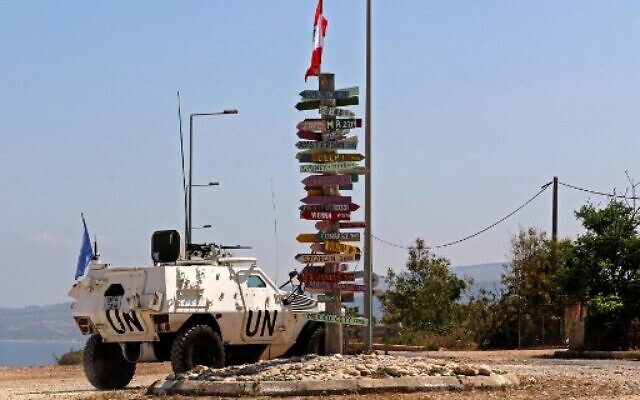

Members of UNIFIL patrol the area of Naqura, south of the Lebanese city of Tyre, along the border with Israel on June 6, 2022. (Mahmoud Zayyat/AFP)

UNIFIL’s failure to fulfill its core mission​

UNIFIL was first deployed in 1978 after the IDF invasion of southern Lebanon. The operation came in response to the “coastal road massacre,” a terror attack in which 35 Israeli civilians were killed on a bus near Tel Aviv by Palestinians who infiltrated from Lebanon into Israel.

The Lebanese government said it had no connection to the Palestinian terrorist commandos and requested UN intervention to ensure the withdrawal of IDF troops from its territory. The UN decided to send a peacekeeping mission to restore stability to the area.

[photo in original] Tal Beeri, a former IDF intelligence officer and director of the research department at the Alma Center, a nonprofit that monitors security developments along Israel’s northern border, 2024 (courtesy)
During the years of the Israeli occupation of southern Lebanon, from 1982 until 2000, UNIFIL remained behind Israeli lines and provided humanitarian assistance to the local population, but was unable to fulfill its mandate and prevent clashes between the IDF and its Lebanese allies against “resistance” groups such as Hezbollah.

In 2006, after the end of the Second Lebanon War, UNIFIL’s mandate was confirmed and expanded by UN Security Council Resolution 1701, which called for an immediate cessation of hostilities between Hezbollah and Israel and for the creation of a buffer zone in Lebanon south of the Litani River, which was supposed to remain free of arms and militias other than those of UNIFIL and the Lebanese government.

UNIFIL’s mission was extended annually over the following years. The last time its mandate was renewed was on August 28 by the UN Security Council.

However, the UN peacekeeping force has been unable to fulfill its mission, despite its massive contingent of 9,500 troops of some 50 nationalities.


Illustrative – Peacekeepers of the United Nations Interim Force in Lebanon (UNIFIL) man their armored vehicle in Lebanon’s southern town of Naqoura near the border with Israel, on October 15, 2023. (AFP)
Resolution 1701 has largely gone unimplemented as Hezbollah progressively entrenched itself in the border area, storing weapons there, firing countless rockets into Israel, and allegedly positioning its forces for a mass invasion of Israel last year.

While UNIFIL has made an important contribution to the residents of southern Lebanon, running projects to provide electricity, healthcare through 15 UNIFIL-run hospitals, and education, and by supporting the local economy through the presence of its thousands of soldiers, it has not fulfilled its core mission — namely, to ensure that the area of southern Lebanon between the border with Israel (the so-called Blue Line) and the Litani River remains demilitarized.

Beeri cited two recent examples of the incapacity or the unwillingness of the UN mission to deal with the terror group that it is supposed to hold at bay.

In December 2018, the IDF uncovered six tunnels dug by Hezbollah that crossed from Lebanon into Israel. The Israeli army said it provided a map of the tunnels to UNIFIL’s commander at the time, Maj. Gen. Stefano Del Col, and called on the UN peacekeeping force to destroy the passages on the Lebanese side of the border, but UNIFIL never complied, Beeri said.
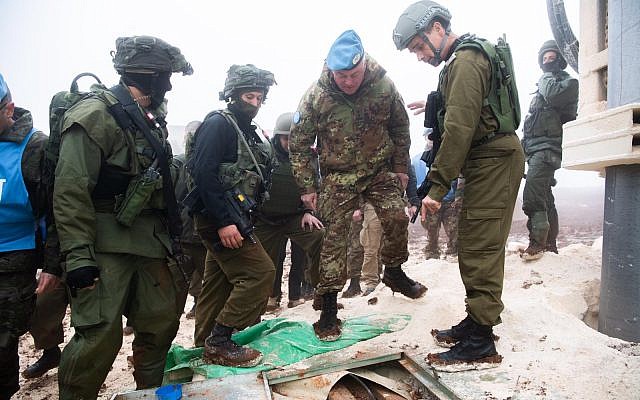

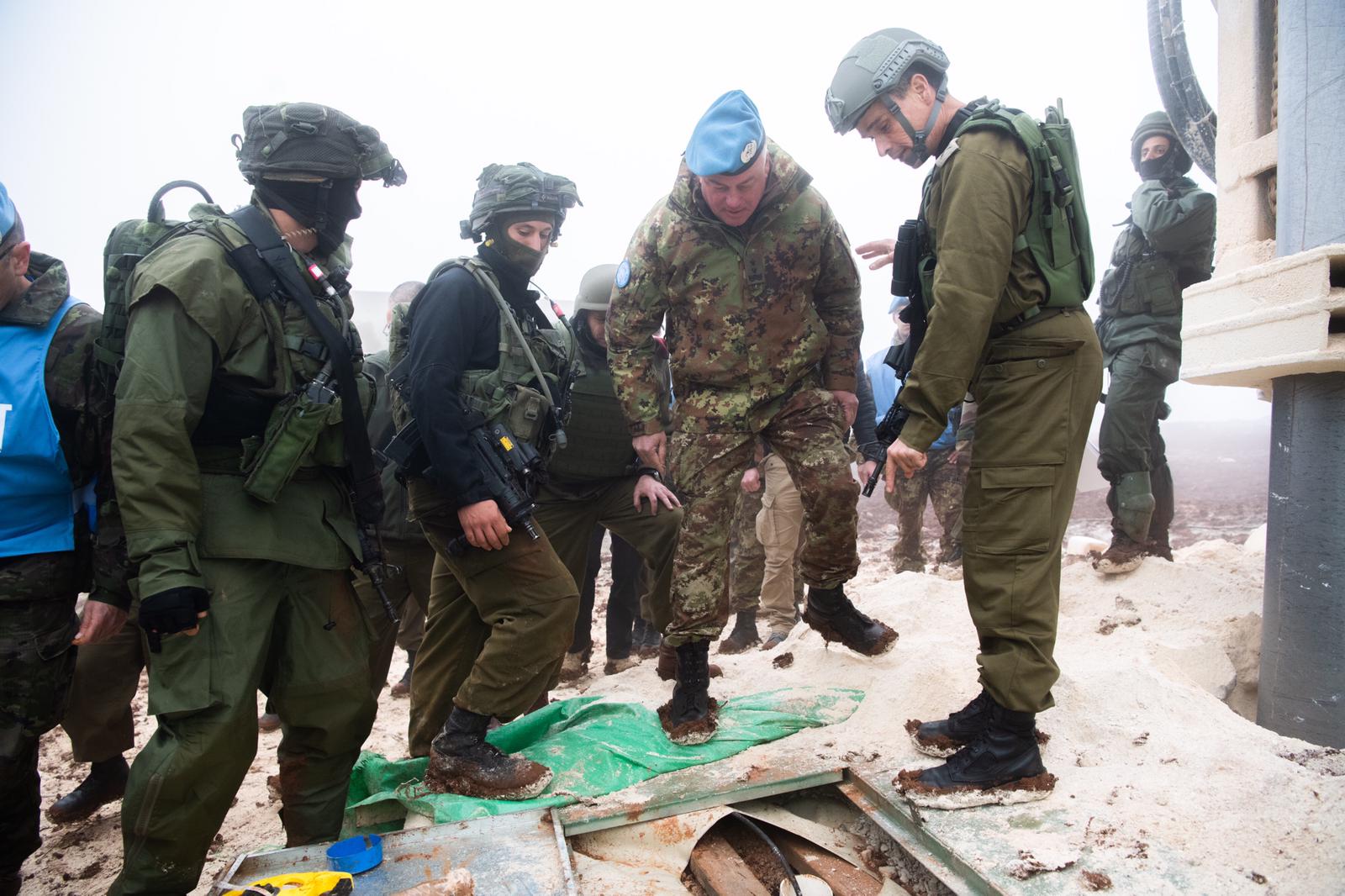
Israeli soldiers show UNIFIL commander Maj. Gen. Stefano Del Col a Hezbollah tunnel that penetrated Israeli territory from southern Lebanon, on December 6, 2018. (Israel Defense Forces)
On September 1, 2019, Hezbollah fired several anti-tank missiles at a military jeep and an IDF base in Avivim, in northern Israel, causing no injuries. Despite Israeli requests, UNIFIL forces have yet to visit the site from where those rockets were launched, Beeri said.

UNIFIL’s spokesperson did not respond to repeated requests for comment by The Times of Israel, about either these two claims or the allegation made by Netanyahu that it serves as Hezbollah’s “human shield.”

Four scenarios for the future of UNIFIL​

In early September, before the ongoing escalation in Lebanon, the Alma Research Center published a report outlining four scenarios for the future of UNIFIL.

Maintaining the status quo is undesirable for Israel, as the IDF runs the risk of inadvertently hitting UNIFIL positions that Hezbollah allegedly uses for cover.


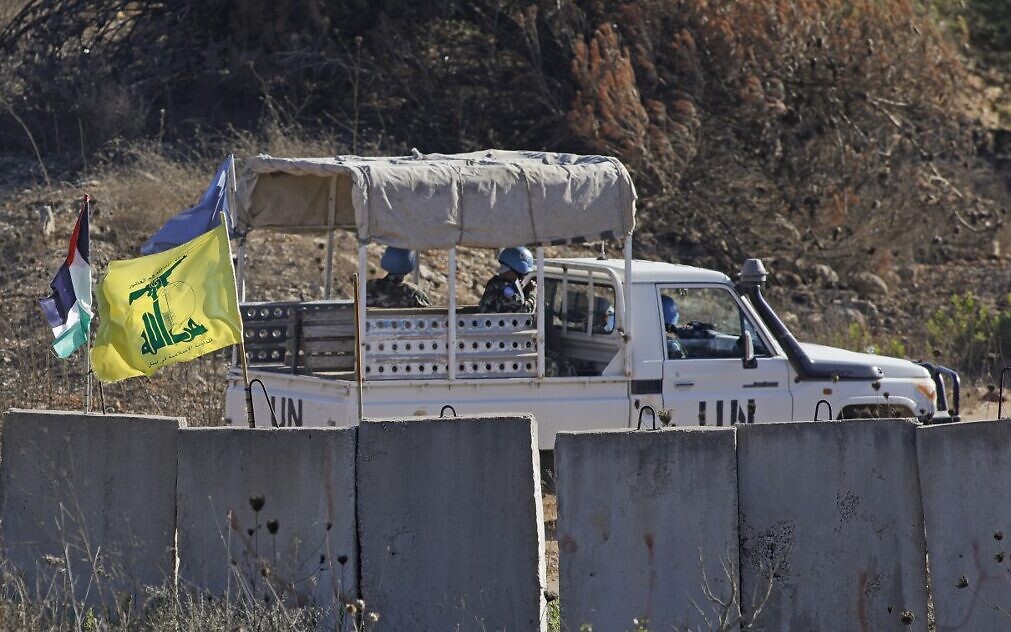
A picture taken from Kibbutz Manara shows UNIFIL peacekeepers driving past Hezbollah and Palestinian flags as they patrol along the border with Israel in the southern Lebanese village of Houla, August 26, 2020. (Jalaa Marey/AFP)
Completely disbanding UNIFIL would also not be a sensible option. The peacekeeping force serves as a “mediation mechanism to resolve tactical conflicts on the ground,” the report indicated.

Expanding and strengthening UNIFIL to perform its mandate and actually confront Hezbollah on the ground does not seem like a realistic scenario at the moment, the report suggested, as Hezbollah would begin targeting UN troops and there would be casualties, and, as a consequence, few countries would agree to maintain their forces in Lebanon under pressure from their citizens.

Reducing the UNIFIL mandate and downsizing its deployment would appear to be the best option, as it would allow the force to preserve its liaison role and its humanitarian projects, and strengthen its reporting function, the report concluded.

However, in light of the ongoing ground offensive by the IDF in south Lebanon, uncertainty still prevails as to what force could guarantee security and confront the threat of Hezbollah fighter cells once the IDF withdraws its troops.

Lazar Berman and Times of Israel staff contributed to this report.
 
Thomas Friedman, another Israeli Firster in America, is one of those guileful Israelis -
I'm not aware that T.F. is an Israeli, much less a Zionist.

@Solomon2 never go into the details about what that 'Two State Solution' would like!
I could but you know what? Now, when Israel's very existence is under attack, is not a sensible time to discuss it.
 
I'm not aware that T.F. is an Israeli, much less a Zionist.


I could but you know what? Now, when Israel's very existence is under attack, is not a sensible time to discuss it.

Answer this... But you never do. Why?

To view this content we will need your consent to set third party cookies.
For more detailed information, see our cookies page.
 
This explains why the Jews plan to destroy the world, including America.

To view this content we will need your consent to set third party cookies.
For more detailed information, see our cookies page.
 
To view this content we will need your consent to set third party cookies.
For more detailed information, see our cookies page.
 
Status
Not open for further replies.

Users who are viewing this thread

Back
Top