J-15 - PLAN carrierborne fighter

Seems indeed to be the first time a WS-10 is confirmed! The only question is, is it a production aircraft (IMO likely) or a prototype like the no. 1518 we saw at Zhuhai 2o24?!

China should have swapped the AL-31F for WS-10H since a decade ago, but it was first prioritized the cost of the logistics and also helped Russia to keep their factory running.

But in recent years, the AL-31F has become very problematic on the J-15 and has seriously threatened the life of the PLAN naval pilots.

So China has eventually decided to tackle this overdue problem by swapping all AL-31F J-15 in the next few years, including the ski-jump version.
 
China should have swapped the AL-31F for WS-10H since a decade ago, but it was first prioritized the cost of the logistics and also helped Russia to keep their factory running.

But in recent years, the AL-31F has become very problematic on the J-15 and has seriously threatened the life of the PLAN naval pilots.

So China has eventually decided to tackle this overdue problem by swapping all AL-31F J-15 in the next few years, including the ski-jump version.
Your statement is overly nationalist.

The AL-31F is an excellent engine, and it remains excellent even today. The WS-10 series engines, in certain aspects, are still inferior to the AL-31F (I will not disclose the specifics).

China's WS-10 series engines adopt the American technological approach, which differs significantly from the Soviet/Russian technological approach of the AL-31F series. A direct comparison between the two is difficult.

The naval version of the engine indeed presents many unique technical challenges. More than a decade ago, China lacked the relevant technological capabilities.
 
Your statement is overly nationalist.

The AL-31F is an excellent engine, and it remains excellent even today. The WS-10 series engines, in certain aspects, are still inferior to the AL-31F (I will not disclose the specifics).

China's WS-10 series engines adopt the American technological approach, which differs significantly from the Soviet/Russian technological approach of the AL-31F series. A direct comparison between the two is difficult.

The naval version of the engine indeed presents many unique technical challenges. More than a decade ago, China lacked the relevant technological capabilities.

Few months ago, I read the leak information from 胡诌施佬 that the PLAN gonna swap all AL-31F because it has reliability issue that put many of our naval pilots in danger.

I did reserve my own opinion, and until I see the PLAN is starting to phase out all AL-31F which has validated that his leaked information was true.
 
Few months ago, I read the leak information from 胡诌施佬 that the PLAN gonna swap all AL-31F because it has reliability issue that put many of our naval pilots in danger.

I did reserve my own opinion, and until I see the PLAN is starting to phase out all AL-31F which has validated that his leaked information was true.
Self-media, in particular, is a typical example of nationalism.

Here's some absolutely verifiable information for you:

China's J-10C fighter jets have widely adopted the WS-10 engine. However, later-produced J-10CY fighter jets still insist on using the AL-31F engine, not the WS-10. So, can you guess why?

I go to this place often. I trust their expertise more than what self-media outlets say.
1783668002134.png

Of course, you can continue to trust them.
 
Self-media, in particular, is a typical example of nationalism.

Here's some absolutely verifiable information for you:

China's J-10C fighter jets have widely adopted the WS-10 engine. However, later-produced J-10CY fighter jets still insist on using the AL-31F engine, not the WS-10. So, can you guess why?

I go to this place often. I trust their expertise more than what self-media outlets say.
View attachment 205466

Of course, you can continue to trust them.

Bro, you are not above those self-media.

And stop entitled yourself as the only official source.
 
Bro, you are not above those self-media.

And stop entitled yourself as the only official source.
1. I never claim to be an official source.

2. I've provided you with a direction for verification: Why does the J-10CY insist on using the AL-31F engine instead of the WS-10 engine?

These are two turbofan engines based on different technological approaches; they cannot be compared directly. It's pointless to deliberately belittle one while praising the other.
 

The evolution of the powerplant

The history of the J-10 fighter’s engine development reflects the Chinese aviation industry’s long and arduous struggle to create a reliable military turbofan engine. Engineers initially designed the J-10 around the promising domestic WS-10 Taihang engine, whose development was initiated by specialists at the Shenyang Aeroengine Research Institute (or 606 Institute) as early as 1987.

The engine’s core incorporated technology from the civilian CFM56-II, which, in turn, was derived from the American military General Electric F101 engine. Due to the high technological complexity and the inability to integrate off-the-shelf Russian fuel control units from the AL-31F series engines, the developers faced setbacks in the initial phase. It took Chinese scientists nearly 20 years to independently develop a full-authority digital engine control system (FADEC). The first versions of the WS-10A engine suffered from unpredictable reliability and service life issues.
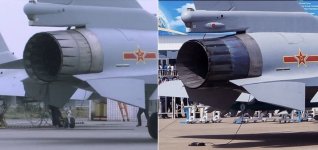
Vynyshhuvachi-J-10-z-dvygunamy-AL-31-ta-WS-10.jpeg
J-10 fighters equipped with AL-31 and WS-10 engines. Photo collage: Military Watch Magazine.

In the early stages, J-10 fighters equipped with experimental WS-10A engines were significantly inferior in performance to those with original Russian powerplants. As a result, in 2010, China urgently ordered an additional batch of 123 AL-31FN engines from the Russian Federation, with delivery scheduled for 2012, to ensure the combat readiness of its existing J-10 fleet. It was only after the development of the WS-10B variant, with a thrust of 14.5 metric tons (approximately 142 kN), that the Chinese engine was able to completely replace Russian powerplants on the production lines.

A comparative analysis of the technical parameters clearly demonstrates the distinctive features of both powerplants. The Russian AL-31FN afterburning turbofan engine is manufactured by the Chernyshev Moscow Machine-Building Enterprise, while the Chinese WS-10 Taihang afterburning turbofan engine is produced by the Shenyang Liming Aero-Engine Group Corporation. The maximum thrust with afterburner for the Russian engine is 122.5–125 kN, while the base Chinese engine produces 132 kN, and its WS-10B variant develops up to 142–145 kN.

In maximum dry thrust mode, the Russian engine delivers approximately 74.9 kN, falling short of its Chinese competitor’s 89.17 kN. The specific fuel consumption in afterburner mode is about 1.96 kg/(kgf·h) for the AL-31FN and 2.02–2.08 kg/(kgf·h) for the WS-10. At the same time, in cruise mode, the Chinese engine demonstrates higher fuel efficiency with a consumption rate of 0.695 kg/(kgf·h) compared to approximately 0.75 kg/(kgf·h) for its Russian counterpart.

In terms of weight and dimensions, the Chinese design significantly exceeds the Russian one: the WS-10’s dry weight is 1,794.7 kilograms, its length is 4,950 millimeters, and its maximum diameter is 1,160 millimeters. The Russian AL-31FN engine has a dry weight of about 1,538 kilograms, a length of 4,897 millimeters, and a maximum diameter of 1,140 millimeters.
 
1. I never claim to be an official source.

2. I've provided you with a direction for verification: Why does the J-10CY insist on using the AL-31F engine instead of the WS-10 engine?

These are two turbofan engines based on different technological approaches; they cannot be compared directly. It's pointless to deliberately belittle one while praising the other.

The Russian engines love to display those useless acrobatic showoff, but they are not reliable and have shorter longevity.

China fully controls the military grade rare earth that is indispensable for the jet engine, no one can build its own engine by completely bypassing China.
 

Users who are viewing this thread

Pakistan Defence Latest

Country Watch Latest

Back
Top