The evolution of the powerplant
The history of the J-10 fighter’s engine development reflects the Chinese aviation industry’s long and arduous struggle to create a reliable military turbofan engine. Engineers initially designed the J-10 around the promising domestic WS-10 Taihang engine, whose development was initiated by specialists at the Shenyang Aeroengine Research Institute (or 606 Institute) as early as 1987.
The engine’s core incorporated technology from the civilian CFM56-II, which, in turn, was derived from the American military General Electric F101 engine. Due to the high technological complexity and the inability to integrate off-the-shelf Russian fuel control units from the AL-31F series engines, the developers faced setbacks in the initial phase. It took Chinese scientists nearly 20 years to independently develop a full-authority digital engine control system (FADEC). The first versions of the WS-10A engine suffered from unpredictable reliability and service life issues.
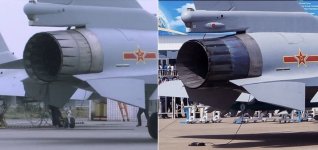
J-10 fighters equipped with AL-31 and WS-10 engines. Photo collage: Military Watch Magazine.
In the early stages, J-10 fighters equipped with experimental WS-10A engines were significantly inferior in performance to those with original Russian powerplants. As a result, in 2010, China urgently ordered an additional batch of 123 AL-31FN engines from the Russian Federation, with delivery scheduled for 2012, to ensure the combat readiness of its existing J-10 fleet. It was only after the development of the WS-10B variant, with a thrust of 14.5 metric tons (approximately 142 kN), that the Chinese engine was able to completely replace Russian powerplants on the production lines.
A comparative analysis of the technical parameters clearly demonstrates the distinctive features of both powerplants. The Russian AL-31FN afterburning turbofan engine is manufactured by the Chernyshev Moscow Machine-Building Enterprise, while the Chinese WS-10 Taihang afterburning turbofan engine is produced by the Shenyang Liming Aero-Engine Group Corporation. The maximum thrust with afterburner for the Russian engine is 122.5–125 kN, while the base Chinese engine produces 132 kN, and its WS-10B variant develops up to 142–145 kN.
In maximum dry thrust mode, the Russian engine delivers approximately 74.9 kN, falling short of its Chinese competitor’s 89.17 kN. The specific fuel consumption in afterburner mode is about 1.96 kg/(kgf·h) for the AL-31FN and 2.02–2.08 kg/(kgf·h) for the WS-10. At the same time, in cruise mode, the Chinese engine demonstrates higher fuel efficiency with a consumption rate of 0.695 kg/(kgf·h) compared to approximately 0.75 kg/(kgf·h) for its Russian counterpart.
In terms of weight and dimensions, the Chinese design significantly exceeds the Russian one: the WS-10’s dry weight is 1,794.7 kilograms, its length is 4,950 millimeters, and its maximum diameter is 1,160 millimeters. The Russian AL-31FN engine has a dry weight of about 1,538 kilograms, a length of 4,897 millimeters, and a maximum diameter of 1,140 millimeters.