Japan Defence and General News Discussions

Japan’s population is projected to decline sharply over the next 50 years due to a combination of record-low birth rates, rapid aging, and limited immigration. These trends are already accelerating and pose major social and economic challenges.

Japan has very serious problems. The Japanese people don't realise it yet.
 
Japan’s population is projected to decline sharply over the next 50 years due to a combination of record-low birth rates, rapid aging, and limited immigration. These trends are already accelerating and pose major social and economic challenges.
Japan is a post industrialisation state. Given their depressing work culture and high cost of living it's not looking positive.

South Korea has this same problem and is working on it.

America effectively neutered the Japanese growth in the 90s. Japan is a hardware first country and it can't compete with others in terms of cost (in quality it is leaps above).
 
The three East Asian countries have similar fertility rates, and the demographic dilemma Japan is currently facing will be a challenge China will also face in five years. Ironically, after strictly enforcing the one-child policy for forty years, China is now turning around to encourage childbirth and is gradually relaxing green card restrictions.
 
Maybe they will take in large number of Vietnamese, haha, I think that's what you like.
Yes, we bring Chinese civilization to Japan.
 
Japan is a post industrialisation state. Given their depressing work culture and high cost of living it's not looking positive.

South Korea has this same problem and is working on it.

America effectively neutered the Japanese growth in the 90s. Japan is a hardware first country and it can't compete with others in terms of cost (in quality it is leaps above).

Japanese can improve it by allowing limited immigration either through business investment or lottery visa. Most likely people from East Asian countries like Taiwan, Vietnam, Laos, Cambodia, Thailand, Malaysia, and Indonesia are the best candidates.
 
Japanese can improve it by allowing limited immigration either through business investment or lottery visa. Most likely people from East Asian countries like Taiwan, Vietnam, Laos, Cambodia, Thailand, Malaysia, and Indonesia are the best candidates.
They can but they are a very inward looking country. If you aren't a tourist you might not be welcome there. Whatever little foreign population that lives there works in white collar jobs. Even with their limited immigration there have been anti immigration protests.

But yes they can effectively compete by taking in blue collar workers.
 
To view this content we will need your consent to set third party cookies.
For more detailed information, see our cookies page.


To view this content we will need your consent to set third party cookies.
For more detailed information, see our cookies page.


To view this content we will need your consent to set third party cookies.
For more detailed information, see our cookies page.
 
Last edited:
To view this content we will need your consent to set third party cookies.
For more detailed information, see our cookies page.


To view this content we will need your consent to set third party cookies.
For more detailed information, see our cookies page.


To view this content we will need your consent to set third party cookies.
For more detailed information, see our cookies page.

Futile protests. Japan's shortage of blue-collar workers isn't a political issue, it's a demographic one. For decades, no matter which party or prime minister was in charge, the outcome has been the same, more reliance on foreign labor. Swapping out one leader won't fix a structural problem that has been brewing for generations. And if the flow of Vietnamese and Indonesian workers slows down, it will just open the door for Africans and Indians to come to Japan in larger numbers.
 
Futile protests. Japan's shortage of blue-collar workers isn't a political issue, it's a demographic one. For decades, no matter which party or prime minister was in charge, the outcome has been the same, more reliance on foreign labor. Swapping out one leader won't fix a structural problem that has been brewing for generations. And if the flow of Vietnamese and Indonesian workers slows down, it will just open the door for Africans and Indians to come to Japan in larger numbers.
I think Japanese don't want many dirty street***** in their country, so are Chinese with similar sentiment on this.
 
I think Japanese don't want many dirty street***** in their country, so are Chinese with similar sentiment on this.
Most Indian tourists, immigrant workers, business executives to the West are from educated upper class. So should not a problem.
But what the previous Japanese gov planned is fantasy and unrealistic.
Japan is a very conservative country. huge influx from foreign culture people will create tension. Same here in the West.
Then comes the money, Japan has long working hours with little pay. That’s hardly a draw for hundreds of thousands educated Indians.
 
Most Indian tourists, immigrant workers, business executives to the West are from educated upper class. So should not a problem.
But what the previous Japanese gov planned is fantasy and unrealistic.
Japan is a very conservative country. huge influx from foreign culture people will create tension. Same here in the West.
Then comes the money, Japan has long working hours with little pay. That’s hardly a draw for hundreds of thousands educated Indians.
Some of them have been caught Sh***** on beaches in Canada, people are outraged. Old habits die hard. And then they protested on the streets telling whites to go back to Europe, saying Canada belong to them.
 
The three East Asian countries have similar fertility rates, and the demographic dilemma Japan is currently facing will be a challenge China will also face in five years. Ironically, after strictly enforcing the one-child policy for forty years, China is now turning around to encourage childbirth and is gradually relaxing green card restrictions.

Japan actually has the highest TFR out of the three. It's just that Japan developed the earliest, and their TFR dropped the earliest.

Demographic is the single most important issue facing the East Asian countries. It's not trade war with the US, not the current property crisis, not Diaoyu/Senkaku or Dokdo Islands, not North Korea, not the South China Sea/Taiwan. All these pale in comparison to the demographic issue in the long run.

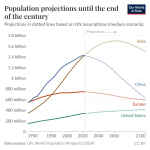
1762704014684.png https://ourworldindata.org/data-ins...states-are-on-very-different-population-paths

Based on the latest UN's projection, China's population will fall to Europe's levels towards the end of the century.

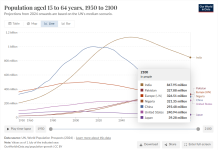
1762704345276.png

If you go by just working-age population (15 to 64 years old), China will fall below Europe, Pakistan, and Nigeria by the end of the century.

China's working-age population is projected to start falling by ~10mil annually by the 2030s. That's Singapore's total population every ~6 months, Taiwan's total population every ~2 years, South Korea's total population every ~5 years.

And South Korea's demographic situation is worse.

The Korean economy could start to shrink approximately 10 years from now if its current population structure and productivity persist, a study by the Bank of Korea (BOK) showed, Monday.

In a report titled, "Korea ranked second in the world for R&D, yet productivity stagnates," the central bank's Economic Research Institute noted that the Korean economy is likely to face a phase of "negative growth" in the 2040s unless the country achieves dramatic changes, such as a significant rebound in the birthrate or substantial improvements in productivity.

Their own central bank projects that its economy would enter a phase of negative growth by the 2040s as population decline outpaces productivity gains.

In its latest long-term forecast, the Korean Peninsula Population Institute for Future used a cohort component method to project South Korea’s demographic trends over the next century. This internationally recognised technique estimates future populations by incorporating factors such as birth rates, mortality rates and immigration patterns.

Under the institute’s worst-case scenario, South Korea’s population could drop to 7.53 million by 2125 – a sharp fall from the current 51.68 million. This would be even less than the current population of the city of Seoul alone, which is over 9.3 million.

It is forecasted that South Korea's population could shrink by 85% in another hundred years to 7.5mil people, or around HK's population today. And of which, probably more than half of the population consist of aged >65.

A lot of people like to talk about AI and automation replacing human. But what about the demand side? What economic vitality are we talking about when more than half of the population is aged >65?

A hundred years is actually not a long time for a country's history. If we zoom out and see that a country's population can fall by more than 50% in less than a hundred years, not due to war, famine, or disease, but by low birth rate; then we will realize that the contemporary issues pale in comparison. Raising the birth rate will be the most pressing issue, followed by crafting a sensible, sustainable immigration policy suited for the long-term needs of the society and economy.


NewsMaritime Security
ByDaisuke Sato

Nov 12, 2025
Modified date: Nov 12, 2025


Japan's new anti-ship missile. (ATLA pic)
Key Points
  • Japan’s ATLA revealed a new modular long-range anti-ship missile prototype for island defense.
  • The system uses an XKJ301-1 turbojet engine and will test guidance, seeker, and data-link technologies.
Japan’s Acquisition, Technology & Logistics Agency (ATLA) has revealed details of a new long-range anti-ship missile program designed to strengthen the country’s island defense capabilities.

The project, showcased through official development posters, highlights a modular missile system integrating advanced propulsion, guidance, and data-link technology.

According to ATLA, the research and development effort focuses on creating a next-generation missile platform capable of engaging naval targets at extended ranges while maintaining high survivability against enemy countermeasures. The program’s stated goal is to support Japan’s ability to defend its remote islands and surrounding waters in an increasingly contested environment.


The first prototype, under development in fiscal year 2025, features a compact design powered by the XKJ301-1 turbojet engine. This variant will serve as a test platform for propulsion, guidance, and seeker integration. The airframe incorporates low-observable shaping and internal modular bays to host mission-specific payloads and control systems. ATLA documents describe the prototype as a key step toward validating a new airframe concept built around an “open architecture” to allow rapid integration of future technologies.


The image shows a diagram from Japan’s ATLA illustrating a modular missile design concept. On the left, several interchangeable modules are labeled, including a dual seeker, infrared seeker, jammer/decoy unit, EO/IR sensor, and high-power warhead. The center depicts a common multi-purpose airframe, and the right side shows how different combinations of modules create functional missiles such as anti-ship, decoy, reconnaissance, and strike variants.

A follow-on phase scheduled for 2027 will expand the test series to include two airframes—designated A and B—intended to evaluate advanced sensor configurations, including electro-optical and infrared seekers, as well as a high-speed data-link system. These prototypes will also test improved flight control surfaces and composite airframe structures optimized for low radar visibility.


Japan’s new anti-ship missile. (ATLA pic)

Japanese defense engineers say the program builds directly on earlier research into standoff and anti-ship systems, such as the Type 12 missile modernization effort. While ATLA has not publicly disclosed the new missile’s range, the design’s larger fuselage and efficient turbojet suggest a substantially greater reach than current surface-launched systems.


Japan’s new anti-ship missile. (ATLA pic)

The project reflects Tokyo’s continuing shift toward indigenous long-range precision weapons. In recent years, Japan has invested heavily in technologies that enable preemptive and remote island defense, including hypersonic glide vehicles and extended-range cruise missiles. The new anti-ship missile is expected to form part of a broader integrated strike network alongside air- and ground-launched platforms.
 
100% there is (violent) trouble brewing over the horizon between Japan and China. Women were the ones foolish enough to open the pandora's box, while men are mostly more timid.

In suicide, women have the highest success rate, meaning they choose the most effective method, while men are mostly cowards that rely on ineffective methods to commit suicide, thus most men lived past their suicidal tendencies.

When I was in university, the worst classes I ever took were the ones lead by a White female professor.

This Japanese woman will be the first in Japan's history to successfully provoke China to go kinetic.

Just watch China and Japan go kinetic very very soon all becoz of one foolish Japanese female president's feminine urges. (Not that I don't welcome the chance for China to payback Japan...)
I want to take a look at this post again in a few years.

If we count messing with China's red line as committing suicide/courting death, then a woman prime minister will have a much higher chance of success!

Anyways, all over the world I see the same, women are not fit to be the leader of their own country with one exception... China!
 

Users who are viewing this thread

Pakistan Defence Latest

Back
Top