Japan Defence and General News Discussions

Why is an elderly crimewave gripping Japan?
To view this content we will need your consent to set third party cookies.
For more detailed information, see our cookies page.
 

How Japan is rebuilding its war machine


To view this content we will need your consent to set third party cookies.
For more detailed information, see our cookies page.


Japan lifted a ban on lethal weapons exports that had been in place since the Second World War. Andrew Chang explains how the country is repositioning itself on the global defence market, and why it is rethinking its military readiness in a major shift from pacifist politics.

Chapters:
00:00
Intro
01:33 How to become an arms dealer
05:14 The ‘merchant of death’
 
Interesting news! I hope they arm themselves to the teeth.
 
Revenge is best served cold, the very first thing they do will seek revenge on US after they develop teeth.
Yeah.. sure buddy 😂

Unlike you that lives in a fantasy world, Japan is a rational actor and the last thing they would want would to be obliterated.

But I already mentioned this to you already but you stick to your fantasy world

Nothing left to say really
 
Yeah.. sure buddy 😂

Unlike you that lives in a fantasy world, Japan is a rational actor and the last thing they would want would to be obliterated.

But I already mentioned this to you already but you stick to your fantasy world

Nothing left to say really
Only fools believe they are rational, we've lived side by side with them for thousands of years, you just live in your fantasy to believe so. They will seek revenge on you, sooner or later.
 
Revenge is best served cold, the very first thing they do will seek revenge on US after they develop teeth.
Not necessarily. The country that has long occupied and controlled Japan is the United States. Americans committed many crimes during the colonial period.

If the United States released a dog it raised, and then the dog bit the United States, wouldn't that be very interesting?

Let's look forward to Pearl Harbor 2.

North Korea demands that Japan apologize to China.

Shoigu said that the militarist hydra is rising again, but Moscow and Beijing have accumulated enough experience in cutting off its heads. Russia and China will not allow the revival of criminal regimes in Europe and Japan.

Let's look forward to closing the door and hitting the dog.
 

Massive frigate buy from Japan jolts Australian warship program​

By Gordon Arthur
Apr 27, 2026, 03:53 PM

4TBJALLBPFHS7PDBYIYVURNRW4.jpg
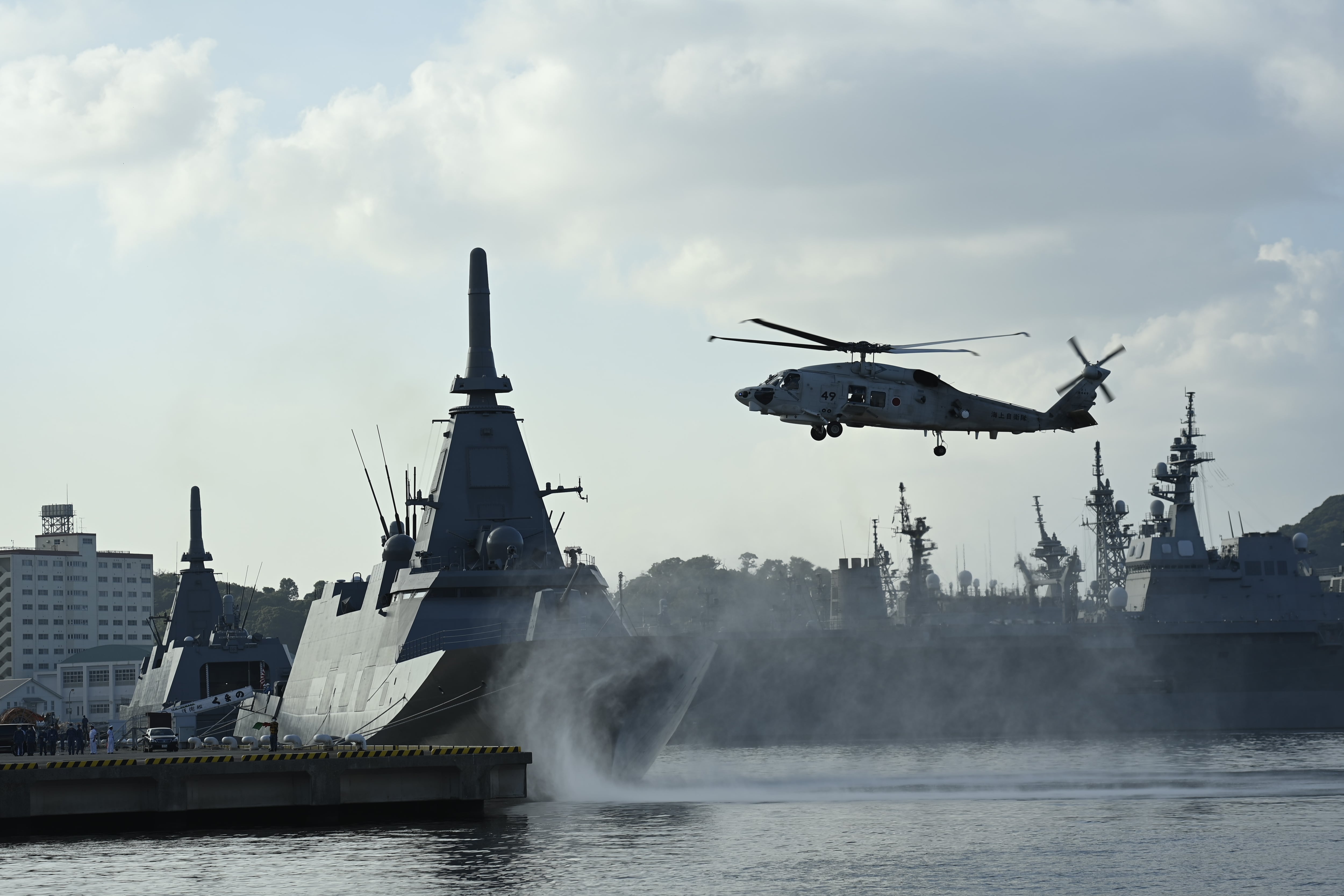
A helicopter hovers at the Yokosuka naval base, Sept. 5, 2022. (David Mareuil/Anadolu Agency via Getty Images)

MANILA, Philippines — Australia has moved to reverse a decline in the number of warships, as its surface combatant fleet stands to fall to its smallest size since World War II.

Under Project Sea 3000, Australia and Japan inked a deal to buy three upgraded Mogami-class frigates for the Royal Australian Navy (RAN). The contract was signed by the two countries’ defense ministers aboard JS Kumano in Melbourne earlier this month.


This represents Japan’s largest-ever defense export, a major boost to its shipbuilding industry, and it advances greater strategic alignment between the two countries.

Mitsubishi Heavy Industries (MHI) will construct three 4,800-ton frigates in Japan, with the first to be delivered by December 2029.

Another eight frigates will subsequently be built in Western Australia. This shipbuilding effort is slated to cost up to A$20 billion (US$14.4 billion) over the next decade, double the amount indicated two years ago.


Minister for Defence Industry Pat Conroy stated: “This is the fastest acquisition for the Royal Australian Navy in peacetime. We’re working closely with Japanese and Australian industry partners as we acquire one of the most, if not the most, advanced general-purpose frigates in the world.”

Speaking to Defense News, Rear Admiral Stephen Hughes, the RAN’s Head of Naval Capability, said: “It’s going to be a game-changer from a capability perspective. The reality is that Mogami is going to allow us to jump a generation in technology in a ship,” not only in its combat system, but also in how the RAN operates and crews these highly automated ships.

Subcontracts are already being awarded, including Japanese company NEC, for nine types of equipment, such as sonars and UNICORN integrated masts, and Rolls-Royce for MT30 gas turbines.

These frigates are desperately needed, since the RAN presently has just ten surface combatants – three Hobart-class destroyers and seven Anzac-class frigates. The latter will be replaced by the upgraded Mogami.


Hughes rejected the notion that the Navy’s capability is currently declining. “I think what you’re managing is a transition from a current force which has a certain amount of capability, to a different force with greater capability, different opportunities. And I don’t believe you count the number of ships. It’s about the capability.”

Hughes described the upgraded Mogami as larger and far more capable than the Anzac class, plus they will offer greater availability of 300 days at sea annually.

Their armaments include ESSM Block 2 surface-to-air missiles in a 32-cell Mk 41 vertical-launch system, deck-mounted Naval Strike Missiles, MK 54 lightweight torpedoes, and a SeaRAM.

Otherwise, these frigates will boast Japanese systems and sensors such as the combat management system, sonar, and UNICORN mast.


Hughes explained the aim is to have as few Australianized changes as possible, because that “would delay the delivery of the ship.”

He added, “We’ve actually picked the best ship with the most compatible capability for the Australian navy’s use.”

Ultimately, Australia and Japan will end up operating a combined fleet of 35 Mogami frigates.

About Gordon Arthur
Gordon Arthur is an Asia correspondent for Defense News. After a 20-year stint working in Hong Kong, he now resides in New Zealand. He has attended military exercises and defense exhibitions in about 20 countries around the Asia-Pacific region.
 

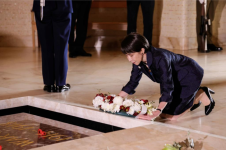
Sanae Takaichi "kneels" to offer flowers in Australia; Chinese state media criticizes this as a double humiliation: why she doesn't come to Nanjing or Asian countries that Japan did the most brutal killings and destructions to kneel. Disgusting ! White lickers.​


1778044388731.png
Japanese Prime Minister Sanae Takaichi recently knelt and laid flowers at the Tomb of the Unknown Soldier at the Canberra War Memorial in Australia. (Official website of the Japanese Prime Minister)
 

Sanae Takaichi "kneels" to offer flowers in Australia; Chinese state media criticizes this as a double humiliation: why she doesn't come to Nanjing or Asian countries that Japan did the most brutal killings and destructions to kneel. Disgusting ! White lickers.​


View attachment 195937
Japanese Prime Minister Sanae Takaichi recently knelt and laid flowers at the Tomb of the Unknown Soldier at the Canberra War Memorial in Australia. (Official website of the Japanese Prime Minister)

They always have this white wannabe mentality, but whites still view them as an expendable pawn.

The Japanese in the white society still face no less discrimination than other Asians.
 

Japan drops to third-largest creditor as China overtakes despite record assets​

Eamonn Sheridan

May 25 2026
  • A record pile of overseas wealth, and Japan is still falling down the table.

Japan's net external assets rose 4.4% to a record 561.75 trillion yen in 2025, but the country fell to third in global creditor rankings as China overtook it, per Finance Ministry data.

Summary: Source: Japanese Finance Ministry, IMF-based data

  • Japan's net external assets rose 4.4% year-on-year to 561.75 trillion yen ($3.53 trillion) in 2025, a record high and the eighth consecutive annual increase
  • Growth was driven by strong overseas investment by Japanese companies, including mergers and acquisitions, and valuation gains on foreign securities held by residents
  • Despite the record, Japan slipped from second to third in global creditor rankings, overtaken by China after losing top spot to Germany the previous year for the first time in 34 years
  • Germany holds the largest net external asset position at 675.5 trillion yen, followed by China at 636.3 trillion yen; both have benefited from sustained trade surpluses
  • Japan's net position was constrained by a significant rise in external liabilities, as the strong performance of the domestic stock market pushed up the value of Japanese equities held by non-resident investors by 62.2 trillion yen
Japan's net external assets climbed to a record high in 2025, but the milestone offered little comfort in the global rankings: the country has now slipped to third place among the world's largest creditor nations, overtaken by China and already behind Germany.

The Finance Ministry reported that the combined net external assets of the Japanese government, businesses and individuals rose 4.4% from the prior year to 561.75 trillion yen, equivalent to roughly $3.53 trillion. The eighth consecutive annual increase was fuelled by vigorous overseas investment from Japanese corporations, a run of cross-border mergers and acquisitions, and valuation gains on foreign securities held by Japanese residents.

Yet the headline growth figure masks a more complicated picture. Japan's external liabilities also expanded sharply over the period, in large part because of the strong performance of the domestic equity market. The rise in Japanese share prices translated into a 62.2 trillion yen upward revaluation of Japanese securities in the hands of non-resident investors, swelling the liability side of the ledger and limiting the net gain.

The result is a country whose gross overseas footprint continues to expand, but whose net position is being compressed by foreign appetite for Japanese assets. That dynamic stands in contrast to Germany and China, whose creditor positions are underpinned by structural trade surpluses that consistently add to the asset side without a comparable liability offset. Germany held net external assets of 675.5 trillion yen at end-2025, with China close behind at 636.3 trillion yen, both figures drawn from IMF-sourced ministry data.

Japan's slide down the rankings carries a certain symbolic weight. For 34 years the country sat atop the global creditor table, a reflection of its postwar savings culture, export-driven accumulation, and the vast overseas investment built up across decades. Losing that position to Germany in the previous year was notable enough. Conceding second place to China marks a more pointed shift in the balance of global financial standing.

Whether the trend continues will depend in part on the trajectory of Japanese corporate overseas investment, the yen's performance, and the extent to which foreign investors continue to add Japanese equity exposure. For now, the record asset figure and the falling rank tell the same story from opposite ends.

The ranking shift carries implications for yen dynamics and Japan's broader external position. A growing stock of foreign liabilities, driven by non-resident demand for Japanese equities, means Japan's net creditor position is being squeezed from both sides: assets rising, but liabilities rising faster in valuation terms. For currency markets, the contrast between Japan's weakening relative creditor standing and the yen's traditional safe-haven status adds a layer of complexity to positioning. The data also underscores Germany and China's structural advantage from persistent trade surpluses, a dynamic that Japan, with its more mixed current account profile, cannot easily replicate.


Japan slips to third-largest creditor behind China despite record net external assets​

By Makiko Yamazaki
May 26, 20267:45 AM GMT+8

Man takes pictures of the market indices at a stock quotation board outside a brokerage in Tokyo

A man uses his phone to take pictures of market indices at a stock quotation board outside a brokerage in Tokyo, August 24, 2015. REUTERS/Thomas Peter/File Photo

TOKYO, May 26 (Reuters) - Japan fell behind China to rank as the world's third-largest net creditor in 2025, marking a further decline in global rankings ‌despite its net external assets hitting an all-time record, the Finance Ministry said on Tuesday.

Net external assets held by the Japanese government, businesses and individuals, rose 4.4% from a year earlier to 561.75 trillion yen ($3.53 trillion).

That marked the eighth ⁠straight year of growth, driven by Japanese companies' robust overseas investment, mergers and acquisitions, as well as valuation gains on foreign securities held by residents.

However, after losing the top spot to Germany the previous year for the first time in 34 years, Japan has now surrendered its position as the world's second-largest creditor to China, falling to third place ‌in ⁠the global rankings.

Germany remained the world's top creditor with 675.5 trillion yen in net external assets, followed by China at 636.3 trillion yen, according to ministry data based on figures from the International Monetary ⁠Fund.

Both Germany and China have seen their net external assets bolstered by annual trade surpluses.

Japan, meanwhile, saw the growth of its net ⁠external assets contained partly because its external liabilities also swelled significantly.


Japan slips to third-largest creditor behind China despite record net external assets​

By Makiko Yamazaki
May 26, 20267:45 AM GMT+8

Man takes pictures of the market indices at a stock quotation board outside a brokerage in Tokyo

A man uses his phone to take pictures of market indices at a stock quotation board outside a brokerage in Tokyo, August 24, 2015. REUTERS/Thomas Peter/File Photo

TOKYO, May 26 (Reuters) - Japan fell behind China to rank as the world's third-largest net creditor in 2025, marking a further decline in global rankings ‌despite its net external assets hitting an all-time record, the Finance Ministry said on Tuesday.

Net external assets held by the Japanese government, businesses and individuals, rose 4.4% from a year earlier to 561.75 trillion yen ($3.53 trillion).

That marked the eighth ⁠straight year of growth, driven by Japanese companies' robust overseas investment, mergers and acquisitions, as well as valuation gains on foreign securities held by residents.

However, after losing the top spot to Germany the previous year for the first time in 34 years, Japan has now surrendered its position as the world's second-largest creditor to China, falling to third place ‌in ⁠the global rankings.

Germany remained the world's top creditor with 675.5 trillion yen in net external assets, followed by China at 636.3 trillion yen, according to ministry data based on figures from the International Monetary ⁠Fund.

Both Germany and China have seen their net external assets bolstered by annual trade surpluses.

Japan, meanwhile, saw the growth of its net ⁠external assets contained partly because its external liabilities also swelled significantly.

What happened to the sole superpower US ? I thought it is by far the richest country in the world in every respect.
 

Users who are viewing this thread

Pakistan Defence Latest

Country Watch Latest

Latest Posts

Back
Top