Navigation
Install the app
How to install the app on iOS
Follow along with the video below to see how to install our site as a web app on your home screen.
Note: This feature may not be available in some browsers.
More options
Style variation
You are using an out of date browser. It may not display this or other websites correctly.
You should upgrade or use an alternative browser.
You should upgrade or use an alternative browser.
JF-17 - In the Mirror of History
- Thread starter ghazi52
- Start date
More options
Who Replied?


ghazi52
THINK TANK: CONSULTANT
- Thread starter
- #43
7MF


Chengdu F-7MF/J-7FS
While in Western countries is almost inconceivable that a company has invested in the development of two aircraft in exactly the same category for exactly the same purpose, in China it is clearly possible.
At the end of the millennium was put in flight one versi'on radically modernized F-7MG, called J-7FS. This aircraft should represent the final development stage of the series J-7 and had previst large exports to the poorest countries. Chengdu The company created a direct competitor to its own project, FC-1, with the same objectives.
The June 8, 1998 maiden flight demonstrator concept J-7F, equipped with a powerful radar in the nose covered by a conical radome, which was located under the air intake in a similar configuration to that of the Vought F Crusader -8.
Originally, the demonstrator flew F-enrollment 7MF nro 139 to his conversion, from which he was installed a new double delta wing (or double angle arrow) as the F-7MG. The new aircraft also was painted with a new standard esquemno composed of stripes in shades of olive green and yellow sand. In the upper vertical empennage angular projection was added.
The final configuration of the F-7MF be exhibited publicly for the first time in the exhibition of Zai 2000. The F-7MF showed definitive ventral an air intake similar to that used in the J-10 from the company. Even the sides of the cabin fixed canard pequeñasplanos added. Because of all this we had to redesign the whole landing gear leg forward and your accommodation.
From its predecessor, the F-7MF retained the WP-13F engine, the rear of the wing and tail surfaces. The electronic equipment came from a variety of sources, such as Russia, Israel, Europe and China itself, connected via the MIL-STD-1553.
The configuration tests exceeded the wind tunnel and flight of the prototype was planned for around 2002. The cost of fly-away production was estimated at U.S. $ 7 to 8,000,000 the price level of 2000.
But after Pakistan agreed to pay half the cost of developing the FC-1 and with the introduction into service of the J-10A significant in Chinese aviation, decreased expectations about the F-7MF and this eventually disappeared or was canceled. J-7FS with the original delta wing and the double delta
Beijing Super Wing CY-1 and FTC-16
Another interesting adaptation of the J-7 was the CY-1, designed by the airline superwing Beijing Technology Research Institute Co., founded in China sometime in around 1997. Unlike state-owned aviation giants such as Chengdu, the new company specializes in modifications to the structures inherited from the oldest light fighters, using innovative ideas that can be used in the new millennium.
The concept was centered mainly in countries that need new fighter and fighter jets, but could not afford even the cheapest modern fighters such as the Sino-Pakistani JF-17 Thunder. In most cases, operators would former MiG-19 and MiG-21.
The multipurpose single-seat fighter CY-1 was based on J-7/MiG-21 Chengdu, but with "duck tail" and an unusual longitudinal dimensional area on the sides of the body (highlighted in blue in the photos of the model) that according to statements by the manufacturer issues like maneuverability aircraft equipped with costly advanced FBW system.
In short, the CY-1 was a MiG-21 prepared for the installation of equipment provided modernosy greater maneuverability obtained by adding new nonstandard maneuvering surfaces.
The aircraft was developed in 1998 and the general configuration was tested by radio-controlled models. Beijing superwing The company had to compete economically and politically against aircraft more evolved in its development, such as the FC-1 and F-7MF in the same category, so it was decided to participate in Zhuhai Air Show 2002 and submit this proposal to the public in an effort to find the right sponsors.
Although trust company officials claimed that the Chinese armed forces have expressed a strong interest in the concept, the reality was much less poetic. Many rightly wondered if the plane really did without FBW system.
However, the company is not denying that despite its five years of existence, competing with giants superwing Beijing and Chengdu and Guizhou state. If they had managed to find a foreign investor, its engineers have gained valuable experience useful for future projects.
The CY-1 series should have a length of 14.08 meters, a wingspan of 8.32 meters, a takeoff weight of 8500 kg and a load of 3000 kg war. Have reached speeds up to Mach 1.8. The previto engine had a thrust of 70 kN.
Although not returned to knowing anything about the CY-1 after its public debut in 2004, again in the Zhuhai Airshow, the surprise came in the form of its successor, the LFC-16 light fighter (Chinese Light Hunting 16). From Beijing superwing company were clear that alone would not succeed, they needed government support to raise its factory in Guizhou.
The plane seemed to be based on the fuselage of the FTC-2000 but with a single cab and a variety of surfaces maneuverable innovative inherited CY-1. The goals and objectives were always the same: create a cheap successor MiG-21, focusing mainly on the export to the poorest countries, than it would be a cheaper alternative than FC-1/JF-17 hunting.
Again, from Beijing superwing stated that the project had the support of senior Chinese officials and a prototype could be completed in one to three years, but in reality the whole initiative'm nothing.
Chengdu F-7MF/J-7FS
While in Western countries is almost inconceivable that a company has invested in the development of two aircraft in exactly the same category for exactly the same purpose, in China it is clearly possible.
At the end of the millennium was put in flight one versi'on radically modernized F-7MG, called J-7FS. This aircraft should represent the final development stage of the series J-7 and had previst large exports to the poorest countries. Chengdu The company created a direct competitor to its own project, FC-1, with the same objectives.
The June 8, 1998 maiden flight demonstrator concept J-7F, equipped with a powerful radar in the nose covered by a conical radome, which was located under the air intake in a similar configuration to that of the Vought F Crusader -8.
Originally, the demonstrator flew F-enrollment 7MF nro 139 to his conversion, from which he was installed a new double delta wing (or double angle arrow) as the F-7MG. The new aircraft also was painted with a new standard esquemno composed of stripes in shades of olive green and yellow sand. In the upper vertical empennage angular projection was added.
The final configuration of the F-7MF be exhibited publicly for the first time in the exhibition of Zai 2000. The F-7MF showed definitive ventral an air intake similar to that used in the J-10 from the company. Even the sides of the cabin fixed canard pequeñasplanos added. Because of all this we had to redesign the whole landing gear leg forward and your accommodation.
From its predecessor, the F-7MF retained the WP-13F engine, the rear of the wing and tail surfaces. The electronic equipment came from a variety of sources, such as Russia, Israel, Europe and China itself, connected via the MIL-STD-1553.
The configuration tests exceeded the wind tunnel and flight of the prototype was planned for around 2002. The cost of fly-away production was estimated at U.S. $ 7 to 8,000,000 the price level of 2000.
But after Pakistan agreed to pay half the cost of developing the FC-1 and with the introduction into service of the J-10A significant in Chinese aviation, decreased expectations about the F-7MF and this eventually disappeared or was canceled. J-7FS with the original delta wing and the double delta
Beijing Super Wing CY-1 and FTC-16
Another interesting adaptation of the J-7 was the CY-1, designed by the airline superwing Beijing Technology Research Institute Co., founded in China sometime in around 1997. Unlike state-owned aviation giants such as Chengdu, the new company specializes in modifications to the structures inherited from the oldest light fighters, using innovative ideas that can be used in the new millennium.
The concept was centered mainly in countries that need new fighter and fighter jets, but could not afford even the cheapest modern fighters such as the Sino-Pakistani JF-17 Thunder. In most cases, operators would former MiG-19 and MiG-21.
The multipurpose single-seat fighter CY-1 was based on J-7/MiG-21 Chengdu, but with "duck tail" and an unusual longitudinal dimensional area on the sides of the body (highlighted in blue in the photos of the model) that according to statements by the manufacturer issues like maneuverability aircraft equipped with costly advanced FBW system.
In short, the CY-1 was a MiG-21 prepared for the installation of equipment provided modernosy greater maneuverability obtained by adding new nonstandard maneuvering surfaces.
The aircraft was developed in 1998 and the general configuration was tested by radio-controlled models. Beijing superwing The company had to compete economically and politically against aircraft more evolved in its development, such as the FC-1 and F-7MF in the same category, so it was decided to participate in Zhuhai Air Show 2002 and submit this proposal to the public in an effort to find the right sponsors.
Although trust company officials claimed that the Chinese armed forces have expressed a strong interest in the concept, the reality was much less poetic. Many rightly wondered if the plane really did without FBW system.
However, the company is not denying that despite its five years of existence, competing with giants superwing Beijing and Chengdu and Guizhou state. If they had managed to find a foreign investor, its engineers have gained valuable experience useful for future projects.
The CY-1 series should have a length of 14.08 meters, a wingspan of 8.32 meters, a takeoff weight of 8500 kg and a load of 3000 kg war. Have reached speeds up to Mach 1.8. The previto engine had a thrust of 70 kN.
Although not returned to knowing anything about the CY-1 after its public debut in 2004, again in the Zhuhai Airshow, the surprise came in the form of its successor, the LFC-16 light fighter (Chinese Light Hunting 16). From Beijing superwing company were clear that alone would not succeed, they needed government support to raise its factory in Guizhou.
The plane seemed to be based on the fuselage of the FTC-2000 but with a single cab and a variety of surfaces maneuverable innovative inherited CY-1. The goals and objectives were always the same: create a cheap successor MiG-21, focusing mainly on the export to the poorest countries, than it would be a cheaper alternative than FC-1/JF-17 hunting.
Again, from Beijing superwing stated that the project had the support of senior Chinese officials and a prototype could be completed in one to three years, but in reality the whole initiative'm nothing.
ghazi52
THINK TANK: CONSULTANT
- Thread starter
- #44
F-7P Sabre II "Super 7" (Chao Qi)
The Super-7 is a development of the F-7, Chengdu's version of the Mikoyan MiG-21 Fishbed. The upgraded F-7M was to be offered for export by China as a lowcost, new-build replacement for the US-built Northrop F-5, the Soviet MiG-21, and the Chinese F-6 and F-7.
By the early 1980s the PAF was looking for a new fighter to replace the F-6 [Chinese J-6]. Pakistan initiated the Sabre II project which would upgrade the Chengdu F-7M Skybolt with a Western engine and avionics.
The early 1980s was characterized by a pronounced improvement in US-Chinese relations. It was therefore only natural that China became a major market for Western military hardware, in contrast to the years following China's 1949 Communist revolution, when an economic embargo imposed by the West forced China to seek assistance from the Soviet Union.
Grumman and China studied the feasibility of producing substantially improved F-7s using US engines and avionics. The extensively modified version of China's F-7 (MiG-21) fighter, called the Sabre II, would be re-engined and given a new forward fuselage with "solid" nose and side intakes.
The new plane was deep modernization of J-7 fighter. The Sabre II was an F-7 with a General Electric F404 or Pratt & Whitney PW1216 or PW1120 engine producing between 16,0001b and 20,0001b thrust.
The aircraft was equipped with the Westinghouse AN/APG-66 radar (the same as on the F-16 fighter. According to Chinese experts, the combat capabilities of the aircraft "Super 7" must have been closer to the American F-16 fighter.
The "SUPER-7" was the first fighter jet completely designed and manufactured by China. Super-7 (Chao Qi) fighter was a new generation fighter and the first of its kind of China's own intellectual property rights.
The third-generation fighter plane, which can carry 3.8 tons of missiles, also has improved systems for attacking ground targets. Its advanced radar positioning and operating systems give the plane greater flexibility and better close-range manoeuvrability.
The wing area would be enlarged by increasing span (from 23.5ft to 26ft) and chord. Leading-edge slats and combat flaps would be fitted. Two additional hardpoints would be incorporated for Sidewinder-class air-to-air missiles.
The higher thrust and lower wing loading would increase manuverability, while the longer fuselage (stretched from 45.8ft to 49.3ft) would give an 1,1001b increase in fuel capacity and single-point refuelling. The extra fuel and more-efficient turbofan would enhance range and endurance.
The main landing gear would be beefed up, and larger wheels fitted. The nose gear would also be redesigned, and would incorporate nosewheel steering. An arrester hook would be fitted, and the ventral strake would be reshaped.
The cockpit would be changed completely, with a Northrop F-20 Tigershark windscreen and canopy, F-16-type displays and instrumentation, and a new ejection seat. The gaseous oxygen system would be replaced by a higher-capacity liquid oxygen system.
The program was partially funded by Pakistan, which was considered as the main potential customer. The fighter was offered as a low-cost alternative to the F-16 to meet Pakistan's 150-aircraft requirement to replace Chinese-supplied F-6s (MiG-19s). The flyaway cost will be $8-9 million.
Grumman completed a five-month feasibility study in 1987. The American firm had performed preliminary studies and wind tunnel aircraft models.
Grumman, China's Chengdu aircraft factory, China Aero Technology Import-Export Company, the Pakistan Air Force and the Pakistan Aeronautical Complex (PAC) promoted the F-7 modification. Chengdu would build the revised rear fuselage to a Grumman design, while the US company would build the new forward fuselage. PAC would assemble the aircraft. Several other Western companies were in competition to supply the engine and avionics.
In November 1988 Grumman and the China National Aero Technology Import-Export Corporation (Catic) started a nine month preliminary design study to upgrade Chinese-built Xian F-7M Airguard (MiG-21) fighter/ ground-attack aircraft. But by 1988 Grumman doubted that its proposal will be accepted, but believed that China could become interested in the modified F-7 for its own use.
The joint program to produce the Super 7 fighter was delayed in part because of resource constraints which prevented Beijing from meeting the project's initial R&D costs.
Within a few years, project costs had escalated, and by 1989 the program was regarded as posing high financial risk by the PAF, given the 40% increase in the cost of the project. Chinese relations with the West broke down following the suppression of the Tiananmen Square protests in June 1989. Consequently, the "Sabre II" project was cancelled.
In the meantime the US lost interest in Pakistan following the Soviet withdrawal from Afghanistan. The US suddenly focused on Pakistan's nuclear weapons development program, and in 1990 the US imposed military and economic sanctions in the Pressler amendments.
Development of the "Super 7" upgrade was slowed with the end of American technical assistance following the Tienanmen repression of 1989.
The PAF opted for a less ambitious option of acquiring the F-7P Skybolt, an upgraded version of the F-7M, to support the fleet of F-7P Skybolts with over a 100 F-16 Fighting Falcons.
By 1993 Saturn's AL-31F, which powers the Sukhoi Su-27 Flanker, had been selected to power the Chinese Chengdu Super-7, which was due to be flown in 1994. The Super-7 was to have been powered by the General Electric F404, but use of the engine was blocked by a US trade embargo.
The Russian powerplant was selected over the Turbo-Union marketed by Rolls-Royce. By 1995 Moscow was willing to assist with a number of Chinese programs, including the Super-7 fighter plane. But even with Russia's help, this aircraft ws not scheduled for delivery until the latter part of the 1990s. Pakistan and China later foreclosed the option of producing F-Super 7 aircraft due to non-availability of engines.
However, Chengdu continued it efforts to improve the F-7M airframe by re-designing air intakes on the sides of the fuselage, hence the name Super-7.
Both the "F-7P" and "Super 7" nomenclature are extremely ambiguous, and seem to refer as much to requirments as to actual specific pieces of hardware. The "F-7P" nomenclature seems to reference the full range of F-7 configurations for Pakistan, and antedates the development of the side inlet design.
Similarly, the "Super 7" nomenclature survived this F-7 derivative configuration, and for a while decended on the essentially unrelated FC-1 "Chao Qi" / JF-17 Thunder program, which Pakistan and China embarked on in the late 1990s.
F-7P Sabre II "Super 7" (Chao Qi)
The Super-7 is a development of the F-7, Chengdu's version of the Mikoyan MiG-21 Fishbed. The upgraded F-7M was to be offered for export by China as a lowcost, new-build replacement for the US-built Northrop F-5, the Soviet MiG-21, and the Chinese F-6 and F-7.
By the early 1980s the PAF was looking for a new fighter to replace the F-6 [Chinese J-6]. Pakistan initiated the Sabre II project which would upgrade the Chengdu F-7M Skybolt with a Western engine and avionics.
The early 1980s was characterized by a pronounced improvement in US-Chinese relations. It was therefore only natural that China became a major market for Western military hardware, in contrast to the years following China's 1949 Communist revolution, when an economic embargo imposed by the West forced China to seek assistance from the Soviet Union.
Grumman and China studied the feasibility of producing substantially improved F-7s using US engines and avionics. The extensively modified version of China's F-7 (MiG-21) fighter, called the Sabre II, would be re-engined and given a new forward fuselage with "solid" nose and side intakes.
The new plane was deep modernization of J-7 fighter. The Sabre II was an F-7 with a General Electric F404 or Pratt & Whitney PW1216 or PW1120 engine producing between 16,0001b and 20,0001b thrust.
The aircraft was equipped with the Westinghouse AN/APG-66 radar (the same as on the F-16 fighter. According to Chinese experts, the combat capabilities of the aircraft "Super 7" must have been closer to the American F-16 fighter.
The "SUPER-7" was the first fighter jet completely designed and manufactured by China. Super-7 (Chao Qi) fighter was a new generation fighter and the first of its kind of China's own intellectual property rights.
The third-generation fighter plane, which can carry 3.8 tons of missiles, also has improved systems for attacking ground targets. Its advanced radar positioning and operating systems give the plane greater flexibility and better close-range manoeuvrability.
The wing area would be enlarged by increasing span (from 23.5ft to 26ft) and chord. Leading-edge slats and combat flaps would be fitted. Two additional hardpoints would be incorporated for Sidewinder-class air-to-air missiles.
The higher thrust and lower wing loading would increase manuverability, while the longer fuselage (stretched from 45.8ft to 49.3ft) would give an 1,1001b increase in fuel capacity and single-point refuelling. The extra fuel and more-efficient turbofan would enhance range and endurance.
The main landing gear would be beefed up, and larger wheels fitted. The nose gear would also be redesigned, and would incorporate nosewheel steering. An arrester hook would be fitted, and the ventral strake would be reshaped.
The cockpit would be changed completely, with a Northrop F-20 Tigershark windscreen and canopy, F-16-type displays and instrumentation, and a new ejection seat. The gaseous oxygen system would be replaced by a higher-capacity liquid oxygen system.
The program was partially funded by Pakistan, which was considered as the main potential customer. The fighter was offered as a low-cost alternative to the F-16 to meet Pakistan's 150-aircraft requirement to replace Chinese-supplied F-6s (MiG-19s). The flyaway cost will be $8-9 million.
Grumman completed a five-month feasibility study in 1987. The American firm had performed preliminary studies and wind tunnel aircraft models.
Grumman, China's Chengdu aircraft factory, China Aero Technology Import-Export Company, the Pakistan Air Force and the Pakistan Aeronautical Complex (PAC) promoted the F-7 modification. Chengdu would build the revised rear fuselage to a Grumman design, while the US company would build the new forward fuselage. PAC would assemble the aircraft. Several other Western companies were in competition to supply the engine and avionics.
In November 1988 Grumman and the China National Aero Technology Import-Export Corporation (Catic) started a nine month preliminary design study to upgrade Chinese-built Xian F-7M Airguard (MiG-21) fighter/ ground-attack aircraft. But by 1988 Grumman doubted that its proposal will be accepted, but believed that China could become interested in the modified F-7 for its own use.
The joint program to produce the Super 7 fighter was delayed in part because of resource constraints which prevented Beijing from meeting the project's initial R&D costs.
Within a few years, project costs had escalated, and by 1989 the program was regarded as posing high financial risk by the PAF, given the 40% increase in the cost of the project. Chinese relations with the West broke down following the suppression of the Tiananmen Square protests in June 1989. Consequently, the "Sabre II" project was cancelled.
In the meantime the US lost interest in Pakistan following the Soviet withdrawal from Afghanistan. The US suddenly focused on Pakistan's nuclear weapons development program, and in 1990 the US imposed military and economic sanctions in the Pressler amendments.
Development of the "Super 7" upgrade was slowed with the end of American technical assistance following the Tienanmen repression of 1989.
The PAF opted for a less ambitious option of acquiring the F-7P Skybolt, an upgraded version of the F-7M, to support the fleet of F-7P Skybolts with over a 100 F-16 Fighting Falcons.
By 1993 Saturn's AL-31F, which powers the Sukhoi Su-27 Flanker, had been selected to power the Chinese Chengdu Super-7, which was due to be flown in 1994. The Super-7 was to have been powered by the General Electric F404, but use of the engine was blocked by a US trade embargo.
The Russian powerplant was selected over the Turbo-Union marketed by Rolls-Royce. By 1995 Moscow was willing to assist with a number of Chinese programs, including the Super-7 fighter plane. But even with Russia's help, this aircraft ws not scheduled for delivery until the latter part of the 1990s. Pakistan and China later foreclosed the option of producing F-Super 7 aircraft due to non-availability of engines.
However, Chengdu continued it efforts to improve the F-7M airframe by re-designing air intakes on the sides of the fuselage, hence the name Super-7.
Both the "F-7P" and "Super 7" nomenclature are extremely ambiguous, and seem to refer as much to requirments as to actual specific pieces of hardware. The "F-7P" nomenclature seems to reference the full range of F-7 configurations for Pakistan, and antedates the development of the side inlet design.
Similarly, the "Super 7" nomenclature survived this F-7 derivative configuration, and for a while decended on the essentially unrelated FC-1 "Chao Qi" / JF-17 Thunder program, which Pakistan and China embarked on in the late 1990s.
F-7P Sabre II "Super 7" (Chao Qi)
ghazi52
THINK TANK: CONSULTANT
- Thread starter
- #45
Pakistan Aeronautical Complex (PAC). The aircraft is designated JF-17 Thunder by the Pakistani Air Force (PAF).
The first batch of 50 aircraft in the Block-I variant were delivered to the PAF between 2008 and 2013. Production of further 50 aircraft in the improved Block-II variant reportedly began in early 2014.
Key Facts
Number in service 50 (Pakistani Air Force)
Designer Chengdu Aircraft Design Institute (611 Institute)
Manufacturer Chengdu Aircraft Industry Group (CAIG)
Pakistan Aeronautical Complex (PAC)
Maiden flight 25 August 2003
IOC 2008 (PAF)
Crew One
Role Air superiority / ground attack
Development History
The FC-1/JF-17 can trace its origin to the Super-7 programme initiated in 1989 by CAIG and U.S. aerospace company Grumman. The aim of the programme was to introduce a radically redesigned Chengdu J-7 (Mig-21 Fishbed-C) fitted with Western engine and avionics for the PLAAF as well as potential international customers. Grumman pulled out of the programme in late 1989 following the military technology boycott on China imposed by the U.S. government. CAIG resumed the development in 1991 under the revised Fighter China 1 programme.
In 1995, Pakistan in search for a replacement for its ageing Dassault Mirage III/5s, Chengdu F-7s and Nanchang Q-5s entered an initial agreement with China to jointly develop a modern multirole fighter aircraft. Russian Mikoyan also joined the development programme in the same year to provide design support and sent a team of engineers to CAIG to assist the development. Russia also agreed to supply the Klimov RD-93 turbofan jet engine to power the aircraft.
In 1999, China and Pakistan signed an official joint-development agreement, with each side sharing 50% of the total development cost. CAIG is the prime Chinese contractor for aircraft development and manufacture, while Pakistani Aeronautical Complex (PAC) is the main partner responsible for post-sale service and maintenance, as well as the production of some parts for the aircraft in Pakistan.
The first six prototypes were produced in 2003 and the aircraft made its maiden flight on 25 August 2003.
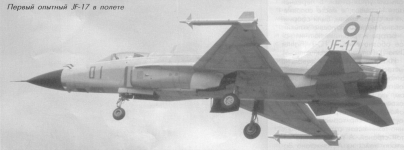
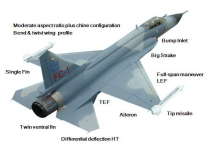
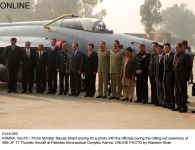
Super-7

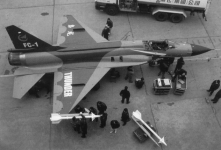
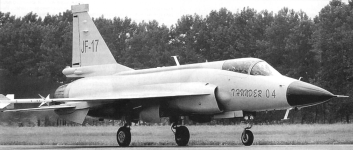
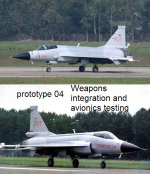
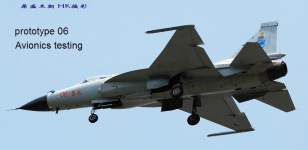
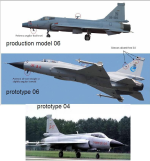
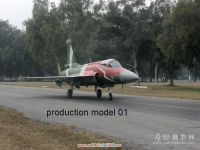
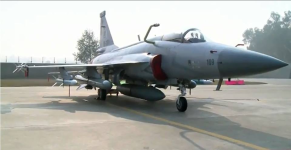
FC-1 prototype


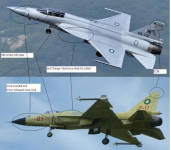
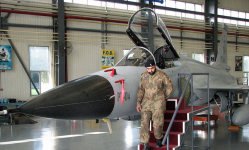
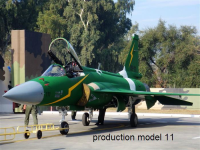
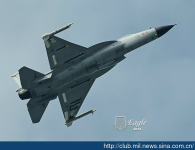
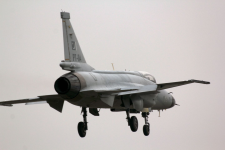
PAF JF-17 Thunder (Block-I)


The first batch of 50 aircraft in the Block-I variant were delivered to the PAF between 2008 and 2013. Production of further 50 aircraft in the improved Block-II variant reportedly began in early 2014.
Key Facts
Number in service 50 (Pakistani Air Force)
Designer Chengdu Aircraft Design Institute (611 Institute)
Manufacturer Chengdu Aircraft Industry Group (CAIG)
Pakistan Aeronautical Complex (PAC)
Maiden flight 25 August 2003
IOC 2008 (PAF)
Crew One
Role Air superiority / ground attack
Development History
The FC-1/JF-17 can trace its origin to the Super-7 programme initiated in 1989 by CAIG and U.S. aerospace company Grumman. The aim of the programme was to introduce a radically redesigned Chengdu J-7 (Mig-21 Fishbed-C) fitted with Western engine and avionics for the PLAAF as well as potential international customers. Grumman pulled out of the programme in late 1989 following the military technology boycott on China imposed by the U.S. government. CAIG resumed the development in 1991 under the revised Fighter China 1 programme.
In 1995, Pakistan in search for a replacement for its ageing Dassault Mirage III/5s, Chengdu F-7s and Nanchang Q-5s entered an initial agreement with China to jointly develop a modern multirole fighter aircraft. Russian Mikoyan also joined the development programme in the same year to provide design support and sent a team of engineers to CAIG to assist the development. Russia also agreed to supply the Klimov RD-93 turbofan jet engine to power the aircraft.
In 1999, China and Pakistan signed an official joint-development agreement, with each side sharing 50% of the total development cost. CAIG is the prime Chinese contractor for aircraft development and manufacture, while Pakistani Aeronautical Complex (PAC) is the main partner responsible for post-sale service and maintenance, as well as the production of some parts for the aircraft in Pakistan.
The first six prototypes were produced in 2003 and the aircraft made its maiden flight on 25 August 2003.
Super-7
FC-1 prototype
PAF JF-17 Thunder (Block-I)
Users who are viewing this thread
Total: 1 (members: 0, guests: 1)
Pakistan Defence Latest


Country Watch Latest
-

-

-
-
 Breaking: First F-47 Sixth-Gen Fighter Already Being Built, Expected to Fly in 2028 (3 Viewers)
- Latest: Yommie
-
Latest Posts
-
 Türkiye vs Israel - tensions, conflicts and rivalry | Latest News and Updates (6 Viewers)
- Latest: Eşbah
-

-
-
-
Chinese shipments of energy storage batteries outpace growth in EV batteries (3 Viewers)
- Latest: 冖_冖