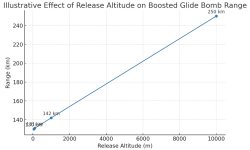
Azb 83 has a 250km range when powered by an engine.
Usually a booster gives the bomb a kick (altitude and/or speed), then the kit’s wings do the rest as an unpowered glide. They use a short rocket/solid motor that burns briefly to loft and accelerate the weapon. Boosted glide kits almost always use the booster for the initial phase, not continuous propulsion for the whole route.
In a simple steady glide the ideal horizontal distance ≈ altitude × Lift to Drag (so higher altitude or a higher L/D gives more range).
The booster increases the munition’s total mechanical energy (potential from altitude + kinetic from speed). More initial energy → more distance available for the gliding phase. The booster’s role is typically to raise the altitude and forward speed quickly so the glide kit starts from a high-energy state.
Higher release altitude = more potential energy to convert into horizontal travel (directly increases maximum glide distance).
Air density falls with altitude: that usually reduces aerodynamic drag, which helps range. (However lower density also reduces lift at a given indicated airspeed, so the vehicle must fly at a higher true airspeed to generate the same lift.)
In practice, for a fixed vehicle and flight Mach/airspeed limits, launching higher almost always increases unpowered range — assuming guidance and structural limits are respected.
Initial speed matters, too.
Higher initial forward speed (from the booster or from being released by a fast aircraft) provides extra kinetic energy that can be traded for distance. But aerodynamic drag rises with speed, so there are trade-offs and an optimal speed/trajectory for best range.
Assumptions (for the sake of example)
The AZB-83 LR max stand-off ~250 km occurs from an optimal high-altitude release (think ~10 km) plus the kit’s short booster and a decent wing (assume L/D ≈ 12).
A quick back-of-the-envelope model for range is:
> Range ≈ (L/D) × (effective height), where
effective height = release altitude + “equivalent altitude” added by the booster’s speed/loft.
Calibrating this model to hit 250 km at a 10 km release implies the booster contributes an “equivalent” ~10.8 km of height.
Worked examples:
1) Very low release: 100 m AGL (0.1 km)
Effective height ≈ 10.8 + 0.1 = 10.9 km
Range ≈ 12 × 10.9 ≈ ~131 km
(At 50 m AGL it’s ~130 km—basically the same, because most of the range here is coming from the booster’s added energy, not the tiny altitude.)
2) Moderate release: 1,000 m AGL (1.0 km)
Effective height ≈ 10.8 + 1.0 = 11.8 km
Range ≈ 12 × 11.8 ≈ ~142 km
Why the jump to 250 km at high altitude?
From ~10 km release, effective height ≈ 10.8 + 10 = 20.8 km → 12 × 20.8 ≈ ~250 km.
Higher altitude gives:
More potential energy to trade for distance,
Thinner air (less drag) during the early, long-range part of the glide,
If a boosted glide kit reaches ~250 km in ideal high-altitude conditions, the same kit released near the deck (50–100 m) might only manage ~130 km, and from 1,000 m roughly ~140 km, all else equal.
Real outcomes vary with winds, temperature, exact L/D, guidance/structural limits, and how the booster is flown.
These numbers are illustrative, not operational figures.