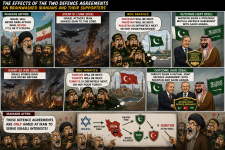
Turkey-Saudi Arabia-Pakistan joint defense agreement.
Lebanon's Prime Minister and President's visits to Turkey.
Egypt's Defense Minister's visit to Ankara.
Mahmoud Abbas's visit to Turkey.
Hakan Fidan's (East and West) Libya and Egypt visits.
Hakan Fidan's "radical steps" statement.
The picture is quite clear, isn't it?
Turkey is very active!
Last year, in February 2025, when President Recep Tayyip Erdoğan visited Pakistan, Najam Sethi sahib offered an interesting explanation for the visit.
According to Sethi's analysis at the time, Türkiye was preparing for a much more assertive role against Israel, with the objective of putting pressure on Israel over the genocide in Gaza and curbing what Ankara regarded as Israeli expansionist ambitions in the region.
Sethi argued that Türkiye believed Saudi Arabia and other Arab states were increasingly likely to move towards some form of recognition or accommodation with Israel. Ankara therefore feared that the Gulf Arab states could eventually pressure Pakistan to align itself with the prevailing Arab position on Israel.
In this interpretation, Erdoğan's visit to Pakistan was therefore not merely about bilateral relations. It was also intended to reassure the Pakistani leadership of Türkiye's support, explain Ankara's regional thinking and strengthen Pakistani support for Türkiye's emerging position.
That was Najam Sethi sahib's assessment at the time. In light of what happened afterwards, it is certainly worth revisiting.
Then came May 2025.
India and Pakistan entered their most serious military confrontation in years. The conflict demonstrated that the strategic and military balance in South Asia was no longer something that could simply be taken for granted. Pakistan's decisive victory over India had a profound effect on regional perceptions of the risks associated with any future Indian-Pakistani escalation.
Then, barely a month later, Israel launched its surprise attack on Iran on 13 June 2025.
The attack was not merely another episode in the long-running Israel-Iran confrontation. Israel struck Iranian nuclear and military targets, senior Iranian commanders were killed, and Iran's air-defence and strategic military vulnerabilities were exposed in a manner that shocked the region.
The combined effect of the May and June crises was to fundamentally alter the strategic environment of South, Central and West Asia.
And there was another development taking place in parallel.
Washington was increasingly placing greater emphasis on the Western Hemisphere, reviving the Monroe Doctrine framework and explicitly prioritising the defence of the American homeland and Western Hemisphere. At the same time, competition with China remained a major American strategic concern.
This does not mean that the United States was simply abandoning the Middle East or South Asia. It does, however, suggest that regional states had increasing reason to think about what their security architecture would look like if they could no longer assume that Washington would always be willing or able to provide the same degree of strategic protection.
And this is where the developments of 2025 and 2026 become particularly interesting.
Pakistan's victory over India, Israel's successful penetration of Iran's strategic defences, continuing uncertainty over America's long-term regional role, the strategic realignment between Türkiye, Saudi Arabia and Pakistan on one side, and Iran's strategic defeat and the weakening of its Terror Tentacles, as well as the enhanced and ever-growing strategic partnership between Israel and India on the other, have all contributed to a fundamental question:
If the existing security architecture is changing, who will provide security for the countries of the region?
The answer increasingly appears to be: the regional countries themselves.
And that brings us to the events of August 2026.


www.aljazeera.com