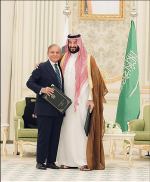
Interesting article, it covers off the fact that with all 3 pact members being US allies (to various degrees) it gives each of them more leeway in Washington, it also addresses some of the technical/interoperability issues we have discussed on here
Mecca Agreement gives Turkey new leverage and risk in equal measure
The collective defence commitment has evoked comparisons with Nato, but the three countries still face major political, operational and technological hurdles
A woman walks past armoured vehicles at the International Defence Industry Fair in Istanbul, 9 May 2017 (Yasin Akgul/AFP)
Fatma Menal Akın
Published date: 28 August 2026 09:40 BST | Last update: 26 mins 50 secs ago
The defence pact signed by
Turkey,
Saudi Arabia and
Pakistan, known for now as the
Mecca Agreement, has laid down a firm statement of political intent: to sharpen regional deterrence, and to put the burden of the region's security back in the hands of the region itself.
Yet the collective defence promise at the heart of the pact raises as many questions as it answers.
Its central clause, that an attack on one member is to be treated as an attack on all, has fuelled expectations that the three countries could build a Nato-style deterrent of their own.
But the structure is still in its infancy, and much remains unclear: how far it will hold up on the ground, how durable the political trust between the parties will prove, and how military, intelligence and technological capabilities are to be pooled.
For Turkey, the timing of the initiative, and the choice of partners, matter every bit as much as the agreement itself.
New MEE newsletter: Jerusalem Dispatch
Sign up to get the latest insights and analysis on
At a moment when the region's existing deterrents are wearing thin, when Washington's role in Middle Eastern security is being reopened for debate, and when tensions between
Israel and Turkey are taking on new dimensions, Ankara appears to be reaching for regional partnerships that widen its own security options.
Speaking to Turkish media after the signing, Foreign Minister Hakan Fidan
said the talks between Turkey, Saudi Arabia and Pakistan had been running for more than two years.
Years of instability, the widening theatres of conflict since 7 October 2023 and a security balance in the Red Sea that has come apart have made the search for a regional answer look all the more urgent.
Analysts suggest that what the pact offers Ankara, at least for now, is less a hard military guarantee than fresh diplomatic room to manoeuvre.
It is also expected to deepen Turkey's security ties with Saudi Arabia and to multiply its options across the region.
The flip side is that Ankara now faces the risk of being dragged into crises that are not its own, of stretching its military and industrial capacity past its limits, and of taking on commitments that sit awkwardly with its obligations inside Nato.
New bargaining chip
The security landscape that produced the agreement is one in which the regional order that the United States has spent years trying to build in the Middle East is under serious strain.
Washington's strategy rested largely on drawing Israel closer to the Gulf states, containing and deterring Iran, and gradually winding down its own direct military footprint in the region.
The Abraham Accords supplied the diplomatic scaffolding for that architecture, and the normalisation deal expected between Saudi Arabia and Israel was meant to be its keystone.
Mecca Agreement: A Muslim Nato or yet another Baghdad Pact?
Read More »
For Dr Yasir Atalan, deputy director at the Washington-based Center for Strategic and International Studies (CSIS), what lies behind the pact is the erosion of the region's deterrent mechanisms and a security balance that grows more brittle by the month.
In Atalan's reading, Turkey is looking for a new principal partner amid the deepening regional insecurity that followed the 7 October attack by Hamas and the war with Iran.
Building that partnership, however, means holding another balance: between Nato membership, relations with Washington and a security rivalry with Israel that is hardening by the day.
Turkey and Israel, Atalan says, increasingly see each other as a threat across a widening set of arenas with Syria, Cyprus, the Eastern Mediterranean and Somalia among them.
Atalan sees the United States acting as the referee in that contest, managing the friction between Turkey and Israel.
The partnership with Riyadh and Islamabad, he argues, could strengthen Ankara's hand and its bargaining power in Washington, while making it harder for Israel to isolate Turkey there.
That approach dovetails with the argument Ankara has been making for years: that the region should own its own security.
But Turkey's aim is probably less to step into America's shoes than to build relationships that keep Washington's Israel-centred policies from leaving it out in the cold.
Dr Betul Dogan-Akkas, who works on Gulf politics and regional security as deputy director of Ankara University's centre for Middle Eastern Studies and a faculty member in its international relations department, does not expect any of the three countries to strike out entirely on their own from Washington.
But she says the Israel-centred cast of US policy is pushing regional powers to work more closely with one another.
Why Riyadh and Islamabad?
Ankara's turn towards a new regional security arrangement matters, but so does the question of why Riyadh and Islamabad, of all capitals, emerged as the partners of choice.
Turkey's search for new avenues of cooperation against the region's uncertainties, without tearing up the alliances it already has, brought the three countries into the same security equation.
Why the Mecca Agreement has given the UAE-Israel alliance the jitters
Read More »
For Atalan, that choice is bound up with how the region's security environment has shifted in recent years. A United States inclined to pare back its commitments in the Middle East, the deepening insecurity since 7 October and the new equation thrown up by the war with Iran have all pushed Turkey to look for fresh partners.
Saudi Arabia, Atalan says, is seen in Ankara as a "principal partner", both for its weight in the Gulf and for the reach of its ties elsewhere in the region.
Pakistan emerges as the third leg of the structure thanks to its long-running military and defence relationship with Turkey and the security bonds it already maintains with Riyadh.
In Atalan's view, Turkey read the partnership as an opportunity within the new regional equation that took shape after the war with Iran. Whether the trio will widen its circle, though, is a matter of some disagreement.
One of the candidates Atalan points to is Egypt. Bringing Cairo in at a later stage, he suggests, could help turn the three-way partnership into something closer to a broader regional security framework.
Egypt's inclusion would stretch the structure's geographic reach along both the Eastern Mediterranean and the Red Sea.
Akkas is more cautious. Egypt may be among the first names raised whenever expansion comes up, she says, but "given its military structure and the security problems it would generate, it isn't actually the most rational partner".
Undefined edges
Because the trust between the parties has yet to be tested in the field, the limits of the security backing they could actually offer one another remain unclear.
Fidan's remarks suggest the parties are alive to the operational and political difficulties ahead. But for all the preparation and planning, the fact that strategic trust between the three, and their capacity to act as one, has never been put to the test is among the pact's biggest unknowns.
For Akkas, the real question is how much room the domestic politics of the three countries will leave for a long-term partnership.
'Playing with fire': Israel's Syria strike tests Turkey after Mecca defence pact
Read More »
The balance of political forces in Pakistan, whether Mohammed bin Salman ascends to the Saudi throne, and elections in Turkey are all, she notes, processes capable of testing the political will behind the arrangement.
Atalan, for his part, stresses that trust of this kind has to be proven over time, and that the limits of the security support the three could extend to one another have yet to come into focus.
For all the talk of security, the pact identifies no adversary and offers no definition of the threat it exists to counter.
What it does offer is a window onto Ankara's thinking; a deterrent posture, aimed at heading off dangers before they materialise.
That leaves an obvious question hanging: in the event of an actual attack, what would trigger the commitment, and how would it work?
Akkas draws attention to Fidan's choice of words: he spoke of a "common threat" rather than a common enemy.
"Naming an enemy points to a more aggressive posture," she says, "whereas drawing the boundaries of a threat describes an approach built around defence and deterrence."
Once that common threat is defined, she argues, it will become clearer who the pact is meant to protect and when it would be activated.
At this stage, she stresses, the agreement is not concerned with the small-scale attacks the region contends with day to day.
Layered regional equation
Managing the new partnership, though, leaves Turkey with a set of diplomatic sensitivities and risks to navigate.
Ankara has to keep its channels open with Iran, contain the scale of its confrontation with Israel, handle a delicate relationship with the UAE and meet Saudi expectations on security, all at once.
Not least because one reading now circulating in public debate holds that the pact amounts to a Sunni security axis aimed at Iran.
Fidan insists the agreement is not an offensive structure directed at any country, and that its purpose is to shore up regional stability and build mutual security and solidarity among the parties.
Is the Mecca Agreement Israel's worst nightmare come true?
Read More »
As he frames it, the alliance is less about targeting an outside actor than about members underwriting one another's security. Iran, he underlines, is not in its sights.
Atalan, too, argues against reading the pact as a sectarian bloc. What drives the region, in his view, is not sectarian dynamics but the national security calculations of the actors involved, their real capabilities and the geopolitics binding them together.
Seen in that light, the agreement reflects more than a mutual search for security among its signatories. It also captures Ankara's bid to take on a more active security role at a moment of deep regional uncertainty.
Even with the insistence that no country is being targeted, how this new security convergence is read against the region's existing balance of power remains a live question for Ankara.
Iran, in particular, is one of the actors Turkey both diverges from on regional files and works with, keeping diplomatic channels running throughout.
That leaves Ankara having to weigh the delicate balances in its relationship with Tehran as it develops the new partnership.
Akkas, though, says the parties will need to persuade Tehran that the agreement is not aimed at it.
With Israel and Iran locked in confrontation, that will be no easy task, and it stands as one of the Mecca Agreement's more serious tests.
Nor is Iran the only balance Ankara has to hold. As it builds the new security partnership, it must simultaneously manage its existing relationships inside the Gulf and the differing security outlooks it finds there.
Akkas points out that as Turkey deepens security cooperation with Saudi Arabia, it also has to preserve the equilibrium it has built with the UAE.
Abu Dhabi's purchase of an air defence system from Israel, she notes, has made the question of what constitutes a shared threat in the Gulf, and how security is perceived there, considerably more tangled.
Military planning and cooperation matter, she says, but so does the pact's diplomatic language, and the way it is explained to Western allies.
First test
Where the limits of this security commitment are drawn may well be settled by Saudi Arabia's own security and by the Red Sea-Bab al-Mandeb corridor, which looms as a proving ground.
A fresh crisis along that stretch of water could quickly become a shared security problem for the signatories.
Any disruption to maritime trade there would land not only on Riyadh, but directly on the security calculations of Turkey, which has both commercial and strategic interests running through the Red Sea.
How the Mecca Agreement aims to manage US separation from Middle East
Read More »
Should Houthi attacks on Saudi Arabia escalate again, Atalan says, the question of what exactly Turkey's commitment amounts to under the agreement would come to the fore, and that ambiguity is a test in its own right.
He stresses that the Houthis fight in a decentralised, fragmented fashion.
In a threat of that kind, he predicts, the classic security scenario of squaring off against a conventional actor simply would not apply and that, in itself, is a problem in waiting.
A similar tension surfaces in Yemen. Akkas notes that if Houthi attacks on Saudi Arabia flare up again, Ankara will want to honour the security commitment it has made to Riyadh while keeping clear of becoming a direct party to Yemen's chronic conflict.
Sending a message of deterrence is one thing. Being obliged to send troops when deterrence fails is quite another.
The pact's real credibility, Atalan says, will only become visible when a crisis of that sort actually arrives.
As Akkas puts it, how the common threat is defined will determine "in what circumstances, and for whom, the pact would be activated".
For Turkey, the deeper worry is being pulled into a new and open-ended military front in a theatre that poses it no direct threat.
Systems mismatch
Militarily and industrially, whether the pact can match its political ambition in the field depends on how far the parties can make their existing capabilities and systems work together.
Arda Mevlutoglu, a defence analyst and chief executive of Mergen Analytical Strategies, says the relationship between Turkey, Saudi Arabia and Pakistan has already moved beyond a conventional buyer-seller arrangement, but has yet to reach the level of a genuine multinational consortium along the lines of Eurofighter.
Saudi Arabia opposed Egypt's inclusion in Mecca agreement, sources say
Read More »
The most realistic model, at least to begin with, would be a Turkish-led programme architecture with Saudi and Pakistani industrial work packages settled by negotiation, Mevlutoglu says.
Turkey would bring the largest body of platform design and systems engineering know-how; Pakistan its engineering, integration and production experience; Saudi Arabia capital, procurement scale and industrial capacity. Repeated cooperation over time, he adds, could grow into something closer to a genuine consortium.
But shared ownership of technology is another matter: source codes, mission-system architecture, propulsion technology, radar algorithms, electronic warfare libraries and the division of export rights are among the far thornier issues standing between the three and genuine joint production.
Mevlutoglu would not measure the agreement's success by whether it turns into a "Middle Eastern Nato".
A more realistic architecture, he says, would combine strategic consultation, intelligence sharing, exercises, contingency planning, missile warning, air and maritime surveillance, industrial cooperation, and military support packages agreed in advance for specific crisis scenarios.
In air defence especially, he suggests a federated model would be the more workable route: each country keeping its own sovereign network, with certain data and early-warning feeds shared across controlled links.
Operational risks
One of the biggest technical hurdles to the pact is the mismatch between the weapons and command systems the three countries use.
On paper, Turkey's platform development capacity, Pakistan's experience in fighter production and integration, and Saudi financial power fit neatly together.
But finding the money is not the same thing as speeding the programme up.
Mecca agreement: Why Saudi Arabia, Turkey and Pakistan teamed up
Read More »
Turkey's military infrastructure is built to Nato standards. Saudi Arabia relies largely on American and other Western systems. Pakistan's inventory is a patchwork of American, European, Chinese and domestically produced equipment.
Past a certain point, Mevlutoglu says, it is engineering integration that sets the critical path, and everything turns on the shape Saudi participation takes.
The three countries have the potential to build a broader industrial base between them, he says, but full independence in fighter jet engines, advanced microelectronics and specialist materials is likely to take a decade or longer.
Turning political will into a functioning security mechanism depends on clearing away the ambiguities that remain, and on establishing how far the parties can actually act together on technology and intelligence sharing, training, exercises, defence industry and finance.
The agreement's true limits, though, will only emerge in the face of shifting regional threats, and above all in how the three behave during the first serious crisis or attack.
Whether the Mecca Agreement can become something more than a political declaration will, in large part, be answered there.
The collective defence commitment has evoked comparisons with Nato, but the three countries still face major political, operational and technological hurdles

www.middleeasteye.net