Navigation
Install the app
How to install the app on iOS
Follow along with the video below to see how to install our site as a web app on your home screen.
Note: This feature may not be available in some browsers.
More options
Style variation
You are using an out of date browser. It may not display this or other websites correctly.
You should upgrade or use an alternative browser.
You should upgrade or use an alternative browser.
Just a Nice Pic
- Thread starter Fatman17
- Start date
More options
Who Replied?



Falcon26
Trusted Member

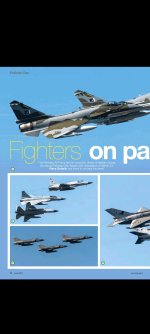
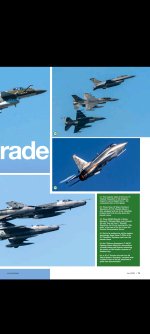
The tail signs on this planes are amazing, especially the red circle. Wonder why the PAF hasn’t revived these.

Fatman17
THINK TANK: CONSULTANT
- Thread starter
- #260
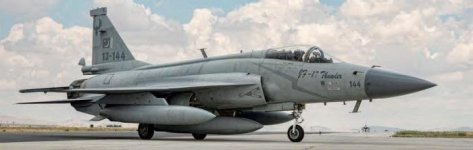
The JF-17 Thunder made its first appearance at Anatolian Eagle, a NATO exercise, with a contingent at Konya from Samungli-based 28 Squadron ‘Phoenix’, the latest unit to equip with the type which stood-up on February 28, 2018. Note this Block 1 aircraft is fitted with three large fuel tanks, normally only used for ferry flights.
Fatman17
THINK TANK: CONSULTANT
- Thread starter
- #261
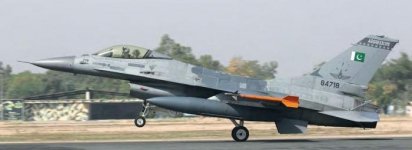
A FIFTH Pakistan Air Force F-16 squadron was formed earlier this year at PAF Base Mushaf in Sargodha. As evidenced by the tail markings on F-16A serial 84718, 29 Squadron is an aggressor squadron operated by the co-located Airpower Centre of Excellence (ACE). However, the unit also has a combat role and is believed to have played a major part in Operation Swift Retort, when the PAF responded to an Indian Air Force attack on February 27.
Fatman17
THINK TANK: CONSULTANT
- Thread starter
- #262
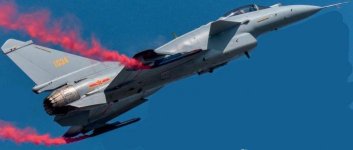
A Chinese-made J-10B powered by a thrust-vectoring version of the indigenous WS-10 engine is put through its paces at last year’s China International Aviation & Aerospace Exhibition at Zhuhai. Although the J-10 should be an attractive proposition for foreign customers seeking to avoid reliance on Western manufacturers, it has yet to win any export orders. Katsuhiko Tokunaga
Until 2022.
Fatman17
THINK TANK: CONSULTANT
- Thread starter
- #263
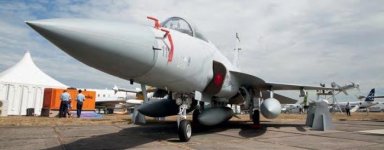
In an effort to bring its JF-17 to a wider market, the Pakistan Aeronautical Complex displayed the multi-role fi ghter at the Farnborough International Airshow in 2010. Since then the Thunder has been delivered to Myanmar, and Nigeria and lraq, Azerbaijan and Zimbabwe are also expected to be potential buyers. Jamie Hunter
Fatman17
THINK TANK: CONSULTANT
- Thread starter
- #264
ITAR
When the US does agree to export sensitive systems, such as F-16s, there is often some kind of trade-off. It usually leads to another form of control – the Communications Interoperability and Security Memorandum of Agreement (CISMOA) – under which the US military maintains a presence at the jet’s base. This ensures no unauthorised individuals gain access to F-16 technologies. Egypt and Pakistan both operate F-16s and have also come under US sanctions in recent years – Egypt in the wake of the 2013 coup, and Pakistan due to conflicts with India and for not signing the Non- Proliferation Treaty in 1990. Pakistan suffered particularly badly in the 1965 war with India when its fleet of US jets was grounded by a lack of spares. It led to the Pakistan Air Force turning towards China and this approach has continued ever since. The closeness of China- Pakistan relations and the threat of terrorism in the country means the US government strictly controls access to the PAF’s F-16s.
Faced by US sanctions, Pakistan has developed the JF-17 Thunder multi-role fighter with China. This now swells the PAF’s fighter ranks and, unlike the F-16, will never be subject to US sanctions.
When the US does agree to export sensitive systems, such as F-16s, there is often some kind of trade-off. It usually leads to another form of control – the Communications Interoperability and Security Memorandum of Agreement (CISMOA) – under which the US military maintains a presence at the jet’s base. This ensures no unauthorised individuals gain access to F-16 technologies. Egypt and Pakistan both operate F-16s and have also come under US sanctions in recent years – Egypt in the wake of the 2013 coup, and Pakistan due to conflicts with India and for not signing the Non- Proliferation Treaty in 1990. Pakistan suffered particularly badly in the 1965 war with India when its fleet of US jets was grounded by a lack of spares. It led to the Pakistan Air Force turning towards China and this approach has continued ever since. The closeness of China- Pakistan relations and the threat of terrorism in the country means the US government strictly controls access to the PAF’s F-16s.
Faced by US sanctions, Pakistan has developed the JF-17 Thunder multi-role fighter with China. This now swells the PAF’s fighter ranks and, unlike the F-16, will never be subject to US sanctions.
Fatman17
THINK TANK: CONSULTANT
- Thread starter
- #265
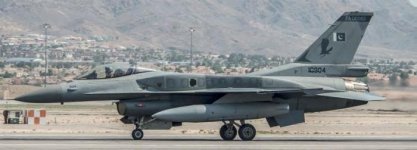
Pakistan Air Force F-16C Block 52 serial 10904 assigned to 5 Squadron prepares for take-off at Nellis Air Force Base, Nevada during Exercise Red Flag 16-4. The ‘Viper’ provides the PAF with a highly capable multi-role warplane, albeit one subject to ITAR restrictions and vulnerable to sanctions. USAF/Tech Sgt Frank Miller
Fatman17
THINK TANK: CONSULTANT
- Thread starter
- #267
PHOTO SHOOT AT THE TOP OF THE WORLD
- Aviation Features
- PHOTO SHOOT AT THE TOP OF THE WORLD
20th September 2018
FEATURE
In the first of an occasional series, former RAF photographer Warrant Officer Rick Brewell (ret’d) gives behind the scenes insights into what was required to capture the stunning images he took. This article details one of the more unusual photo shoots from his 39-year service career.

A bubble window on the port side near the front of the aircraft was opened so I could get my shots. A North Pole image featured in the RAF calendar and others appeared in various publications.
All photos WO Rick Brewell (ret’d)/MOD
In May 1992 two nuclear-powered submarines HMS Trenchant and USS Spadefish were set to break through the ice at the North Pole and rendezvous with two RAF Nimrods involved in a navigation training mission. Because compasses don’t work very well as you near the magnetic pole, the aircrews were to practise other means of navigation in this featureless and inhospitable place – the proximity of the subs provided a unique photo opportunity that I was tasked to capture.
The initial plan was for us air force guys to spend the first night at Thule AB in Greenland and then make the trip to the North Pole the next day. However, Thule was experiencing white-out conditions with drifting snow, so the night-stop was changed to Andøya AB on the northernmost island in the Vesterålen archipelago. After departing RAF Kinloss, Moray, we landed at the Norwegian base in the late afternoon of May 6; both aircraft were then prepped for an early morning departure. Although we were taking off from near the top of Norway we were still facing a roundtrip of almost 3,000 miles (4,828km), plus the additional time on ‘target’ at the North Pole.
MASTER LENSMAN
Rick Brewell joined the RAF at the age of 16 in 1971 and served for 39 years as an photographer. He undertook numerous air-to-air photoshoots over 15 years in this, the most challenging realm of aviation photography. On shoots he accumulated just under 2,600 hours in the air of which 788 were in fast jets. He was the man behind many of the iconic RAF images from yesteryear.

Rick Brewell in the cockpit of a Tornado F3 during one of the many photoshoots he took part in.
Before departing from Kinloss I had briefed the Nimrod crews (one each from 120 Sqn and 206 Sqn) that I wanted both aircraft to fly in close formation low over the submarines, and went through the different compositions I was looking for. I opted for my favourite lens for air-to-air – the standard 80mm for the Hasselblad (the equivalent of about 55mm on a 35mm camera). I have always thought the best photograph is achieved in the air by bringing the subject close to you rather than employing large telephoto lenses.
I had to determine where I needed to position myself in the cabin so that I could frame the other Nimrod with the submarines in the same shot. I opted for the front port side window as it was well in front of the wing’s leading edge and had a reasonable vantage point. However, this was the large convex bubble window that an observer would place his head inside, giving him an exceptional view all around including underneath the aircraft as well as forward and aft along the fuselage. It was ideal for a search and rescue mission, but when I tried to focus through it, the effect was like having another lens on the front of the camera. As I looked through my viewfinder towards the horizon or infinity, the focusing ring on the lens, registered only 8ft (2.5m). I explained my predicament to one of the rear cabin operators but fortunately it wasn’t going to be a problem because once on ‘target’, they would open the window for me. He explained that I would be strapped into a seat that slid diagonally to and from the window and could be locked in position.
I decided to dispense with the lens hood for fear that it might detach in the wind turbulence – the last thing you want to see is it disappearing straight down an engine intake!
RENDEZVOUS
We were about an hour away from the rendezvous when our aircraft’s captain announced that a US Navy P-3 Orion was heading to the same spot from northern Canada. With 15 minutes to go, the crew were instructed by the captain to position themselves at a window and keep their eyes peeled for the two submarines. Ten minutes later he told everyone to stand down as he had spotted them directly ahead. By this time, we had dropped down to 400ft and the ice below was zipping past quickly. We arrived at the North Pole before the P-3 and performed the initial flypast directly over the submarines, then positioned our two aircraft in the first formation briefed for the photographic part of the sortie.
I was strapped into the sliding chair and the window/porthole was opened. I was amazed to find that although flying at about 300kts no wind entered the cabin and there was very little additional noise. My first thought was to get the relatively easy shot of the Nimrod in close formation with us while positioned a good distance from the submarines. By doing this at least I could be confident the event had been recorded. Once that shot was in the bag, I requested over my personal communications headset that the other Nimrod fly low over the subs while we positioned ourselves about half a mile away. As we proceeded through my planned formations we finally got to what would be the most taxing one. I wanted the subject Nimrod to manoeuvre into a fairly tight echelon – close to our left, slightly back and a little higher. A problem soon presented itself, my viewpoint was only looking directly out at the other aircraft, what I could not see or predict was when the submarines were to come into view (and I would hopefully frame). It was quickly agreed the captain would give me a countdown over the radio when he thought the nose of our aircraft would be in line with the vessels and that was when I would hit the shutter release. With both aircraft so low, the submarines flashed past in a fraction of a second. It was made even more tricky because the mirror inside the Hasselblad (as is the case with many cameras) pops up and you can’t actually see through the lens at the critical moment. So, although I was fairly confident I had achieved what I had intended, you never completely know what you have until the film is processed. It’s different nowadays of course, with digital cameras you can check what you have captured straightaway.


Here’s a little tip for estimating camera exposure, particularly with snow in the background or fluffy white clouds – however bright it may seem to you, don’t be tempted to close down the aperture or select a faster shutter speed. The reflective light from your subject is no brighter than if it was sitting on grass on a sunny day, so stick to the same exposure you would use in that situation.
We made more passes over the submarines than I was expecting, so I was confident that I had plenty of good photographs to cover this extraordinary event. After explaining that to the captain we headed back toward Andøya for another overnight stay.
I was invited up to the flight deck during the return journey to chat with the captain and cockpit crew about how the whole assignment had come together. I told them how much I appreciated the tremendous co-operation of both pilots in positioning their aircraft in the right place at the right time.
UNEXPECTED OPPORTUNITY
The next morning, as we boarded our Nimrod at Andøya, one of the pilots suggested there would be another great photo opportunity to capture the other Nimrod against the stunning Norwegian coastline. The rugged shoreline and characterful fishing villages are so picturesque – it was just too good a chance to miss. Shortly after taking off I was being strapped into the seat next to the porthole window which was opened again. Having shot the other Nimrod from various heights along the coast I asked if we could both be put into a 360° orbit while staying in close formation to capture the aircraft from a different perspective. As our angle of bank increased during the turn, I was able to get the topside of the other aircraft at a three-quarter viewpoint. It was just sheer luck that as we made the turn a colourful little fishing village came into the frame. Click! Of all the other shots I took this day this is my favourite. With our ‘mission’ complete, we climbed to 32,000ft for the transit back to RAF Kinloss.

The Nimrod flying along the coast of Norway with a dramatic backdrop.

Fatman17
THINK TANK: CONSULTANT
- Thread starter
- #268
I wasn’t able to release any photos from this shoot for a couple of weeks, so that the subs had time to disperse and wouldn’t be located by the Russians.
An informal certificate was produced for all the crew to mark their involvement in the flight to the North Pole and I was delighted when one arrived with my post shortly after I got back to London.


On the return trip one of the Nimrod crew suggested the picturesque coastline south of Andøya AB would provide a stunning backdrop for photos. This is my favourite shot from the sequence.

An informal certificate was produced for all the crew to mark their involvement in the flight to the North Pole and I was delighted when one arrived with my post shortly after I got back to London.
On the return trip one of the Nimrod crew suggested the picturesque coastline south of Andøya AB would provide a stunning backdrop for photos. This is my favourite shot from the sequence.
Originally published in Aviation News Magazine
Fatman17
THINK TANK: CONSULTANT
- Thread starter
- #270
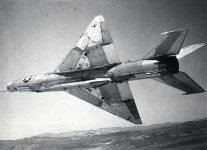
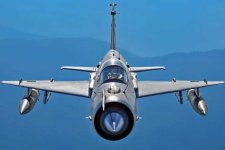
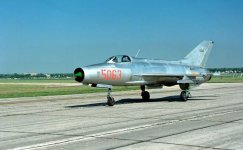
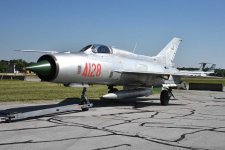
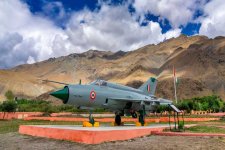
MiG-21 Fighter Jets
BYDR. OMAR MEMONThe type remains in service nearly 70 years after its first flight.
Users who are viewing this thread
Total: 3 (members: 1, guests: 2)


