Navigation
Install the app
How to install the app on iOS
Follow along with the video below to see how to install our site as a web app on your home screen.
Note: This feature may not be available in some browsers.
More options
Style variation
You are using an out of date browser. It may not display this or other websites correctly.
You should upgrade or use an alternative browser.
You should upgrade or use an alternative browser.
Lebanon-Israel War | 2023-present
- Thread starter Persian Gulf
- Start date
More options
Who Replied?

The SC
INT'L MOD
#Urgent | Islamic Resistance Operations Room:
The Israeli enemy was unable to completely occupy any village in southern #Lebanon.
- We destroyed 28 Merkava tanks, 4 military bulldozers, an armored vehicle, and a troop carrier.
The total number of enemy losses amounted to more than 70 killed and 600 wounded among its officers and soldiers.
The Israeli enemy was unable to completely occupy any village in southern #Lebanon.
- We destroyed 28 Merkava tanks, 4 military bulldozers, an armored vehicle, and a troop carrier.
The total number of enemy losses amounted to more than 70 killed and 600 wounded among its officers and soldiers.
Shags202
Trusted Member


#Hezbollah: We were bombed with quality missiles from the Tai Military Industries Company on the outskirts of Tel Aviv.
Ta’as just in case anyone decides to look it up things are sometimes loss in translation.Great hit it shows that they have been expending grads greatly and israeli defenses are weakening by the hour.


The history of conflict between Hezbollah and Israel
Killing of Hezbollah leader Hassan Nasrallah is the latest salvo in a decades-long battle.The conflict between Hezbollah and Israel – which have been exchanging fire across the border of Israel and Lebanon since the start of the war on Gaza last October – has descended into “war”, Al Jazeera’s Zeina Khodr has reported from Beirut.

Hezbollah confirmed that its leader, Hassan Nasrallah, had been killed in an Israeli air strike on residential buildings in Beirut, which Israel claimed were above Hezbollah’s headquarters, on the night of Friday, September 27. Ali Karki, the commander of Hezbollah’s southern front, and other Hezbollah commanders, were also killed in the massive air attack on Beirut’s southern suburb of Dahiyeh on Friday, the Israeli military claimed.
On Saturday, Israel’s military said jet fighters had also attacked “dozens” of Hezbollah targets in the Bekaa Valley and various areas of southern Lebanon and the attacks are continuing.
The conflict has escalated severely since September 17, when some 2,800 people in Lebanon were injured when their pager devices exploded. At least nine people were killed, among them three children.
Most of the people injured in that attack were members of Hezbollah, which blamed the attack on Israel.
Hezbollah has been trading attacks across the southern Lebanese border with Israel for nearly a year, since October 8 when it began its attacks to deter Israel from its war on Gaza, which has killed at least 41,500 people.
Israel has returned fire, escalating and slowing in turn against one of the region’s most experienced nongovernmental fighting groups, which is well-armed and battle-tested against it.
The conflict between the two is not new, rather it goes back nearly half a century.

The history of conflict between Hezbollah and Israel
Killing of Hezbollah leader Hassan Nasrallah is the latest salvo in a decades-long battle.
Last edited:
it was expected that the war between Israel and Arab region would be short timed so it might be favour of Israel. might be, not sure......
but as of now, Israel couldn't score much during this time period. and we would say, the ongoing long term war would be in favour of opponents of Israel......
Israel won't be able to maintain its stand/positions on war if this war goes for a long term war. .... Israel won't able to win over its Arab rivals is the war goes for longer

ghazi52
THINK TANK: CONSULTANT

‘The whole city shook’ after Israel pounded ancient Tyre
AFPOctober 24, 2024

Smoke billows over the Unesco-listed port city of Tyre after Israeli strikes, amid the ongoing hostilities between Hezbollah and Israeli forces, southern Lebanon October 23, 2024. — Reuters
https://whatsapp.com/channel/0029VaMc238IiRov8okfYy3n
TYRE: Israeli strikes on Wednesday pounded Lebanon’s Tyre, an ancient coastal city which boasts a Unesco World Heritage site, leaving swathes of its centre in ruins.
The raids, among the worst since the start of the Israel-Hezbollah war last month, hit the “heart of Tyre”, said Rana, a resident who asked to only use her first name over security concerns. “The whole city shook,” said Rana, after fleeing to the seafront following an Israeli military warning for people to evacuate much of Tyre’s centre in the morning.
Thick black plumes of smoke were seen rising from several neighbourhoods, with parts of the evacuation area just 500 metres (yards) from the city’s ancient ruins.
The strikes caused “massive destruction and serious damage to homes, infrastructure, buildings, shops and cars,” said the official National News Agency. Footage showed entire neighbourhoods buried under rubble.
The Israeli army struck “command and control complexes of various Hezbollah units”, according to a post from the military’s Arabic-language spokesman, Avichay Adraee, on social media platform X.City witnesses exodus as people began to escape amid evacuation orders from the Israeli army
Bilal Kashmar of Tyre’s disaster management unit said seven building were completely levelled and more than 400 apartments in their vicinity damaged in the strikes. Four streets were completely blocked by debris, he said, adding that at least two people were left wounded after most residents fled.
Fresh exodus
Before Hezbollah and Israel started trading fire over the border last year, at least 50,000 people lived in Tyre, a vibrant city home to both Christians and Muslims. The city was emptied of most of its population when Israel’s heavy bombardment began last month. Only 14,500 remained there on Tuesday, Kashamr said.
But the city saw a fresh exodus on Wednesday as people began to escape immediately after the Israeli army issued an evacuation warning for four neighbourhoods at 8am.
Emergency teams drove around the city, urging people to evacuate over megaphones, a video journalist said. Photographer in the city of Sidon, further north, saw dozens of cars on the coastal highway filled with families carrying mattresses, suitcases and clothes.
“Some families, who had not left the city of Tyre before, began leaving their homes to stay clear of areas that the Israeli enemy threatened to target,” NNA said. Civil defence teams helped transport elderly people and people with limited mobility “to safe areas”, the NNA added.
ghazi52
THINK TANK: CONSULTANT
Antique city
The Risala Scouts, rescuers affiliated with Hezbollah ally Amal, deployed ambulances to targeted areas to transport wounded civilians to nearby hospitals. “We are working on providing alternative housing with municipalities,” said Rabih Issa, an official with the organisation.
Tyre is one of the oldest continuously inhabited cities in the world. It is home to important archaeological sites, mainly from Roman times. Kashmar of Tyre’s disaster management unit said there has yet to be a damage assessment for heritage sites.
However, “damage is possible,” he said, explaining that one strike hit less than 50 metres away from one of the city’s ruins.
Unesco said it was “closely following the impact of the ongoing conflict on the World Heritage site of Tyre” using remote sensing tools and satellite imagery.
On Sep 23, Israel launched an intensive air campaign in Lebanon, after almost a year of cross-border exchanges with Hezbollah over the Gaza conflict. Since then, at least 1,552 people have been killed in Israeli strikes on Lebanon, according to a tally of health ministry figures, although the real number is likely to be higher due to data gaps.
The Risala Scouts, rescuers affiliated with Hezbollah ally Amal, deployed ambulances to targeted areas to transport wounded civilians to nearby hospitals. “We are working on providing alternative housing with municipalities,” said Rabih Issa, an official with the organisation.
Tyre is one of the oldest continuously inhabited cities in the world. It is home to important archaeological sites, mainly from Roman times. Kashmar of Tyre’s disaster management unit said there has yet to be a damage assessment for heritage sites.
However, “damage is possible,” he said, explaining that one strike hit less than 50 metres away from one of the city’s ruins.
Unesco said it was “closely following the impact of the ongoing conflict on the World Heritage site of Tyre” using remote sensing tools and satellite imagery.
On Sep 23, Israel launched an intensive air campaign in Lebanon, after almost a year of cross-border exchanges with Hezbollah over the Gaza conflict. Since then, at least 1,552 people have been killed in Israeli strikes on Lebanon, according to a tally of health ministry figures, although the real number is likely to be higher due to data gaps.
ghazi52
THINK TANK: CONSULTANT
Lebanon: Satellite imagery reveals intensity of Israeli bombing
Ahmed Nour & Erwan Rivault
BBC Arabic & BBC Visual Journalism
Getty Images
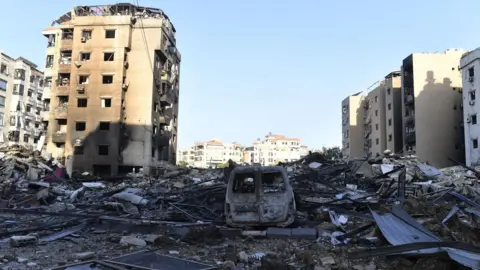
Damaged buildings in a residential area following an Israeli attack on Dahieh suburb in Beirut
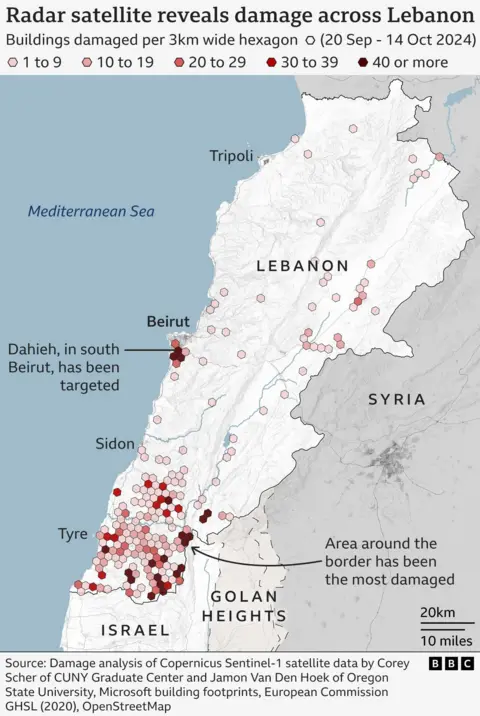
Israel's intensified bombing campaign of Lebanon has caused more damage to buildings in two weeks than occurred during a year of cross-border fighting with Hezbollah, according to satellite-based radar data assessed by the BBC.
Data shows that more than 3,600 buildings in Lebanon appear to have been damaged or destroyed between 2 and 14 October 2024. This represents about 54% of the total estimated damage since cross-border hostilities between Israel and Hezbollah broke out just over a year ago.
The damage data was gathered by Corey Scher of City University of New York and Jamon Van Den Hoek of Oregon State University. They compared radar satellite images to reveal sudden changes in the height or structure of buildings which indicate damage.
Wim Zwijnenburg, an environmental expert from the Pax for Peace organisation, reviewed the satellite-based radar data and warned of the impact of Israel’s bombing.
“The Israeli military campaign seems to be creating a ‘dead zone’ in the south of Lebanon to drive out the population, and making it difficult for Hezbollah to re-establish positions, at the cost of the civilian population,” he said.
Cross-border hostilities between Israel and Hezbollah broke out after the armed Lebanese group started firing rockets in and around northern Israel in support of Palestinians on 8 October 2023, the day after its ally Hamas’s deadly attack on southern Israel.
Israel invaded southern Lebanon in a dramatic escalation on 30 September to destroy, it said, Hezbollah weapons and infrastructure in “limited, localised, targeted raids”.
Satellite photos, radar imagery, and military records show recent Israeli bombardment in Lebanon has focused on the southern border region. It has also expanded to central and northern areas, including the Bekaa Valley and Beirut's southern suburbs.
The Israeli army said it hit thousands of Hezbollah targets across Lebanon, including the capital, Beirut.
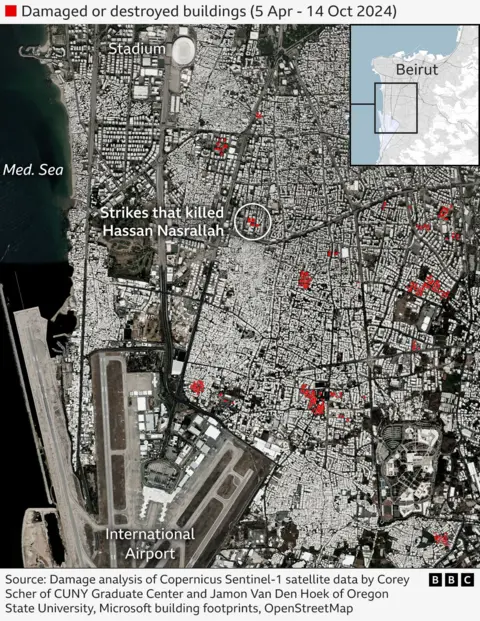
Most of the strikes on Beirut have targeted Dahieh, a southern suburb that is home to thousands of civilians. The Israeli military claims the area is home to Hezbollah’s command headquarters.
A series of Israeli strikes on buildings in the area killed Hezbollah's leader Hassan Nasrallah on 27 September.
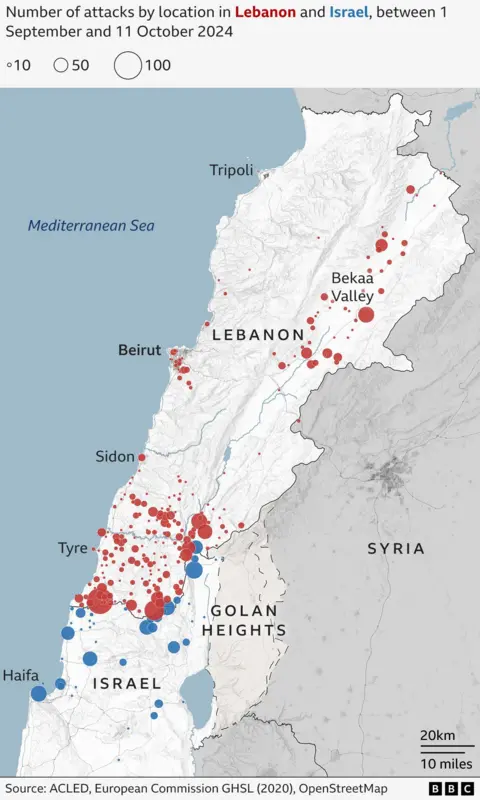
Separate data from the US-based Armed Conflict Location and Event Data Project (Acled), which has been analysed by the BBC, indicates at least 2,700 attacks by the Israeli military on Lebanese areas from 1 September until 11 October 2024. While these attacks primarily focus on southern border areas, they have also extended to northern and central regions.
Hezbollah has carried out around 540 attacks against Israel in the same timeframe, according to Acled. Each Hezbollah attack can include a barrage of rockets, missiles and drones.
ghazi52
THINK TANK: CONSULTANT
.
The Israeli military says air strikes in Lebanon are targeting Hezbollah infrastructure.
It regularly adds it wants to ensure the safe return of tens of thousands of residents of Israeli border areas displaced by attacks from the Iran-backed group.
About 60,000 people have been evacuated from northern Israel because of near-daily attacks by Hezbollah. But some rockets have reached further south and damaged homes in and around the coastal city of Haifa.
On the Lebanese side, many Israeli air strikes targeted the city of Tyre, the Bekaa Valley, and Beirut, according to the BBC’s analysis of the latest monthly data collected by Acled.
Lebanon's government says up to 1.3 million people have been internally displaced, whilst Prime Minister Najib Mikati warned of the "largest displacement” in the country's history.
The Israel Defense Forces (IDF) has been issuing evacuation orders to residents across the country, including areas of Beirut.
In the south, the army instructed residents of several villages to leave their homes and "immediately head north of the Awali River," which meets the coast about 50 km (30 miles) from the Israeli border.
“This is a humanitarian catastrophe,” Gabriel Karlsson, Middle East Manager at the British Red Cross in Beirut, told the BBC.
He said there are insufficient shelters to accommodate so many evacuees.
“I saw children sleeping in the streets,” Karlsson added, urging humanitarian organisations to coordinate their efforts to address the escalating crisis.
Lebanese officials say at least 2,350 have been killed and over 10,000 injured in Israeli attacks. The Lebanon health minister said many casualties were civilians.
On the Israeli side, 60 people have been killed and more than 570 wounded by Hezbollah attacks, Israeli authorities say.
“Collateral damage is inevitable in war”, Amos Yadlin, the former head of Israeli military intelligence, told the BBC.
The retired major-general blamed Hezbollah for the war and claimed Israel’s ground offensive would force the group out from the border areas.
Zwijnenburg, from the Pax for Peace organisation, however, has warned of the impact of Israel’s military campaign on civilians and the populated areas.
“The heavy blast radius kills and maims civilians nearby”, he said, in reference to Israeli air strikes.
“Open-source data combined with satellite imagery also showed that civilian infrastructure such as irrigation channels, gas stations and electricity grids were damaged, which is worsening the humanitarian situation,” he added.
Additional reporting by Paul Cusiac and Maria Rashed
The Israeli military says air strikes in Lebanon are targeting Hezbollah infrastructure.
It regularly adds it wants to ensure the safe return of tens of thousands of residents of Israeli border areas displaced by attacks from the Iran-backed group.
About 60,000 people have been evacuated from northern Israel because of near-daily attacks by Hezbollah. But some rockets have reached further south and damaged homes in and around the coastal city of Haifa.
On the Lebanese side, many Israeli air strikes targeted the city of Tyre, the Bekaa Valley, and Beirut, according to the BBC’s analysis of the latest monthly data collected by Acled.
Lebanon's government says up to 1.3 million people have been internally displaced, whilst Prime Minister Najib Mikati warned of the "largest displacement” in the country's history.
The Israel Defense Forces (IDF) has been issuing evacuation orders to residents across the country, including areas of Beirut.
In the south, the army instructed residents of several villages to leave their homes and "immediately head north of the Awali River," which meets the coast about 50 km (30 miles) from the Israeli border.
“This is a humanitarian catastrophe,” Gabriel Karlsson, Middle East Manager at the British Red Cross in Beirut, told the BBC.
He said there are insufficient shelters to accommodate so many evacuees.
“I saw children sleeping in the streets,” Karlsson added, urging humanitarian organisations to coordinate their efforts to address the escalating crisis.
Lebanese officials say at least 2,350 have been killed and over 10,000 injured in Israeli attacks. The Lebanon health minister said many casualties were civilians.
On the Israeli side, 60 people have been killed and more than 570 wounded by Hezbollah attacks, Israeli authorities say.
“Collateral damage is inevitable in war”, Amos Yadlin, the former head of Israeli military intelligence, told the BBC.
The retired major-general blamed Hezbollah for the war and claimed Israel’s ground offensive would force the group out from the border areas.
Zwijnenburg, from the Pax for Peace organisation, however, has warned of the impact of Israel’s military campaign on civilians and the populated areas.
“The heavy blast radius kills and maims civilians nearby”, he said, in reference to Israeli air strikes.
“Open-source data combined with satellite imagery also showed that civilian infrastructure such as irrigation channels, gas stations and electricity grids were damaged, which is worsening the humanitarian situation,” he added.
Additional reporting by Paul Cusiac and Maria Rashed


Flotilla
Trusted Member

No, it is impossible. You must be kidding. Do you have any link to that?. Hey let us laugh a bit in the middle of misery!.Do you want to hear something cute?
Israel has sent a message they have achieved their goal in Lebanon and they are ready for peace talks.
Little cute kitties. They don’t know yet

Alter_Ego
Registered Member


Unfortunately its the only way to make Israel stop its agression.
I dont like civillians being killed, even if they are Israelis or Zionists. Targeting industrial buildings during nighttime could be an answer to that.
Users who are viewing this thread
Total: 7 (members: 0, guests: 7)


