Muhammad Ali Jinnah - The Great Leader

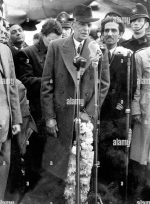
1772312029651.png


Muhammad Ali Jinnah (president Muslim League) speaking probably to the press on his arrival at London Airport.
Must be a big gathering as he is using a microphone.
Courtesy: Alamy
 
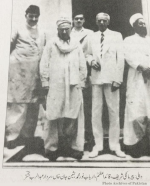
1772312104357.png

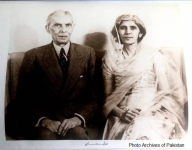
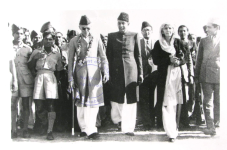
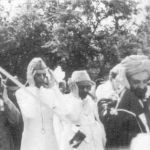
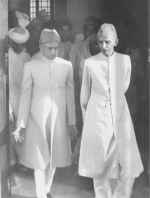
Jinnah, Sir Feroz Khan Noon and Miss Fatima Jinnah with other dignitaries.
 
1772312155845.png


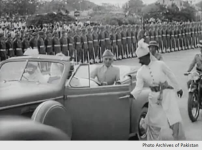
A memorable moment in the history of Pakistan.
Quaid-e-Azam arrives at the constituent Assembly of Pakistan in Karachi.
Date: 1947
 
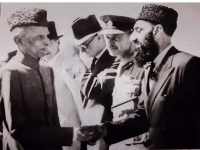
1772312237388.png


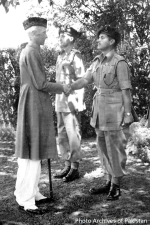
Quaid-i-Azam Muhammad Ali Jinnah shaking hands with Captain Muhammad Akbar Hussain, Adjutant 6th Punjab Regiment, Peshawar.
Date: April 1948.
 
1772312282098.png


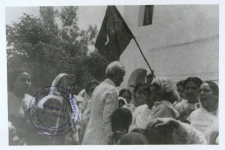
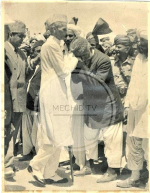
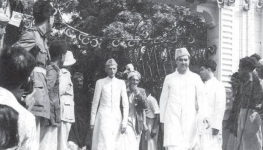
Quaid-e-Azam Muhammad Ali Jinnah is being greeted in Quetta. Qazi Essa is behind the Quaid.
 
1774201588999.png


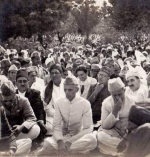
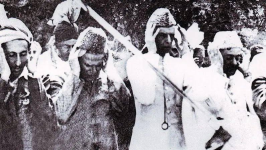
First Eid-ul-Fitr After Independence 1947

First of all, Eid Mubarak to all group members including Admin Sahib.
May Allah grant thousands of such happiness of Eid to all of us, the entire world of humanity, the Islamic world and especially the oppressed Palestinians in the form of freedom. Amen.

When Pakistan came into existence, that day was 27th of Ramadan, Thursday, and 4 days later on Monday, 18th August, 1947 the first Eid-ul-Fitr was celebrated with utmost simplicity due to the population and difficulties of the refugees.

The main gathering of Eid prayers was held in the Eid Gah Maidan located in front of Jamia Cloth Market on Bandar Road. It was led by Maulana Zahoor ul Hasan Daras, who was once a member of the All India Muslim League and later elected President of the Muslim League Sindh. And Quaid-e-Azam was also called the brave friend of Sindh.

It is said that the Quaid-e-Azam was late to reach the Eid place, even though it was time for prayer, on which the worshippers requested Maulana Zahoor-ul-Hassan Daras to wait for a while so that the Quaid e-Azam could participate in the prayer.

Maulana Zahoor-ul-Hassan Daras replied, "The leader of the nation was informed, he should have come early, we cannot delay prayer for any personality"

And then they started Namaz, in such a long time the Quaid-e-Azam also reached, but they found a place in the back rows.

After offering Eid prayers, the worshipers were surprised to see the Quaid-e-Azam among them and they started shouting slogans of Long Live Quaid-e Azam.

Later, Quaid-e-Azam along with the worshipers met Eid from Maulana Zahoor-ul-Hassan Daras and he praised Maulana Sahib for saying that instead of a particular personality, he preferred to offer prayers at the prescribed time.

This was the first and last Eid-ul-Fitr of Quaid-e-Azam after the formation of Pakistan, because the second Eid-ul-fitr was celebrated on 7 August 1948, but at that time Quaid-E-Azam was in Ziarat Balochistan and was seriously ill. However, he celebrated Eid-ul-Fitr through his companion Ms. Fatima Jinnah. Sent the message to the nation.

(Courtesy: Daily Jang Karachi)
 
Every Muslim country in this region is now shivering with uncertainty under a nuclear cloud of fear, save "Mr." Jinnah's Pakistan! Such is the ramification of his Iman and Ihlas through decades to come.....
 

A dream turned sour?


The visionary that he was, Jinnah applied a scientific approach to achieve reforms that the emerging state of Pakistan needed.

Dr Noman Ahmed
March 23, 2026

1774273854101.png


Quaid-i-Azam and Zahid Hussain, the first Governor of the State Bank of Pakistan, entering the SBP building in Karachi.

SEVERAL historians, political analysts and scholars are of the view that the Lahore Resolution of March 23, 1940 gave meaning and purpose to the freedom struggle of the Muslims in India. This assessment carries substantial weight. After experiencing the harsh rule of the Indian National Congress, which ended in 1939, the Muslims realised that there will be limited opportunities for them to sustain themselves.

Thus began an organised and structured movement to force the rulers to acknowledge diversity. On October 10, 1938, Shaikh Abdul Majid tabled Resolution No.5 at the Sindh Muslim League Conference in Karachi. It was endorsed by Khan Bahadur Gurmani and championed by Sir Abdullah Haroon, Sayed Abdul Rauf Shah and Maulana Abdul Hamid Badayuni. G.M. Sayed had famously stated at this event that the Hindus and Muslims were two separate nations.

“This Conference considers it absolutely essential, in the interests of unhampered cultural development, the economic and social betterment and political self-determination of the two nations, known as Hindus and Muslims, to recommend to the All-India Muslim League to review and revise the entire conception of what should be the suitable constitution for India which will secure honourable and legitimate status to them.”

It may be remembered that the conversations related to the creation of a separate land for the Muslims of the subcontinent was taking place on several forums. Chaudhry Rehmat Ali, in his famous pamphlet Now or Never had provided a sketch of this homeland in 1933.

Based in Cambridge, he reached out to many notable leaders, scholars and opinion makers linked to the political struggle in this region.

When various political forces and stakeholders of All India Muslim League agreed to adopt the proposal for a separate homeland for the Muslims and oppressed polities, the struggle gained traction. And under the principled leadership of Jinnah and his comrades, they eventually succeeded. It is another story that the dream turned sour for many in later years.
 
Jinnah devoted himself to evolving plans for every walk of life in the new nation, focusing on its future economic development and management. After the adoption of the Lahore Resolution in 1940, Jinnah and his comrades were mindful of the mammoth task of upgrading the lives of millions of impoverished people in what was to become the new state of Pakistan.

One of the significant attempts in achieving this goal was the formulation of the Economic Planning Committee. Scholars, including Professors Sharif-ul-Mujahid and Naureen Talha, maintain that Jinnah was very concerned about his downtrodden countrymen.

The visionary that he was, Jinnah applied a scientific approach to achieve reforms that the emerging state of Pakistan needed. The inauguration of State Bank of Pakistan in July 1948, less than a year after independence, was a remarkable achievement.

The Quaid had entrusted the task of formulating economic strategies to concerned professionals. His idea of economic and social reforms was clear. He intended to transform Pakistan into a functioning welfare state, capable of providing employment opportunities through private enterprises in agricultural and industrial sectors.

When one reviews the legacy of Jinnah — a lawyer by profession and a politician by choice — in terms of future planning, one sees a series of sincere efforts to put the economy of the new country on the right path. The visionary that he was, Jinnah applied a scientific approach to achieve reforms that the emerging state of Pakistan needed. The inauguration of State Bank of Pakistan in July 1948 – less than a year after independence – was a remarkable achievement.
 

Users who are viewing this thread

Back
Top