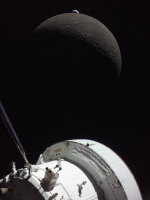
We've already seen the crew of the Artemis II
chuck around iPhones in space and have trouble
accessing their Outlook accounts, and when they finally make it to the moon's orbit we should be treated to some high-resolution
4K footage of the lunar surface.
The astronauts are flying by the moon rather than landing on it, but thanks to laser technology developed in part by the
MIT Lincoln Laboratory (via the
BBC Sky at Night Magazine), they have best-in-class tech for reporting back.
Space missions have traditionally used radio frequency (RF) communications, but the spectrums it uses are now highly congested, and it's no longer the best technology we have for beaming data across large distances (to the moon and back, for instance).
"Laser communication is a solution that could solve this problem, and the laboratory is an expert in the field, which was really pioneered here," says Farzana Khatri, a lead systems engineer at the MIT Lincoln Laboratory.
If everything goes according to plan, we should be
able to enjoy "high-definition video from the moon" over the next few days. Think something of a similar quality to a premium Netflix feed, only of the actual moon rather than a middling sci-fi movie.
The system in use is the Orion Artemis II Optical Communications System (O2O), and it comprises several complex instruments, including a gimbal-mounted telescope that can direct laser beams back to base at NASA.
"You can imagine the Artemis astronauts using videoconferencing to connect with physicians, coordinate mission activities, and livestream their lunar trips," says Jane Wang, also on the team that developed the system.
The actual capturing will be done by Nikon cameras that are included in the astronauts' kit. Besides sending back photos, audio, and video from the mission, the laser links will be able to transmit real time diagnostics reports to and from Orion.








 Federal cabinet gives nod to imposition of emergency in KP; summary sent to president (58 Viewers)


 Magnitude-7 earthquake hits Tibet, killing at least 16 and destroying hundreds of homes (7 Viewers)