
Navigation
Install the app
How to install the app on iOS
Follow along with the video below to see how to install our site as a web app on your home screen.
Note: This feature may not be available in some browsers.
More options
Style variation
You are using an out of date browser. It may not display this or other websites correctly.
You should upgrade or use an alternative browser.
You should upgrade or use an alternative browser.
NASA Space Program
- Thread starter Hamartia Antidote
- Start date
More options
Who Replied?
F-22Raptor
Elite Member
So proud of this crew and everyone at NASA! Amazing mission and I can’t wait for the Moon landing missions in 2028!

Hamartia Antidote
Elite Member
- Thread starter
- #273
F-22Raptor
Elite Member
Hamartia Antidote
Elite Member
- Thread starter
- #275
Hamartia Antidote
Elite Member
- Thread starter
- #276
Hamartia Antidote
Elite Member
- Thread starter
- #277
Hamartia Antidote
Elite Member
- Thread starter
- #278
Watch Artemis II's Snapshot Of The Moon | NASA's Artemis II Makes Lunar Flyby
Hamartia Antidote
Elite Member
- Thread starter
- #279
Hamartia Antidote
Elite Member
- Thread starter
- #280
Hamartia Antidote
Elite Member
- Thread starter
- #281

Hamartia Antidote
Elite Member
- Thread starter
- #282
Hamartia Antidote
Elite Member
- Thread starter
- #283

NASA Fires Up Powerful Lithium-Fed Thruster for Trips to Mars - NASA
A technology that could propel crewed missions to Mars and robotic spacecraft throughout the solar system was recently put to the test at NASA’s Jet
 www.nasa.gov
NASA Fires Up Powerful Lithium-Fed Thruster for Trips to Mars
A technology that could propel crewed missions to Mars and robotic spacecraft throughout the solar system was recently put to the test at NASA’s Jet Propulsion Laboratory in Southern California. On Feb. 24, for the first time in years and at power levels exceeding any previous test in the United States, a team fired up an electromagnetic thruster that runs on lithium metal vapor.This prototype achieved power levels beyond the highest-power electric thrusters on any of the agency’s current spacecraft. Valuable data from the first firing of this thruster will help inform an upcoming series of tests.
“At NASA, we work on many things at once, and we haven’t lost sight of Mars. The successful performance of our thruster in this test demonstrates real progress toward sending an American astronaut to set foot on the Red Planet,” said NASA Administrator Jared Isaacman. “This marks the first time in the United States that an electric propulsion system has operated at power levels this high, reaching up to 120 kilowatts. We will continue to make strategic investments that will propel that next giant leap.”
During five ignitions, the tungsten electrode at the thruster’s center glowed bright white, reaching over 5,000 degrees Fahrenheit (2,800 degrees Celsius). The work was conducted in JPL’s Electric Propulsion Lab, home to the condensable metal propellant vacuum facility, a unique national asset for safely testing electric thrusters that use metal vapor propellants at up to megawatt-class power levels.
Powering up
Electric propulsion uses up to 90% less propellant than traditional, high-thrust chemical rockets. Current electric propulsion thrusters, like those powering NASA’s Psyche mission, use solar power to accelerate propellants, producing a low, continuous thrust that reaches high speeds over time. NASA JPL is testing a lithium-fed magnetoplasmadynamic (MPD) thruster, a technology that has been researched since the 1960s but never flown operationally. The MPD engine differs from existing thrusters by using high currents interacting with a magnetic field to electromagnetically accelerate lithium plasma.During the test, the team achieved power levels of up to 120 kilowatts. That’s over 25 times the power of the thrusters on Psyche, which is currently operating the highest-power electric thrusters of any NASA spacecraft. In the vacuum of space, the gentle but steady force Psyche’s thrusters provide over time accelerates the spacecraft to 124,000 mph.
“Designing and building these thrusters over the last couple of years has been a long lead-up to this first test,” said James Polk, senior research scientist at JPL. “It’s a huge moment for us because we not only showed the thruster works, but we also hit the power levels we were targeting. And we know we have a good testbed to begin addressing the challenges to scaling up.”
Going electric
To view the test, Polk peered through a small portal into the 26-foot-long (8-meter-long) water-cooled vacuum chamber. Inside, the thruster flared to life, its nozzle-shaped outer electrode glowing incandescent as it emitted a vibrant red plume. Polk has researched lithium-fed MPD thrusters for decades, having worked on NASA’s Dawn mission and the agency’s Deep Space 1, the first demonstration of electric propulsion beyond Earth orbit.The team aims to reach power levels between 500 kilowatts and 1 megawatt per thruster in coming years. Because the hardware operates at such high temperatures, proving the components can withstand the heat over many hours of testing will be a key challenge. A human mission to Mars might need 2 to 4 megawatts of power, requiring multiple MPD thrusters, which would have to operate for more than 23,000 hours.
Lithium-fed MPD thrusters have the potential to operate at high power levels, use propellant efficiently, and provide significantly greater thrust than currently flying electric thrusters. Fully developed and paired with a nuclear power source, they could reduce launch mass and support payloads required for human Mars missions.
The MPD thruster work, in development for the past 2½ years, is led by JPL in collaboration with Princeton University in New Jersey and NASA’s Glenn Research Center in Cleveland. It is funded by NASA’s Space Nuclear Propulsion project, which in 2020 began supporting a megawatt-class nuclear electric propulsion program for human Mars missions by focusing on five critical technology elements, of which the electric propulsion subsystem is one. The project, based at the agency’s Marshall Space Flight Center in Huntsville, Alabama, is part of the NASA’s Space Technology Mission Directorate.
JPL Tests Next-Generation Electric Thruster
Hamartia Antidote
Elite Member
- Thread starter
- #284
F-22Raptor
Elite Member
NASA Outlines Preliminary Artemis III Mission Plans
NASA is moving quickly to define next year’s Artemis III mission in Earth orbit, a crewed flight that will test rendezvous and docking capabilities between the agency’s Orion spacecraft and commercial landers from Blue Origin and SpaceX. Since a February announcement adding an Artemis mission ahead of crewed landing missions to the Moon’s South Pole region, engineers have been evaluating mission profile options and operational considerations for Artemis III to ensure the test flight helps the agency and its partners reduce risk ahead of the next Americans landing on the Moon during Artemis IV.
“While this is a mission to Earth orbit, it is an important stepping stone to successfully landing on the Moon with Artemis IV. Artemis III is one of the most highly complex missions NASA has undertaken,” said Jeremy Parsons, Moon to Mars acting assistant deputy administrator, NASA’s Exploration Systems Development Mission Directorate in Washington. “For the first time, NASA will coordinate a launch campaign involving multiple spacecraft integrating new capabilities into Artemis operations. We’re integrating more partners and interrelated operations into this mission by design, which will help us learn how Orion, the crew, and ground teams all interact together with hardware and teams from both providers before we send astronauts to the Moon’s surface and build a Moon Base there.”
The mission is planned to carry out a series of objectives designed to demonstrate critical systems needed for a future lunar landing. During the Artemis III mission, the SLS (Space Launch System) rocket will launch the Orion spacecraft from NASA’s Kennedy Space Center in Florida with four crew members. Instead of using the interim cryogenic propulsion stage as the upper stage of the rocket, NASA will use a “spacer,” a representation of the mass and overall dimensions of an upper stage but without propulsive capabilities. The spacer will maintain the same overall dimensions and interface connection points as the upper stage between the Orion stage adapter and launch vehicle stage adapter.
Design and fabrication activities for the spacer are progressing rapidly at NASA’s Marshall Space Flight Center in Huntsville, Alabama. Material for the barrel section and the upper and lower rings is currently being machined at Marshall in preparation for upcoming welding operations.
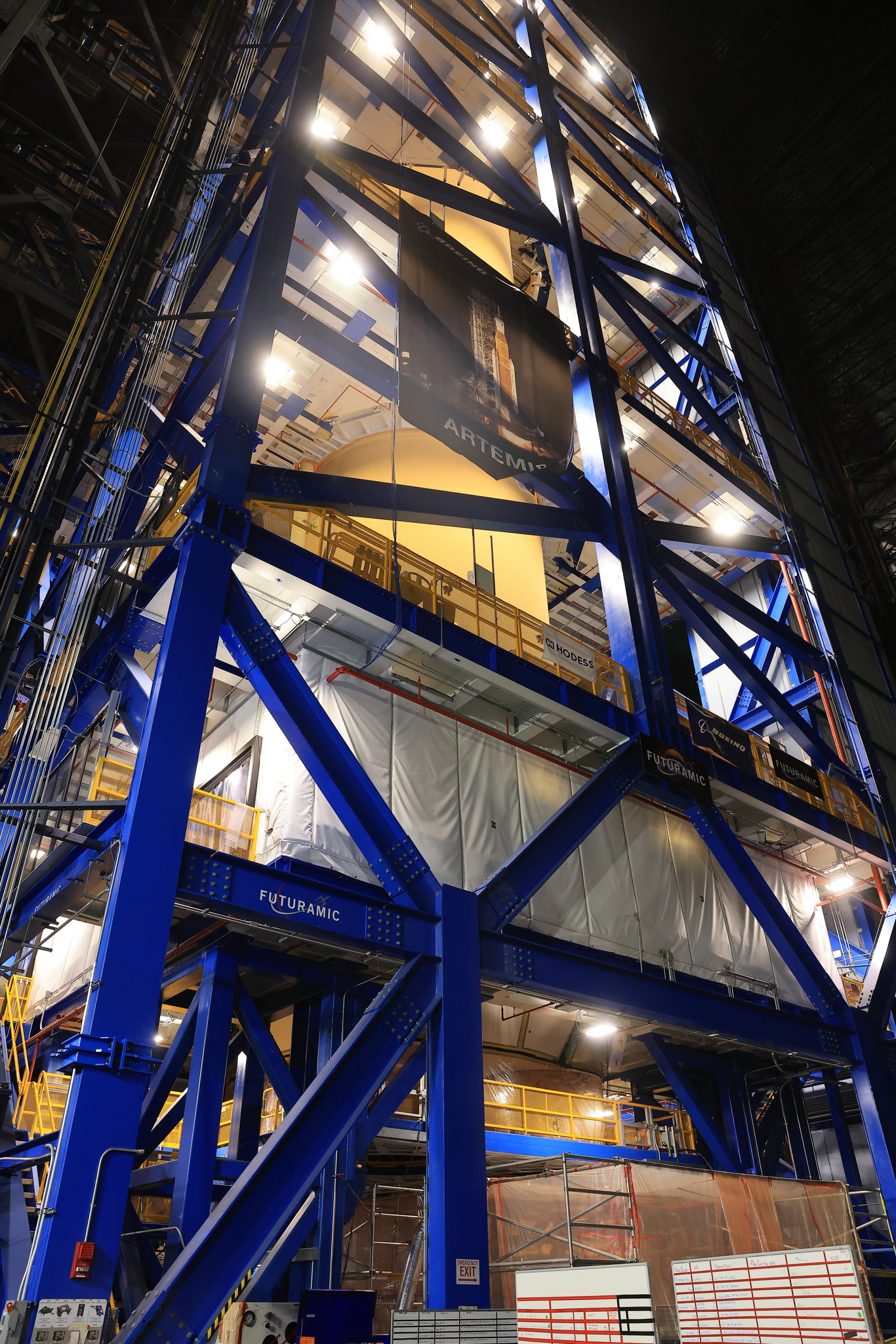
The Artemis III core stage sits in High Bay 2 in the Vehicle Assembly Building at NASA Kennedy with the core stage tank attached to its engine section on May 12, 2026.
Credit: NASA/Kim Shiflett
After the rocket delivers Orion to orbit, the spacecraft’s European-built service module will provide propulsion to circularize Orion’s orbit around the planet in low Earth orbit. This orbit increases overall mission success by allowing more launch opportunities for each element as compared to a lunar mission — SLS carrying Orion and its crew, SpaceX’s Starship human landing system pathfinder, and Blue Origin’s Blue Moon Mark 2 human landing system pathfinder.
Informed by Blue Origin and SpaceX capabilities, NASA also is defining the concept of operations for the mission. While some decisions are yet to be determined, astronauts could potentially enter at least one lander test article.
The crew will spend more time aboard Orion than during Artemis II, further advancing the evaluation of life support systems, and for the first time will demonstrate the docking system performance. The mission will inform lander rendezvous and habitation concepts and mission operations in preparation for future surface missions. The agency also plans to test an upgraded heat shield during Orion’s return to Earth to enable more flexible and robust reentry profiles for future missions.
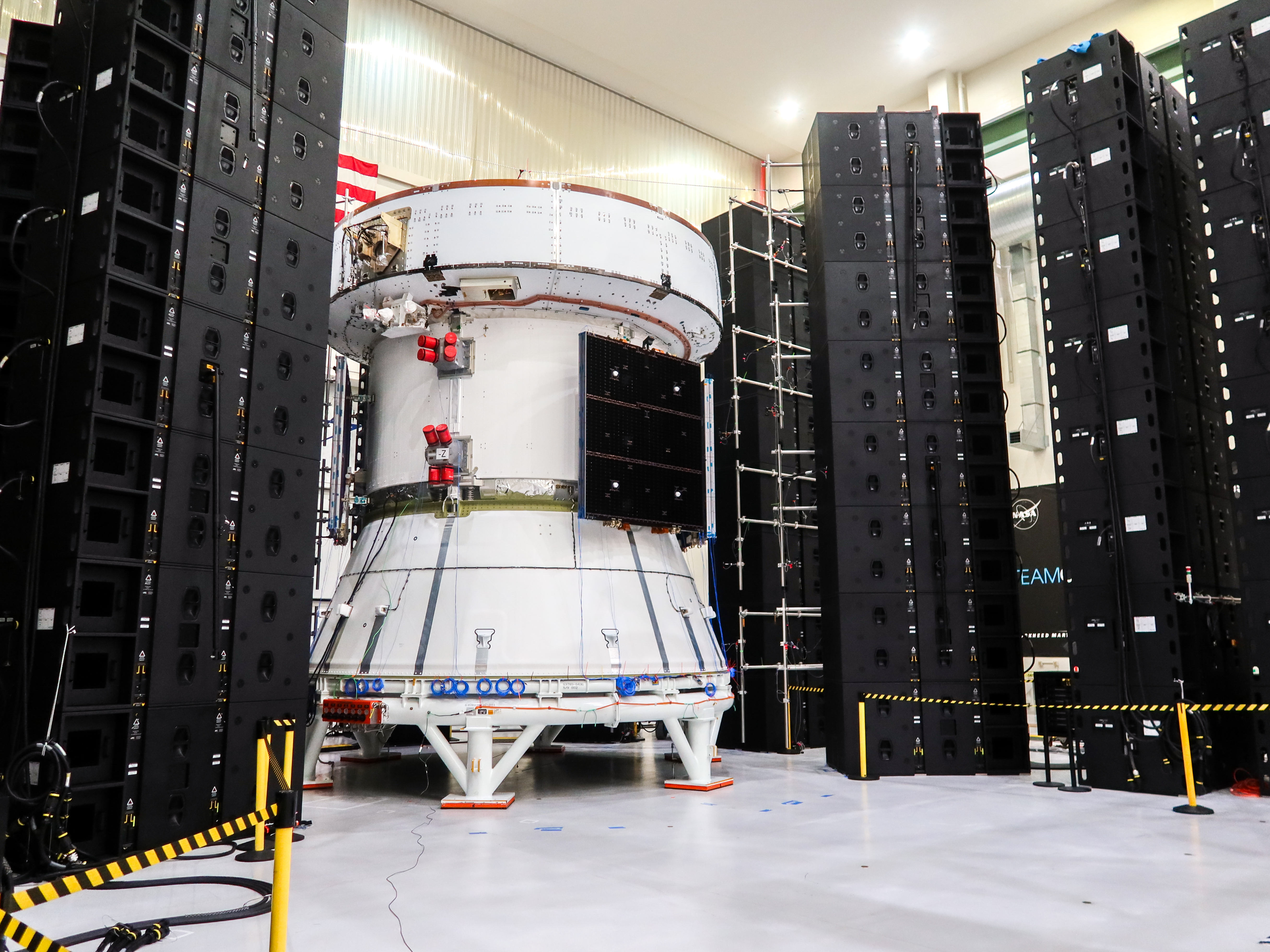
The Artemis III Orion service module is pictured ahead of acoustic testing in NASA’s Kennedy Space Center Operations and Checkout Facility on May 7, 2026.
NASA/Jess Ruffa
Over the coming weeks, NASA will continue to refine specific plans for the flight, including a timeline for identifying astronauts to train for mission operations, options to evaluate Axiom’s AxEMU spacesuit lander interfaces ahead of lunar surface missions, mission duration, and potential science operations for the flight. NASA has asked for industry input on potential solutions to improve the communications with the ground during the mission since the Deep Space Network will not be used. The agency also is seeking both international and domestic interest in potentially flying CubeSats to deploy in Earth orbit, and may share other opportunities as the concept of operations for the mission is further defined.
As part of the Golden Age of innovation and exploration, NASA will send Artemis astronauts on increasingly difficult missions to explore more of the Moon for scientific discovery, economic benefits, establish an enduring human presence on the lunar surface, and to build on our foundation for the first crewed missions to Mars.
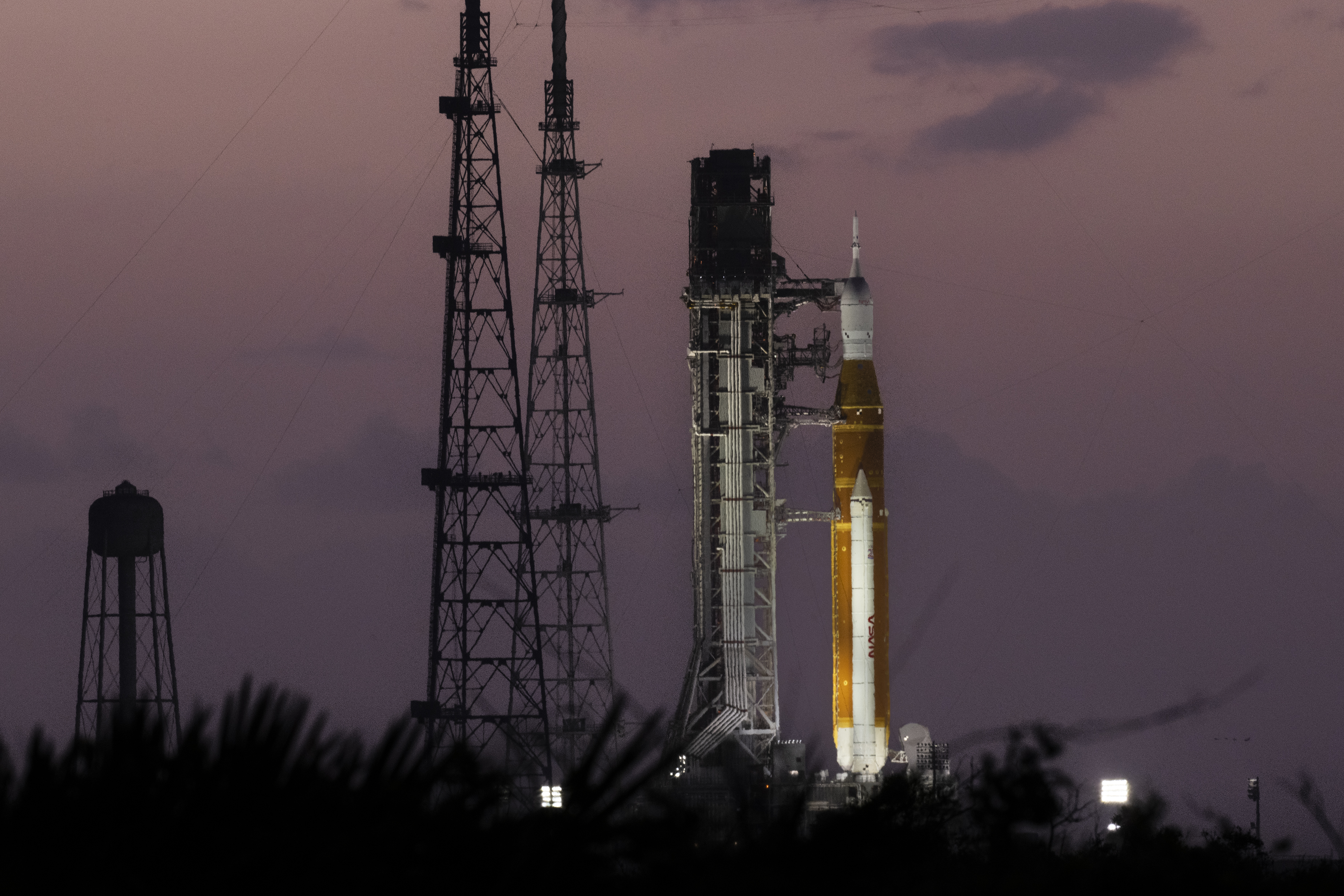
NASA Outlines Preliminary Artemis III Mission Plans - NASA
NASA is moving quickly to define next year’s Artemis III mission in Earth orbit, a crewed flight that will test rendezvous and docking capabilities between
www.nasa.gov
Users who are viewing this thread
Total: 6 (members: 0, guests: 6)
Pakistan Defence Latest
-
 Federal cabinet gives nod to imposition of emergency in KP; summary sent to president (58 Viewers)
- Latest: Forsvaret
-
-
-

-
Country Watch Latest
-

-

-
Iran - Israel/US War: Israel-US declare war on Iran, Iran responds (1,128 Viewers)
- Latest: AZ_HighCountry
-

-

Latest Posts
-

-
-
 Magnitude-7 earthquake hits Tibet, killing at least 16 and destroying hundreds of homes (7 Viewers)
- Latest: NGAD IS THE BEST
-
Federal cabinet gives nod to imposition of emergency in KP; summary sent to president (58 Viewers)
- Latest: Forsvaret
-