NASA Space Program

Top three images from BepiColombo's sixth Mercury flyby​


Top three images from BepiColombo's sixth Mercury flyby​


NASA related???
 

Vast Space now aims for 2026 launch of Haven-1 space station after key milestone (photos)​


Designing a space station is taking a little longer than Vast expected, but the company is still moving at a breakneck pace.

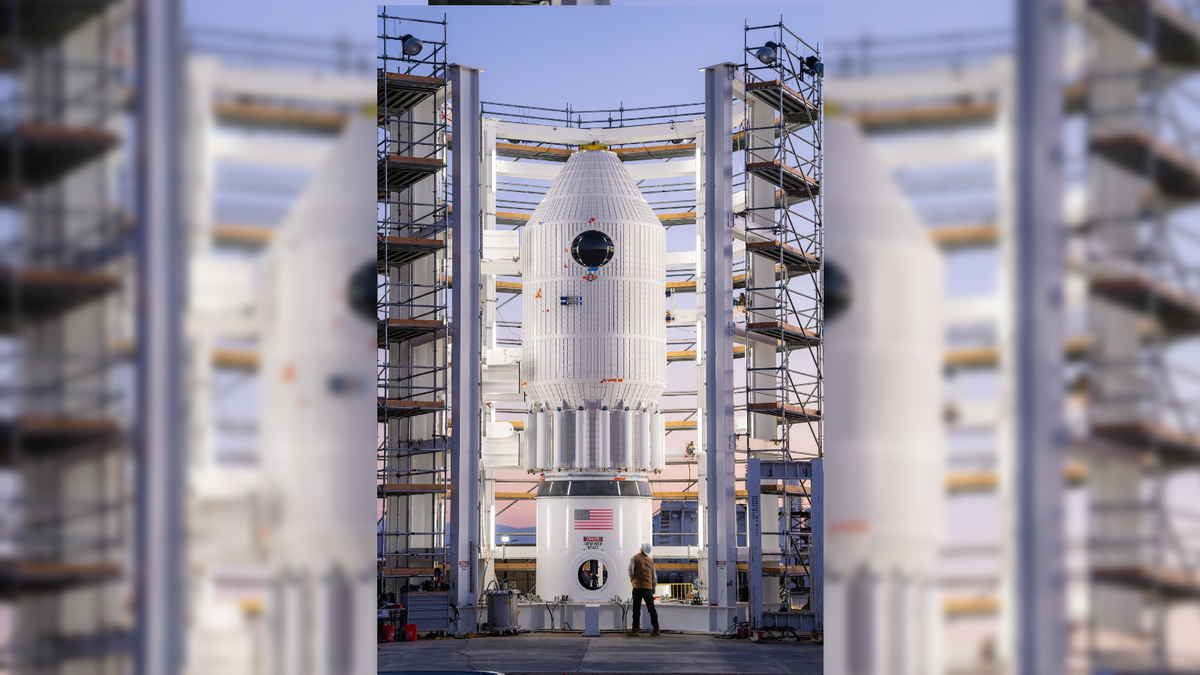
a white cylindrical vessel with conical top is mounted to stand on a test area, surrounded by railed scaffolding.

A qualification version of Vast Space's Haven-1 space station module on the test stand. (Image credit: Vast Space)

Vast Space is taking big steps toward putting the first commercial space station in orbit.


The California-based startup recently completed a major testing milestone for the qualification vessel of its upcoming Haven-1 station, a benchmark Vast also used to reevaluate the launch date for the company's first flight-ready module.


"With the completion of our primary structure qualification test and a fully assembled team, we now have greater clarity on our build and launch schedule. As a result, we are updating our timeline," Vast said in a statement.

Haven-1 will ride a SpaceX Falcon 9 rocket to low-Earth orbit — a mission that was initially slated for this August. Now, Vast expects Haven-1 to launch no earlier than May 2026.

Even with the delay, it's still an "ambitious timeline," the company said. But Vast remains optimistic: "If all goes as planned, we will have designed, built, and launched the world’s first commercial space station in three years — a pace never before achieved in human spaceflight."


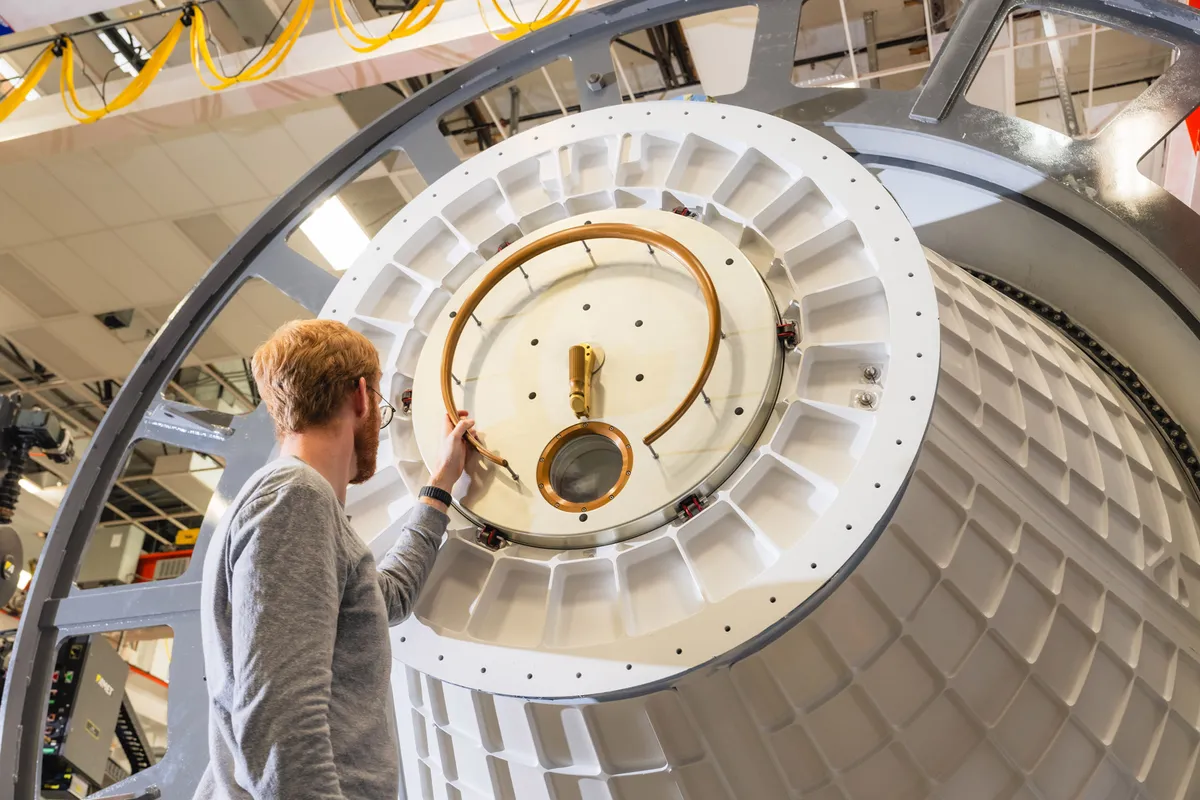
Vast began manufacturing the Haven-1 qualification article at its Long Beach headquarters in July 2024 and transported the module to the company's test stand in Mojave, California, last month. There, the module began a series of campaigns to qualify the module's structural integrity. Those campaigns are ongoing, but one passed recently was a significant hurdle for the module's continued development.

Using dry nitrogen, Vast pressurized the module on the test stand twice — the first for a duration of five hours, and the second for 48 hours. According to the company's data, Haven-1's pressure sensors showed an "indiscernible" leak rate, exceeding the vessel's requirements and falling within compliance for NASA's crew-rated spacecraft qualifications.

HJ3ZRFPQqja8rKwGsdj9UN-1200-80.jpg.webp


That last bit is important. Vast is hoping to win the bid for NASA's Commercial LEO Destination (CLD) contract in 2026, and wants to put itself ahead of the competition.

With the International Space Station (ISS) approaching retirement at the end of 2030, NASA has been eager for companies to get commercial space stations up and running. Indeed, nearly half a dozen other private contenders have voiced plans to construct their own LEO destinations — namely, Northrop Grumman, Axiom Space, Nanoracks and Sierra Space.

As those companies tread water while they gauge market demand or continue their station developments in the background, Vast says it's on track to get Haven-1 to orbit in record time, and has begun actively seeking out customers and scientists with research they want to fly to space.


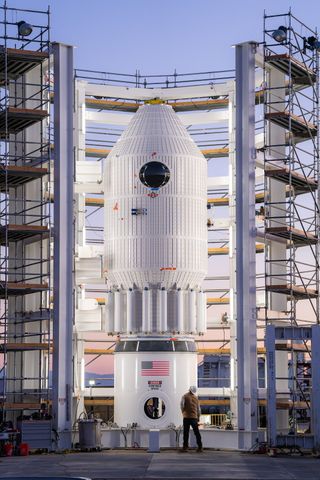
a white cylindrical vessel with conical top is mounted to stand on a test area, surrounded by railed scaffolding.


Vast's Haven'-1 qualification article on the test stand in Mojave, CA. (Image credit: Vast Space)
In the weeks ahead, the test module will be submitted to simulated launch pressures using hydraulic actuators on the Mojave test stand, as well as undergo structural load tests while under pressure.

Even as the qualification article began its test campaign at the end of last month, Vast was already manufacturing the Haven-1 flight vehicle — the one going to space. Matching the six-month pace the qualification module took from manufacturing to its tests in Mojave, Vast aims to complete the primary structure for the flight module by July of this year. The company's full timeline, from now through the first crewed mission to Haven-1 is as follows:

haven.png
gFcyRgvSo9ZtNAX4gHjnmc-1200-80.gif

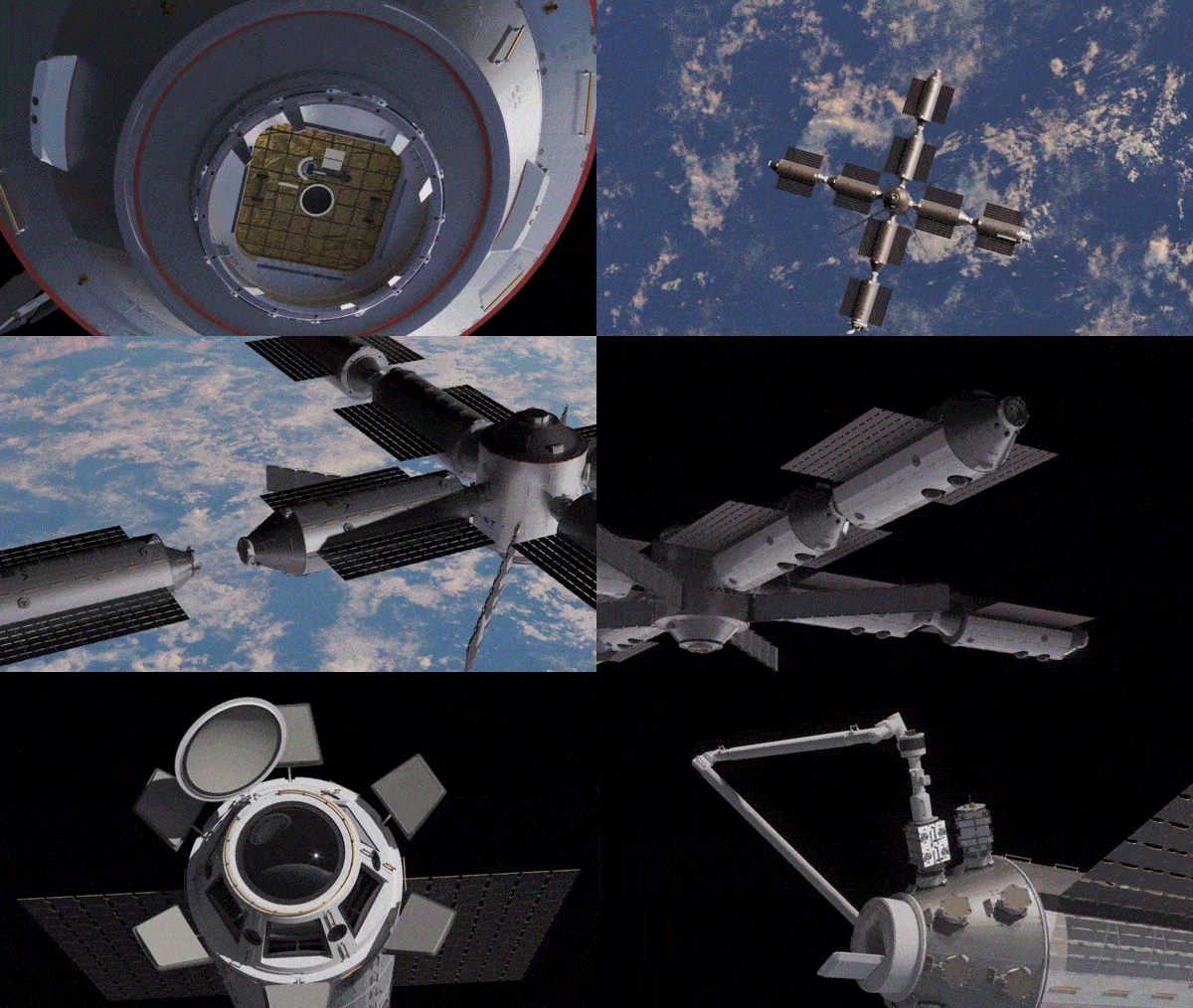
Haven-2 is poised to succeed the International Space Station. (Image credit: Vast Space)

Once Haven-1 is operational in orbit, Vast plans to launch a four-person crew to the outpost aboard a SpaceX Crew Dragon. That mission will last about two weeks, as the astronauts check out the station's systems and habitability.

Looking ahead even further, Vast has already unveiled its plans for Haven-2, a second module design that will dock with Haven-1 to increase the space station's capacity and capabilities. Vast is currently targeting 2028 for the first Haven-2 launch, with plans to to add to the modular station through 2032 to eventually exceed the current capabilities of the ISS.
 

BAE wins $230.6 million contract for space weather program​


Illustration of a satellite observing solar weather.
BAE Systems, Space & Mission Systems, also is building the Space Weather Follow On Lagrange 1 spacecraft, to provide unobstructed views of the Sun’s corona. Credit: NOAA/Ball Aerospace

SAN FRANCISCO – BAE Systems won a $230.6 million NASA contract to deliver spacecraft for the National Oceanic and Atmospheric Agency’s Lagrange 1 Series space weather project.

Under the firm-fixed-price award, announced Feb. 21, BAE Systems Space & Mission Systems, formerly Ball Aerospace, will develop Lagrange 1 Series spacecraft, integrate instruments, and support flight and mission operations. Contract-related work, scheduled to begin this month, will be performed in Boulder, Colorado, through January 2034.

The Lagrange 1 Series, part of NOAA’s Space Weather Next program, is designed to provide continuity of coronal imagery and upstream solar wind measurements, with spacecraft expected to launch in 2029 and 2032. BAE Systems also is building the Space Weather Follow On Lagrange 1 mission set to fly no earlier than September on NASA’s Interstellar Mapping and Acceleration Probe.

Observations of the sun and space environment near Earth provide satellite operators with forecasts and warnings of extreme events. During the recent geomagnetic storms, those alerts helped to mitigate the impact on the terrestrial electric power grid, air travel, communications and navigation.

NASA and NOAA will work together to oversee development, launch testing and operation of Lagrange 1 Series satellites. NOAA determines program requirements, provides funding, manages operations and disseminates data gathered by the spacecraft. NASA works with the companies building spacecraft, instruments and launching the satellites.

NASA awarded BAE the Lagrange 1 Series delivery order under the Rapid Spacecraft Acquisition IV contract. The Rapid IV contract mechanism is a tool to speed up acquisition of spacecraft, instruments and services for U.S government agencies.
 

Starship program at Cape Canaveral kicking into gear


Roberts-Road-with-VAB-1170x780.jpg


After building a Launch Tower at LC-39A in 2022, building what was to be the Roberts Road Starfactory, and then putting all of the plans on hold, SpaceX has since started ramping up the Starship Program at Cape Canaveral. With the redesign of the Starship Pad at LC-39A and a much larger production facility at Roberts Road, SpaceX is on its way to having a large Starship presence in Florida.

To view this content we will need your consent to set third party cookies.
For more detailed information, see our cookies page.


SpaceX has been clearing out land just north of its Falcon 9 refurbishment hangar, otherwise known as Hangar X. This land will become the Production Site for the Starship program at Cape Canaveral. At Starbase, the production site includes a one million square foot Starfactory with two Mega Bays, one for Boosters and one for Ships, and an older High Bay, which is rarely used anymore.

Roberts Road is set to get a Gigabay, 130 meters by 110 meters and 115 meters tall. In comparison, the Mega Bays at Starbase are around 38 meters by 54 meters and 99 meters tall. These numbers mean that SpaceX can fit around 28 separate workstations inside this bay compared to the five that are currently in the Mega Bays. The height increase will also allow for the production of the stretched Boosters and Ships that SpaceX has planned, as the current Mega Bays aren’t tall enough.

Roberts-Road-scaled.jpg

Roberts Road (Credit: Max Evans for NSF)
In addition to the Gigabay, SpaceX plans to build a 1.5 million square foot Starfactor,y which is 50 percent bigger than the current one in Starbase. This factory plus the larger bay, will help significantly increase production capacity. Another benefit is more room to maintain Boosters and Ships after flights and storage space. SpaceX will likely build more than one Gigabay as there is more than enough space in the northern area being cleared, and it intends to create hundreds of vehicles.

Overall, this will be a significant upgrade over what SpaceX has in Starbase, but it will take years to build and kit out with tooling and workstations. Currently, the Federal Aviation Administration document with the specifications for Gigabay states an Aug 2026 completion date, likely for just the structure itself.

LC-39A-OLM-at-Roberts-Road-scaled.jpg

LC-39A OLM at Roberts Road (Credit: Max Evans for NSF)
Roberts Road is also home to SpaceX’s Starship launch tower production, where the stands from Starbase’s Pad B tower were returned. These have helped build three towers so far, and eventually, SpaceX will use the stands to build a tower for possibly SLC-37, which currently has an Environmental Impact Statement (EIS) going.

Roberts Road is also home to the pieces for LC-39A’s Orbital Launch Mount which is set to be a replica of the one currently being built in Sanchez at Starbase. Most of the first two levels have already arrived for construction.

LC-39A Starship Pad

Starship’s first launch pad at Cape Canaveral will be at LC-39A, where a launch tower has been completed since Sept 2022. The tower sat unused with its chopsticks for a few years while SpaceX focused on Starbase and getting flight test data before proceeding. With the lessons learned and a flame trench now being dug for Pad B at Starbase, SpaceX has started working on the pad again after submitting a new EIS in the summer of 2024.

This outlined the changes to the launch pad and vehicle since the EIS from 2019 was out of date. As of Jan 2025, crews had started drilling pilings which will be for the flame trench and pile cap. This design is likely the same as what is currently being constructed at Pad B in Starbase.

LC-39A-with-Starship-Pad-Progress-scaled.jpg

LC-39A with Starship Pad Progress (Credit: Max Evans for NSF)
SpaceX has also dismantled the large vertical liquid oxygen (LOX) tank built just behind the launch tower, where the launch mount was to be located. This is set to be replaced by several horizontal tanks, possibly next to the LOX sphere that has been at LC-39A since the Apollo Program and is currently being used by Falcon 9. With Starship’s LOX farm likely moving to next to the LOX Sphere, the water deluge farm will likely move to behind the tower, mirroring Pad B at Starbase

In addition to changing the LOX farm, all of the above-ground propellant lines that were between the Liquid Methane Sphere and the pad have since been dug up and SpaceX seems to be digging a commodities trench like at Starbase’s Pad B.

All the changes come from lessons learned over the pad seven test flights and the refurbishment of Pad A at Starbase. SpaceX has likely developed a launch pad that can be replicated anywhere it intends to build one for the Starship program.

LC-39A-LOX-Tank-Farm-scaled.jpg

LC-39A LOX Tank Farm (Credit: Max Evans for NSF)
SLC-37

SpaceX is also planning on building more pads at Cape Canaveral, specifically SLC-37 or SLC-50, depending on the current EIS outcome. This would have at least one Starship pad to bring the total to four, including Starbase and LC-39A. The draft EIS is set to be released to the public in the spring of 2025, with a final completion date of fall of 2025.

The pad layout is unknown, but most of the existing Delta IV Heavy hardware would have to be demolished to build the Starship pad.
 

Mars orbiter snaps 1st image of Curiosity rover driving on the Red Planet (photo)​


black and white photo taken from mars orbit showing a rover on the surface as a tiny speck, with a trail of tire tracks extending from it

NASA’s Curiosity rover appears as a dark speck in this contrast-enhanced view captured on Feb. 28, 2025, by the HiRISE camera aboard NASA’s Mars Reconnaissance Orbiter. Trailing Curiosity are the rover’s tracks, which can linger on the Martian surface for months before being erased by the wind. (Image credit: NASA/JPL-Caltech/University of Arizona)

NASA's Mars Reconnaissance Orbiter (MRO) just snapped an off-Earth action shot the likes of which we've never seen before.


On Feb. 28, MRO's HiRISE (High-Resolution Imaging Science Experiment) camera captured NASA's Curiosity rover making tracks across Mars' huge Gale Crater.

MRO has spotted Curiosity before, but the car-sized rover had always been stationary in those cases. The newly released photo "is believed to be the first orbital image of the rover mid-drive across the Red Planet," NASA officials said in a statement today (April 24).

The rover tracks seen in the HiRISE image cover about 1,050 feet (320 meters) and will likely last for months before the Martian wind erases them, agency officials added.

"They represent roughly 11 drives starting on Feb. 2 as Curiosity trucked along at a top speed of 0.1 mph (0.16 kph) from Gediz Vallis channel on the journey to its next science stop: a region with potential boxwork formations, possibly made by groundwater billions of years ago," they wrote in the statement.

Curiosity landed on the floor of the 96-mile-wide (154 km) Gale Crater in August 2012, on a mission to assess the area's past potential to host life as we know it.

The rover's work has been extremely intriguing to astrobiologists, showing that Gale was indeed a habitable environment long ago: The area hosted a long-lived lake-and-stream system that had the ingredients for life, as well as a possible chemical energy source that could support microbial metabolism.

MRO has been operating at the Red Planet even longer than Curiosity, reaching Mars orbit in March 2006. As the new photo shows, MRO is still going strong, hunting for signs of past water activity on the Red Planet, serving as a communications relay for surface craft like Curiosity and its younger cousin, Perseverance — and keeping tabs on these robots' movements from time to time as well.
 
To view this content we will need your consent to set third party cookies.
For more detailed information, see our cookies page.

NASA Marshall Fires Up Motor for Artemis Lander Study​

 
To view this content we will need your consent to set third party cookies.
For more detailed information, see our cookies page.

LIVE: Astronauts Step Out Of ISS For Spacewalk​


NASA's PUNCH delivers knockout views of colossal solar storms erupting from sun (video)​


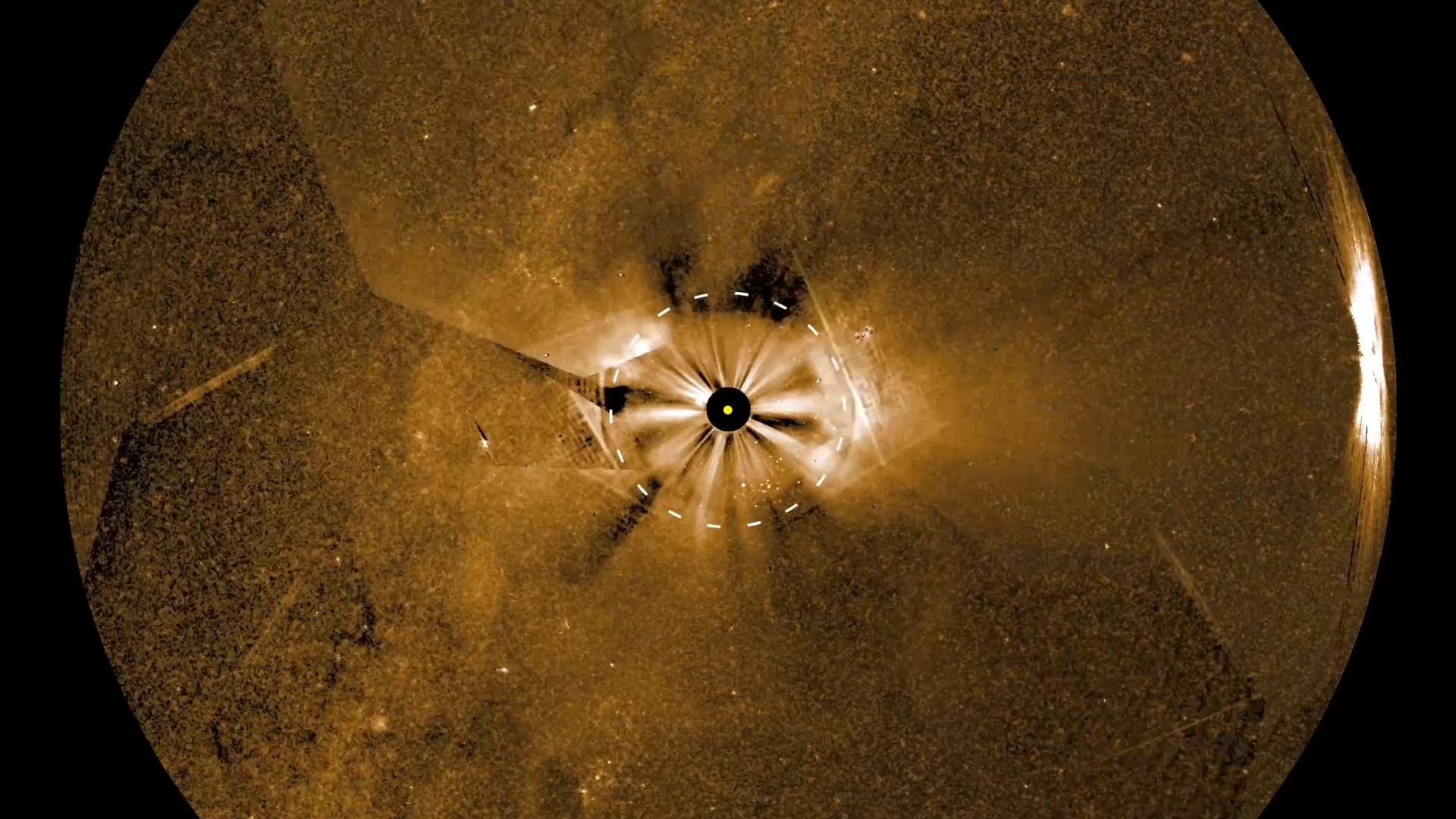
first images released from NASA's PUNCH spacecraft as it watches colossal solar storm eruptions from the sun.

NASA's PUNCH spacecraft view of the sun in unprecedented detail. (Image credit: NASA/SwRI)

NASA's PUNCH mission has unveiled its first images of colossal solar eruptions known as coronal mass ejections (CMEs) — delivering an unprecedented, wide-field view of how these solar storms travel through the inner solar system.


CMEs are vast plumes of plasma and magnetic field ejected from the sun. When directed toward Earth, they can trigger geomagnetic storms that disrupt satellites, GPS and pose risks to astronauts. These geomagnetic storms can also supercharge auroras, leading to incredible light shows beyond their usual latitude range. Understanding the mechanisms behind these key drivers in space weather will help protect satellites, astronauts, and infrastructure, while also giving us a better sense of when to expect dramatic aurora displays.

The new CME images, captured from late May to early June 2025 by three of PUNCH's four spacecraft, were revealed Tuesday during the 246th American Astronomical Society meeting in Anchorage, Alaska. The PUNCH spacecraft features four cameras that together form a "virtual instrument" that allows scientists to track CMEs across the inner solar system in greater detail than ever before.

"These first images are astonishing, but the best is still yet to come," Craig DeForest, PUNCH principal investigator from Southwest Research Institute's Solar System Science and Exploration Division in Boulder, Colorado, said in a statement. "Once the spacecraft are in their final formation, we'll be able to routinely track space weather in 3D across the entire inner solar system."

In a stitched video sequence, massive CMEs can be seen billowing outward in all directions, some heading directly toward the camera. Among the celestial backdrop are the moon, Venus, Jupiter and the constellation Orion.

The moon is visible as a bright object toward the left of the frame at the start of the video. The Orion constellation is at the bottom left, while Jupiter is just left of the center and Venus is on the far right. The sun itself is marked by a yellow dot at the center, while a dashed white circle represents the field of view of the older LASCO C3 coronagraph on NASA-ESA's SOHO spacecraft.

The fourth spacecraft's Narrow Field Imager (NFI), a coronagraph designed to block the sun's light captured a CME in exquisite detail on June 3. The bulb-shaped eruption emerges above the blacked-out sun, showcasing the instrument's ability to observe the sun's outer atmosphere in great detail.


To view this content we will need your consent to set third party cookies.
For more detailed information, see our cookies page.
 

New Horizons conducts first-ever successful deep space stellar navigation test​


First successful deep-space demonstration of stellar navigation
Just 15 minutes after its closest approach to Pluto on July 14, 2015, NASA's New Horizons spacecraft looked back toward the sun and captured this near-sunset view of the rugged, icy mountains and flat ice plains extending to Pluto's horizon. The smooth expanse of the informally named icy plain Sputnik Planum (right) is flanked to the west (left) by rugged mountains up to 11,000 feet (3,500 meters) high, including the informally named Norgay Montes in the foreground and Hillary Montes on the skyline. To the right, east of Sputnik, rougher terrain is cut by apparent glaciers. The backlighting highlights more than a dozen layers of haze in Pluto's tenuous but distended atmosphere. The image was taken from a distance of 11,000 miles (18,000 kilometers) to Pluto; the scene is 780 miles (1,250 kilometers) wide. Credit: NASA/Johns Hopkins University Applied Physics Laboratory/Southwest Research Institute


As NASA's New Horizons spacecraft traveled through the Kuiper Belt at a distance of 438 million miles from Earth, an international team of astronomers used the far-flung probe to conduct an unprecedented experiment: the first-ever successful demonstration of deep space stellar navigation


A paper describing the results was accepted for publication in The Astronomical Journal. The pre-print is available on the server arXiv.

As a proof-of-concept test, the researchers took advantage of the spacecraft's unique vantage point as it traveled toward interstellar space to image two of our nearest stellar neighbors, Proxima Centauri, which is 4.2 light-years from Earth, and Wolf 359, which is 7.86 light-years away.

From New Horizons' perspective, the two nearby stars shifted their apparent positions in the sky as they appear to astronomers here on Earth, an effect known as stellar parallax.

Using the positions of the two stars and referencing a three-dimensional model of the solar neighborhood, the team calculated the spacecraft's position relative to nearby stars with an accuracy of about 4.1 million miles. (This is comparable to an accuracy of about 26 inches as measured from New York to Los Angeles.)

Although this demonstration did not yield research-grade results, the researchers note that directly observing large stellar parallaxes from widely separated simultaneous observers is vividly educational.


According to Tod Lauer, an astronomer with NSF's NOIRLab in Tucson, Ariz., and lead author on the paper, "Taking simultaneous Earth/Spacecraft images we hoped would make the concept of stellar parallaxes instantly and vividly clear."

"It's one thing to know something, but another to say "Hey, look! This really works!'"

New Horizons is the fifth robotic spacecraft to leave Earth that will eventually reach interstellar space. Its primary mission was to study the dwarf planet Pluto and its largest moon, Charon.

After a journey of nine and a half years and over 3 billion miles, it captured amazing first images of these icy worlds and expanded our understanding of their geology, composition, and tenuous atmospheres.

Now in its extended mission, New Horizons will continue studying the heliosphere and is expected to cross the "termination shock," the point that marks the boundary of interstellar space, in the next few years.
 
Last edited:

Users who are viewing this thread

Back
Top