ety
Trusted Member

Russia placed an order for 62 Arctic ships with China; the US, which had intended to restrict China's access to the Russian military, ended up delivering the business to China's doorstep.
Global Insider
Published in Jiangsu on 2026-08-28 23:29
How can new AI - driven Arctic transport cooperation diminish the effectiveness of Western sanctions?
Foreword
A report published on the website of Rossiyskaya Gazeta stated that Russian Presidential Special Representative Titov revealed during an Arctic forum that the United Shipbuilding Corporation of Russia is discussing having ships needed for the Arctic shipping route built in Chinese shipyards. Titov stated bluntly: "China is a leader in shipbuilding, and we are in discussions with them."
Around the same time, Chinese shipping companies launched their first regular weekly container shipping route via the Arctic, connecting Ningbo Port with Felixstowe Port in the UK. The fourth joint Sino-Russian Arctic scientific expedition also commenced on August 20th. Sino-Russian cooperation in the Arctic has moved from a "trial run" phase to a "widespread" stage.
The sanctions imposed by the United States are gradually pushing Russia, which originally relied on South Korean and European shipyards, onto the slipways of Chinese shipyards. The United States wanted to block Russia's Arctic energy exports, but it ended up empty-handed—instead handing over shipbuilding orders to China.
First, Russia has waterways but no ships; the gap is there.
Russia's advantage in the Arctic is natural. The Northern Sea Route stretches along its northern coast, with Rosatom, the state-owned nuclear energy corporation, responsible for passage permits and icebreaking support. Its nuclear-powered icebreaker fleet is unique in the world. In 2024, the Northern Sea Route handled nearly 37.9 million tons of cargo. Russia's vision for 2030 is between 70 million and 109 million tons.
But the problem lies on the ship.
The United Shipbuilding Corporation of Russia estimates that the Northern Sea Route will require 62 icebreakers, research vessels, and ice-class cargo ships by 2030. Russian Deputy Prime Minister Trutnev provided an even more stark figure: a shortage of at least 70 ice-class cargo ships, while Russian shipyards can only build 16 by 2030. A gap of even one ship is problematic enough; a shortage of 70 means that the freight transport target will remain merely on paper.
In early 2026, Russia was forced to cut its civilian cargo ship construction plan in half. It wasn't that it didn't want to build them, but that it couldn't. Insufficient production capacity, equipment shortages, and technological limitations meant that Russian shipyards simply couldn't keep up with the pace of Arctic development.
II. Sanctions have pushed Russia toward Chinese shipyards.
This gap could have been much smaller.
Russia previously relied heavily on South Korean and European companies for large ships, hull sections, engines, and key equipment. Following the Russia-Ukraine conflict, related contracts and supply chains were repeatedly disrupted. Samsung Heavy Industries of South Korea cancelled an order worth approximately $3.5 billion for ice-class LNG carriers and shuttle tankers with the Russian Far East's Zvezda shipyard. Russia's Arctic LNG 2 project also faced a shortage of suitable ice-class transport vessels, resulting in production capacity but an inability to ship the goods.
When sanctions reached the shipping sector, Russia faced a physical constraint on whether its goods could leave Arctic ports. Energy projects were completed, but a lack of an Arc7-class LNG carrier meant that once the storage tanks were full, shipments could not continue. The restrictions no longer limited to financing and insurance costs; they directly reduced the actual export volume that the projects could realize.
According to market tracking data, the biggest obstacle to exporting the Arctic LNG 2 project remains the shortage of vessels. At least 21 ships are being used to transport LNG from sanctioned Russian projects—the fact that Russia is even using old vessels illustrates the extent of the shortage.
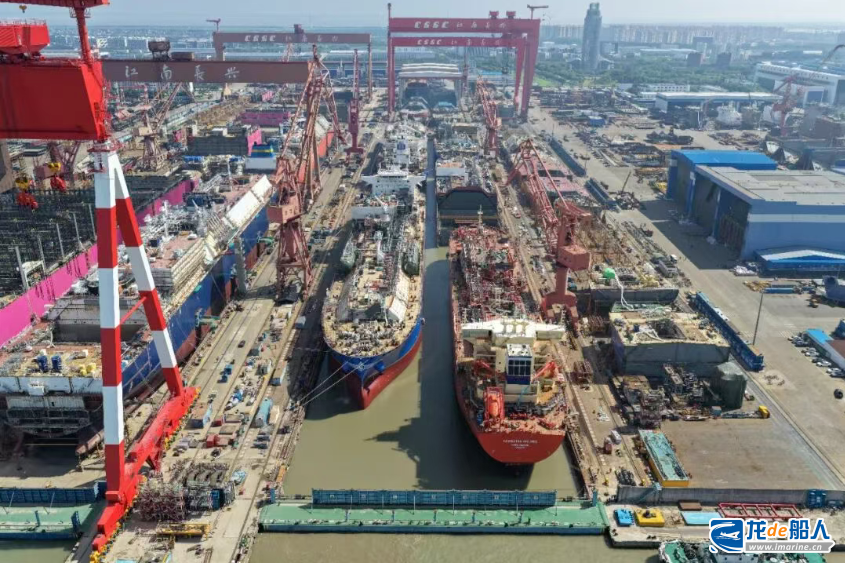
Russia is urgently seeking to replenish its fleet, focusing on large merchant ships capable of long-term operation in polar regions and meeting ice class and low-temperature requirements. China happens to possess exactly what Russia currently lacks – shipbuilding capacity.
III. The trump card of Chinese shipyards: three indicators ranking first in the world
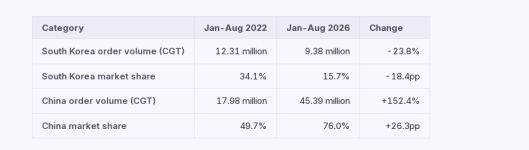
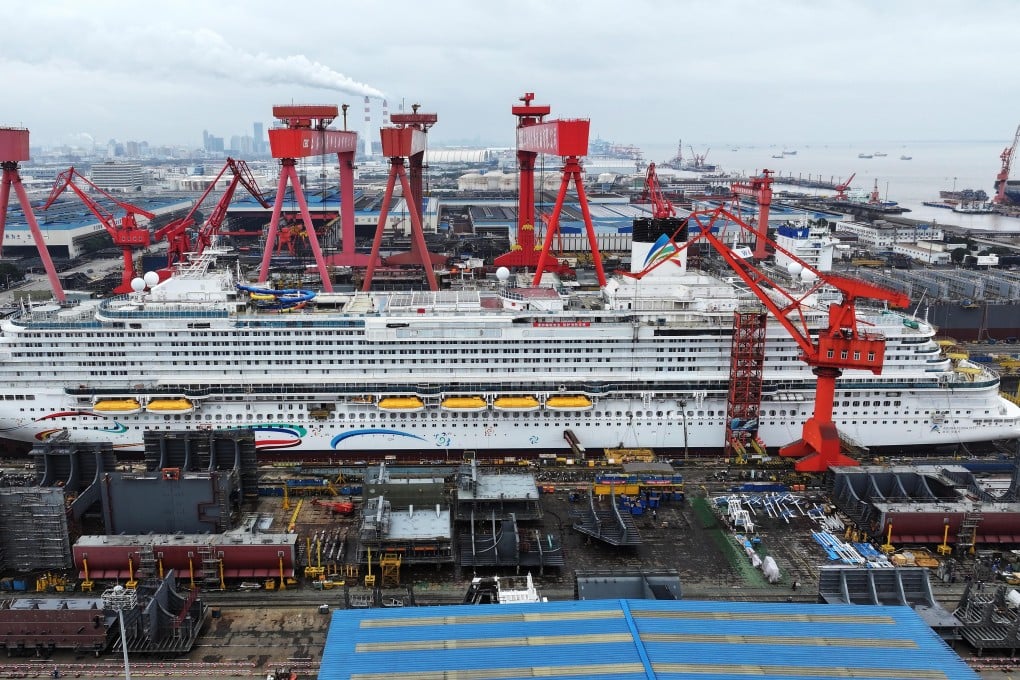
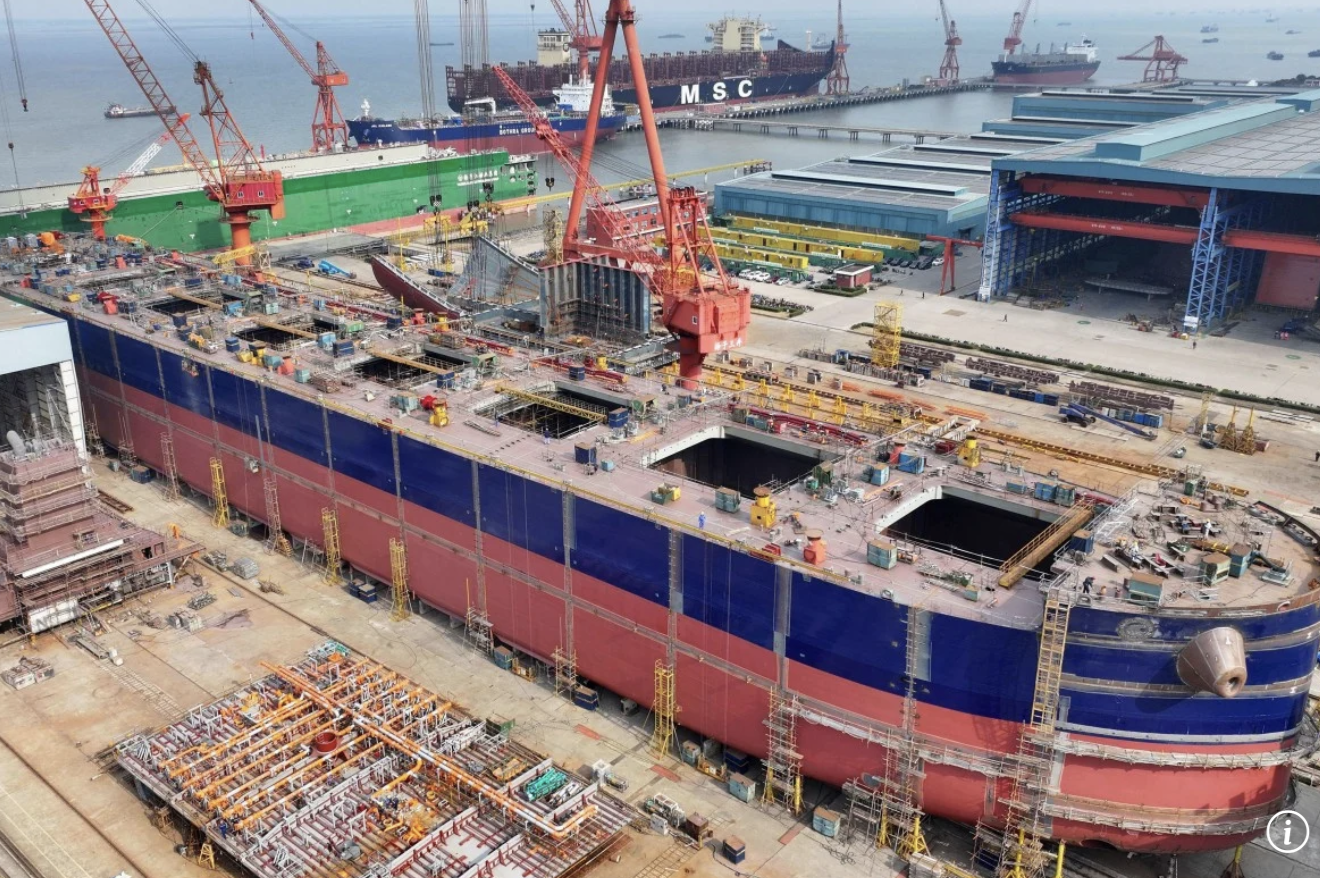
In the first half of 2026, China's shipbuilding completion volume reached 36.5 million deadweight tons, a year-on-year increase of 51.2%, accounting for 62.2% of the world's total. New orders reached 121.06 million deadweight tons, a year-on-year increase of 173.1%, accounting for 82.3% of the world's total. The order backlog reached 363.25 million deadweight tons, accounting for 71.2% of the world's total. All three indicators reached record highs.
For 16 consecutive years, China has maintained its position as the world's largest shipbuilder, accounting for over 56% of global shipbuilding completions, 69% of new orders, and nearly 67% of its order backlog. A complete industrial chain has been formed for large container ships, LNG carriers, oil tankers, and complex marine engineering equipment.
Russia seeks cooperation with China because it values delivery capabilities and industrial support. Price is only one factor.
The Russian side is discussing " distributed shipbuilding "—where some design, assembly, equipment, or hull construction can be shared across shipyards. Russia doesn't need to wait for all its domestic shipyards to be fully expanded before catching up with its 2030 capacity targets. The more ships the Northern Sea Route needs, the easier it will be for China's shipbuilding industry to translate its scale advantage into faster delivery.
IV. Where were America's core assets stolen?
The United States and its allies possess a stronger financial, insurance, port, sanctions enforcement, and maritime military presence within the traditional Eurasian maritime transport system. The Northern Sea Route, running along the Russian coast, receives a significant portion of its cargo from Russia, and its vessels are likely built and operated by China, thus reducing reliance on Western maritime services in certain transport segments.
This is where US sanctions fail. For sanctions to be effective, the target country needs to lack alternative shipyards, alternative insurance, alternative settlement methods, and alternative markets. Once Chinese shipyards enter the ice-class shipbuilding sector on a large scale, at least in the area of "whether there are ships to build," the original constraints imposed by the West will be breached.
The U.S. Department of Defense's Arctic strategy has included expanding Arctic cooperation between China and Russia as a key focus. Washington's main concern is that as this new transportation capacity between China and Russia gradually takes shape, the effectiveness of past pressure tactics relying on shipping services, sanctions lists, and maritime nodes in the South China Sea will be weakened.
The US intended to strangle Russia through sanctions, but instead, it has blocked Russia at the doorstep of Chinese shipyards. Ships on the Arctic shipping routes, which could previously be built in South Korea and Europe, may now all be built in China. Sanctions have not stopped Russia from developing the Arctic; they have merely shifted shipbuilding orders from the West to the East.
Conclusion
The fact that Titov publicly announced this news is itself a signal. Russia is considering building ships for the Arctic route in Chinese shipyards—this is not a trial run of one or two ships, but a systematic cooperation starting with 62 ships.
China has the world's largest shipbuilding capacity, while Russia has the world's longest Arctic coastline and a fleet of nuclear-powered icebreakers. US sanctions have forced these two partners, who could have gradually integrated, to a point where rapid alignment is imperative.
The US's core strength has been exploited, specifically the ineffectiveness of its sanctions tools. Sanctioning Russia didn't bring Russia down; sanctioning the Bank of China didn't cause the Bank of China to collapse; sanctioning Iran didn't prevent Iran from selling oil. Each round of sanctions is like digging a hole for oneself—the hole gets deeper and deeper, until finally Washington itself is buried in it.
俄罗斯把62艘北极船订单给中国,美国本想卡脖子,结果把活送上门_腾讯新闻
前言 《俄罗斯报》网站刊登了一则消息。俄罗斯总统特别代表季托夫在一场北极论坛期间透露,俄联合造船集团正在讨论把北极航线所需船舶放到中国船厂建造。季托夫说得不绕弯子:“中国是造船领域的领先者....