Navigation
Install the app
How to install the app on iOS
Follow along with the video below to see how to install our site as a web app on your home screen.
Note: This feature may not be available in some browsers.
More options
Style variation
You are using an out of date browser. It may not display this or other websites correctly.
You should upgrade or use an alternative browser.
You should upgrade or use an alternative browser.
Old Karachi
- Thread starter ghazi52
- Start date
More options
Who Replied?


ghazi52
THINK TANK: CONSULTANT
- Thread starter
- #48
Conquest of Karachi
Behram Sohrab H.J. RustomjeeBy the late Ardeshir Cowasjee
One hundred and sixty-four years ago the British decided to conquer Sindh. Rear Admiral Sir Frederick Maitland (who as captain of HMS Bellerephon in 1815 had the honour of transporting Napoleon Bonaparte to the remote island of St Helena) was ordered to land an invading force at Karachi.
He was aboard the flag ship, HMS Wellesley, built in Bombay. The fortress commander, the ‘Killardar’ of Manora, Wasul Ben Butcha, considered it beneath his Baloch pride to surrender. The Wellesley fired a broadside, the fort was smashed to smithereens, and the white flag was hoisted.
What did the unfortunate brave Wasul have on his side? If Sir Richard Burton is to be believed, his garrison was three-strong – an old man, a young woman and a boy. One gun had no carriage, another gun had been fired once and had jumped from its carriage – ‘which it had destroyed in its violent struggle for freedom’, and the third gun would not go off. (Hopefully, we are now better prepared.)
An agreement for the surrender of Karachi was signed by Maitland, and, as Behram Rustomjee (May 1912 – December 2002) writes in his book ‘Karachi’, : “Thus it was that Karachi came to be formally occupied by the British on 7th February 1839.”
Behli (as he was known) Rustomjee, who had graduated in London as a BE, was our English and modern history teacher at the Bai Virbaijee Soparivala Parsi High School in the mid-1930s. He rose to be principal and was at the BVS for over thirty years until he retired in 1965. How fortunate my generation was to have had teachers such as he and the great Shams-ul-ulema Dastur Dr Maneckji Nusserwanjee Dhalla (Ph.D, Columbia 1909) who taught us ancient history, the history of civilization and religion. Dr Maneck Bezonjee Pithawalla, a Doctor of Science, a Fellow of the Royal Geographical Society and also of the Geological Society, taught us geography and poetry. In fact, each could lecture on any subject.
Together with our academic learning, what was instilled into us was decency, tolerance, the spirit of ‘do as you would be done by’, the acceptance of the right of each man to his opinion, that religion is strictly between a man and his God and that it has nothing to do with politics or the state, that men of different faiths and beliefs can coexist, and that, above all, life is a gift from God to be lived and enjoyed to the full.
Behli gave me a copy of his book ‘Karachi (1839-1947)’ and in it he inscribed: “To a great-grandson of HJ from the author, a grandson of HJ. Let us work with unswerving faith on the future of Karachi, the city we both love.”
From the arrival of Sir Charles Napier in 1843 right up to the death of Mohammad Ali Jinnah in 1948 Karachi was a well-governed, tidy, clean and organized city. It was home to Hindus (of all castes and sorts), Muslims (Shias and Sunnis and all the other sects), Christians, Sikhs, Jains, Jews, Buddhists and Parsis who all coexisted amicably. And the same applied to the entire province of Sindh.
Behli wrote much on Napier, the first governor of Sindh, to whom the old and fine Karachi owes much. He tells us of the Italian marble obelisk erected in 1853 at what was later known as Napier Mole on which was inscribed the following words:
“From this spot on 1st October 1847 was fired the Farewell Salute to His Excellency Lt. General Sir Charles Napier, GCB, on his retirement from the Governorship of Sind, being the extreme point from which at that date a wheel carriage had ever passed along this Bunder, a work planned and executed under the government of His Excellency, and thus far completed at the date of his departure from this province.”
As says Behli, it was a befitting testimony to the planning and vision of Napier, to his extraordinary talent for civil administration, to his love for Karachi and to the care and attention he had accorded this then beautiful peaceful city. As he departed Karachi’s shores that morning on board the ‘Moozuffer’ bound for Suez, he exclaimed: “Thou shalt be the Glory of the East, would that I could come again to see you, Kurrachee, in your grandeur.”
Sir Charles Napier was ‘an old Peninsular Officer’ and the hero of the storming of the impregnable Imambargah fortress and of the victorious battles of Mianee and Dabo which rendered the province of Sindh unto the British Empire and gave rise to the story of the famous telegram he sent back to London which bore the sole word ‘Peccavi’.
He was 61 years of age in 1843 when he first came to Scinde (as it was then written). Slight and meagre of frame, scarred with the wounds of many battles, his conquest of our province was the culmination of his military career. He was appointed the first governor and commander of forces in Sindh by the governor-general, Lord Ellenborough. His first act was to move the centre of government from Hyderabad to Karachi, which for a sea power such as Britain could not have been a better choice.
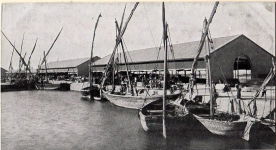
Thus started the transformation of Karachi from a ‘miserable native fortress’ into a thriving port, a fortified town and a nerve centre for its new rulers. He built the finest barracks to house his soldiers (these magnificent buildings still stand and house the offices of the commander 5 corps and the Naval Comkar), whose welfare was his primary consideration, he set up for them a sanatorium at Gizree and Clifton, and laid out gardens and playgrounds. He planned the construction of Karachi harbour and its docks, he set up a timber pile pier at Keamari and built a causeway between that point and the city of Karachi, and he built the Manora lighthouse.
To ensure a sufficient supply of water he laid down plans: “The waters of the Muleer River were to be utilized not only for irrigating the government gardens for fountains but also for the houses of the town, the cantonment and even for the harbour of Keamari.”
Law and order being the first duty of any government, it was Napier who organized the police department of Sindh and Sir Bartle Frere commenting on it wrote: “His police system was, at the time he introduced it, far in advance of any other in India. It has been the model for most of what is good in subsequent reform of the Indian police.”
Security brought an increase in trade and business and industry and a growth in population. Merchants and cultivators came to settle and British and Parsi mercantile men turned their attention to Karachi which promised to be the ‘great emporium of trade with Central Asia’.
On August 10, 1847, for reasons of his own state of health and that of his family, Napier sent in his letter of resignation to the governor-general, who, in accepting it, recorded his regret at the loss of an officer “who combined rare abilities for the civil and military administration of the country, an ability which justifies the unlimited confidence.”
To revert to Behli’s inscription in his book, the HJ to whom he refers was Hormusjee Jamshedjee Rustomjee (1846-1899), grand seigneur, merchant prince, philanthropist and Grand Master of his Masonic Lodge, who lived and enjoyed his life in Karachi, and who ensured that many less endowed than he were also able to enjoy life. A marble tablet salvaged from the Masonic Lodge has inscribed on it: “This tablet has been erected by the Masonic Fraternity of Sind as a mark of the esteem and respect in which H.J. Rustomjee was held, for his sterling qualities both as a gentleman and a Mason.”
Our school, the BVS, founded in 1859 and nurtured by many an educated man of the community, enrolled only Parsis until 1948, when, on Jinnah’s request,
its doors were opened to admit boys of any faith, irrespective of caste or creed. In the year 2000, the government education division adjudged it to be ‘the best private boys’ school of Karachi, and it was awarded the Millennial Shield.
(Source: DAWN.com, Dated Feb 09, 2003)
ghazi52
THINK TANK: CONSULTANT
- Thread starter
- #50
Bicycles as a Means of Livelihood
Posted on November 21, 2023 by Amin H. Karim MDBy Menin Rodrigues


How a pair of wheels shaped our lives in good old Karachi.
HOMESTEAD: November 21, 2023 – In the days of our youthful exuberance, cycling was a passport to adventure, a vehicle of freedom that whisked us away from the mundane into a world of endless exploration. The wind in our hair, the rhythmic spin of the pedals, and the open road before us created a symphony of excitement. It may not have been a mode of transport for us like it did for many others, but it was a gateway to joy.
I am sure many of us have our own stories to tell and how cycling was a part of our lives, however, this recollection is about how cycling, as a means of livelihood, was a routine spectacle in the Karachi of yore – in this case, specifically the 1960s and 1970s. Here is a memory recall of who among the city’s visibly distinctive vendors used bicycles for their daily chores and economic sustenance.
As the very first rays of dawn crept over the horizon, there was a familiar sight that became the harbinger of a delicious morning ritual in Karachi. It was the ‘Roti-Walla,’ who embarked on his daily journey, pedaling his way to your doorstep. His cargo consisted of woven baskets, laden with the enticing aroma of piping-hot ‘karak’ double roti.
The ‘karak’ in the name had always held a particular fascination for me, akin to a captivating riddle that begged for an answer. What exactly made this roti ‘double’? Was it the layers of its soft, flaky texture, or was it the way it seemed to magically double the pleasure of breakfast? These early morning musings were an intrinsic part of this delightful ritual, where the ‘Roti-Walla’ not only delivered nourishment but also added a pinch of mystery to the dawn of each day, making each bite a moment of delectable intrigue and warmth.
After the ‘Roti-Walla’ had made his aromatic delivery, the ‘Doodh-Walla’ would gracefully roll into the neighborhood, announcing his arrival with the gentle clinking of milk cans. His trusty bicycle bore the weight of canisters filled to the brim with fresh, creamy milk, which exuded an irresistible fragrance of goodness. This daily spectacle was a cornerstone of life in Karachi, a reminder of how life was so simple then.
What truly distinguished the ‘Doodh-Walla’s’ role was the remarkable precision with which he executed his task. With dexterity honed by years of experience, he would deftly transfer the milk from his larger containers into smaller ones.
These smaller vessels were perfectly calibrated to cater to individual homes or, in some cases, to traverse the labyrinthine lanes of multi-story buildings, where the milk was delivered from one apartment to another, and sometimes, from one floor to the next. The ‘Doodh-Walla’ was the quintessential milk conductor, ensuring that every household, regardless of its location or size, received its share of the freshly drawn dairy goodness.
Between 9:00 and 10:00 am, the ‘Machli-Walla’ would make his appearance, a cornucopia of fresh seawater fish straight from the Arabian Sea. Their sales pitch would echo through the neighborhood compounds as womenfolk eagerly clustered around their bicycles, peering into baskets packed with an array of fish, carefully preserved amidst mounds of ice.
These peddling fish vendors of Karachi were a well-coordinated cohort, numbering about 500 in my estimate. They embarked on their daily odyssey to the harbor as early as 3 a.m., haggling for their day’s requirements. Returning to the city in groups of 20 or 30, they would fan out to their respective ‘mohollas’ or neighborhoods. Each ‘machliwalla’ had his allotted catchment area for business, and no other ‘walla’ would dare to infringe upon it.
The ‘Khana-Walla‘ (or the ‘Dabba-Walla’) followed closely between 10.00 and 11.00 a.m., an intriguing sight as several of them pedaled along, each of their cycles loaded with no fewer than 20 to 30 tiffin boxes (3 or 4-tiered), neatly stacked on both sides of their contraptions.
Families entrusted their most cherished and ‘reliable’ service for the task of delivering home-cooked meals to their loved ones toiling in offices. Once again, these ‘khana-wallas’ numbered in the hundreds. They would gather the tiffin boxes from various neighborhoods and congregate at a designated roadside corner to sort them based on their ultimate destination.
The tiffin boxes would then be exchanged with meticulous precision, ensuring not a single mistake was made in the process. These swapped tiffin boxes would be expertly delivered to their rightful recipients, only to return to the ‘exchange’ spot for reloading onto the original ‘khana-wala’ bicycle, ready for their next leg of the journey – back to where they had originally picked up their sets.
Following in this parade of service providers was the ‘Dhobi,’ pedaling his way to your door. His faithful bicycle often bore two towering stacks of bundled clothing: one stack consisted of freshly hand-laundered and crisply ironed garments, tied to the back carrier, while the other contained the ‘to be washed’ items, held tightly together on the handle.
The dhobis, much like their fellow ‘wallas,’ were a highly organized and disciplined group of individuals. Dealing with a myriad of garments, bedsheets, towels, shirts, trousers, and more, they demonstrated an uncanny ability to never mix up their orders or deliveries. Garments that were returned after a thorough cleansing sported an immaculate finish, each crease and fold diligently pressed, with an abundance of starch to ensure they appeared as sharp as new.
In the tapestry of memories that weaves together the simple yet rich life in Karachi, the bicycle-wielding service providers stand as silent but cherished threads. Their daily arrival was a steadfast part of our existence, and their services were far more than mere transactions. These individuals became integral to our families, representing reliability and trust, etching their names in our hearts with the dependable turn of their bicycle wheels. Their generations still render some of these services.
In a world far removed from the hurried pace of today, where technology reigns supreme, the ‘wallas’ who brought their services (bread, milk, fish, food, and laundry) to our doorsteps on humble bicycles were the bearers of tradition, connection, and an era marked by personal service, community bonding, and the unforgettable charm of a bygone Karachi. © Menin Rodrigues

RescueRanger
Meme Lord
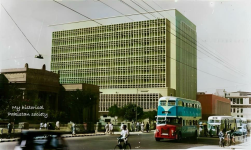
Double Decker buses such as the one pictured here were manufactured by Leyland, England and after decommissioning, one of these were stored in the shed near P.E.C.H.S Colony up until 93, then sadly it disappeared. Some say, it was sold to a private collector from the England.
ghazi52
THINK TANK: CONSULTANT
- Thread starter
- #52
Karachi Cinema Houses
Posted on April 23, 2019 by Amin H. Karim MD
The credit for this idea of arranging photos of Karachi based on their category goes to Menin Rodrigues. Karachi had at one time more than 100 cinema houses. There is an article on them on this site which details the various cinema houses in the city. On this page we will just show the pictures of those houses that are available. If you have any photo of a movie house of Karachi that is not represented here please send it to us and we will publish it with credit to you. Please send it to [email protected] Thanks.


RescueRanger
Meme Lord
Nishat Cinema, Karachi is mentioned in the Movie theaters hall of fame:Karachi Cinema Houses
Posted on April 23, 2019 by Amin H. Karim MD
The credit for this idea of arranging photos of Karachi based on their category goes to Menin Rodrigues. Karachi had at one time more than 100 cinema houses. There is an article on them on this site which details the various cinema houses in the city. On this page we will just show the pictures of those houses that are available. If you have any photo of a movie house of Karachi that is not represented here please send it to us and we will publish it with credit to you. Please send it to [email protected] Thanks.
Movie Theaters - Cinema Treasures
We're building the world's largest guide to movie theaters.
cinematreasures.org


ghazi52
THINK TANK: CONSULTANT
- Thread starter
- #56


Karachi Cinema Houses
The credit for this idea of arranging photos of Karachi based on their category goes to Menin Rodrigues. Karachi had at one time more than 100 cinema houses. There is an article on them on this sit…
 goodoldkarachi.com
ghazi52
THINK TANK: CONSULTANT
- Thread starter
- #57
Luckily, I had seen movies in all these cinema halls.Nishat Cinema, Karachi is mentioned in the Movie theaters hall of fame:
Movie Theaters - Cinema Treasures
We're building the world's largest guide to movie theaters.cinematreasures.org
ghazi52
THINK TANK: CONSULTANT
- Thread starter
- #58
Yes, I travelled in them.Double Decker buses such as the one pictured here were manufactured by Leyland, England and after decommissioning, one of these were stored in the shed near P.E.C.H.S Colony up until 93, then sadly it disappeared. Some say, it was sold to a private collector from the England.
ghazi52
THINK TANK: CONSULTANT
- Thread starter
- #59
Trams of Karachi
Posted on May 17, 2019 by Amin H. Karim MDBy Menin Rodrigues
The idea of a tramway system for Karachi was conceived and a tender for its construction was first made in 1881. On February 8, 1883 a plan for a tramway was drawn up and permission obtained from the government for the use of steam-powered trams. In October 1884 construction was started. John Brunton was the Chief Engineer of the project. The tramway was opened on April 20, 1885 employing steam-powered cars. The opening ceremony took place near St Andrew’s Church (Abdullah Haroon Road and Sharah-e-Liaquat).


Users who are viewing this thread
Total: 1 (members: 0, guests: 1)
Pakistan Defence Latest
-

-
-
-
 KP govt backs out of counterterrorism commitments during talks: Naqvi (3 Viewers)
- Latest: Distant_Observer
-
Country Watch Latest


Latest Posts
-
-
 Makkah Defence Alliance: Turkey, Saudi Arabia, and Pakistan, news & updates (36 Viewers)
- Latest: Mobius
-

-