Old/New Articles and News item about PAF

Aeronautical Prowess: Pakistan Air Force’s Bold Steps Towards Air Superiority​

ByAbdul Wassay
January 24, 2024

Founder of Pakistan Quaid-e-Azam Muhammad Ali Jinnah said,
“There is no doubt that a country without a strong Air Force is at the mercy of any aggressor. Pakistan must build up her air force as quickly as possible. It must be an efficient air force second to none and must take its right place with the Army and the Navy in securing Pakistan’s Defence.”

“Second-to-None” is the way the Pakistan Air Force (PAF) takes when it comes to safeguarding the airspace and effectively projecting its prowess in front of its adversaries. PAF is also dedicated to technological advancements, operational excellence, and preparedness through indigenization and human resource development.

In the 1st week of 2024, PAF conducted its aircraft fleet’s “Induction and Operationalization” ceremony, which included the induction of various fighter jets and air mobility platforms like the J-10 CP Vigorous Dragon, C-130 Hercules, Boeing 737, Piper M-600, and Beechcraft Super King Air 350i aircraft.

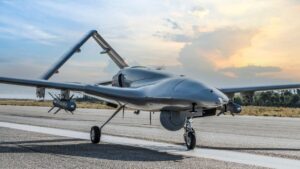
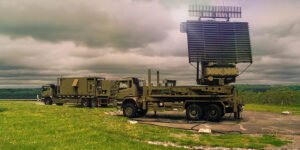
The PAF has also inducted modern radars and unmanned Aerial Systems like Bayraktar Akinci, Tb2, and Shahpar-II along with Swarm Drones. Various munitions for the platforms were also displayed at the event inducted that day.

Speaking at the ceremony, the Chief of Air Staff, Air Marshall Zaheer Ahmed Baber Sidhu, emphasized the PAF’s readiness to integrate specialized technologies via rapid strategic inductions from friendly nations and diverse indigenous initiatives. He further elaborated on his vision to transform the PAF into a formidable air force of the next generation.

Chief of Army Staff General Asim Munir was the Chief Guest at the ceremony, and he commended the dynamic leadership of Air Chief Marshal Zaheer Ahmed Baber Sidhu and lauded the operational preparedness of Pakistan Air Force in incorporating state-of-the-art weapon systems, substantially contributing to ensuring the balance of power in the region.

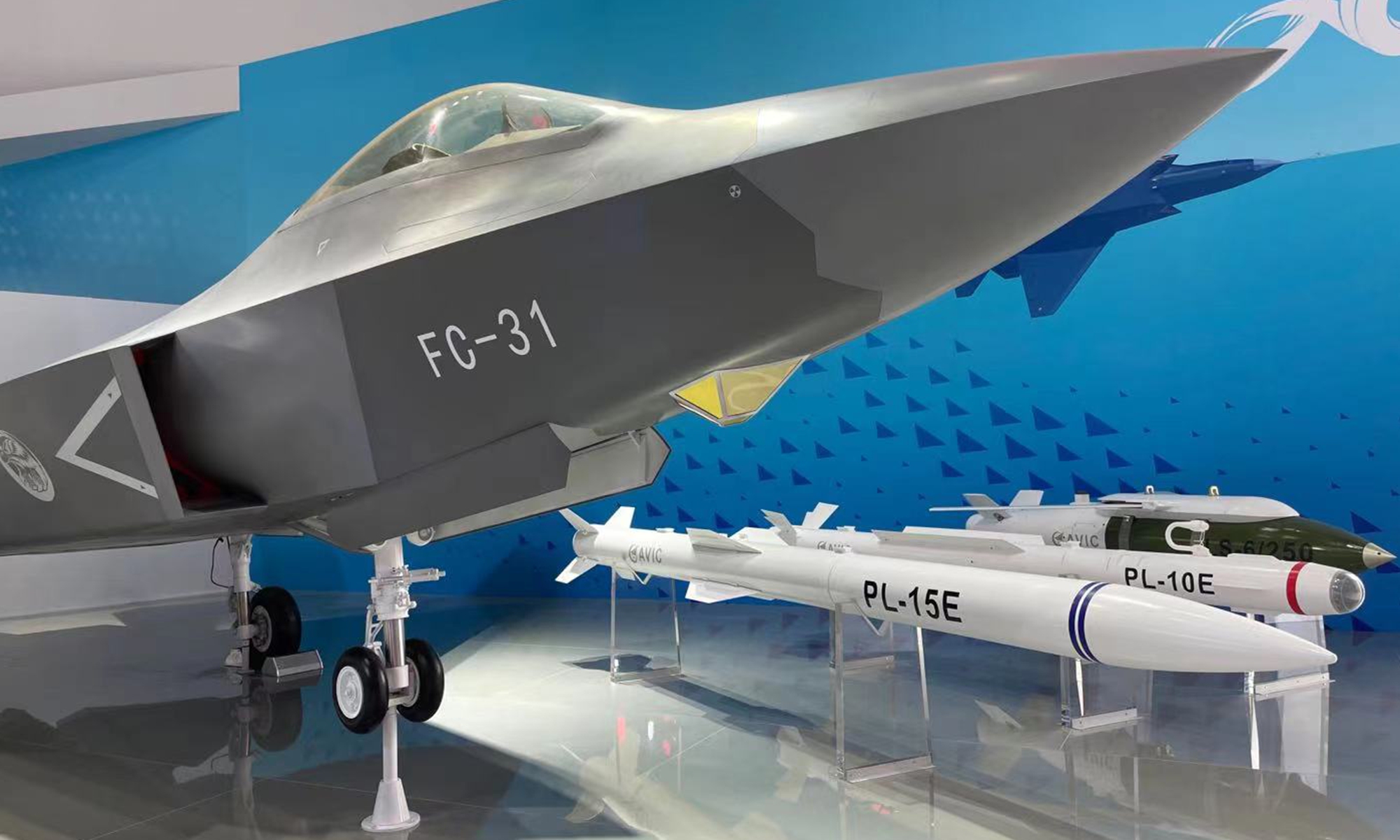
The most interesting development for the PAF and the defence enthusiasts was the announcement that the foundation for acquiring the Shenyang J-31 Stealth Fighter aircraft, which would become part of the PAF fleet in the foreseeable future, had already been laid. This is a huge development because Pakistan would be the 1st nation in South Asia to acquire 5th Generation Stealth Aircraft with advanced avionics and munitions from neighboring China.

This revelation offers a glimpse into PAF’s strategic outlook and its efforts to maintain regional aerial dominance. Pakistan’s induction of J-10CP into its fleet was also an answer to the Indian Air Force’s induction of advanced 4+ Generation French Rafale Jets, which hindered the balance of power in the region along with long-range S-400 Surface-to-Air Missile System Induction.

Shenyang J-31, when inducted, would give Pakistan Long-Range target capability without detection. Once acquired, the new fighters could replace early versions of the American F-16 aircraft in Pakistan’s fleet.
Pakistan Air Force is also in the process of upgrading its Airborne Early Warning and Control System (AEW&Cs) and Electronic Warfare (EW) aircrafts.

These aircraft are often underrated but are important to gain air superiority in an air battle. PAF’s DA-20 Falcon EW aircraft blinded the Mig-21 Bison of the Indian Air Force Pilot Wing Commander Abhinandan during the 2019 Operation Swift Retort. Then PAF’s aircrafts were able to shoot the Mig-21.
Pakistan Air Force’s Pakistan Aeronautical Complex (PAC) Kamra is also developing and inducting JF-17 Thunder aircraft in a Joint venture with China.

Recently, Pakistan inducted the Block-III Variant of the aircraft, which features advanced sensors, avionics, long-range air-to-air missiles, and an advanced AESA radar for long-range detection. Other enhancements include a reduction in the aircraft’s radar cross-section, which is a result of greater use of composite material.

These recent inductions show a strategic shift from Western Military equipment to Indigenous and Eastern suppliers like China and Turkey. This will ensure that Pakistan will not be dependent on the supplies of spare parts and munitions from the United States or any other Western states during the crisis.

Pakistan also faces a constant economic crunch, so the indigenization and import of non-western platforms will have less economic burden on the economy.

With all these inductions, the Pakistan Air Force will give its aircraft inventory a major, much-needed boost to counter the growing threat from its Eastern neighbor, which is modernizing its air force rapidly.

The prospective acquisition of Shenyang J-31 Stealth Fighter highlights a significant leap in Pakistan’s air defense capabilities.

The PAF demonstrates a commitment to self-sufficiency and readiness with a focus on indigenization, upgrades to critical systems, and a strategic shift towards non-Western and indigenous suppliers. This not only reinforces its regional aerial dominance through aeronautical prowess but also positions the force as a technologically advanced and economically prudent guardian of national security, embodying a vision for a formidable air force of the next generation.

The overall aim of these power projections is to maintain a balance of power in South Asia against the hegemonic designs of our Eastern neighbor.

Photo Credits: Liu Xuanzun/Global Times


Pakistan Air Force To Acquire State-Of-The-Art Weaponry from Allied Nations​

Global Defense Insight
August 26, 2022

The Pakistan Air Force (PAF) is undergoing a massive modernization plan, and as part of those efforts, the PAF is acquiring cutting-edge weapons.
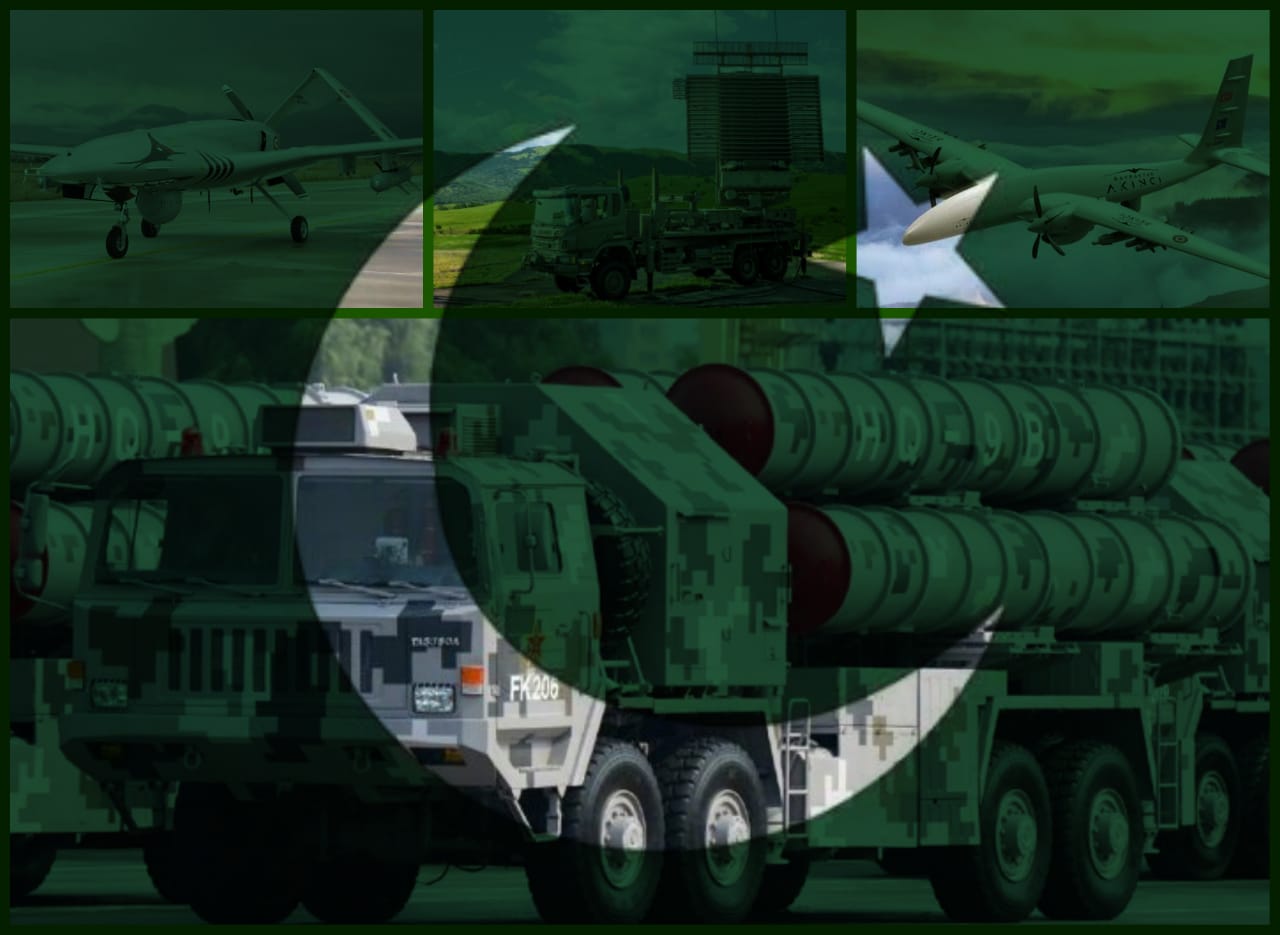
Video released on the occasion of Pakistan’s 75th Independence Day indicates that Pakistan Air Force (PAF) is procuring HQ-9B Air Defense System from China. Moreover, the video also indicates the acquisition of several other military equipment, including Bayraktar TB2 unmanned aerial combat vehicles (UCAVs), Akinci UCAVs, and TPS-77 (multi-role radar) MRR.

HQ-9B:

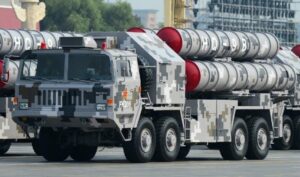
Chinese HQ-9 is a hybrid design based on a Russian SA-20, but with multiple improvements. Reportedly, it has a range of about 250 to 300 kilometers. Besides the S-400 purchased from Russia, the HQ-9B is China’s most capable multirole long-range air defense system. This air defense system is highly mobile and can be easily transported from one place to another.

HQ-9B Long Range Air Defense System


HQ-9B Long Range Air Defense System

Bayraktar TB-2:

As per information received by GDI Intelligence Wing, Pakistan has received a few Bayraktar TB2 UCAVs. Bayraktar TB2 is a Turkish-origin Medium Altitude Long Endurance (MALE) drone, capable of flying at an altitude of 24000 ft. with flying endurance of 24 hours. According to Baykar, the aircraft has a 150 km communication range, a 12-m wing span, a 650 kg maximum takeoff weight, and a 55 kg payload capacity.

Bayraktar TB2 UCAV


Bayraktar TB2 UCAV
Read More: Bayraktar TB2: Ankara’s dominance in drone warfare

Baykar Akinci:

PAF video also shows short footage of the Akinci High Altitude Long Endurance (HALE) drone. Reportedly, Pakistan will start receiving 1st batch of Akinci UCAVs in 1st half of 2023. Akinci is a twin-engine combat drone being developed by the Turkish firm “Baykar”. The latest variant of the Akinci drone can carry payload of up to 2000 kilograms.

TPS-77 MRR:
Pakistan Air Force (PAF) has received several batches of AN/TPS-77 Multi-Role Radars from Lockheed Martin. To read about AN/TPS-77 radar: click here

TPS-77 MRR


TPS-77 Multi-Role Radar

 
To view this content we will need your consent to set third party cookies.
For more detailed information, see our cookies page.
 

THUNDER DRAWS FIRST BLOOD​

  1. Aviation Features
  2. Thunder draws first blood


20th July 2017
FEATURE

THE JF-17 saw its first air-to-air action on June 19 since its induction to the Pakistan Air Force back in 2010.
A JF-17A operating from an undisclosed PAF base shot down an Iranian UAV on a reconnaissance mission over the district of Panjgur in the province of Balochistan, on the Pakistan-Iran border.
Although reports of the incident first surfaced in the media on June 20, Pakistan’s Ministry of Foreign Affairs only acknowledged the shootdown on the 21st.
According to an official press release, the drone was hit as it was unidentified and flying at around 3 to 4km (1.9 to 2.5 miles) inside Pakistani territory.
The PAF has not released information on the type of UAV or how it was downed, although pictures circulating online showed the wreckage, including a Rotax engine. Waseem Abbas
 

MAIDEN FLIGHT FOR PRODUCTION CH-5 DRONE​

  1. Aviation Features
  2. Maiden flight for production CH-5 drone


17th August 2017
FEATURE


img_28-2_32.jpg

via Chinese internet
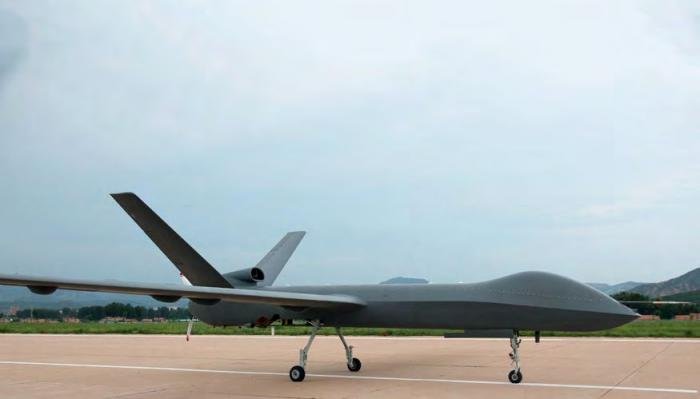
THE SERIES production version of the CH-5 – or CaiHong (Rainbow) 5 – unmanned aerial vehicle (UAV) performed its maiden flight in north China’s Hebei Province on July 14. The current model has been comprehensively revised compared with the UAV that was first flown in August 2015 before being unveiled at the Zhuhai Airshow in November last year. The new CH-5 features more aerodynamically refined lines that will improve its stealth characteristics.
Intended primarily for export, the CaiHong family of UAVs is being developed by the Academy of Aerospace Aerodynamics, also known as the 11th Academy or 701st Research Institute, part of the China Aerospace Science and Technology Corporation (CASC). The series includes the CH-3 operated by Myanmar, Nigeria and Pakistan (as the locally built Burraq) and the CH-4, used by Egypt, Iraq and Saudi Arabia. Andreas Rupprecht
Thumbnail

Originally published in AirForces Monthly Magazine​


FC-20 / J-10CE / J-10CP Fighter​

FC-20
Independently developed by China's aviation industry, the J-10CE is an all-weather, single-engine, single-seat, multirole, fourth-plus generation fighter jet. It excels at systematic, cooperative combat, is capable of striking multiple targets from beyond visual range under complex electromagnetic environment, and can deliver precision attacks on ground targets with multiple guidance modes. Equipped with advanced comprehensive avionics and weapon systems, the aircraft boasts outstanding mid-to-low altitude combat maneuverability, supersonic flight, short-range takeoff and landing, large combat radius, long range and mid-air refueling capabilities. The J-10CE is not only more powerful than the lightweight JF-17 because of its bigger size, it is also more powerful than Pakistan's old US-made F-16 fighter.

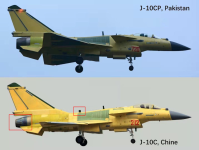
Pakistan's J-10CP uses a more stubby "Taihang" engine, and at the same time lacks the data link antenna on the baseline J-10C. Pakistan signed a $1.4 billion deal with China in 2009 to buy a reported 36 J-10B Vigorous Dragon multirole fighters. Pakistani media reports suggest that the country purchased a total of 25 J-10CEs. According to Defense News on 07 October 2013, the most probable buyer of J-10, Pakistan, might put off the purchase plan under the influence of economic factors and technology maturity. By 2013 tough International Monetary Fund conditions on Pakistan and concerns about untested technology delayed Islamabad's plan.

The United States needed Pakistan's help in the Soviet invasion of Afghanistan. So from 1983 to 1987, the United States provided Pakistan with 40 F-16A/BBlock15 fighter jets. However, with the end of the Soviet Union's invasion of Afghanistan, Pakistan's strategic value to the United States decreased sharply. In 1990, the United States froze the 28 F-16A/Bs that were about to be delivered to Pakistan and refused to return the purchase price. sanctioned for 11 years. A turnaround occurred in 2003. The United States began to get stuck in the Afghanistan battlefield. The United States needed to use Pakistan to build a stable logistics supply line. Therefore, the United States delivered 14 of the 23 F-16s detained to Pakistan from 2005 to 2008. In 2006, the United States provided Pakistan with 12 F-16Cs and 6 F-16DBlock52+ in the form of military aid and plans to provide 18 additional aircraft to Pakistan. That is to say, at least 30 of the 76 F-16s in active service in Pakistan have reached the service time of more than 30 years, which is basically the highest period of fighter service. The airframe has basically reached its life without major life extension.

Compared with Pakistan's F-16, its performance is not bad in all aspects. The J-10 itself has been replaced. The domestic "Taihang" engine has been completely localized, and export is not a problem at all. Moreover, Pakistan itself has experience in the use of Chinese fighter jets, and the main fighter jets and early warning aircraft in active service are developed and produced in China, and various ammunition are also produced in China. Therefore, even if the new J-10C is introduced, it can be quickly integrated into the combat system, forming combat effectiveness in a short period of time, and reducing the production countries and types of fighter aircraft and ammunition can also reduce the logistical pressure of the Pakistan Air Force. The overall price of Chinese weapons and equipment in the international market is not very high, and it is also suitable for Pakistan from an economic point of view.

The Pakistani Air Force often comes into contact with China's J-10 series fighter jets, and Chinese J-10C fighter jets have gone abroad for many times to participate in the "Eagle Series" exercises of the China-Pakistan Air Force. Pakistani media interviewed Pakistani Air Force sources at the time, saying that the agility and excellent avionics of the J-10C left a deep impression on the Pakistan Air Force.

Although Pakistan already offered an olive branch to China’s J-10 fighter jets and its Chief of Army Staff Qamar Javed Bajwa even personally mounted on a J-10C during the “Shaheen-VII” China-Pakistan joint air exercise at the end of 2018, it remained hard for the country to make up its mind to sign the official contract to purchase J-10 aircraft. It was not until 2016 that China's aviation industry admitted that it had just received official approval to export the FC-20 "in the past few years", and exhibited the J-10A with the words FC-20 written on it for the first time at the Singapore Air Show in February of that year. Fighter model. Pakistan, on the other hand, only came into contact with the J-10C fighter in a close-to-combat environment after the "Eagle-VII" China-Pakistan Air Force joint exercise in 2018.

Judging from this relatively compact procurement decision, on the one hand, Pakistan has completely abandoned the previous stereotype of Chinese aviation equipment, on the other hand, it fully recognizes the performance advantages of the new generation of Chinese fighter jets, and will obtain advanced equipment such as the J-10C as the Pakistan Air Force. On the other hand, the contract signed by India and France to purchase 36 Rafale fighter jets in 2016 put enormous pressure on Pakistan, making Pakistan urgently need newer fighter jets.

the "Rafale" fighter, which uses the RBE-2AA active phased array radar after the upgrade, is completely different. As a serious fourth and a half generation fighter, the aircraft completely overwhelms the Pakistan Air Force's F-16 in performance. The Air Force purchased the "Meteor" long-range air-to-air missile with a huge range for its matching, which caused huge pressure on the Pakistani army. India purchased the "Meteor" long-range air-to-air missile with a maximum range of 200 kilometers. As a result, in the absence of an effective data link and guidance, the airborne fire control system of the "Rafale" itself is fundamental. Unable to take advantage of the missile's range, its actual combat effect is not necessarily better than the PL-15E with a range of 145 kilometers with the J-10CE.

To compare the performance of the J-10CE and the "Rafale" carefully, it is limited by the limited information that can be disclosed. Most of the time, it can only be said that the two have their own advantages. Due to the basic design factors of the Rafale, the multi-purpose performance, especially a series of ground There is even a clear advantage in the mountability of the weapon. However, in terms of air combat performance, which both the Indian and Pakistani air forces value most, it can only be said that the configuration of the "Rafale" is not as dominant as it looks on paper.

The purchase of the J-10C had not been confirmed for the Pakistan Air Force, but the rumors of Pakistan purchasing the J-10C have been around for a long time. According to the Pakistan Institute of Strategic and International Affairs (HSIA), the Pakistan Air Force has signed a supply contract with China Aviation Technology for the supply of the J-10CE (export type, also known as FC-20) fighter jets. According to the contract, the Pakistan Air Force will begin receiving the J-10CE fighter jets by the end of 2021, eventually reaching a delivery scale of about 36 aircraft and two squadrons. According to rumors, the 7th "Villain" Squadron at the Sumer Air Base will be given priority to replace the J-10C fighter jets, replacing the old "Phantom-3" fighter jets currently equipped by the unit.

According to a report by Pakistani media SAMAA TV on 29 December 2021, Pakistani Interior Minister Sheikh Rashid Ahmed said in a public speech to the media on the 28th that Pakistan purchased Chinese fighter jets. The 10C fighter jets will enter service as early as March 2022, and a full J-10C squadron of 25 fighter jets will perform an air show during the Pakistan Day National Day military parade on March 23, 2022. Minister Ahmed also commented that Pakistan's purchase of J-10C is a direct response to the purchase of Rafale fighter jets by the Indian army, which are far superior to French fighter jets.

In February 2022, photos of the J-10CE fighter produced by Chengfei, painted with the Pakistani flag and the Pakistani tail number, appeared on the Internet. After purported images of the J-10C fighter jet with the marking of the Pakistan Air Force emerged on social media and were widely circulated by media outlets, Chinese analysts lauded the latest defense cooperation between China and Pakistan, saying that the move yields great significance to both countries, in terms of boosting combat capabilities of the Pakistan military, promoting China's aviation equipment, and responding to both countries' security interests in the region.

First published on social media on 15 February 2022, the images showed two J-10Cs, equipped with China's domestically developed WS-10B Taihang turbofan engines, undertaking test flights at an undisclosed location.

The Pakistan Air Force on 11 March 2022 held an induction ceremony for the first batch of six J-10CE fighter jets in Kamra, with Pakistani Prime Minister Imran Khan attending the event. The official commissioning of China's new-generation main battle aircraft into the Pakistan Air Force marks the systematized, organic export of such aviation equipment by China, and is yet another major milestone in the export of China's advanced aviation equipment.


Pakistan Air Force - Modernization​

paf.gif
The US security assistance relationship with Pakistan resumed subsequent to September 11. Given its geo-strategic location and partnership in the Global War on Terrorism (GWOT), Pakistan is a vital ally of the United States, as reflected in the June 2004 designation of Pakistan as a Major Non-North Atlantic Treaty Organization Ally. By 2008 the United States had delivered a variety of equipment to Pakistan, including refurbished C-130E transports, refurbished P-3C surveillance aircraft, refurbished Cobra helicopters, new Bell 412 helicopters and a number of Harpoon missiles, Harris radios, AN/TPS-77 surveillance radars, night vision goggles and AIM-9M Sidewinder missiles.

On 16 July 2002, the Defense Security Cooperation Agency notified Congress of a possible Foreign Military Sale to Pakistan of C-130E Cargo Aircraft and associated equipment and services. The total value, if all options are exercised, could be as high as $75 Million. The Government of Pakistan has requested a possible sale of six used C-130E aircraft with engines, one C-130E operational capabilities upgrade aircraft for cannibalization with engines, upgrade of engines to Allison 56-A-15 engines, modification kits, spare and repair parts, devices, support equipment, publications and technical documentation, personnel training and training equipment, U.S. Government and contractor engineering and logistics personnel services and other related elements of logistics support.

The estimated cost is $75 million. This proposed sale will contribute to the foreign policy and national security of the United States by helping to improve the security of a friendly country which has been and continues to be an important force for economic progress in South Asia. Pakistan needs these aircraft to support a current and long-term airlift shortfall, both for Pakistan Air Force internal requirements, and as it seeks to support the U.S. Government with Operation Enduring Freedom. These C-130E aircraft will be used for the purpose of providing airlift support. Pakistan can easily absorb and utilize these within its existing structure.

In August 2003 Pakistan agreed to receive from the US six ex-Australian Air Force Lockheed C-130E Hercules aircraft. The seven aircraft had been in storage in the USA for three years awaiting re-sale. A contract was signed in September 2004, for Lockheed to upgrade the six aircrafts, while the seventh example will be used as spares. The first of the six Lockheed C-130 Hercules military cargo airplanes ordered by PAF in 2003, left US on 31 October 2005, heading for Islamabad. The disposition of these aircraf is unclear - logically, they would replace the older L-100 and C-130B in the PAF inventory, but this point is unresolved in the open literature.

PAF ordered four Mi-171 helicopters in 2002 from Ukraine for its Special Services Group, which were delivered in 2004. A follow-on order of further 12 examples was also placed. The helicopters were intended for search and rescue duties at various PAF bases. The delivery of the follow on order also commenced in 2004.

The first of four CN-235 transport aircraft ordered by PAF was delivered three months late, in February 2004, due to labour dispute at the aircraft factory. PAF ordered these planes in 2002 in a $52 million deal. The second example was delivered in September 2004. The delivery of the third was due in October and the final was due in December 2004. The final of the four CN-235 ordered by PAF from Indonesia, was delivered in Jun 2005. This is a VIP aircraft, the interior of which has been designed and fitted by Avion-interiors of Italy.

The “Air Force Development Plan 2025” was launched in 2003/04 by former resident Pervez Musharraf aimed at making it at par with modern air forces of the world. Under the plan, the PAF received money by the federal government till 2007. After 2007 PAF did not get a penny from federal government and had to shelve the plan. Due to financial constraints and non release of funds by the federal government, the Pakistan Air force (PAF) s suspended its up gradation and development plan. The PAF was also not given full share in the defence budget and it received only 60 per cent of the whole budget allocated for PAF.

The expenditure on the entire package would be met from PAF share in Armed Forces Development Program (AFFDP-2019). The Cabinet (Interim Government), according to the document, allowed PAF to set up Joint Working Group (JWG) with CATIC for procurement of 36 FC-20 aircraft. The government was also seeking for PAF in securing long-term credit financing for the J-10 aircraft from Chinese government, besides allowing PAF to initiate a Letter of Request (LoR) for the F-16 package and equipment through the Defence Ministry.

In June 2006, the PAF had signed a deal for the supply of six Saab 2000s. However, because of shortage of funds, the number of aircraft was revised to five. Another report suggests that the Erieye airborne surveillance system deal involves up to eight Saab 2000 aircraft. The first Saab 2000 AEWC aircraft ordered for the PAF was rolled out on 3 April 2008 at the SAAB factory in Sweden. The ERIEYE, developed by the Ericsson Microwave Systems, comprises fixed, dual-sided and electronically scanned phased-array pulse-Doppler radar mounted on top of the fuselage.

Pakistan Air Force received the delivery of a second Gulfstream 450 aircraft in November 2007. The first aircraft was delivered in December 2005.

Pakistan Air Force (PAF) Chief of Staff Tanveer Mehmud Ahmad gave an interview to AFM and was published in the September 2008 issue.

  • By 2015, PAF would comprise 240 JF-17, 60 F-16's, 40 FC-20's (PAF version of J-10), 50 F-7PG's [for a total of 390 combat aircraft, versus 335 in 2008], along with 4 SAAB Erieye, 4 ZDK-03 (PAF version of Y-8), 4 IL-78 Midas. In 2015 the PAF will remain at its current strength of 15 Squadrons.
  • The current order status comprised 150 JF-17's, 32 F-16's (variant unspecified), 4 Erieye's, and 4 IL-78.
  • The Block 52 F-16's will be based at PAF Shahbaz to replace Mirage air defense aircraft.
  • The Peshawar based 26 & 16 Squadrons will be the first to convert from A-5 to JF-17 in 2009. Delivery of JF-17 had started and once the assembly facility had been completed at AMF, the induction pace will pick-up to eventually allow delivery of 25-30 aircraft per year to achieve the final numbers by 2015 [this makes no sense, with a 30/year production rate only yielding about 150 aircraft by 2015, not the stated 240]. The 150 JF-17's are expected to equip 7 or 8 squadrons.
  • The FC-20 order would be confirmed in 2009. The current J-10 technology was not up to PAF requirements, and PAF hoped to include western equipment in the J-10. This would create a different version than the PLAAF J-10, which would be known as FC-20 in PAF service. The FC-20 would not be required to have conformal fuel tanks, since it had sufficient internal fuel capacity as well as AAR by Il-78 Midas tankers. The FC-20 requirement was 2 squadrons of 36-40 single and dual seater aircraft.
  • The IL-78 Midas tankers would provide aerial refueling for all PAF fighter aircraft excepttf the US manufactured F-16s. The F-16s can only refuel with a boom system, and the Midas will be equipped with a probe and drogue underwing pods system. First Midas delivery will commence early 2009. PAF is holding out hope that a KC-135 could be acquired from the US in the near future.
  • While the Erieye's will datalink the F-16's, they will not be able to do so with the Mirage fleet. The first Erieye will be delivered in 2009, followed by the remainder by 2011. The Chinese origin fighter aircraft will have AEW&C support from the planned acquisition of 4 ZDK-03 (Chinese Y-8 AWACS). The ZDK-03 contract was close to be being finalised for the required 4 aircraft.
  • The PAF is acquiring 2 Squadrons of the Italian Falco UAV with coversion taking place for operations from PAF Mushaf and PAF Peshawar. Eventually, the PAF plans to field 5-6 UAV Sqn's.


On November 20, 2008 Air Chief Marshal Tanvir Mahmood Ahmad said 36 high-tech combat aircraft (CF-20 aka J-10B ) would be inducted into the PAF fleet by 2010. He said that modalities were being discussed to acquire two squadrons of the aircraft for the PAF. He said the FC-20 aircraft had been selected after hectic and lengthy deliberations besides considering a long list of the similar category aircraft of various origins.

In September 2008 it was reported that Pakistan was to receive 20 refurbished T-37 training aircrafts from the USA. The aircraft will be supplied to Pakistan free of charge, however Pakistan will bear the cost of shipment only. The delivery of the aircraft was due in two months time.

On 25 January 2009 Pakistan's defence minister informed the parliament that Pakistan has placed a $278 million order for the Chinese AWACS system ZDK-03 based on Chinese Y-8 aircraft.

In January 2009 PAF received delivery of two IL-78 tanker aircraft from Ukraine, out of the four ordered. Once the IL-78 tanker aircraft have been commissioned into service, it will enhance the long range capability of Pakistan air force.

By 2014 Pakistan was concentrating on modernisation its air power, still in line with the Armed Forces Development Plan 2025, by seeking defense deals with China and Russia.


Fighters​

In July 2004 PAF finalised a deal with Libya to buy its fleet of 50 Mirage IIIs and Vs, 150 sealed pack engines and a huge quantity of Mirage spares. Libya had purchased the Mirage jets in the 1970s, and they had been grounded for the previous decade following sanctions imposed after the Boeing 747 was blown up over Lockerbie. With these airframes, Pakistan operated more Mirages than the French Air Force. It is believed that jets would be cannibalized for spare parts to provide spares for the PAF fleet of Mirages for the next seven to ten years. As of 2009 the Mirage Rebuild Factory, which is a part of PAC, had been rebuilding 35 year old version of the Mirage aircraft which were bought as scrap from various countries.

The PAF was offered the J-10 by the Chinese government as the future part of PAF, and the purchase of 36 J-10 aircraft, modified according to the requirements of PAF, was approved on 12 April 2006. The export version to the Pakistan would be called FC-20 (J-10B). PAF planned to purchase 36 to 100 FC-20 aircraft. It was initially panned that China would start exporting FC-20s to Pakistan in the 2014 to 2015 period.

In August 2011 it was reported that the Chinese government had offered to provide its advance fourth generation J-10B fighter jets to the Pakistan air force to meet its requirements of high tech fourth generation frontline fighter aircraft.

The J-10B is an improved version of the basic J-10A powered by the Chinese WS-10 engine. Pakistan has total requirement of 150 front line fourth generation aircrafts which will be met with the induction of Chinese J-10B/FC-20, F-16AM/BM and F-16 C/D Block 52+ fighter aircraft. In September 2013 it was reported that Pakistan air force (PAF) would receive its first FC-20 / J-10B fighter jet in 2014.


JF-17 SHOOTS DOWN UAV​

  1. Aviation Features
  2. JF-17 Shoots Down UAV


20th July 2017
FEATURE


A JF-17A flying from an undisclosed Pakistan Air Force base shot down an Iranian UAV operating on a reconnaissance mission over the district of Panjgur in the province of Balochistan, on the Pakistan-Iran border on June 19. Although reports of the incident first appeared in the media on June 20, Pakistan’s Ministry of Foreign Affairs didn’t acknowledge the shoot-down until the next day. This was the first air-to-air action for the JF-17 since its induction to the PAF in 2010.
According to an official press release, the drone was hit as it was unidentified and flying at around 1.9-2.5 miles (3-4km) inside Pakistani territory. The PAF has not released information on the type of UAV or how it was downed, although pictures circulating online show the wreckage. Waseem Abbas
Thumbnail

Originally published in Aviation News Magazine​


FIRST EX BELGIAN HERCULES FOR PAKISTAN FLIES AT MELSBROEK​

  1. First ex Belgian Hercules for Pakistan flies at Melsbroek


By Jos Schoofs 26th July 2022
NEWS

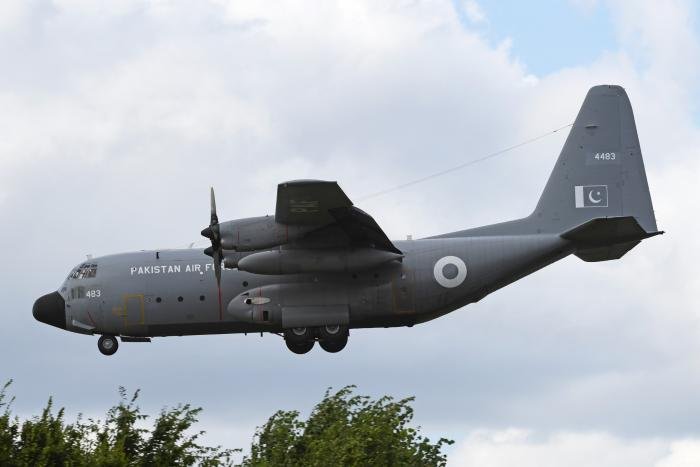
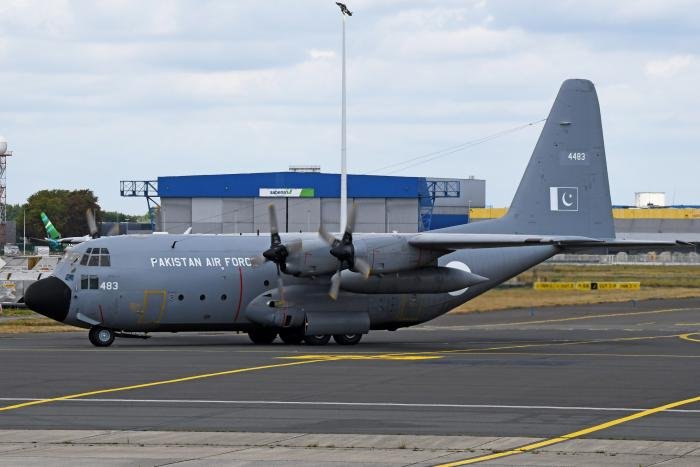
The first ex Belgian Air Force C-130H Hercules flew on July 25 in its new scheme of the Pakistan Air Force. CH-12 (c/n 4483), now carrying its construction number as a serial, made its first post-overhaul flight from Melsbroek Air Base and will soon be handed over to the Pakistan Air Force
Belgium withdrew its final Lockheed C-130H Hercules from service in December 2021. Seven of the remaining aircraft were sold with spare parts, propellers, engines and ground support equipment to a consortium consisting of SABENA Aerospace and Blue Aerospace.
Former Belgian Air Force C-130H (CH-12) approaches its former base of Melsbroek, Brussels, in its new scheme of the Pakistan Air Force.
Former Belgian Air Force C-130H (CH-12) approaches its former base of Melsbroek, Brussels, in its new scheme of the Pakistan Air Force. Jos Schoofs
The former is a Lockheed Hercules Service Centre since 1977 and is tasked with refurbishing the aircraft. The latter is the marketing element of the consortium which sold the entire batch of ex Belgian C-130Hs to the Pakistan Air Force.
The first flight of a former Belgian Air Force Hercules in Pakistan Air Force colours occurred exactly 50 years after the first aircraft of a batch of 12 ordered by Belgium in 1970 landed at Melsbroek Air Base on 25 July 1972. CH-12 was delivered to the Belgian Air Force on 2 April 1973 and flew for the last time in Belgian markings on 20 December 2021. The other aircraft destined for Pakistan are CH-01 (4455), CH-05 (4470), CH-07 (4476), CH-09 (4479) and CH-11 (4482).
The first Pakistan Air Force C-130H prepares for its post overhaul flight at Melsbroek Air Base after the previous Belgian Air Force C-130H fleet were sold to Pakistan after the withdrawal of service in December 2021.
The first Pakistan Air Force C-130H prepares for its post overhaul flight at Melsbroek Air Base after the previous Belgian Air Force C-130H fleet were sold to Pakistan after the withdrawal of service in December 2021. Jos Schoofs

Topics​

Read more about
Thumbnail

Originally published in Key.Aero​


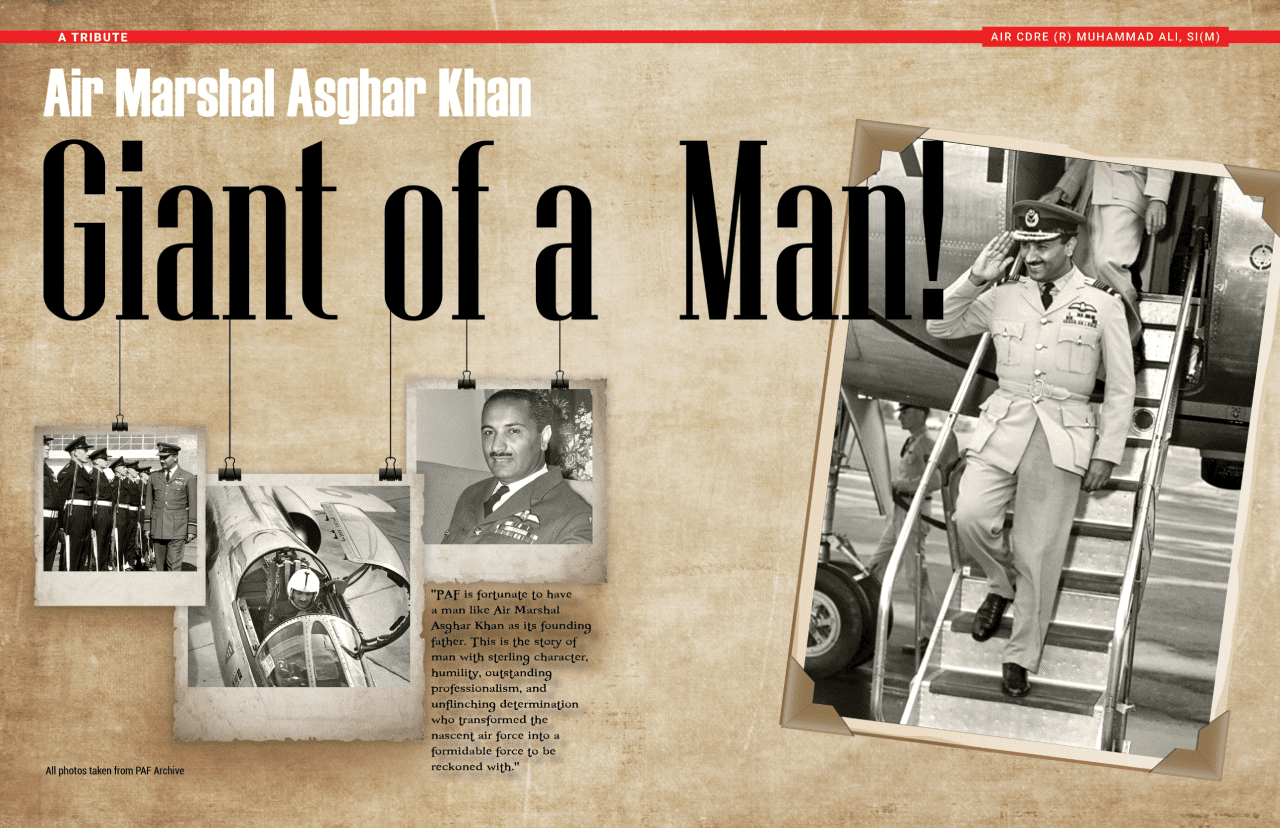
A Giant of a Man Air Marshal Asghar Khan​

Title-photo-3.png


In 2014, I was tasked by the then Chief of the Air Staff, Air Chief Marshal Tahir Rafique Butt to make a tribute documentary about retired Air Marshal Asghar Khan. I felt honored to have been given an opportunity to meet with someone who not only contributed towards military excellence, but also served for the cause of pacifism, peace, and human rights in the country after his retirement. Instead of approaching him directly, I set about preparing for the interview by speaking to people who had served with him, or knew him otherwise. The one thing that came up throughout these meetings was Asghar Khan’s non-indulgence in self-praise and reticence about interviews that glorified him. I was told that he’s a man of few words who believed in action rather than speech. Armed with this insight, I called his residence and spoke to Begum Asghar Khan. She was warm, cordial, and cautioned me about this kind of interview not being a norm for Asghar Khan.

01-3-1024x745.png


I vividly remember, it was a cold November morning when I turned up along with camera crew, half an hour before the appointed time, careful not to be late. I was ushered in, and the Begum Asghar Khan asked us if we would like some refreshments while we waited for the exact time of the meeting. At 1000 hrs sharp, we followed her into a study where the 90-year-old sat, ruddy in complexion, not a hair out of place. After the pleasantries had been exchanged, he asked me about my work and wondered why I would spend time on this when I could be utilizing it on something more productive. He surmised that since there wasn’t really much to tell, we should wrap up the interview in 15 minutes. I looked down at my meticulously prepared questionnaire, and wondered how I could finish my planned interview in such a short period. Nonetheless, I asked the camera crew to begin rolling. Seven and a half minutes into the interview, he brought my attention to the time elapsed and I knew that my questions had to be precise, and few. So far, he had tossed cold water at me. He had brushed off compliments, praises – from being the first Royal Indian Air Force officer to pilot the first fighter jet Gloster Meteor, to being the first and youngest Air Chief of air force in the military, to his contributions towards the excellence of PAF operations. “Anyone in my position would have done what I did. There was nothing extraordinary about me, and I deserve no praise,” he asserted. For the remainder of the time, every feat I asked him about, every stance that he took, he matter-of-factly responded that anyone in his stead would have done the same. I asked him if there was something he would like to say to the youth of PAF, the young boys; he said that they should do everything for Pakistan. If they are fighter pilots, they should love their profession, love flying, they should spend most of their time in their cockpits, and even those engaged otherwise, the priority for them should always be Pakistan.

Once the camera stopped rolling, I requested access to his library, his photos – the archive. As a true gentleman, he told me that he will get back to me once he has conferred with the Begum Sahiba. I was asked back on a Sunday morning to an admirable library in the house. The albums were housed here, long and well organized.

There was an impressive collection of books, some written by the Air Marshal himself. Armed with a scanner, I stayed for the two allotted hours, curating the precious years of history in that room which enabled me to educate myself about the great leader, who truly was a Giant of a Man!

Early Days​


Mohammad Asghar Khan was born to a military family on the 17th of January 1921. Brig Rahmatullah Khan, the father of Asghar Khan served in the Jammu and Kashmir Rifles of the British Indian Army and took part in WW2 in East Africa. Asghar Khan was the second amongst eleven children. His elder brother, Brig Aslam Khan, was a famous officer of Pakistan Army who earned his reputation as the “Legend of Baltistan” after his participation in first war with India in 1947-48.
02-3-1024x798.png


Asghar Khan joined Aitchison College for his earlier education and was later enrolled in the Prince of Wales’s Royal Indian Military College, Dehra Dun in 1933. He secured his matriculation in 1939. He appeared in the selection exam for Indian Military Academy. Only twelve candidates from entire sub-content passed the difficult test that year, out of them Asghar Khan was one. Initially, he wanted to join the RIAF, but the recruitment was put on temporary hold at that time. Instead of wasting time, he joined the army and was commissioned as a Second Lieutenant in the 9 Royal Deccan Horse. However, he had not forgotten his dreams to soar in the open skies. With the advent of the Second World War, the RIAF started recruiting pilots once more and Asghar Khan was seconded to the Air Force on 22 December, 1940.

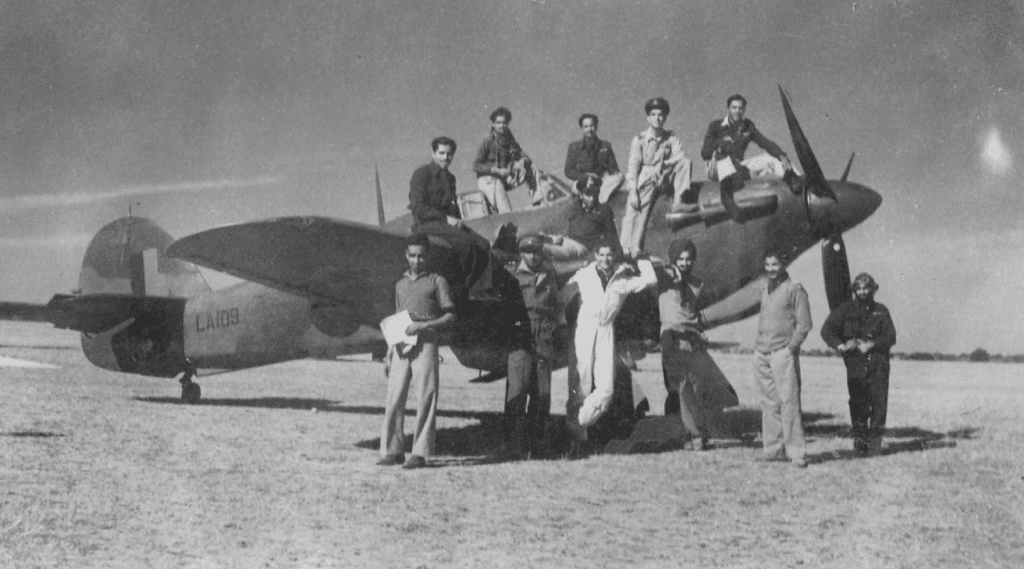
The training he undertook for the Air force started with a short stint in Walton, Lahore, followed by a three-month course in the Elementary Flying Training School in Hyderabad Decan. The first plane he mastered was the Tiger Moth, followed by the Hawker Audax, both bi-planes used by the RIAF.

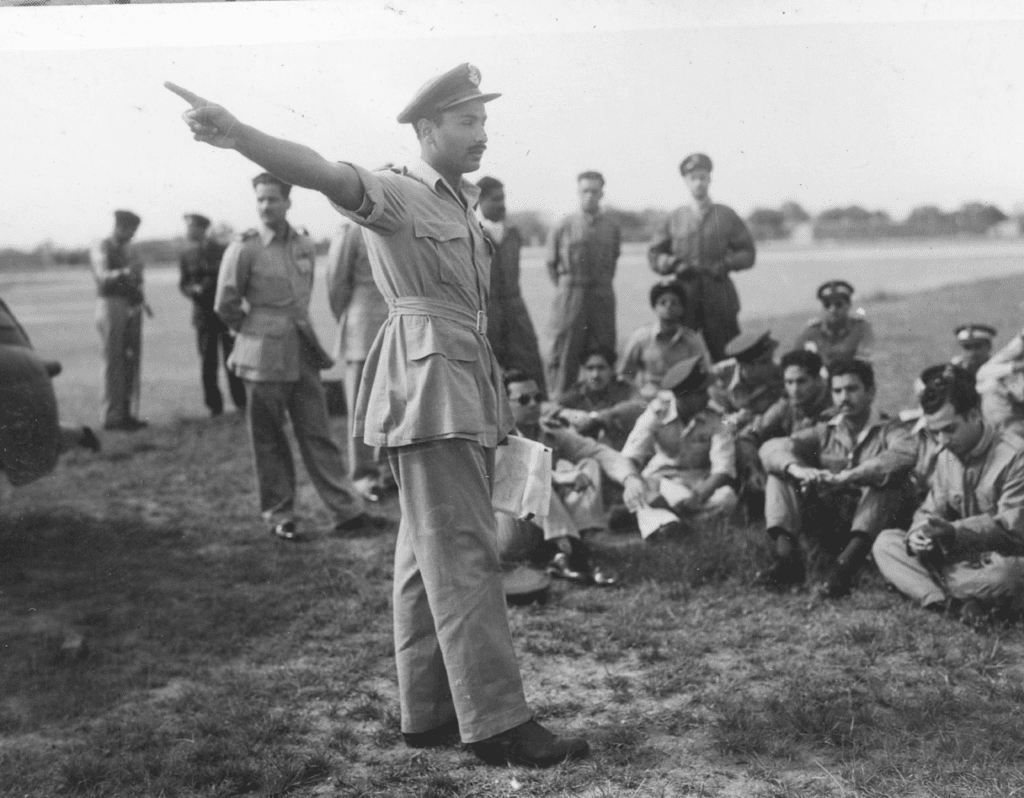
Asghar Khan was first posted in Peshawar and then, in Waziristan. In 1944, he assumed the command of his unit as Flight Commander and led the aerial missions of the famous No 9 Squadron in Arakan, Burma. He actively participated in the Burma Campaign (1944-1945), directing and commanding aerial operations against the Japanese forces in World War 2.

After the Second World War came to its end, Asghar Khan travelled to the UK to enroll in the RAF Staff College in Bracknell, from where he undertook a staff course. On returning from UK, he was appointed as the Chief Flying Instructor at the Advanced Flying Training School at Ambala. When the subcontinent was partitioned, he was still stationed at Ambala as chief flight instructor. As fate would have it, his replacement, Wing Commander Nair, asked the RPAF’s first air chief, Air Vice Marshal Allan Perry-Keene to have Asghar Khan and his family evacuated to Pakistan in the Air Chief’s plane. Perry-Keene obliged. It was later found that the train Asghar Khan and his family were supposed to travel by to Pakistan from Ambala was ambushed by rioters and all the passengers were massacred.

Ascent to the Top:​

03-3-1-1024x569.png


After Asghar Khan moved to Pakistan, he was promoted to the rank of Wing Commander and given charge of Royal Pakistan Air Force College in Risalpur.

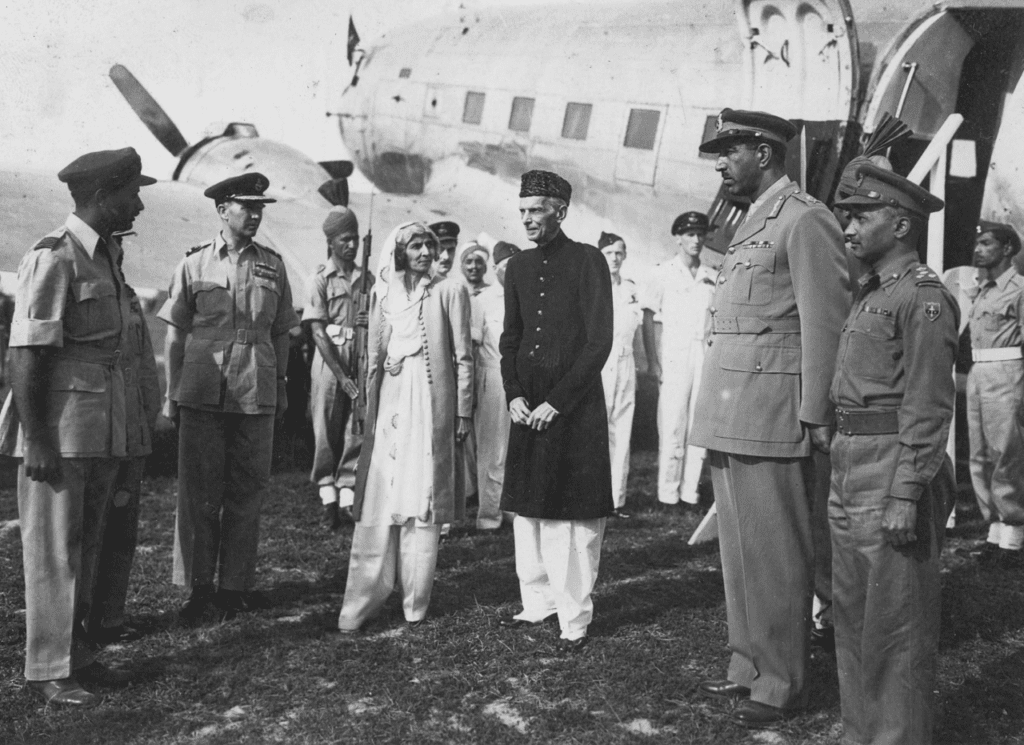
In 1948, Asghar Khan greeted the founder of Pakistan and Governor-General Muhammad Ali Jinnah when he visited for a passing-out parade. Asghar Khan and all present were deeply moved and influenced by Muhammad Ali Jinnah’s speech wherein he thundered the timeless words “A nation without an air force is at the mercy of any aggressor … second to none.” Impressed heavily by the Father of the nation, Asghar Khan took this advice to heart and went on to accomplish great feats which helped PAF, as well as the nation, to stand staunchly on its feet.

When he was done with his tenure at Risalpur, he was handed over the command of the Fighter Bomber Wing and subsequently, the No. 1 group of PAF in February 1949. In 1950, Asghar Khan became the Director General of the Air Operations (DGAO). After a successful five-year run, he was appointed as the Assistant Chief of the Air Staff in the Air Headquarters, in 1955.

Assuming the Role of Commander-in-Chief​

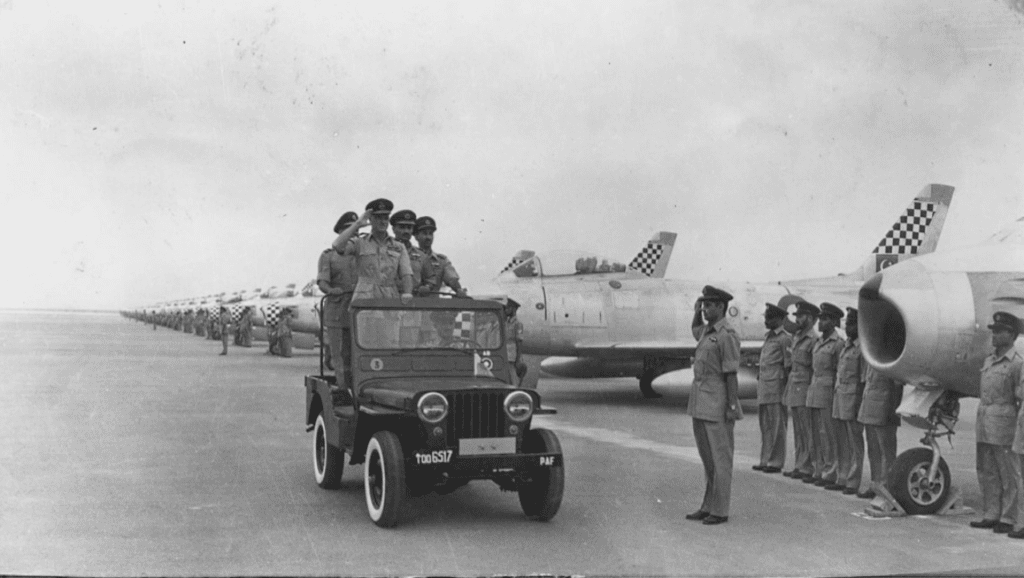
On July 23, 1957, Asghar Khan was promoted to the rank of Air Vice Marshal, thus becoming first native Air Force commander-in-chief at the age of 36. To-date, he has been the youngest to hold that rank. With the vision of the Quaid in mind, Air Marshal Asghar Khan embarked upon a comprehensive strategy to modernise PAF by inducting state-of-the-art aircraft of that time and developing modern infrastructure.

Air Marshal Asghar Khan was a resolute commander and a visionary leader who believed in leading from the front. Being the visionary, he knew the requirements of a potent air force and started to induct modern weapon systems into PAF. There were new developments everywhere. New air bases were being established; the first air defence radar was installed at Badin, and PAF was rapidly setting up its own advanced flying and technical training institutions. New generations of post-independence youth were gaining skills and confidence under their Pakistani squadron and wing leaders.

The visionary leadership of Air Marshal Asghar Khan transformed PAF into a modern air force with the induction of new jet fighters, bombers, trainers, transport aircraft, and helicopters. The old fighter squadrons were gradually re-equipped with jet aircraft and many new ones were established. Under the first Pakistani Commander-in-Chief, the modernisation was extended to PAF’s organization and consolidation into a purposefully designed force that could meet new challenges.


05-3-1024x578.png


Air Marshal Asghar Khan began a continuing quest for professionalism in all air and ground units and gradually replaced the WW-II styles of command and leadership. He chalked out a comprehensive training program for the pilots of PAF and their training abroad. The engineering, logistic, and administrative officers under a new concept were leading the PAF technicians into delivering unprecedented serviceability rates and efficient management of all resources.


During his command, PAF inducted a wide spectrum of aircraft from USA, which included state-of-the-art F-86 Sabres, T-33 Jet Trainers, T-37 Tweety Birds, B-57 Bombers, formidable F-104 Star Fighters, and ubiquitous C-130 Hercules aircraft. Air Marshal Asghar Khan also launched the fighter training programs and combat courses to train fighter pilots in modern air warfare. He had clearly visualized and laid down the operational doctrine for the nation’s air arm and all its personnel were trained and judged against the highest adoptable professional standards.

The gazette report published by the Govt of Pakistan in 1958 highly appreciated the performance of PAF under the able leadership of Air Marshal Asghar Khan. The report revealed that during 1957-8, PAF had the lowest accident rate ever. The report stated “The fact that the service could undertake such a large conversion/induction program with a simultaneous reduction in overall accidents speaks well of the success of PAF”

PAF also emerged as an inspiration in the global arena, as the Common Wealth’s youngest player. One such example was the memorable formation of sixteen F-86 Fighters which performed a loop during an aerial display for King Zahir Shah of Afghanistan in 1958 during his visit to Pakistan. Asghar Khan also formed the Ski and Snow Survival School at Kalabagh in 1960.

Air Marshal Asghar Khan retired from service on the 23rd July, 1965 leaving behind an incomparable legacy.


to be continued.................​


Users who are viewing this thread

Country Watch Latest

Back
Top