Old Peshawar

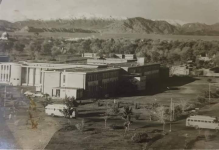
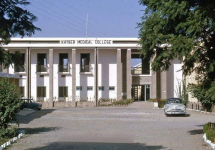
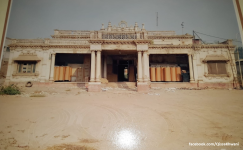
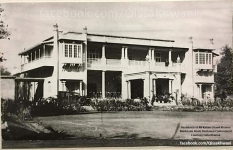
Khyber Medical College, Peshawar, 1958 (c).


1705884645019.png

In 1954, the foundation stone of Khyber Medical College, as faculty of Medicine, of Peshawar University, was laid by the then Governor General of Pakistan, Mr. Ghulam Muhammad. The College started functioning in 1955 with enrollment of fifty students with meager facilities.

1964

1705884915400.png


1705884960505.png
 
1968

1705885031890.png
 
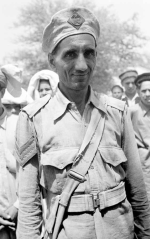
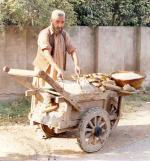
A policeman, Peshawar, NWFP, 1953.

Photo by Harrison Forman.

1706052890238.png
 
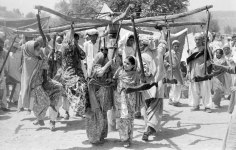
Children on swings on the occasion of Eid, Peshawar, 1957.

1706053022165.png


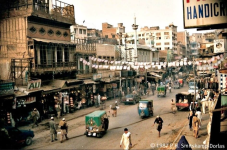
City 1987

1706053209810.png


1706053242224.png

1983

1706053276527.png


1706053347925.png
 
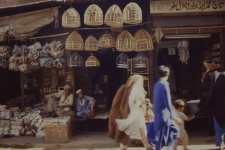
1902, Qissa Khawani

1699050259701.png


1919, Gor Kattri In Peshawar City


1699050562760.png
 
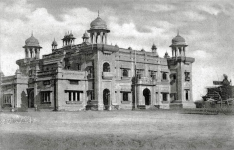
Presently Peshawar Museum.
The Victoria Memorial Hall, Peshawar, 1900's (c).
© East India Company & Raj Research Group

1731599412791.png
 
Late 19th Century British India, North West Frontier Province. (Now Pakistan).
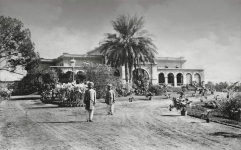
Mall Road, Peshawar. The Club..

1731599524644.png
 
..

1654984318848.png


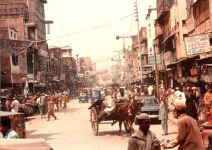
View of the principal street of Peshawar on a holiday.
Year: 1890's


1920

1654984419040.png
 
1772729601274.png

Residences of Peshawar Cantonment: This bungalow, 'Ahmad Manzil', once stood at 4 Saddar Road and belonged to Sir Qazi Mir Ahmad Khan, Kt., B.A., LL.B, Judge of the Judicial Commissioner’s Court of NWFP. The building survived well into recent decades until last year, when it was demolished, marking the end of another chapter of Saddar’s old residential architecture.

Sir Qazi (or Kazi) Mir Ahmad was a prominent Frontier lawyer (later judge) and an early organiser of Muslim League politics in the province. In the formative phase of the All India Muslim League, c.1912 to 1913, he was among the founding figures of the Frontier Muslim League at Peshawar and served as its Joint Secretary. His law chambers in Qissa Khwani Bazaar hosted the earliest office of the party.

By the early 1930s he had entered constitutional politics and served as a Member of the NWFP Legislative Council in 1932, during the period of limited provincial self government under British rule.

In 1934 he was elevated to the superior judiciary as Judge of the Judicial Commissioner’s Court, then the highest appellate tribunal in the province, as the Peshawar High Court had not yet been established. He served on the bench until 1945, a period spanning the constitutional reforms of the Government of India Act 1935 and the wartime administration of the Frontier. For his judicial services he was knighted and thereafter styled Sir Qazi Mir Ahmad, Kt.

His wife, Begum Qazi Mir Ahmad, was herself a social worker and an important figure in the Pakistan movement and served as President of the Frontier Zanana Muslim League.

In later years the house continued to be associated with notable residents. During the 1950s Dr Ahmad Hassan Khan lived here, father of the renowned architect Masood Khan. In subsequent decades Ahmad Manzil passed into commercial use and eventually became a warehouse for the refrigeration and electronics company AYS, the period from which the photograph shown here dates.

Architecturally, Ahmad Manzil was a grand single storey colonial era bungalow designed with a sense of symmetry and presence.

The façade was supported by thick decorative pillars that gave the entrance a stately appearance. The roofline was finished with ornate plaster mouldings and a small raised central feature, while deep verandah spaces and heavy framed windows with projecting sunshades helped shield the interior from the harsh Peshawar heat. Inside, the house had a classic black and white chessboard floor, a feature often seen in elite residences of the period.

By the time this photograph was taken the building already showed signs of wear and neglect. Its once green lawn and trees had disappeared and the house had fallen into a state of disuse, though its solid structure and decorative details still hinted at the dignity it once possessed.

The property stood opposite railway land. Nearby, 3 Saddar Road belonged to Justice Sheikh Abdul Hamid, and further towards Saddar Bazaar stood the Benevolent Fund Building.

Photo courtesy: Lt Col Mian Liaquat Shah (Retd)
 
1772729683692.png


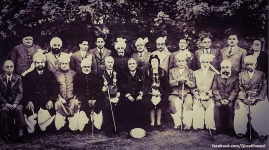
Sir Qazi Mir Ahmad Khan, seated in the centre, is flanked by NWFP Governor Sir George Cunningham and Lady Cunningham, along with other notable figures of Peshawar (Courtesy: Haider Arbab)
 
1772730006221.png

These old bungalows were a part of history apart from being architectural gems, full of beauty and nostalgia.

1772730080890.png

Residences of Peshawar Cantonment: The Qazi family residence on 13 Fort Road was among the earliest colonial era bungalows established in the Cantonment during the 1850s. Set within gardens surrounding it, the residence was constructed in the prevailing style of its time.

Thick mud and brick masonry walls, lime washed in a warm yellow hue, deep wraparound curved verandas and high ceiling rooms were all carefully designed to provide ventilation during Peshawar’s long summer afternoons.

Its location, in close proximity to the historic Ali Mardan Khan pavilion, a 17th century Mughal baradari currently within 11 Corps HQ lent the property particular historical significance. The pavilion first came into prominence during the Sikh era when it was associated with their French officer General Auguste Court and was later used as the Residency under George Lawrence, the British Resident. In such distinguished company this modest bungalow formed part of an important historical landscape.

At one time the bungalow was owned by a Parsi gentleman, Dr Jamshaid Gai. During the earlier upheavals in Afghanistan following the 1st Anglo Afghan War in 1842 he had rescued and adopted an Afghan child named Qazi Mahmud Khan and raised him as his own.

In 1856, Dr. Jamshaid Gai bought three properties in the name of his adopted son Qazi Mahmud Khan who was a munshi (language teacher). The house then became home to Mahmud’s son, Qazi Abdul Ghani also a scholar in his own right and his later descendants, including Gen Kazi Abdur Rahim and his son Maj Tariq Rahim (tragically killed in the 1981 hijacking of PIA Flight 326. Nearby Tariq Road, formerly Willcocks Road, bears his name in his honour) thereby linking the house to the highly respected and erudite Qazi family of Peshawar.

Architecturally, the single storey bungalow exemplified earliest domestic design. Built with brick, mud and lime, the structure was distinctly climatically responsive.

The broad curved front verandah, carried on simple yet sturdy columns, reduced the harsh summer heat. Thick lime plastered walls provided natural insulation, keeping the rooms cool in summer and warm in winter.

The dwelling stood as one of the earliest residential forms in the Cantonment and a fine example of indigenous building wisdom and tradition.

Sadly, the bungalow has since given way, fading from the landscape, its memory finally settling into dust in 2024. A futsal field now occupies the site where it once quietly stood.
(AJ)
 
1772730135271.png


1772730157418.png


1772730176915.png


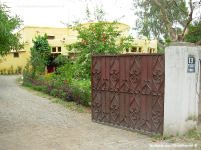
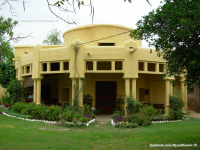
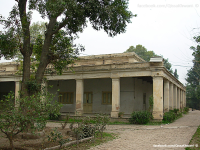
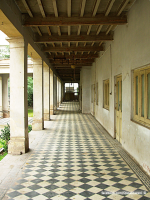
Residences of Peshawar Cantonment: K. A. Gai, a Parsi resident of Peshawar lived in this old bungalow with his three daughters, Nargis, Ratti and Sheran.
Location: Fakhr e Alam Road (old name Kitchener Road)

Kitchener Lane runs along one side and Khyber Motors owned by the Talwars once stood on the other before 1947. Opposite is the western side of CMH.

Kaikobad Aderji Gai (1881 - 1969) was a well read man and an antiquarian. Many objects on display in the Peshawar Museum were donated by him. His personal library was considered one of the finest in Peshawar.

He owned a grocery and liquor store on the main Arbab Road and supplied provisions to the British Legation in Kabul from the 1920s onwards. He is frequently mentioned in contemporary accounts and was widely known in his time.

He lived with his daughters after his wife's demise in 1938. Two of his daughters were educationists. None of them married. After the passing of the last daughter, a piano teacher, in 2004, the affairs of the house passed into other hands.
Reportedly in 2018, the cantonment authorities attempted to demolish and level the property. The front wall and verandas were ruthlessly pulled down and demolition of the main structure had begun when the occupants managed to obtain a restraining stay order through legal intervention. Unfortunately, considerable damage had already been caused. The photos were taken prior to the damage.

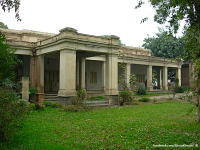
Architecturally, the residence is a fine example of a colonial era Parsi bungalow in Peshawar, gently elegant rather than showy clearly designed for comfort rather than ostentation. It is a single storey structure built with high ceilings, roshandaans and with an open backyard.

A continuous veranda along the front, back and one side defines the building’s character, supported by square pillars with simple classical mouldings. A striking feature is the black and white chessboard floor of the veranda, reflecting a common colonial aesthetic. Above, exposed wooden beams support the roof.

In front lies a modest garden, maintaining the bungalow tradition of being set within greenery rather than directly on the street. The presence of tall trees lends welcome shade.

Chander Mohan Bhasin who lived nearby and migrated to Delhi after 1947 in an email once wrote:
"The name was K.A.Gai. He had three daughters. His business was a huge liquor store on Arbab Road (opposite Capitol Cinema), with imported canned food, fruits, chocolates, etc...During my visit to Peshawar in Dec 1997, I visited K.A.Gai's beautiful house off Mall Road (Kitchener Rd) & met his aged daughter for half hour, before I caught the flight for Lahore. She did remember my father & mother.

Sad to know that she passed away in 2004.

I remember that in the early 1940s at Mr. Gai's house, every Friday or Saturday evening, a few good friends including eminent Muslim, Hindu, Sikh & Parsee, would meet for an hour to discuss the similarity in the Koran, Geeta, Guru Granth & Parsi Holy Book. It was a great brotherhood."

Chander Mohan
New Delhi, India"
2011 fr
 
1772730615367.png


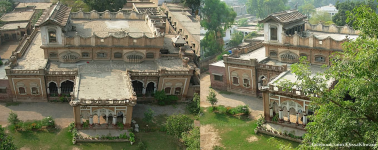
This is a vintage two-storey home located at the back of Company Bagh. It originally belonged to Rai Bahadur Karam Chand Khanna, an affluent businessman from one of Peshawar’s leading families. His father, Hony. Magistrate Lorinda Mul, and his son, RB Mehr Chand Khanna, who became a prominent politician, both add to the house’s remarkable lineage. It is said that both Gandhi and Nehru visited or stayed here.

The photo c.1930s has been graciously shared by his great-granddaughter, Gita Khanna.

After the 1947 Partition, in 1963 the house was acquired by Sardar Gul Khan of the Muslim League of Gymkhana Tennis and Cricket fame, brother of Muhammad Yunas popularly known as “Chacha Yunus” of the Peshawar Municipal Committee. He named the house "Dilkusha", located on Khalid Bin Walid Road (formerly Mackeson Road).

Opposite the residence lies Company Bagh (formerly Mackeson Garden, now Khalid Bin Walid Bagh). To the west, next door lived Miss Birch, a British educationist who ran a private school; she remained in Peshawar until her death in the 1970s. A few houses to the east was the British High Commission's Peshawar office, located at 2 Mackeson Road.

The stately house still stands with dignity.

Architecturally, this two-storey residence blends colonial-era bungalow planning with Indo-Islamic decorative touches, set gracefully within an open lawn. Deep, shaded verandas run along the main facade, supported by evenly spaced classical pillars.

The ground-floor veranda was clearly designed for social life in Peshawar’s warm climate, with the upper level repeating the same theme. Elegant jharoka-style bay windows projecting slightly from the facade introduce a distinctly subcontinental character.

The sides of the house feature open balconies, while small ornamental minarets at the parapet level add a subtle oriental flourish, blending regional architectural vocabulary with the colonial bungalow form.
(AJ)
 
Residences of Peshawar Cantonment: Mehr Chand Khanna Residence in Saddar
Once standing prominently at the corner of Saddar Road and Arbab Road, this elegant residence belonged to Rai Bahadur Mehr Chand Khanna. In later years the property became known as APWA House and today a commercial shopping plaza occupies the historic site.

Mehr Chand Khanna was the son of Rai Bahadur Karam Chand Khanna a prominent Hindu businessman and the grandson of RB Lorinda Mul, an Honourary Magistrate in the 19th century. Educated at Edwardes College, he went on to obtain a law degree and entered public life with distinction.

He served as the first member of the Cantonment Board Peshawar in 1926 and later as a member of the NWFP Legislative Assembly, eventually holding ministerial office.

During the 1947 Partition, MC Khanna himself became a refugee and was appointed Minister for Rehabilitation in India. Contemporary accounts credit him with rendering notable service in the relief and resettlement of displaced persons.
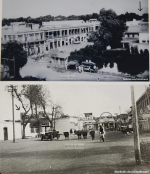
Upper Photo: View from Saddar Road. Arrow marks the residence (Photo courtesy: Mr. Fakhr Zaman "Uncle Tony")

Lower Photo: View from Arbab Road

[Note: There is no relation to actor Vinod Khanna. This is a common misconception. Vinod Khanna’s parents lived in Dabgari area in the Walled City, not in the Cantonment. Different Khanna family]

1772731134557.png

Saddar Road , Arbab Road. Peshawar Cantt.
 
1772731247903.png


This historic building on Arbab Road in Saddar, formerly known as Chapel Road, once belonged to a Sikh widow Mrs Kaur before 1947.

For some years it housed St Xavier's Convent College before the institution later moved to the Mall, where it continues today as FG College for Women.

Near Presentation Convent School for Girls, this is one of the last heritage remnants still standing from a long departed era
 

Users who are viewing this thread

Country Watch Latest

Back
Top