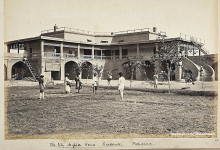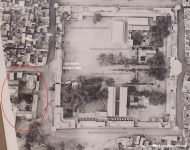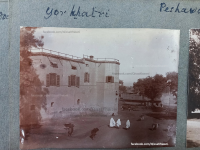
Back of the Mission House. North Eastern Octagonal Tower of Gorkhatri
Miss C. S. Vines, a C.E.Z.M.S. missionary based at Gor Khatri Hospital, Peshawar, in 1914 wrote:
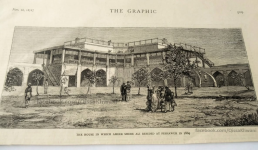
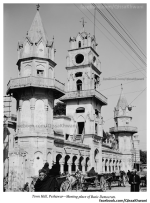
"The Gor Khatri. As I sit at the table there lies before me a leather covered book containing extracts about the Gor Khatri, and as I read I look round on the old place with fresh interest. The two great gates still stand, the four great walls, the four towers at the corners. We, the C.E.Z.M.S., possess a corner of the Gor Khatri, and I am sitting in the octagonal tower room. The rest of the Gor Khatri is occupied by the police, and we hear drill and sounds of command all the morning. Over one gateway the police officer lives, the only Englishman in the city, and the Treasury, etc., takes up the other gateway. Under the gateway, on either side, live the prisoners, and we watch them with interest as we drive through. All day a sentry guards the gate, and at evening time it is locked.
Inside the Gor Khatri, there stands a mean looking temple. It has chambers full of hair, they say, offered by women. It is the last representative of the Buddhist monastery and the Hindu temple, which once stood on this hill. The people have a tradition that a secret passage runs from the Gor Khatri to the city. No one knows whether this is true, or, if true, where it is..."
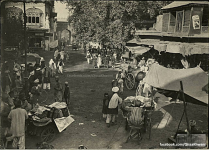
"We have, as I said, one corner of the Gor Khatri, and from our windows we look down to the road beneath, far beneath us. All sorts of things happen under our windows, things interesting to watch, and things which send us flying from the window — quail fights, ram fights, dog fights, cock fights. Horses are exercised, camels are loaded and unloaded, rows of black buffaloes are milked. Men play cards, gamble, cast lots and fight under our very windows, up against our wall. Children play and scream and squabble and torture dogs. We hear the loud cry of the fakir. We hear in the stillness the Mohammedan call to prayer.
At night time in the distance the jackals set up their weird cry, and near us, from the houses, all the dogs bark together. In the morning, gaily dressed Hindu women pass by to the temple. The little bride is carried to her husband's house. A Pathan wedding passes with its wild looking twirling dancers.
A corpse is carried past on a bed lifted shoulder high, a throng of grave, silent men follow. It is being carried out to the desolated, deserted country beyond, where there are thousands of nameless mounds. Another mound is added, the people bathe and return.
From our windows we watch the women come to hospital. Town women well covered up in their burkhas, women from the hills, gipsy women, caravan women, Hindus, rich and poor, high and low.
A camel arrives and deposits its load of women; sometimes a buffalo, sometimes a donkey, brings a woman too ill to walk. The hospital gate opens, and the women disappear from view; the men wait patiently outside."
( C. S. Vines, CEZMS missionary, 'India's Women' 1914)