Old pictures of Pakistani Cities

Peshawar Saddar
This place was in sadder near to the cantonment hispital ..

1781554475946.png
 
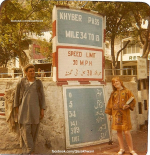
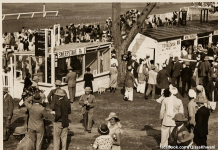
𝐓𝐨𝐫𝐤𝐡𝐚𝐦 𝐁𝐨𝐫𝐝𝐞𝐫 𝐂𝐫𝐨𝐬𝐬𝐢𝐧𝐠, 𝐜. 𝟏𝟗𝟕𝟎𝐬: A glimpse of a different era at 𝐓𝐨𝐫𝐤𝐡𝐚𝐦, the historic gateway between 𝐏𝐚𝐤𝐢𝐬𝐭𝐚𝐧 and 𝐀𝐟𝐠𝐡𝐚𝐧𝐢𝐬𝐭𝐚𝐧.

A young European traveller, camera in hand, posing beside the 𝐊𝐡𝐲𝐛𝐞𝐫 𝐏𝐚𝐬𝐬 sign, while a local stands nearby. Before decades of conflict transformed the region, Torkham was a lively international crossing frequented by tourists.

At the time, the border was open to international travellers and formed part of the celebrated overland route linking Europe, Iran, Afghanistan and South Asia, a journey that later became popularly associated with the "hippie trail" of the 1960s and 1970s.

Worth noting in the background are the Tourism Department's information centre and restaurant, facilities that once welcomed visitors exploring the Khyber Pass. The prominent sign records the extent of the pass between Milestones 34 and 13, while another board lists distances to key destinations: Torkham (0 miles), Landi Kotal (5), Peshawar (34), Islamabad (141), Lahore (309) and Karachi (1107). A speed limit of 30 mph reflects the winding mountain road that has carried merchants, armies and travellers through this strategic corridor for centuries.

Today, this image serves as a reminder of a time when the frontier was more accessible, drawing visitors from around the world to experience one of Asia's most legendary routes.


1781640827537.png
 
1781641422556.png


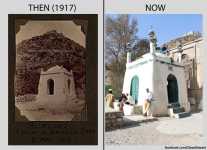
𝐀𝐥𝐢 𝐌𝐚𝐬𝐣𝐢𝐝 𝐓𝐡𝐫𝐨𝐮𝐠𝐡 𝐭𝐡𝐞 𝐀𝐠𝐞𝐬: 𝟏𝟗𝟏𝟕 𝐚𝐧𝐝 𝐓𝐨𝐝𝐚𝐲

The left photograph dates from 1917, while the other is a recent view, both captured from almost the same angle nearly 110 years apart. In the distance, the historic Ali Masjid fort can be seen perched on the hilltop overlooking the narrowest point of the famed Khyber Pass.

According to local legend, the mosque is associated with Hazrat Ali (RA), from whom it derives its name. For centuries, this strategic gorge served as an important caravan halt on the ancient route between Central and South Asia.

Owing to its commanding position, Ali Masjid also witnessed some of the fiercest and bloodiest skirmishes fought in the Khyber Pass through successive eras of invasion and empire.

Unfortunately, newer construction has marred much of the mosque’s historic character, and the once open surroundings have gradually been overtaken by recent concrete development.
 
1781641485991.png


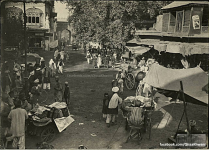
𝐂𝐡𝐨𝐰𝐤 𝐘𝐚𝐝𝐠𝐚𝐫 or the Remembrance Square, looking north toward Kacheri Gate from the Hastings Memorial platform. The scene captures the everyday rhythm of the city, with pedestrians and tongas moving through the square, while a prominent shop sign reads: “SARDAR SODA WATERS | VIMTO HOUSE.” A rare glimpse into the old character of historic Peshawar in 1947.

(Source: LIFE, 1947)
 
1781641664375.png


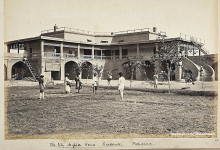
Photo by James Caddock 1870s

The following description is by Captain (afterwards Sir) Henry Havelock:

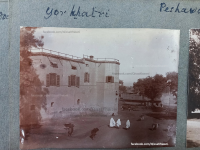
"In the 'Serai,' mentioned by Elphinstone as one of the glories of Peshawar in 1809, the present Governor of the city has established his military headquarters, and his civil and fiscal tribunals. It is called the Gor Khatri, and is a vast quadrangle, the length of each side being 250 yards.

This has been rendered habitable, first by building a suite of apartments over the gateway nearest to the country and next by erecting a very handsome dwelling in the Persian fashion, consisting of three storeys and a rez-de-chaussée, on the side nearer the city." ('History of the War in Afghanistan' 1839)
 
1781641722267.png


Back of the Mission House. North Eastern Octagonal Tower of Gorkhatri

Miss C. S. Vines, a C.E.Z.M.S. missionary based at Gor Khatri Hospital, Peshawar, in 1914 wrote:

"The Gor Khatri. As I sit at the table there lies before me a leather covered book containing extracts about the Gor Khatri, and as I read I look round on the old place with fresh interest. The two great gates still stand, the four great walls, the four towers at the corners. We, the C.E.Z.M.S., possess a corner of the Gor Khatri, and I am sitting in the octagonal tower room. The rest of the Gor Khatri is occupied by the police, and we hear drill and sounds of command all the morning. Over one gateway the police officer lives, the only Englishman in the city, and the Treasury, etc., takes up the other gateway. Under the gateway, on either side, live the prisoners, and we watch them with interest as we drive through. All day a sentry guards the gate, and at evening time it is locked.

Inside the Gor Khatri, there stands a mean looking temple. It has chambers full of hair, they say, offered by women. It is the last representative of the Buddhist monastery and the Hindu temple, which once stood on this hill. The people have a tradition that a secret passage runs from the Gor Khatri to the city. No one knows whether this is true, or, if true, where it is..."

"We have, as I said, one corner of the Gor Khatri, and from our windows we look down to the road beneath, far beneath us. All sorts of things happen under our windows, things interesting to watch, and things which send us flying from the window — quail fights, ram fights, dog fights, cock fights. Horses are exercised, camels are loaded and unloaded, rows of black buffaloes are milked. Men play cards, gamble, cast lots and fight under our very windows, up against our wall. Children play and scream and squabble and torture dogs. We hear the loud cry of the fakir. We hear in the stillness the Mohammedan call to prayer.

At night time in the distance the jackals set up their weird cry, and near us, from the houses, all the dogs bark together. In the morning, gaily dressed Hindu women pass by to the temple. The little bride is carried to her husband's house. A Pathan wedding passes with its wild looking twirling dancers.

A corpse is carried past on a bed lifted shoulder high, a throng of grave, silent men follow. It is being carried out to the desolated, deserted country beyond, where there are thousands of nameless mounds. Another mound is added, the people bathe and return.

From our windows we watch the women come to hospital. Town women well covered up in their burkhas, women from the hills, gipsy women, caravan women, Hindus, rich and poor, high and low.

A camel arrives and deposits its load of women; sometimes a buffalo, sometimes a donkey, brings a woman too ill to walk. The hospital gate opens, and the women disappear from view; the men wait patiently outside."

( C. S. Vines, CEZMS missionary, 'India's Women' 1914)
 
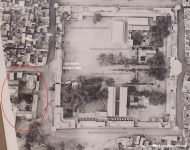
Aerial image of Gor Khatri from 1922

1781641870743.png
 
1781641954329.png

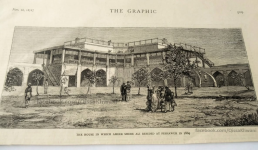
The House in which Amir Shere Ali (King of Afghanistan) stayed in 1869
(The Graphic).
 
1781642027641.png


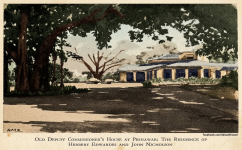
𝐑𝐞𝐬𝐢𝐝𝐞𝐧𝐜𝐞𝐬 𝐨𝐟 𝐏𝐞𝐬𝐡𝐚𝐰𝐚𝐫 𝐂𝐚𝐧𝐭𝐨𝐧𝐦𝐞𝐧𝐭: A watercolour painting of the Deputy Commissioner’s House on The Mall in Peshawar, where Herbert Edwardes and John Nicholson once lived.

Nicholson served as DC of Peshawar in 1857, while Edwardes became Commissioner in 1853. The painting bears the initials “HMR” of the artist.
 
1781642170244.png

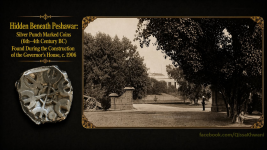
Little known is the fact that beneath the tranquil lawns of the Governor’s House lies a hint of Peshawar’s remote antiquity.

In 1906, labourers removing earth from the grounds chanced upon an earthen vessel buried nearly ten feet below the surface. Inside were silver punch-marked coins which the finders hastily divided among themselves and began disposing of in the bazaars.

When the authorities learned of the discovery, the Deputy Commissioner managed to recover 61 specimens.

The coins were then examined by the American archaeologist DB Spooner, curator of the Peshawar Museum, who dated them to around the 6th century BC.

The discovery suggests that the mound on which the residence stands may conceal traces of a much earlier settlement, adding yet another fascinating layer to the long and continuous history of Peshawar, often regarded as one of the oldest living cities in Asia.
 
1781642251038.png

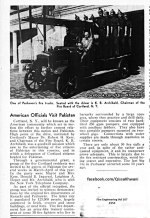
Mr Archibald, Chairman of Cortland’s Fire Board, visited the Peshawar Fire Brigade Station at Gor Khatri and witnessed, among other things, the two antiquated fire engines “hard tired 250 gmp pumpers, one equipped with auxiliary ladders”.
 
1781642304438.png
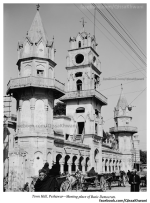
Town Hall, A Lost Landmark of Peshawar near Chowk Yadgar

Once standing near Chowk Yadgar, the Town Hall of Peshawar was one of the city’s notable buildings. It was located on Kacheri Road, now known as Ashraf Road, close to Kacheri Darwaza and opposite Reti Bazaar. The building served as an important civic space and was used by the Peshawar Municipal Corporation.

Architecturally, it was built in the Indo Saracenic style, a revivalist design widely used by British architects in the late 19th and early 20th centuries.

This style blended Victorian proportions and Gothic features with traditional Indian, Mughal, and Islamic design elements, creating a distinctive and locally influenced colonial architecture. Its towers were topped with weather vanes, adding to its historic character and visual appeal.
(QK)

(Photo c 1950)
 

Users who are viewing this thread

Pakistan Defence Latest

Back
Top