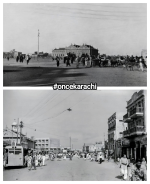
Constructed in 1927 in Napier Quarters by the Karachi municipality, Lea Market was named after Measham Lea, a British municipal engineer who served Karachi.
From its early years, the market became an important wholesale trading centre, particularly for vegetables, fruits and other agricultural produce. Its strategic location at the junction of several important roads made it one of the city's major commercial hubs.
Originally comprising three two-storey buildings, the market was later expanded with a fourth building during the Ayub Khan era, designed to complement the original architecture. Its sections included vegetables, dairy, fish and meat, while its distinctive clock tower became one of its best-known landmarks.
Lea Market was also an important transport hub, with local, inter-city and inter-provincial buses connecting it with destinations across Karachi, interior Sindh and Balochistan. Routes included Landhi, Malir, Korangi, Thatta, Sujawal, Sehwan, Hub, Lasbela, Khuzdar, Turbat, Quetta and Gwadar, among others.
For generations, Lea Market was much more than a place of trade—it was a meeting point where commerce, transportation and everyday Karachi life came together.






 Trump orders military base mass shooter to be executed by firing squad (3 Viewers)
 Iran - Israel/US War: Israel-US declare war on Iran, Iran responds (81 Viewers)
 New Indian movie supports and agitates Tibetan separatism and terrorism (12 Viewers)