ghazi52
THINK TANK: CONSULTANT


- Thread starter
- #451
The Domed Dining Room of Government House (Now Governor House), Lahore c. 1870s
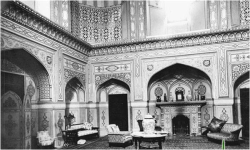
This dining room, originally the upper story of the tomb of Mohammad Kasim Khan, a maternal cousin of Emperor Akbar, dating from 1635 and the grave is still located underneath this room.
Historian, Syed Muhammad Latif and Kannahiya Lal both agree about a Mughal tomb at this place, build in Shahjehan’s reign, but both has raised conflicting accounts of who was actually buried here. According to Kannahiya Lal it was Saint Syed Badruddin Gilani, where Latif credits it to Kasim Khan.
In earlier times, a ground adjacent to the tomb was used as a 'akhaara' a wrestling ground, for this, the tomb was also known as Gumbuz Kushti Wala.
In the reign of Ranjit Singh, his Jamadar Khushal Singh, built a house around the tomb, later the building was acquired from Khushal Singh's successor Teja Singh with the exchange of property worth Rs. 2500 in Sialkot and was first utilized as a residence by deputy commissioner Major MacGregor, later in 1859 it was converted into Government House during the lieutenant governorship of Robert Montgomery.
Original tomb continued to exist on the ground floor, where its interior and furniture were designated by John Lockwood Kiping along with his talented student, Bhai Ram Singh.
Ashley Jackson writes in her book Buildings of Empire:
“Sometimes the British adopted buildings that pre-dated their arrival... Government House Lahore was build around the tomb of Mohammed Kasim Khan (died 1635). Its centre was a domed dining room, formed from the upper part of the tomb itself; below it was a kitchen, in which the sarcophagus served as a chopping board.”
Kasim, a cousin of the Mughal emperor Akbar, built it while he was alive. He was buried somewhere else. The prince was very fond of wrestling and a patron of many wrestlers, and the place was known as the Wrestlers’ Dome (Kushtiwala Gumbaz).
This dining room, originally the upper story of the tomb of Mohammad Kasim Khan, a maternal cousin of Emperor Akbar, dating from 1635 and the grave is still located underneath this room.
Historian, Syed Muhammad Latif and Kannahiya Lal both agree about a Mughal tomb at this place, build in Shahjehan’s reign, but both has raised conflicting accounts of who was actually buried here. According to Kannahiya Lal it was Saint Syed Badruddin Gilani, where Latif credits it to Kasim Khan.
In earlier times, a ground adjacent to the tomb was used as a 'akhaara' a wrestling ground, for this, the tomb was also known as Gumbuz Kushti Wala.
In the reign of Ranjit Singh, his Jamadar Khushal Singh, built a house around the tomb, later the building was acquired from Khushal Singh's successor Teja Singh with the exchange of property worth Rs. 2500 in Sialkot and was first utilized as a residence by deputy commissioner Major MacGregor, later in 1859 it was converted into Government House during the lieutenant governorship of Robert Montgomery.
Original tomb continued to exist on the ground floor, where its interior and furniture were designated by John Lockwood Kiping along with his talented student, Bhai Ram Singh.
Ashley Jackson writes in her book Buildings of Empire:
“Sometimes the British adopted buildings that pre-dated their arrival... Government House Lahore was build around the tomb of Mohammed Kasim Khan (died 1635). Its centre was a domed dining room, formed from the upper part of the tomb itself; below it was a kitchen, in which the sarcophagus served as a chopping board.”
Kasim, a cousin of the Mughal emperor Akbar, built it while he was alive. He was buried somewhere else. The prince was very fond of wrestling and a patron of many wrestlers, and the place was known as the Wrestlers’ Dome (Kushtiwala Gumbaz).