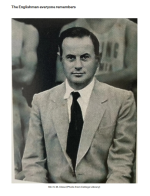
Mr. Close
The Englishman Everyone Remembers
[Below quoted from Mr. Aziz Ahmed's blog]
Any old student of Islamia College Peshawar, who was at the college during the 1950s and 60s, if asked who he remembers the most from among their teachers, would invariably name an Englishman, other than Dean Saab.
His name was Hubert Michael Close or H. M. Close or simply Close for his students and colleagues. After graduating from Cambridge, Close went to teach English at St. Stephen’s College, Delhi, in 1937. However, his teaching career was interrupted by World War II when he joined the army and ended up in Cyprus and other Mediterranean islands commanding a Pathan Company.
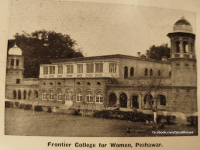
At the end of the war, Close went back to St. Stephen’s and then, after the Partition, migrated to Pakistan, and took up teaching English at Islamia College Peshawar.
In his book, A Pathan Company, published in 1993, Close warmly describes his “boys” in B Company that he commanded, admiring their sturdiness, simplicity of habits, sincerity, and loyalty to their commander. It was probably his affection for young Pathan soldiers of his Company that motivated him to move to Peshawar.
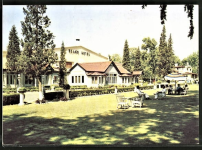
I first saw Close when I entered college and was allotted Room 52 in Hardinge hostel, a room I shared with three other students: Ayub Kundi from D.I.Khan, Sahibzada Ayaz from Mansehra, and Mian Jameel from Peshawar. Close also lived in Hardinge hostel, in a one-bedroom apartment immediately above our room. Because of our proximity to his room upstairs, we often saw him going or coming to and from his apartment and, in the process, developed more than a nodding acquaintance with him.
I remember him as a lean man of medium height, probably in his forties, with a ruddy complexion, thinning brown hair, small penetrating eyes, and a rather shy demeanor.
In the early years of Pakistan, elementary military training called Compulsory Military Training, or CMT for short, was introduced in the college. All first-year students had to undergo CMT for three months. Close, with his army background, was a natural choice to head the CMT, and he plunged himself into the task with passion. At daybreak, he would blow a whistle to pull the students out of their beds, sometimes literally, make them change into the prescribed uniform — shorts, shirt, and what we called PT shoes — and after a few drills, take them on a run-and-crawl routine all the way to Jamrud and back, a distance of 3 - 4 miles either way.
CMT came to be synonymous with Close, and students called it Close Military Training. Close demanded and instilled a discipline, which the students, mostly coming from the rural areas of the province, were not used to. Not many relished the rigors of CMT, but every one of the old students you talk to remembers it fondly.
Donating blood was another of Close’s passions. He not only donated blood himself — repeatedly — but also encouraged students to donate it. He would go round the campus looking for potential donors, talk to them, befriend them, cajole them — almost compel them — and ultimately lead them to Lady Reading Hospital, the only public hospital in town. Without Close’s efforts, the blood bank at the hospital could not have remained solvent.
During summer vacation, Close would lead teams of students on anti-malaria campaigns (another of his passions) in the remote villages of Hazara, where they would go from village to village, spraying houses, cowsheds, and ponds of stagnant water with insecticides. Those campaigns not only helped save villagers from the ravages of malaria, but also helped the students gain an insight into the life of ordinary village folk, and inspired some to explore the surrounding mountains at the end of their social work projects.
I remember a hiking trip when, at the end of an anti-malaria campaign in Balakot and the surrounding villages, a group of five of us climbed Musa ka Musalla, a 14,000 feet high peak in the Himalayas. We didn’t quite make it to the top, but it was, and still remains, the greatest adventure of my life.
The quickest way to get into Close’s good books was to either donate blood or join his summer social work campaigns. Better still, do both.
A lifelong bachelor, Close lived a Spartan life. During the summers he was usually seen in a white shirt and khaki trousers, and in winters in a tweed jacket with leather elbow patches.
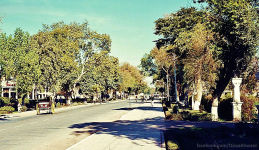
Close was also a biking buff. I don’t remember seeing him travel by the college bus or car. He always rode his Raleigh bicycle, his khaki trousers clamped at the ankles, going round the campus, whistling a tune and taking in the sweet fragrance of bitter-orange blossoms that filled the campus air in March and April.
During the month of Ramzan, Close would get up at sehri along with everyone else and would fast until the iftar. Students, jokingly, referred to him as Hafiz or Haji M Close, playing on his initials. On Sundays, he would ride his bicycle to the city to attend his church service, a 5-mile ride either way. He was a religious man.
Other than social work, Close’s pursuit of happiness included smoking a pipe and listening to Western classical music. We could trace his movements to and from his room by the fragrant trail of the pipe smoke he left behind him. Occasionally, when we went upstairs to his room to ask something and found the door half ajar, we would see him humming along with his gramophone, vigorously chopping the air with his hands as if he were conducting the symphony he was listening to. This was our introduction to Western classical music.
Close is remembered today by his students not for what he taught in the classroom but for what he taught outside it: Discipline, compassion, social work, and adventure, and to us, in Room 52, the names of Beethoven and Mozart and the sound of their music.
Close remained at Islamia College until his retirement and then moved to Edwardes College and remained there until his death, in 1999. According to his wish, he was buried in England.
(Aziz Ahmed is author of 'Mansehra to Manhattan'. Link to full article on his blog mentioning H. M. Close: