Beijingwalker
VIP Member

Only One Country Can Feed Itself Fully
April 12, 2026
Key Takeaways
- Only one country—Guyana—can produce all seven essential food groups domestically.
- Most countries, including the U.S. and China, fall short in at least one category.
- Wealth doesn’t guarantee food independence, with many rich nations relying on imports.
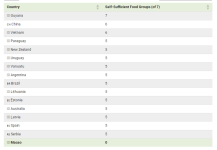
This map shows how many of seven essential food groups each country can supply domestically, based on data from a Nature Food study. The result reveals a striking gap: just one country can meet all its food needs on its own.
The analysis covers key categories including starchy staples, fruits, vegetables, dairy, meat, fish, and legumes—offering a more complete picture of national food independence. Even major agricultural producers like the United States and China still depend on imports for at least one of these groups.
Only One Country Covers All Food Groups
Guyana is the only country that can produce enough of all seven essential food groups to meet domestic demand. It not only covers every category, but exceeds needs in starchy staples and fruit—making it a clear global outlier in food independence.China and Vietnam come close, each covering six out of seven groups. However, both fall short in dairy production, reflecting structural constraints in key sectors. Even top performers still rely on imports for at least one essential category.
Wealth Doesn’t Guarantee Food Independence
High-income countries often rank lower than expected. For example, Canada and the United States each cover only four out of seven food groups. Despite strong production in meat, dairy, and grains, both countries depend heavily on imports for fruits and vegetables.This pattern reflects geography and climate. Northern countries face shorter growing seasons, limiting domestic output of fresh produce. As a result, even advanced agricultural systems cannot fully produce a balanced diet domestically.
Structural Constraints Shape Regional Gaps
The Middle East and North Africa consistently rank among the least self-sufficient regions. Limited water resources play a major role. The region holds roughly 6% of the global population but less than 2% of renewable water supply, restricting agricultural expansion.Fish production is another major constraint globally. According to the Food and Agriculture Organization (FAO), Asia accounts for 91% of aquaculture output. This concentration leaves many countries dependent on seafood imports, even when they can produce meat or crops domestically.