Iran’s missile attack on Israel raises questions about limits of arsenal
Iran’s missile attack on Israel this week stood out for its large scope and limited impact. Some analysts say it calls into question the value of Iran’s arsenal.
Iran’s ballistic missile attack on Israel this week, only the second time Iran has attacked Israel directly, stood out for its large scope and limited impact, analysts say.
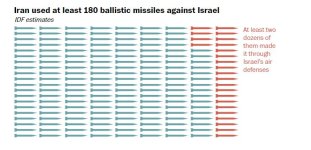
Iran gave little warning before launching at Israel at least 180 fast-moving ballistic missiles. A Washington Post analysis shows that at least two dozen made it through Israeli defenses on Tuesday, far more than in the preceding attack in April, some causing damage at or near Israeli military and intelligence sites. But so far, reports of critical damage on the ground have been limited.
Evidence suggests that Iran used its highest-grade munitions in the attack: its quickest-to-launch and fastest-traveling missiles and a larger number of launchers than experts knew that the country had. State media also reported that Iran had used an advanced ballistic that had not been used before.
Both this week’s attack and the one that preceded it provide unprecedented windows into the extent of Iran’s capabilities, and to Israel’s ability to intercept or withstand them. Some experts said the insights call into question the value of Tehran’s enormous missile arsenal, which U.S. officials have estimated to be the largest in the Middle East.


A show of force
This week’s attack was notable in how it diverged from Iran’s first missile attack on Israel, which began on the evening of April 13. The move was retaliation for a
deadly Israeli strike on an Iranian diplomatic compound in Syria that took place more than two weeks before, Iranian state media outlets reported.
Iran used more than 300 missiles and drones in that attack: around 170 drones, according to U.S. assessments, and 150 missiles — around 30 of them cruise missiles, which are self-propelled throughout their flight and generally fly closer to the ground. The rest were ballistic missiles, which are propelled high by a rocket and use gravity to descend at high speeds.
Israel’s military said that 99 percent of the missiles and drones were either intercepted or failed. Only a handful appear to have landed in Israel, causing minimal damage.
Analysts say Iran had spent days telegraphing its intentions, allowing Israel and its allies to prepare, used slow munitions that could be picked off, and used older liquid-fueled missiles, some of which appear to have failed.
Even so, analysts said the attack carried real risk. “Any time you’re launching 300 munitions at another country, you’re intending to cause some real damage,” said John Krzyzaniak, a researcher who studies Iran’s weapons programs at the Wisconsin Project on Nuclear Arms Control.
If Iran’s first direct strike on Israel in April was designed as a show of force, this week it seemed to intend a far more significant blow, evidence shows.
Tehran’s standing had been hit by devastating Israeli attacks on its ally, Lebanon’s Hezbollah, and the ongoing
war in Gaza that has largely neutralized another Iranian partner, Hamas. Iran said Tuesday’s strike was retaliation for the killings of Hasan Nasrallah, the leader of Hezbollah, in Beirut late last month, and Hamas leader Ismail Haniyeh, in Tehran in July.
“They wanted to wash away blood with blood,” said Behnam Ben Taleblu, a senior fellow at Foundation for Defense of Democracies.
The United States publicly warned that Iran was preparing for a strike against Israel at roughly 9:30 a.m. Eastern on Tuesday. Three hours later, missiles were in the air.
The U.S. government has said that Iran launched around 200 missiles, while Israeli officials said later that 181 missiles were identified. Analysts, citing images from Iranian state media, said all appeared to be ballistic.
Some analysts said that Iran may have used more modern missiles that use solid fuel, which means they can be launched quickly, without needing to be fueled first.
Iranian state media has reported that Iran used long-range Ghadr and Emad missiles, both also thought to have been used in April. But this time Iran also used for the first time its more advanced “hypersonic” Fattah missiles, Mehr News Agency reported.
Footage of the launches released by state media and reviewed by three analysts showed the launch of the Ghadr missile. Iran also used the Kheibarshekan 2 or the Fattah 1, which look similar at a distance, said Fabian Hinz, an Iran analyst at the International Institute for Strategic Studies in Berlin.
Iran unveiled its Fattah missile last year. Experts said it
does not meet the same criteria as Western weapons described as hypersonic — the ability to maneuver inside the atmosphere at hypersonic speeds, five times the speed of sound, for extended periods of time — but it does have some maneuvering capability that could help evade missile defenses.
While the use of the Fattah missiles was not confirmed by Iranian or Israeli officials, Jeremy Binnie, a Middle East analyst for Janes Defense Intelligence, said that a discarded rocket motor photographed in the West Bank could have come from either that or another modern ballistic missile called the Kheibar Shekan. Two other analysts who reviewed the imagery agreed.
Iranian state media reported that 90 percent of the missiles reached their target. While analysts said this was an exaggeration, evidence suggests that far more reached Israel than in April. Some experts said that Israel’s aerial defense systems may have been depleted.
“This is a significant improvement for the Iranians,” Binnie said. “The extent to which this is down to the use of more ballistic missiles to saturate Israeli defenses or different types [of missiles] remains an open question.”
A Washington Post analysis of satellite imagery and visuals found that at least two dozen missiles struck or came close to two military sites and one intelligence site.
Separately, a team from Middlebury Institute of International Studies published an initial analysis late Thursday that found at least 32 impact points on satellite imagery of Israel’s Nevatim Air Base in the Negev Desert, suggesting 16 percent or more of the missiles fired hit that target.
One death was reported on Tuesday: A Palestinian man in the occupied West Bank was killed by falling debris.
Hitting the limit
Israel is widely expected to respond with strikes of its own, and Iranian officials have suggested that they could respond in kind. “This is only a fraction of our power,” Iran’s president, Masoud Pezeshkian, wrote on X after Tuesday’s attack.
But Afshon Ostovar, a professor of national security affairs at the Naval Postgraduate School in California, said Iranian threats had been made weaker by their strikes. “Iranian officials are trying to describe the hellfire they will rain down on Israel if Israel responds,” he said. “That is not as credible a threat as it might have been before.”
Some analysts said that if Iran were to strike again, it is not clear whether it would could inflict more damage, while facing greater risks from Israel. An exchange could quickly escalate beyond Iran’s capabilities.
Iran has surpassed expectations before. Launching nearly 200 ballistic missiles in a short time frame was itself impressive, Krzyzaniak said, suggesting that Iran may have that many mobile launchers for its missiles — far more than previously estimated.
But Iran appears to have revealed the extent of its missile technology. “There’s always a chance for a surprise,” Krzyzaniak said. “But basically, I think they’ve shown us the best of what they have.”
Iran could change tactics, seeking to target more nonmilitary sites, which might be less protected by aerial defense systems. But experts warned strikes in heavily populated areas could cause deaths, intended or no.
Ballistic missiles with conventional warheads have a high margin of error, especially when fired from far away, said Jeffrey Lewis, one of the experts involved in the Middlebury assessment. He said he would be surprised if Iran’s margin of error was better than a few hundred meters, based on this week’s evidence.
Tehran “cannot win this fight with ballistic missile strikes against Israel,” said Ostovar. “Israel doesn’t need to fire 180 weapons to hit Iran. It can fire 10 weapons and hit Iran more effectively.”
If Tehran decides its missiles do not suffice for deterrence, some experts said Tehran could turn to riskier measures.
Mick Mulroy, a former senior Pentagon official under the Trump administration, said Iran is “looking at what comes next.”
“And I think that unfortunately most countries would say: We need a nuclear deterrent,” he said.


 t.me
t.me


 www.theguardian.com

 .
.


