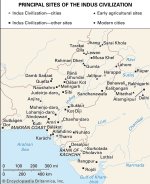
Opinion piece: Basis of Indian claim to Indus Valley Civlisation?

Jinnah didn't care about names Bharat or Gangadesh (? a hilarious recent invention) he wanted to forment the idea of Hindu and Muslim states, hence he wanted India to be Hindustan (I know why you didn't mention that). That's the base of partition. He feared the successor state will inherit the status of British India in short he was worried about the PR and that it'll overshadow his own state.
And why not? When the Portuguese set sail, they were looking for a route to India. The Arab traders before them used to trade with India especially the west coast called it Al Hind, the Chinese who called it Tianzhu/Yindu or even Shendu. So the name was popular among traders, travelers. Pretty sure Jinnah wasn't mad about all this, but rather his own reasoning for seperation.
You see, I try to be neutral when it comes to historical facts to the best of my knowledge. I have heard for a long time that Jinnah wrote to Lord Mountbatten, regretting and complaining about why India chose the name "India" instead of the more familiar name of Hindustan at the time of partition.

If we go before British Raj, there were Mughals, Marathas, Nizams, Rajputs and Sikhs etc. The British colonised them all, or they were directly in control. Then they unified India under British Raj. There was no unification before the British takeover. So for you the British Raj was a blessing in disguise
 
Shinde et al., 2019, Cell 179, 729–735October 17, 2019 ª 2019 Elsevier Inc.
An Ancient Harappan Genome Lacks Ancestry from Steppe Pastoralists or Iranian Farmers

This is the article that andbhakts enjoy misinterpreting. You must already have seen it. From my reading, it demonstrates without doubt the Iranian predominant origins of the Harappan Civilisation. The individual sampled is 3600 years old and is likely the best representative of the early/mature IVC genome available.

Indo-Aryan DNA was added to the "modern" Pakistani/North Indian genome during later migrations, after or during the decline of the IVC (could have been "invasions" but it makes no difference - the Aryans did definitely come one way or another, which is all that matters).

I did not want to reply, just read. But I will to keep the discussion going. Perhaps someone can add or counter my point.

I don't take DNA evidence seriously. It's a moot point. Every claim has to be evaluated on it's own merit. DNA has it's basis, it's certainly not a basis for claiming direct heritage to the Indus Valley Civilisation.
We have indulged various parties on irrelevant points without judging the basis of said arguments.

Humans did not grow out of the earth, they moved around through the ages. The dominant theory is that we came out of Africa. Let's just start claiming Africa, since we all can prove DNA links to the African continent.

The European colonisation wasn't about conquest, it was just Europeans laying claim to their ancestral homeland. Any claim has to make sense, if we just argue a claim based on the claim itself, without questioning the merits of a claim then we're just discussing fantasies.

Arguments and counter arguments about DNA are just fantasies, they have no place in any logical argument, because everyone can prove links to anther location in time.

You are in Britain, will it make sense that in 500 years time your descendants can go to Pakistan and tell them you're a bunch of idiots, this heritage belongs to us British. I'm sure they'll be able to show DNA proof and so much more in this digital age.
We're discussing a 5000+ year timeframe with regards to the Indus Valley Civilisation.

It was one of the most densely populated places on earth, I have the figures. It must have been to start a civilisation, those people did not just disappear or migrate en masse. That does not happen in densely populated regions, they tend to absorb, not be displaced.
Some migrate or move, but not the majority. Did the entirety of your family migrant to Britain, no, the vast majority of your extended family still resides in Pakistan, embedding their links to the land, that continues. The same patterns were followed throughout history.
There is not a single basis for "India wide" claim to the Indus Valley Civilisation, hence the need to ask for clarity before writing my article.
 
Let's be honest folks and stop flaunting the sophistication of your nuances......what are the bases of claim you make on a civilization ? ......1 ) genetics ......2 ) culture.......3) territory........ As far as genetics are concerned, India wins the claim hands down...... culture........as far as culture is concerned, it' weighs in India's favour....... territory is the only claim that Pakistan can justify.
 
We in the Southern India had our own thriving civilizations, no need to piggyback on IVC to validate our history. Recent findings at Keeladi in Tamil Nadu show advanced urban settlements and some of the earliest evidence of iron smelting, directly linked to the southern people, not some mysterious group that vanished without a trace like in the IVC.

So this obsession with IVC as the sole civilizational claim to Indian identity is both narrow and, frankly, laughable. Especially when Pakistanis and North Indians fight over it like it's ancestral property when neither can actually prove any direct cultural or linguistic continuity.

Meanwhile, Southern empires like the Cholas were influencing Southeast Asia in real, documented ways, from architecture to scripts. That’s a legacy still visible today, unlike this archaeological tug-of-war over ruins.

To be blunt, both of you are like migratory tribes staking claim to an abandoned fort shouting from the ramparts about glory while the real cultural lineages lie elsewhere.
 
True..... Dravidian civilization prospered in south India and it's influence was far-reaching....all of southeast Asia was under her cultural influence......one must not distort history.
 
You see, I try to be neutral when it comes to historical facts to the best of my knowledge. I have heard for a long time that Jinnah wrote to Lord Mountbatten, regretting and complaining about why India chose the name "India" instead of the more familiar name of Hindustan at the time of partition.

If we go before British Raj, there were Mughals, Marathas, Nizams, Rajputs and Sikhs etc. The British colonised them all, or they were directly in control. Then they unified India under British Raj. There was no unification before the British takeover. So for you the British Raj was a blessing in disguise
But I don't know what difference it could make. It wasn't a major contention by Jinnah. He wrote a letter to MB after he recieved an invitation for an event where he saw the name being mentioned as such. But that's not his place to decide hence this wasn't a pressing matter, neither for Jinnah nor the British or Indian leaders.

Almost all major rulers tried to unify the country under different banners. Mughals tried it, waged wars throughout their reign. Marathas tried, before all of them Guptas, Magadhas everyone tried to control the entire landmass. If it weren't for the British someone else would've done it. But I don't see any favours, they transferred massive wealth to Europe, while we are left with a tag called "3rd world".
When the British left, India had numerous princely states so British left with around 60% of today's India and the rest we had to take control over by seperately dealing with princely states some times with military intervention like Goa or Hyderabad
 
There is nothing weird here, the study cited by a fellow member missed a crucial part that the other side of the Iranian part is ancient ancestral south Indian (AASI), while none of them are predominant.
Modern Dravidian speaking populations have a mix of AASI, Iranian related ancestry(from neolithic farmer/hunter gatherer) and varying degrees of Steppe ancestry, depending on the region and community. So no they are not exactly IVC but have certain components similar to the DNA found in Rakhigarhi. They also mixed later on so no pure blood IVC whatever that is.
You have misinterpreted what "AASI" (ancient ancestral south indian) is. This is an andamanese and tribal south Indian derived grouping of DNA.
 
Jinnah didn't care about names Bharat or Gangadesh (? a hilarious recent invention) he wanted to forment the idea of Hindu and Muslim states, hence he wanted India to be Hindustan (I know why you didn't mention that). That's the base of partition. He feared the successor state will inherit the status of British India in short he was worried about the PR and that it'll overshadow his own state.
And why not? When the Portuguese set sail, they were looking for a route to India. The Arab traders before them used to trade with India especially the west coast called it Al Hind, the Chinese who called it Tianzhu/Yindu or even Shendu. So the name was popular among traders, travelers. Pretty sure Jinnah wasn't mad about all this, but rather his own reasoning for seperation.
My comments on Jinnah's position are unconfirmed, though it has been speculated on. Jinnah was certainly opposed to the nation state of India - by default - acquiring any socio-political advantages through "brand legacy" alone. In any event, it's history now. Nehru went with "India" and Delhi has reaped a cultural dividend from this clever deception.

In reality, Pakistan is "India".

I say this, not only because of the obvious connection to the Indus, but because the term was coined by Persians and Greeks in relation to the land mass of what is mostly now Pakistan. Herodotus, Alexander etc regarded the floodplains of the Hydaspes (Indus) as "India". General Porus, who resisted Alexander's invasion, was a ruler over the Jhelum and Chenab regions - he was an ancient  Pakistani by every metric, but again, due to an accident of nomenclature in 1947, he is claimed by Delhi.
 
I did not want to reply, just read. But I will to keep the discussion going. Perhaps someone can add or counter my point.

I don't take DNA evidence seriously. It's a moot point. Every claim has to be evaluated on it's own merit. DNA has it's basis, it's certainly not a basis for claiming direct heritage to the Indus Valley Civilisation.
We have indulged various parties on irrelevant points without judging the basis of said arguments.

Humans did not grow out of the earth, they moved around through the ages. The dominant theory is that we came out of Africa. Let's just start claiming Africa, since we all can prove DNA links to the African continent.

The European colonisation wasn't about conquest, it was just Europeans laying claim to their ancestral homeland. Any claim has to make sense, if we just argue a claim based on the claim itself, without questioning the merits of a claim then we're just discussing fantasies.

Arguments and counter arguments about DNA are just fantasies, they have no place in any logical argument, because everyone can prove links to anther location in time.

You are in Britain, will it make sense that in 500 years time your descendants can go to Pakistan and tell them you're a bunch of idiots, this heritage belongs to us British. I'm sure they'll be able to show DNA proof and so much more in this digital age.
We're discussing a 5000+ year timeframe with regards to the Indus Valley Civilisation.

It was one of the most densely populated places on earth, I have the figures. It must have been to start a civilisation, those people did not just disappear or migrate en masse. That does not happen in densely populated regions, they tend to absorb, not be displaced.
Some migrate or move, but not the majority. Did the entirety of your family migrant to Britain, no, the vast majority of your extended family still resides in Pakistan, embedding their links to the land, that continues. The same patterns were followed throughout history.
There is not a single basis for "India wide" claim to the Indus Valley Civilisation, hence the need to ask for clarity before writing my article.
I look forward to your article, whichever angle you approach the subject from. Do tag me (note: there is a masterchief and me, master chief). 👍
 
Let's be honest folks and stop flaunting the sophistication of your nuances......what are the bases of claim you make on a civilization ? ......1 ) genetics ......2 ) culture.......3) territory........ As far as genetics are concerned, India wins the claim hands down...... culture........as far as culture is concerned, it' weighs in India's favour....... territory is the only claim that Pakistan can justify.
I cannot begin to reply to this post that has literally thrown scientific facts under a bus. Take some time to read the relevant genetics insights and see for yourself whether the population of Pakistan or the population of India is closer to the Harappan genome. Only north Indians can claim some similarity. Therefore "India" as a nation state categorically fails to establish genetic descendancy from the IVC relative to Pakistani claims of the same.
 
You have misinterpreted what "AASI" (ancient ancestral south indian) is. This is an andamanese and tribal south Indian derived grouping of DNA.
You're right and kinda wrong I was talking about Ancestral South Indians but IVC of different kline that is they mixed much later. Although IVC infact have those significant connection to Andamanese triabals through their AASI. I guess they are have better claims by "blood". Then again it is what it is.
My comments on Jinnah's position are unconfirmed, though it has been speculated on. Jinnah was certainly opposed to the nation state of India - by default - acquiring any socio-political advantages through "brand legacy" alone. In any event, it's history now. Nehru went with "India" and Delhi has reaped a cultural dividend from this clever deception.

In reality, Pakistan is "India".

I say this, not only because of the obvious connection to the Indus, but because the term was coined by Persians and Greeks in relation to the land mass of what is mostly now Pakistan. Herodotus, Alexander etc regarded the floodplains of the Hydaspes (Indus) as "India". General Porus, who resisted Alexander's invasion, was a ruler over the Jhelum and Chenab regions - he was an ancient  Pakistani by every metric, but again, due to an accident of nomenclature in 1947, he is claimed by Delhi.
Very bold statement if only Jinnah was alive to read this.
There's a problem with the assertion on what India is, especially since Greeks clearly had a rough sketch of how India is with ocean surrounding all three sides and where gold was in the dust, with dresses made from gold threads and what not, most of it just exaggeration by travelers but they got one thing right the geography and Greek diplomats did travel here after Alexander when greek general established a kingdom over your land. King Porus didn't resist he was systematically defeated and made a suzerainty, he wasn't a major kingdom hence lack any historical records outside greek accounts. Wonder why his soldiers mutinied after a victory.
 
When the British left, India had numerous princely states so British left with around 60% of today's India and the rest we had to take control over by seperately dealing with princely states some times with military intervention like Goa or Hyderabad

Jinnah opposed the derogatory term Indian and did not see such imposed identity on many nations of geographical India as unfair. He ultimately resigned to the fact that people can be best classified as a Hindu nation and a Muslim nation.

For the quoted part. The military expansion and imposition of a superficial identity is fueling Indian terrorism from Bengal to Balochistan.
 
You're right and kinda wrong I was talking about Ancestral South Indians but IVC of different kline that is they mixed much later. Although IVC infact have those significant connection to Andamanese triabals through their AASI. I guess they are have better claims by "blood". Then again it is what it is.

Very bold statement if only Jinnah was alive to read this.
There's a problem with the assertion on what India is, especially since Greeks clearly had a rough sketch of how India is with ocean surrounding all three sides and where gold was in the dust, with dresses made from gold threads and what not, most of it just exaggeration by travelers but they got one thing right the geography and Greek diplomats did travel here after Alexander when greek general established a kingdom over your land. King Porus didn't resist he was systematically defeated and made a suzerainty, he wasn't a major kingdom hence lack any historical records outside greek accounts. Wonder why his soldiers mutinied after a victory.
But I didn't claim Porus won. He resisted, as in, was the only viable defence around the region of the Indus. He did lose to Alexander, as did everyone else.

Still, a good discussion on history to distract briefly from military matters.
 
So this obsession with IVC as the sole civilizational claim to Indian identity

This obsession is related to the Hindutva religious struggle that threatens to define and possibly consume India. The definition of 'Indian identity' is used to exclude Muslims and other religious groups.

Will South Indians be included as 'true Indians' or savages who got conquered and civilized by the Vedic North Indians? That question is coming sooner or later.

@Joe Shearer is very knowledgeable and has written extensively on this subject in the old forum. I am surprised he hasn't joined in here.
 

Users who are viewing this thread

Pakistan Defence Latest

Country Watch Latest

Latest Posts

Back
Top