PA MLRS, Self Propelled and towed artillery [BM-11, Fatah-I GMLRS, Fatah-II] - News, Updates & Discussions

For us it will never be economical
At $100,000 per missile, it can’t get any more economical for the capabilities offered. Suppose the requirement was for 1000 such missiles, it would only cost $100 million. Spread out over suppose just 3 years, it would be the equivalent of one JF-17 Block 3 per year, but offer orders of magnitude more long range unmanned strike capabilities; taking out all enemy air defenses, major military assets (such as ships and aircraft) C4ISR, and key industrial infrastructure on the first day, with missiles left over for follow on strikes.
 
At $100,000 per missile, it can’t get any more economical for the capabilities offered. Suppose the requirement was for 1000 such missiles, it would only cost $100 million. Spread out over suppose just 3 years, it would be the equivalent of one JF-17 Block 3 per year, but offer orders of magnitude more long range unmanned strike capabilities; taking out all enemy air defenses, major military assets (such as ships and aircraft) C4ISR, and key industrial infrastructure on the first day, with missiles left over for follow on strikes.
yeah but no way our new missile is based in that
 
yeah but no way our new missile is based in that
The Fatah 5 may not exactly the same missile, but is probably built around a similar design; an economical hypersonic glider, capable enough to evade defenses and strike with enough speed to cause enough damage to out valuable assets inside hardened shelter (through the use of kinetic energy). Putting Delhi in the cross hairs from the moment of hostiles commencing, is the only way to boost a conventional “minimum credible deterrence”.

If the missile has a 1000+ km range, it could be based much further inland; probably in mountain based shelters and still hold Delhi, Mumbai and other points in between, in check.
 
At $100,000 per missile, it can’t get any more economical for the capabilities offered. Suppose the requirement was for 1000 such missiles, it would only cost $100 million. Spread out over suppose just 3 years, it would be the equivalent of one JF-17 Block 3 per year, but offer orders of magnitude more long range unmanned strike capabilities; taking out all enemy air defenses, major military assets (such as ships and aircraft) C4ISR, and key industrial infrastructure on the first day, with missiles left over for follow on strikes.
Weibo insider chichat about this company and the missile, he said the tech is far off from PLA's own projects, it's just some entry level hypersonic missile.
 
Weibo insider chichat about this company and the missile, he said the tech is far off from PLA's own projects, it's just some entry level hypersonic missile.
Is it effective against a modern IADS? Similar to what India states it is preparing? I assume the calculus is to take into account the estimate that most missiles get through, if the missiles are you”good enough”.
 
Is it effective against a modern IADS? Similar to what India states it is preparing? I assume the calculus is to take into account the estimate that most missiles get through, if the missiles are you”good enough”.
You are probably right, the company said the low price is due to uses of civilian grade parts and kits, cheap and easy for mass production is exactly what Pakistan lacks right now, even if the price double or triple because of export, it's still super cheap, an entry level hypersonic missile in large numbers is definitely enough for what Indian have to counter, and considering PLA projects are solely prepared for USA, Pak may not wanted to import PLA version due to much higher cost.
 

GIDS Nishana PGK: The Low-Cost Tech Breathing New Life into Old Munitions​


QUWA

1768349254221.png


Key Takeaways​

  • Nishana kit turns unguided shells into smart weapons.
  • Delivers precision capability at a fraction of missile costs.
  • Compatible with mortars, artillery, rockets, and general bombs.
Pakistan’s Global Industrial and Defence Solutions (GIDS) revealed its own family of screw-on precision-guidance kits (PGK) under the “Nishana” designation.

The Nishana PGK was designed to adapt to a wide variety of non-guided munitions – including mortar shells, artillery shells, rockets, and general purpose bombs (GPB) – into satellite-guided (GPS/GNSS) munitions.

This is done by replacing the munition’s standard fuzes with Nishana fuzes, which pair a new fuze with a GPS/GNSS-based guidance system and aerodynamic control surfaces. Otherwise, the conversion involves no other changes.

According to GIDS, the Nishana PGK allows militaries to convert their existing stocks of unguided munitions rapidly – be it surface-launched or airborne – into guided ones with relatively minimal additional conversion work.

Not only does this approach reduce upfront procurement costs, but it also eliminates the need to replace existing artillery guns, rocket launchers, and other launch platforms to enable precision-guided capability.

To view this content we will need your consent to set third party cookies.
For more detailed information, see our cookies page.


In a broad sense, the Nishana could be viewed as Pakistan’s analogous counterpart to the U.S. M1156, a PGK solution that converts 155 mm artillery shells into GPS-guided munitions. It offers an accuracy of within 30 m CEP.

The M1156 has been in production since 2013 and, according to an August 2024 U.S. State Department notification, costs approximately $12,727 per unit.

While markedly lower in price than a new-generation guided shell, such as the M982 Excalibur, PGKs like the M1156 (and, by extension, the Nishana) require trade-offs to control costs in terms of accuracy and range.

The M982 offers an accuracy of within 4-5 m CEP and a range of 40-57 km, or even 70 km when fired from a 58-calibre Extended Range Cannon Artilery (ERCA) gun.

Thus, the M928 is a markedly more capable munition, but it comes with a much higher price tag (e.g., $217,592+ per shell for India in 2025 or $177,859 per shell for the Spanish Army in 2023).

In effect, the M1156 and M982 play complementary roles in the wider guided artillery ‘stack’, so to speak – i.e., one serves as a high-performance munition for high-value targets (M982), while the other drives scale by adapting large volumes of existing or even new-build stocks while controlling costs.

Pakistan could be working towards a similar interplay between the Nishana PGK and its growing portfolio of purpose-built smart munitions.

GIDS did not disclose the Nishana PGK’s performance specifications; however, one can infer that its accuracy will likely be comparable to that of the M1156 – i.e., within 30 m CEP, especially as the sole guidance mechanism is GPS/INSS.


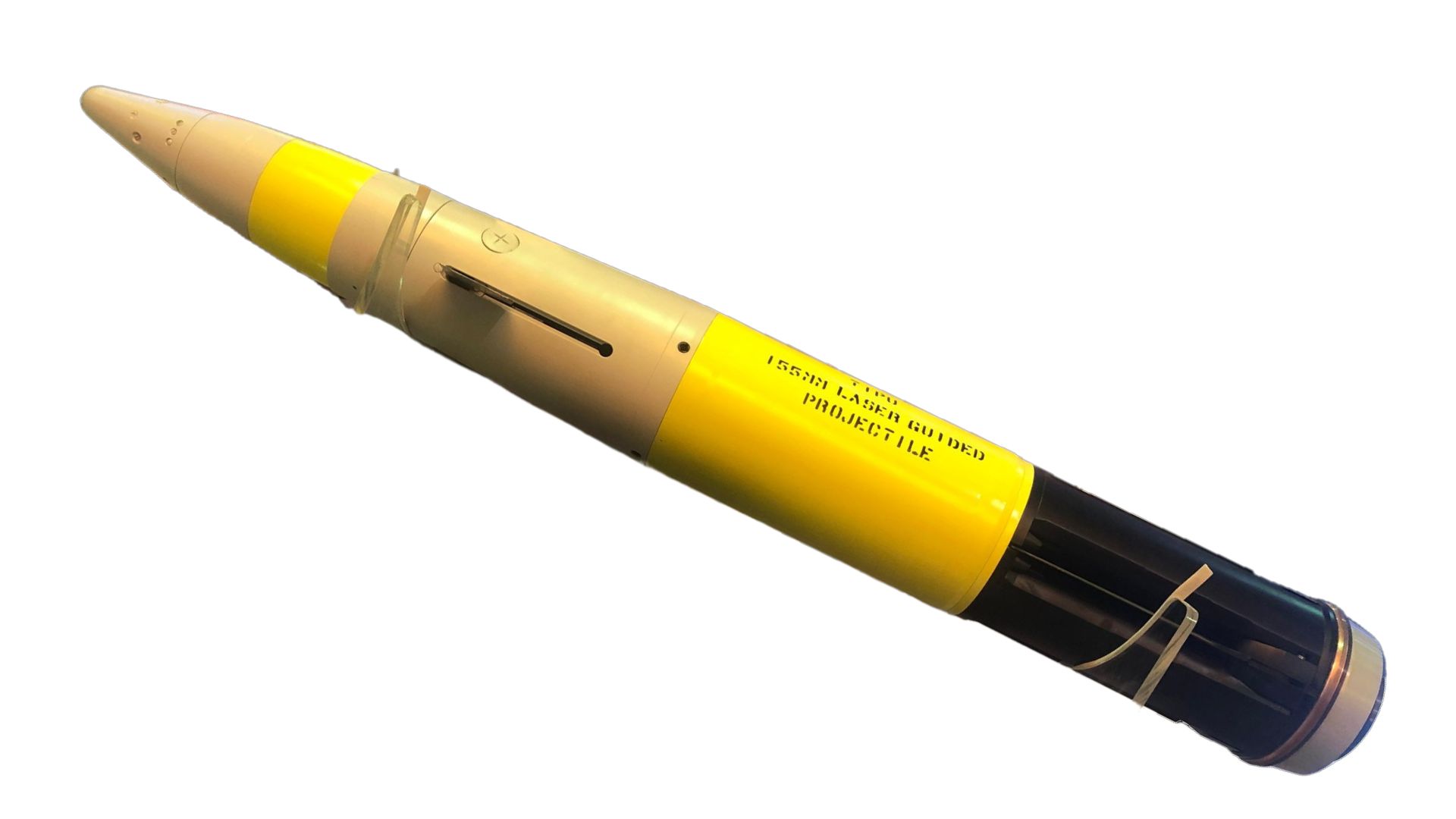
For reference, another Pakistani-designed solution, the DynTek Tipu guided artillery shell, achieves a 20 m CEP with GNSS/GPS-aided INS, while the semi-active laser-homing (SALH) variant achieves a 2 m CEP.
 
Last edited:
To view this content we will need your consent to set third party cookies.
For more detailed information, see our cookies page.

The Indonesian defense minister talks about delivery of agrees items when referring to gids.
From what it looks like this is deal is combination of F4 missiles and F1/2
@AeronautIR talked about export customer for F4 CM, looks like it's Indonesia
@JamD do we have the capacity to mass produce F1/2 and secondly you talked about how costly it was to acquire items on the black market for CMs.
Do you think something changed here, because recently I was told supply chain issues were resolved and now we are seeing this. Any thoughts on this.
Because as you've mentioned and explained it earlier in our case the more you want to produce in numbers the costly it gets.
@Panzerkiel ur thoughts too on this would help.
 
To view this content we will need your consent to set third party cookies.
For more detailed information, see our cookies page.

The Indonesian defense minister talks about delivery of agrees items when referring to gids.
From what it looks like this is deal is combination of F4 missiles and F1/2
@AeronautIR talked about export customer for F4 CM, looks like it's Indonesia
@JamD do we have the capacity to mass produce F1/2 and secondly you talked about how costly it was to acquire items on the black market for CMs.
Do you think something changed here, because recently I was told supply chain issues were resolved and now we are seeing this. Any thoughts on this.
Because as you've mentioned and explained it earlier in our case the more you want to produce in numbers the costly it gets.
@Panzerkiel ur thoughts too on this would help.


It's a bit iffy, unless they are being offered the F4 without MCTR restrictions I don't see why they would go for it since it's a pretty standard GLCM otherwise, especially if they are being offered the brahmos at the same time, a tech transfer agreement for the F1/2 does make sense.

@Indos thoughts?
 
It's a bit iffy, unless they are being offered the F4 without MCTR restrictions I don't see why they would go for it since it's a pretty standard GLCM otherwise, especially if they are being offered the brahmos at the same time, a tech transfer agreement for the F1/2 does make sense.

@Indos thoughts?
Well for one there is an agreement not offered read the post of the Indonesian Mod, he explicitly says agreed upon items hence any effective agreement.
Secondly I think we are seeing this boom in pak Defense cause we are offering stuff with MCTR for both GMLRS and GLCM.
Thirdly this fits well what another respected member posted by GLCM
 
Well for one there is an agreement not offered read the post of the Indonesian Mod, he explicitly says agreed upon items hence any effective agreement.
Secondly I think we are seeing this boom in pak Defense cause we are offering stuff with MCTR for both GMLRS and GLCM.
Thirdly this fits well what another respected member posted by GLCM

What are the "agreed items"? We don't know so no point in making assumptions.
 
It's a bit iffy, unless they are being offered the F4 without MCTR restrictions I don't see why they would go for it since it's a pretty standard GLCM otherwise, especially if they are being offered the brahmos at the same time, a tech transfer agreement for the F1/2 does make sense.

@Indos thoughts?

Brahmos look like not getting traction anymore from what I see maybe because India doesnt provide sufficient TOT

Regarding to missiles, Turkiye get many order due to sufficient TOT.

It is because cruise missile, missile technology are part of Indonesia gov focus

Fighter jet is part of it, then this is why Prabowo mentioned KF21 program during his meeting with SK President, something that Jokowi never did. KF21 joint development started since 2009 under SBY administration. Both SBY and Prabowo were Armed Force Generals
 

Users who are viewing this thread

Pakistan Defence Latest

Country Watch Latest

Latest Posts

Back
Top