Navigation
Install the app
How to install the app on iOS
Follow along with the video below to see how to install our site as a web app on your home screen.
Note: This feature may not be available in some browsers.
More options
Style variation
You are using an out of date browser. It may not display this or other websites correctly.
You should upgrade or use an alternative browser.
You should upgrade or use an alternative browser.
PA MLRS, Self Propelled and towed artillery [BM-11, Fatah-I GMLRS, Fatah-II] - News, Updates & Discussions
- Thread starter CSAW
- Start date
More options
Who Replied?


Michael
VIP Member

I have a question:
What is the approximate equipment rate of fire adjustment drones in the Pakistan artillery units?
Currently, all artillery units of the PLAGF are equipped with fire adjustment drones, with an equipment rate of 100% ------ excluding individual-carried mortars.
Bilal
THINK TANK: CONSULTANT
Pretty sure it’s 100% or approaching that. The UAVs being used are Scout and Ranger being offered by GIDS.I have a question:
What is the approximate equipment rate of fire adjustment drones in the Pakistan artillery units?
Currently, all artillery units of the PLAGF are equipped with fire adjustment drones, with an equipment rate of 100% ------ excluding individual-carried mortars.
Last edited:

Intervention-06
Registered Member

Why Pakistani SH-15 are not equipped with rooftop machine gun ?Pretty sure it’s 100% or approaching that. The UAVs being used are Scout and Ranger being offered by GIDS.
Bilal
THINK TANK: CONSULTANT
Not needed. It’s not supposed to be near the front line.Why Pakistani SH-15 are not equipped with rooftop machine gun ?
Intervention-06
Registered Member
Not needed. It’s not supposed to be near the front line.
And against drone threats? **** I have sleepless nights after seeing the Ukraine-Russian Drone warfare - don’t want to know what Indians are preparing for the next round.


Samurai
Registered Member
Impressive - notice some new equipment right there
At 0:47 you guys can see the airburst warheads exploding right before impact and the munitions are spreading. This is different from what we saw in the Fatah-IV test, where it was totally incendiary. So does PA has this kind of airburst warheads in its inventory just like in the video? In comparison I think airburst's spread is wider than the incendiary one.

avx._4884
Registered Member
View attachment 203604
Pakistan officially states the range of the FATAH-1 Guided Multiple Launch Rocket System (GMLRS) as 140 kilometers. This is the accepted and publicly confirmed operational range. However, published military specifications often represent the validated combat envelope rather than the absolute aerodynamic or kinematic capability of a missile.
This analysis does not claim access to classified information, nor does it suggest that the official figure is inaccurate. Instead, it is an engineering exercise using publicly available information, established rocket performance equations, and comparisons with broadly similar systems to estimate the missile's potential upper-bound kinematic performance.
Publicly Known Characteristics
Based on official imagery and publicly available information, the FATAH-1 is estimated to have the following characteristics:
Since detailed specifications have not been publicly disclosed, several engineering assumptions are necessary.
Step 1 – Estimated Propellant Mass Fraction
Modern 300 mm guided rockets typically devote approximately 62–68% of their launch mass to solid propellant.
Assuming:
The resulting Mass Ratio is calculated as 770 divided by 270, which is approximately 2.85. These values are estimates intended to represent a plausible modern tactical rocket configuration.
Step 2 – Specific Impulse
Modern composite solid propellants generally achieve a specific impulse of approximately 250 seconds. The corresponding effective exhaust velocity is found by multiplying specific impulse by standard gravity (250 multiplied by 9.81), which equals approximately 2450 meters per second. This is consistent with contemporary aluminized HTPB-based solid rocket motors.
Step 3 – Ideal Delta-V
Applying the Tsiolkovsky Rocket Equation, the ideal velocity increment (Delta-V) equals the effective exhaust velocity multiplied by the natural logarithm of the Mass Ratio. Fusing our parameters (2450 multiplied by the natural log of 2.85) yields an ideal Delta-V of approximately 2565 meters per second.
This represents the rocket's ideal velocity increment under vacuum conditions. Actual flight performance is lower because of gravity losses, atmospheric drag during powered flight, and energy expended on guidance and trajectory corrections. Applying representative losses typical of tactical solid rockets suggests a burnout velocity on the order of 2.0 to 2.3 kilometers per second.
Step 4 – Aerodynamic Considerations
The rocket equation alone cannot determine maximum range. Actual range depends on numerous undisclosed factors, including the aerodynamic drag coefficient, ballistic coefficient, burnout altitude, burnout flight angle, thrust profile, guidance corrections, atmospheric density, and structural flight limits.
A simple vacuum ballistic calculation would substantially overestimate range because atmospheric drag dominates the flight of large artillery rockets. Without a detailed six-degree-of-freedom trajectory model incorporating these parameters, the missile's maximum range cannot be calculated directly from Delta-V alone.
Step 5 – Estimated Upper-Bound Kinematic Range
Although an exact trajectory solution is not possible using publicly available data, comparison with modern guided rockets of similar size, estimated propulsion performance, and expected aerodynamic efficiency suggests that a maximum kinematic range on the order of approximately 175 to 185 kilometers appears physically plausible under favorable conditions. This estimate represents a theoretical upper-bound engineering assessment rather than a verified operational capability.
Why Is the Official Range 140 km?
Several engineering and operational factors can explain why the officially published range is lower than an estimated physical maximum.
1. Accuracy
Beyond the validated engagement envelope, Circular Error Probable (CEP) generally increases. Official specifications typically reflect the range at which required accuracy is consistently achieved.
2. Standard Combat Payload
Operational range is generally quoted using the standard service warhead rather than reduced-payload developmental configurations.
3. Reliability Margin
Operating below absolute aerodynamic limits reduces structural stress, improves reliability, and ensures consistent performance across varying environmental conditions.
4. Operational Qualification
Military range specifications typically represent the envelope that has been fully tested, validated, and accepted for operational use. They do not necessarily define the missile's absolute physical limit.
Comparison
The estimated range fits reasonably within the expected performance envelope of a modern 300 mm guided rocket employing contemporary composite solid propellant technology.
Conclusion
Based on first-principles rocket analysis, reasonable assumptions regarding propulsion performance, and comparison with analogous guided rocket systems, a maximum kinematic range on the order of 175–185 km appears physically plausible for a missile with the estimated characteristics of the FATAH-1.
Because critical parameters such as drag coefficient, thrust profile, structural limits, and guidance algorithms remain undisclosed, this figure should be regarded as an engineering estimate rather than a calculated or verified performance value.
The officially published 140 km range remains the only confirmed operational capability. This analysis is intended solely as an open-source engineering assessment based on publicly available information and should not be interpreted as evidence of undisclosed performance.
Constructive feedback, alternative calculations, or additional publicly available data from those with expertise in aerospace engineering, propulsion, or external ballistics are welcome.
Pakistan officially states the range of the FATAH-1 Guided Multiple Launch Rocket System (GMLRS) as 140 kilometers. This is the accepted and publicly confirmed operational range. However, published military specifications often represent the validated combat envelope rather than the absolute aerodynamic or kinematic capability of a missile.
This analysis does not claim access to classified information, nor does it suggest that the official figure is inaccurate. Instead, it is an engineering exercise using publicly available information, established rocket performance equations, and comparisons with broadly similar systems to estimate the missile's potential upper-bound kinematic performance.
Publicly Known Characteristics
Based on official imagery and publicly available information, the FATAH-1 is estimated to have the following characteristics:
| Diameter | 300 mm |
| Estimated Length | 7.3 to 7.6 meters |
| Estimated Launch Mass | 720 to 820 kg |
| Propulsion | Single-stage solid rocket motor |
| Guidance | INS and GNSS guidance with terminal corrections |
| Official Operational Range | 140 kilometers |
Since detailed specifications have not been publicly disclosed, several engineering assumptions are necessary.
Step 1 – Estimated Propellant Mass Fraction
Modern 300 mm guided rockets typically devote approximately 62–68% of their launch mass to solid propellant.
Assuming:
| Launch Mass | 770 kg |
| Propellant Mass | 500 kg |
| Dry Mass | 270 kg |
The resulting Mass Ratio is calculated as 770 divided by 270, which is approximately 2.85. These values are estimates intended to represent a plausible modern tactical rocket configuration.
Step 2 – Specific Impulse
Modern composite solid propellants generally achieve a specific impulse of approximately 250 seconds. The corresponding effective exhaust velocity is found by multiplying specific impulse by standard gravity (250 multiplied by 9.81), which equals approximately 2450 meters per second. This is consistent with contemporary aluminized HTPB-based solid rocket motors.
Step 3 – Ideal Delta-V
Applying the Tsiolkovsky Rocket Equation, the ideal velocity increment (Delta-V) equals the effective exhaust velocity multiplied by the natural logarithm of the Mass Ratio. Fusing our parameters (2450 multiplied by the natural log of 2.85) yields an ideal Delta-V of approximately 2565 meters per second.
This represents the rocket's ideal velocity increment under vacuum conditions. Actual flight performance is lower because of gravity losses, atmospheric drag during powered flight, and energy expended on guidance and trajectory corrections. Applying representative losses typical of tactical solid rockets suggests a burnout velocity on the order of 2.0 to 2.3 kilometers per second.
Step 4 – Aerodynamic Considerations
The rocket equation alone cannot determine maximum range. Actual range depends on numerous undisclosed factors, including the aerodynamic drag coefficient, ballistic coefficient, burnout altitude, burnout flight angle, thrust profile, guidance corrections, atmospheric density, and structural flight limits.
A simple vacuum ballistic calculation would substantially overestimate range because atmospheric drag dominates the flight of large artillery rockets. Without a detailed six-degree-of-freedom trajectory model incorporating these parameters, the missile's maximum range cannot be calculated directly from Delta-V alone.
Step 5 – Estimated Upper-Bound Kinematic Range
Although an exact trajectory solution is not possible using publicly available data, comparison with modern guided rockets of similar size, estimated propulsion performance, and expected aerodynamic efficiency suggests that a maximum kinematic range on the order of approximately 175 to 185 kilometers appears physically plausible under favorable conditions. This estimate represents a theoretical upper-bound engineering assessment rather than a verified operational capability.
Why Is the Official Range 140 km?
Several engineering and operational factors can explain why the officially published range is lower than an estimated physical maximum.
1. Accuracy
Beyond the validated engagement envelope, Circular Error Probable (CEP) generally increases. Official specifications typically reflect the range at which required accuracy is consistently achieved.
2. Standard Combat Payload
Operational range is generally quoted using the standard service warhead rather than reduced-payload developmental configurations.
3. Reliability Margin
Operating below absolute aerodynamic limits reduces structural stress, improves reliability, and ensures consistent performance across varying environmental conditions.
4. Operational Qualification
Military range specifications typically represent the envelope that has been fully tested, validated, and accepted for operational use. They do not necessarily define the missile's absolute physical limit.
Comparison
| System | Diameter | Official Range |
| M30 GMLRS | 227 mm | 84 km |
| ER GMLR | 227 mm | 150 km |
| A-100 | 300 mm | 100 km |
| FATAH-1 | 300 mm | 140 km |
| FATAH-1 (Estimated Upper-Bound Kinematic Potential) | 300 mm | 175 to 185 km (Estimated) |
The estimated range fits reasonably within the expected performance envelope of a modern 300 mm guided rocket employing contemporary composite solid propellant technology.
Conclusion
Based on first-principles rocket analysis, reasonable assumptions regarding propulsion performance, and comparison with analogous guided rocket systems, a maximum kinematic range on the order of 175–185 km appears physically plausible for a missile with the estimated characteristics of the FATAH-1.
Because critical parameters such as drag coefficient, thrust profile, structural limits, and guidance algorithms remain undisclosed, this figure should be regarded as an engineering estimate rather than a calculated or verified performance value.
The officially published 140 km range remains the only confirmed operational capability. This analysis is intended solely as an open-source engineering assessment based on publicly available information and should not be interpreted as evidence of undisclosed performance.
Constructive feedback, alternative calculations, or additional publicly available data from those with expertise in aerospace engineering, propulsion, or external ballistics are welcome.
avx._4884
Registered Member
Why This Missile Is a Different Beast Altogether

Before jumping into numbers, it is worth being very clear about something that gets glossed over in most reporting: the FATAH-II is not simply a bigger version of the FATAH-I. It is a structurally different category of weapon.
The FATAH-I is a conventional Guided Multiple Launch Rocket System (GMLRS) — it fires a solid-fuel rocket that follows a ballistic arc to its target, guided throughout by INS/GNSS. Think of it like a very large, very precise mortar round.
The FATAH-II occupies a different category entirely. Multiple independent defence publications, drawing on GIDS's own marketing language ("non-ballistic, all-course manoeuvre, supersonic"), describe the missile as employing some form of post-boost aerodynamic flight after its solid rocket motor burns out. Some analysts specifically interpret the post-boost behaviour as involving a separating glide vehicle — a lifting body that detaches from the spent motor casing and flies itself to target under aerodynamic lift at supersonic speed. This interpretation appears in credible open-source defence coverage and is consistent with GIDS's "non-ballistic, supersonic" language, though it has not been explicitly confirmed by GIDS as a description of physical stage separation.
However, GIDS has not published a detailed technical datasheet explicitly confirming a separating glide vehicle as a discrete component. The architecture is therefore best treated as the most widely held analyst interpretation of the available description, not a formally confirmed factory specification. This distinction matters because the entire glide-phase range contribution in Step 4 is contingent on that architecture being correct. Where it drives the analysis, the glide-vehicle assumption is flagged explicitly.
This document examines both the propulsion performance common to all plausible architectures and the additional range contribution if the analyst-described glide phase is accepted, along with what either scenario implies about the missile's kinematic ceiling.
What Is Actually Confirmed
Sources differ in some particulars, but the following specifications are either directly confirmed by GIDS official documentation or corroborated across multiple independent defence publications:| Parameter | Confirmed Value | Source |
|---|---|---|
| Length | 7.5 m | GIDS / Janes / EDR Magazine |
| Body Diameter | ~600 mm | Quwa |
| Warhead Mass | 365 kg | GIDS official data sheet |
| Warhead Type | Unitary blast / blast-fragmentation | GIDS |
| Propulsion | Single-stage dual-thrust solid rocket motor | Janes / Army Recognition |
| Post-boost behaviour | Supersonic flight at Mach 2+ after motor burnout; some analysts interpret this as involving a separating glide vehicle, but physical stage separation has not been confirmed by GIDS | Quwa / Army Recognition / EDR |
| Official Domestic Range | 400 km | ISPR |
| GIDS Export Range (datasheet) | 100–290 km | GIDS / WDS 2024 documentation |
| Guidance | INS + multi-constellation GNSS | GIDS |
| CEP (manufacturer) | ≤50 m | GIDS |
| CEP (ISPR claim) | <10 m | ISPR |
| Terminal speed | Mach 2+ | Multiple sources |
| Launcher | 2-round canister, Taian TAS5450 8×8 TEL | Janes / Euro-SD |
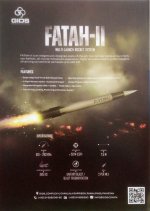
Two figures that remain publicly undisclosed — and which matter enormously to the analysis — are the total launch mass and the motor's propellant load. Everything below that requires those numbers will be estimated.
Step 1 — Estimating Launch Mass
Since GIDS has not published a total launch mass for the FATAH-II, the starting point is geometric scaling and structural analogy.At 600 mm diameter and 7.5 m length, the FATAH-II's volume is roughly four times greater than a 300 mm rocket of comparable length. Structural mass scales somewhat less than linearly with volume (thicker walls, but proportionally lighter), while propellant mass scales with internal volume. Cross-referencing against publicly documented systems of similar calibre and mission:
- The Chinese DF-12 (600 mm, ~7.3 m): estimated launch mass 1,500–1,800 kg
- The American ATACMS Block I (610 mm, ~3.96 m): 1,672 kg total, 560 kg warhead
- The Russian Iskander-M (920 mm, 7.3 m): 3,800 kg — illustrates that diameter scales mass rapidly
Using a propellant mass fraction consistent with modern tactical solid-fuel missiles (60–65%), the resulting total launch mass estimate is:
| Parameter | Estimate |
|---|---|
| Total Launch Mass | ~1,400–1,900 kg (central value: ~1,600 kg) |
| Propellant Mass | ~860–1,140 kg |
| Inert / Dry Mass | ~540–760 kg |
| Mass Ratio (M₀/M_f) | ~2.4–2.8 |
These are engineering estimates with substantial uncertainty. The wider range reflects how little dimensional and structural data is publicly confirmed. They are not manufacturer figures, and the central value of ~1,600 kg is used for illustrative calculation only.
Step 2 — The Dual-Thrust Motor Explained
The "single-stage dual-thrust" description from GIDS is specific and worth unpacking because it directly shapes the trajectory.A dual-thrust motor contains two propellant grain sections within a single casing. The boost grain burns first — high thrust, short duration — accelerating the missile rapidly to high velocity. The sustain grain then takes over at lower thrust, maintaining velocity through the atmospheric drag zone without expending propellant at the expensive rate needed for initial acceleration.
This architecture achieves two practical things:
- It extends powered flight time, giving the guidance system more window to correct the trajectory during the energised phase.
- It produces a flatter trajectory at lower altitudes during the sustain phase — consistent with GIDS and independent analyst descriptions of the FATAH-II as having a "quasi-flat" flight profile.
Modern dual-thrust motors of this class achieve specific impulse (Isp) values in the range of 248–260 seconds, consistent with high-energy aluminised HTPB-based composite propellants. Using 255 seconds as the working value:
Ve = Isp × g0 = 255 × 9.81 = 2502 m/s
Step 3 — Ideal Delta-V (Boost Phase)
Applying the Tsiolkovsky Rocket Equation to the boost phase, using the central mass estimate (MR ≈ 2.63):ΔV₍ideal₎ = Vₑ × ln(M₀/Mf) = 2502 × ln(2.63) = 2502 × 0.967 ≈ 2419 m/s
The Tsiolkovsky equation estimates only the propulsion-derived velocity increment. It does not by itself determine missile range, which also depends on trajectory, atmospheric drag, aerodynamic lift, and guidance. Those factors are addressed in the steps that follow.
Across the full launch mass uncertainty range (MR of 2.4–2.8), ideal ΔV spans roughly 2,175–2,575 m/s — a spread of ~400 m/s driven primarily by how much propellant mass fraction the missile actually carries. Real flight is messier than that. For a quasi-ballistic missile like the FATAH-II flying a relatively flat trajectory (which increases time in the dense lower atmosphere compared to a high-loft profile), estimated losses are:
| Loss Category | Estimated Magnitude |
|---|---|
| Gravity losses (cosine losses along lofted arc) | 350–550 m/s |
| Aerodynamic drag during powered flight | 200–400 m/s |
| Guidance/trajectory correction budget | 50–100 m/s |
| Total losses | ~600–1,050 m/s |
This yields an estimated burnout velocity of approximately 1,370–1,820 m/s — corresponding to roughly Mach 4.0–5.3 at the burnout altitude. Terminal speed is lower than burnout velocity because aerodynamic drag continuously dissipates kinetic energy throughout the descent phase, decelerating the vehicle significantly before impact. The reported Mach 2+ terminal figure is consistent with this picture.
Step 4 — Flight Architecture and Range: Two Scenarios
This is where the analysis must be most explicit about what is known versus inferred, because the architecture assumption determines the range mechanism entirely.Scenario A — Separating Boost-Glide Architecture (Analyst-Described)
Several credible open-source publications, citing GIDS's "non-ballistic, supersonic, all-course manoeuvre" description, interpret the FATAH-II as having a separating glide vehicle: the spent motor casing jettisons after burnout, and an aerodynamic lifting body continues flight under its own control surfaces. If this architecture is correct, the range breakdown becomes two distinct contributions.For a pure ballistic (non-lifting) trajectory from the estimated burnout conditions, the boost phase alone would reach approximately 250–300 km under vacuum, less in atmosphere. The glide vehicle, if present, would extend this by maintaining aerodynamic lift during descent.
The glide contribution depends on the glide vehicle's lift-to-drag ratio (L/D) at supersonic speeds (Mach 2–4 during descent):
- Simple finned body: L/D ≈ 1.5–2.5
- Shaped lifting body with active canards: L/D ≈ 3.0–5.0
Important caveat: The specific figures above (80–140 km glide contribution, 355–435 km total) are internally consistent only if the separating glide vehicle architecture is real. They should not be read as a confirmed decomposition of the missile's range. They are what the math produces under a specific architectural hypothesis.
Scenario B — Unified Quasi-Ballistic Architecture
If the FATAH-II instead operates as a single unified body — the motor burns out and the complete airframe (warhead + guidance + fins, still integrated) follows a quasi-ballistic arc without physically separating — then the range mechanism is purely ballistic with aerodynamic shaping for manoeuvring.Under this scenario, reaching 400 km may require a higher burnout altitude, a more efficient trajectory, or more favourable propulsion parameters than assumed in this analysis — which is one reason many analysts lean toward Scenario A as one plausible physical explanation.
What Both Scenarios Agree On
Regardless of architecture, a missile of this size, propellant fraction, and motor performance can plausibly reach the 350–450 km range band under some combination of propulsion, trajectory, and aerodynamic configuration. The official 400 km claim is technically credible under either scenario. The mechanism differs; the destination does not.Step 5 — Upper Bound: What Lies Beyond 400 km
The official 400 km is almost certainly not the absolute physical limit. The question is how far above it the kinematic ceiling sits — and whether the available open-source data are sufficient to quantify that ceiling confidently. They are not.What can be said with reasonable confidence is that several operational constraints actively reduce range below the physical maximum:
Trajectory profile. The FATAH-II is deliberately designed to fly low and flat to compress radar detection and interception windows. This is tactically sound but aerodynamically inefficient — a higher loft angle would reduce time in dense atmosphere and extend range, at the cost of becoming a more predictable and earlier-detected target.
Manoeuvring overhead. The "all-course manoeuvre" capability requires control surface deflection throughout flight, which adds induced drag and consumes energy that would otherwise go into range extension. A passive ballistic trajectory would be more efficient.
Standard payload constraint. Range figures are quoted with the operational 365 kg warhead. A reduced-payload configuration would mechanically extend range.
Operational validation margin. Stated ranges reflect the tested, qualified operational envelope — not the boundary of what the physics allow.
These factors collectively suggest a theoretical kinematic ceiling somewhat above 400 km exists under optimised conditions (higher loft angle, reduced manoeuvrability, reduced payload). However, the available open-source data are insufficient to determine a reliable numerical upper limit. Deriving a specific figure would require assumptions about trajectory optimisation that cannot be validated without access to the motor thrust profile, drag coefficient, and trajectory modelling — none of which are publicly available.
A 20–35% margin above operational range is sometimes cited as typical for systems of this class, but applying that rule of thumb here would be substituting an analogy for a derivation. It is not done in this analysis.

The MTCR Question — Why 290 km for Export
One of the most telling numbers in the open-source record is not 400 km. It is 290 km — the range ceiling on GIDS's own official export product datasheet.The Missile Technology Control Regime (MTCR) draws its most sensitive line at 300 km range with 500 kg or greater payload. Systems meeting both criteria fall into Category I, the strictest tier of export controls. Pakistan is not a formal MTCR signatory, but it is sensitive to international proliferation norms and keen to preserve its access to dual-use technology.
The FATAH-II's 365 kg warhead sits below the 500 kg Category I payload threshold. However, systems capable of 300+ km range can invite Category I scrutiny regardless of declared payload weight if they are assessed as potentially capable of WMD delivery. By capping the export variant at 290 km, GIDS keeps the system unambiguously below the 300 km range trigger on the MTCR spectrum, making it a cleaner export without requiring individual case-by-case reviews under the most restrictive protocols.
The domestic 400 km variant is retained as a Category I item for Pakistan's own forces, consistent with its role as a deep-strike conventional deterrent under the Army Rocket Force Command.
Comparison With Analogous Systems
| System | Country | Diameter | Propulsion | Official Range | Type |
|---|---|---|---|---|---|
| GMLRS (M31) | USA | 227 mm | Single-stage solid | 84 km | GMLRS |
| ATACMS Block I | USA | 610 mm | Single-stage solid | ~300 km | Quasi-ballistic |
| Iskander-M | Russia | 920 mm | Single-stage solid | 500 km | Quasi-ballistic |
| DF-12 (M20) | China | 600 mm | Single-stage solid | 280–400 km | Quasi-ballistic |
| FATAH-I | Pakistan | 300 mm | Single-stage solid | 140 km | GMLRS |
| FATAH-II | Pakistan | ~600 mm | Dual-thrust solid rocket; post-boost glide reported by analysts | 400 km | Quasi-ballistic |
The DF-12 is the most structurally similar public analogue, sharing comparable diameter and range band. The ATACMS Block I provides a useful propulsion reference, though its warhead mass and trajectory profile differ. Unlike both, the FATAH-II emphasises a flat low-altitude approach profile, which trades aerodynamic range efficiency for survivability against radar-guided intercept systems.
Key Uncertainties in This Analysis
Flight architecture — the foundational uncertainty. Everything in Step 4 depends on whether the FATAH-II actually employs a separating glide vehicle. If it does, the boost-plus-glide range decomposition is meaningful. If the missile operates as a single integrated quasi-ballistic body, the glide L/D calculations are simply inapplicable. This is the single most important unknown and it cannot currently be resolved from open-source information.Launch mass. The range 1,400–1,900 kg already reflects substantial uncertainty. An error of ±200 kg shifts the ideal ΔV by approximately 6–9% and changes the boost-phase range contribution by a similar margin.
Propellant Isp. The difference between 248 and 260 seconds may seem narrow, but over ~1,000 kg of propellant it moves the ideal ΔV by roughly ±150 m/s — equivalent to 5–8 km of boost-phase range.
L/D ratio of the post-boost body. Under Scenario A, this is the parameter with the greatest single-unit sensitivity on the result. Even one unit of L/D at the estimated separation altitude shifts the glide range contribution by ~25–35 km. And since L/D at Mach 2–4 is not published, any value used is inherently speculative.
Trajectory profile and burnout altitude. The exact launch elevation, dual-thrust motor burn schedule, and burnout altitude all directly determine both boost-phase range and glide efficiency. None of these are in the public record.
The qualitative conclusion — that 400 km is physically credible, and that a kinematic ceiling above it exists but cannot be reliably quantified — is robust to these uncertainties. The specific numbers throughout this analysis are not.
Conclusion
The FATAH-II is a more complex analytical subject than the FATAH-I because its range depends not just on propulsion performance but on a flight architecture that has not been formally confirmed in GIDS's own published documentation. That distinction matters, and this analysis has tried to treat it honestly.What the propulsion analysis does establish clearly is that a 600 mm solid-fuel missile with plausible mass fractions and modern composite propellant can credibly reach the 350–450 km range band under a range of reasonable trajectory and architectural assumptions. The official 400 km claim is technically credible. It does not require exotic propulsion or implausible structural assumptions to achieve.
The question of whether the FATAH-II possesses a kinematic envelope meaningfully above 400 km is real and reasonable. The operational trajectory choice, manoeuvring overhead, and standard payload constraint all suggest some headroom exists. But the available open-source data are insufficient to quantify that ceiling reliably. Any specific numerical upper bound — including figures that have appeared in other analyses — should be understood as an analytical hypothesis rather than a derived engineering result.
The same caveat applies to the glide-vehicle architecture itself. Multiple credible open-source publications describe a separating boost-glide configuration, and it is one plausible physical explanation for how the missile achieves 400 km from a flat-trajectory profile with a modest propellant load. But until GIDS publishes a technical breakdown that explicitly confirms the separation mechanism, that description remains the most widely held analyst interpretation, not a formally confirmed characteristic.
The official 400 km domestic range remains the only validated, publicly stated capability. The 290 km export ceiling is a deliberate MTCR-sensitivity decision, not a physical constraint. And the 110 km gap between them is, as noted throughout, one of the most informative signals in the publicly available record.
This analysis is an open-source engineering exercise using publicly available information, standard propulsion equations, and stated engineering principles. No classified information was used or implied. Corrections, alternative calculations, and additional public data from those with relevant expertise are welcome — particularly on the flight architecture question, where the open-source record remains genuinely incomplete.
All figures rounded to significant digits consistent with the uncertainty of the underlying estimates. Mass fractions, Isp values, aerodynamic coefficients, and trajectory parameters are engineering assumptions, not measured or manufacturer-confirmed values. The glide-vehicle L/D analysis in Step 4 (Scenario A) is contingent on the separating glide vehicle architecture being correct and should be treated accordingly.

Raja Porus
Registered Member
NULL or ZEROI have a question:
What is the approximate equipment rate of fire adjustment drones in the Pakistan artillery units?
Currently, all artillery units of the PLAGF are equipped with fire adjustment drones, with an equipment rate of 100% ------ excluding individual-carried mortars.



Users who are viewing this thread
Total: 4 (members: 0, guests: 4)
Pakistan Defence Latest
-

-

-

-

-
 Federal cabinet gives nod to imposition of emergency in KP; summary sent to president (25 Viewers)
- Latest: Forsvaret
Country Watch Latest
-
Iran - Israel/US War: Israel-US declare war on Iran, Iran responds (692 Viewers)
- Latest: BananaRepublic
-

-
 Turkey, Pakistan, Qatar, and Indonesia forge ‘Badr’ Pact to Jointly Produce Weapons (12 Viewers)
- Latest: Oublious
-
TF-X / KAAN / Hürjet Turkish Fighter & Trainer Aircrafts News & Discussions (8 Viewers)
- Latest: Oublious
-
