PA MLRS, Self Propelled and towed artillery [BM-11, Fatah-I GMLRS, Fatah-II] - News, Updates & Discussions

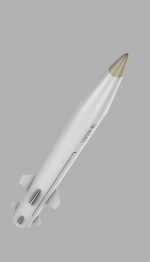
To my eyes it looks a single stage system due to the length and what seem to be the same fins at the rear.
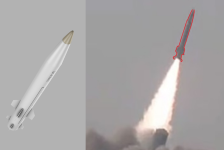
You may be right but this thing is too fast at terminal stage to make any accurate assessment.
Much faster than Nasr.I took ss at 0.2 mach speed.

I think its re-entry vehicle separates from missile body at its terminal phase so looks two-stage missile to me
See this:Screenshot_20231230_020525~2.jpg
The missile has just hit the ground and it has gone completely underground
No external missile body visible

@HRK @Quwa @JamD your thoughts?
If its two stage then it's certainly not CM-400AKG copy.
 
Last edited:
The biggest advantage of fateh II vs s400 is the simple fact that now india will not be deploying s400 close to our borders, infact will deploy it well inland 300-400 km inside India.
Negating s400 biggest advantage...its range.

It will also put a damper of the Indians who from day one have been chest thumping about the fact that with the acquisition of s400 they will shoot PAF ac right after take off.

Ukraine war has shown us all the negative points/ dark spots of the s400....
 
I think its re-entry vehicle separates from missile body at its terminal phase so looks two-stage missile to me
just a single stage missile no separation of warhead/reentry vehicle was observed, I am certain that this misiles followed quasi ballistic trajectory and remained within the earth atmosphere during the whole flight path.
 
just a single stage missile no separation of warhead/reentry vehicle was observed, I am certain that this misiles followed quasi ballistic trajectory and remained within the earth atmosphere during the whole flight path.
Yeah it makes little sense to build a two stage missile for just 400km range.
Let's keep it simple,
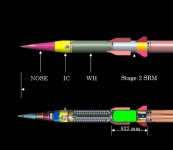
They just thought stage -2 of F-2 is enough:
Screenshot_20231230_121155.jpg
 
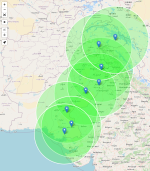
Now specifically to your question we can say that with the stated range of 400 KM now all the defence and economic centers of Indian states of

- Gujrat
- Rajasthan
- Haryana
- Punjab
- Himachal Pardesh
- Jammu & Kashmir and
- Ladhak
are under reach which mean flame of wars could be reached there as well.

Just to give idea about the areas which could be covered with 400 KM range

1703921752476.png
 
We already have nuclear CMs and BMs (Abdali, the Babur series, Ra'ad, Taimoor, and the Naval CMs) in this range category, and with good enough accuracy, but the need for this system (and others like it) is, in my opinion, driven from a doctrinal standpoint - I think our strategic planners realized that there was still some space available for India at a lower threshold (non-nuclear) than the tactical threshold which was believed to have been plugged by Nasr.

This would explain the new focus on such precision-guided, conventional systems. A distinction was needed between primarily nuclear and non-nuclear systems because such a distinction (or absence of it) can have huge implications in a crisis situation.
 
We already have nuclear CMs and BMs (Abdali, the Babur series, Ra'ad, Taimoor, and the Naval CMs) in this range category, and with good enough accuracy, but the need for this system (and others like it) is, in my opinion, driven from a doctrinal standpoint - I think our strategic planners realized that there was still some space available for India at a lower threshold (non-nuclear) than the tactical threshold which was believed to have been plugged by Nasr.

This would explain the new focus on such precision-guided, conventional systems. A distinction was needed between primarily nuclear and non-nuclear systems because such a distinction (or absence of it) can have huge implications in a crisis situation.
I think they got a sense of how/why guided rockets can be valuable via the Ukraine war. IMO, the key in this sense isn't just the range and capability of the missile, but scalability. We need the industrial back-end to produce guided rockets (of diff calibers and ranges) in large numbers to both build up stocks as well as replenish them during war. I imagine the rocket part is manageable, but mass-producing the guidance stack is still a mystery to me. I guess that we'll just build a massive stockpile of INS/SAT kits from China (e.g., enough for 100,000 missiles of different types?)
 
Last edited:
I think they got a sense of how/why guided rockets can be valuable via the Ukraine war. IMO, the key in this sense isn't just the range and capability of the missile, but scalability. We need the industrial back-end to produce guided rockets (of diff calibers and ranges) in large numbers to both build up stocks as well as replenish them during war. I imagine the rocket part is manageable, but mass-producing the guidance stack is still a mystery to me. I guess that we'll just build a massive stockpile of INS/SAT kits from China (e.g., enough for 100,000 missiles of different types?)
Not that difficult as imagined.

Guidance kit for the original Babur was a combo of a commercial dsp and control unit. Readily available -

Now you can get it all from China at fairly reasonable costs(if you want to get mid quality)
 
Not that difficult as imagined.

Guidance kit for the original Babur was a combo of a commercial dsp and control unit. Readily available -

Now you can get it all from China at fairly reasonable costs(if you want to get mid quality)
The original testing versions. As far as I know, the production and deployed versions all had domestic guidance kits. Of course strategic systems are a different kettle of fish.
 
The biggest advantage of fateh II vs s400 is the simple fact that now india will not be deploying s400 close to our borders, infact will deploy it well inland 300-400 km inside India.
Negating s400 biggest advantage...its range.

It will also put a damper of the Indians who from day one have been chest thumping about the fact that with the acquisition of s400 they will shoot PAF ac right after take off.

Ukraine war has shown us all the negative points/ dark spots of the s400....
No matter what what Pakistan chooses to call it.
Fateh 2 is a guided missile, which follows a ballistic trajectory, and not an area saturation weapon and will cost as much.

So what exactly is the achievement here..didn't Pakistan already possess guided missiles of 400 km range ?

What can fateh 2 do that babur missile could not? That is if you know, exact coordinates of s400's mobile lauchers.

On the other hand a guided missile following a parabolic path, will be easier to shoot down than terrain hugging cruise missile.
 
No matter what what Pakistan chooses to call it.
Fateh 2 is a guided missile, which follows a ballistic trajectory, and not an area saturation weapon and will cost as much.

So what exactly is the achievement here..didn't Pakistan already possess guided missiles of 400 km range ?

What can fateh 2 do that babur missile could not? That is if you know, exact coordinates of s400's mobile lauchers.

On the other hand a guided missile following a parabolic path, will be easier to shoot down than terrain hugging cruise missile.
Valid questions.

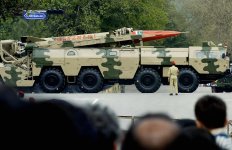
The closest thing to Fatah-II that Pakistan has is the Ghaznavi. There are two things that set Fatah-II apart from Ghaznavi:
1. Each Fatah-II launcher carries TWO missiles, while a single missile is carried by the Ghaznavi TEL:
1704003305005.jpeg
This means very likely, double the potential launches than a Ghaznavi. Also, this very likely points to the improvement of rocket-motor and structural technology over the Ghaznavi, such that two 400 km missiles are being carried and launched by one TEL.
2. As pointed out earlier on this thread, a clear distinction is being made by the non-nuclear role of the Fatah-II. So in a conflict when Pakistan says we attacked India with a Fatah-II, it will be clear that this was a conventional strike and there will be no chance of it being misconstrued as a nuclear first-strike had Pakistan launched a Ghaznavi with a conventional payload.


Regarding Babur. That is a cruise missile, which I think will see very limited use in a Pak-India conflict simply because cruise missiles are a first-world weapon - only countries like USA can use them in enough numbers to be effective. Ballistic rockets and missiles are way cheaper. Also, we have assigned Babur a nuclear role so it has the same problem as Ghaznavi.
 
The biggest advantage of fateh II vs s400 is the simple fact that now india will not be deploying s400 close to our borders, infact will deploy it well inland 300-400 km inside India.
Negating s400 biggest advantage...its range.

It will also put a damper of the Indians who from day one have been chest thumping about the fact that with the acquisition of s400 they will shoot PAF ac right after take off.

Ukraine war has shown us all the negative points/ dark spots of the s400....
What Pakistanis and Indians say on forums doesn't usually translate to the actual strategic tit-for-tat that happens between Pakistan and India.

I don't think Fatah-II is meant for S400s. Fatah-II follows a mostly predictable path, easily intercepted by S400. I doubt Pakistan can launch enough Fatah-II's to saturate an S400 battery. Our planners certainly know this. And they know that the Indians know it too.

I believe dealing with S400 will be a purely PAF mission, for which they must have developed the tools and tactics.
 
Valid questions.

The closest thing to Fatah-II that Pakistan has is the Ghaznavi. There are two things that set Fatah-II apart from Ghaznavi:
1. Each Fatah-II launcher carries TWO missiles, while a single missile is carried by the Ghaznavi TEL:
View attachment 6280
2. As pointed out earlier on this thread, a clear distinction is being made by the non-nuclear role of the Fatah-II. So in a conflict when Pakistan says we attacked India with a Fatah-II, it will be clear that this was a conventional strike and there will be no chance of it being misconstrued as a nuclear first-strike had Pakistan launched a Ghaznavi with a conventional payload.


.
Do u think any country would wait for another country,to say oh we launched an coventional missile on u instead of Nuclear, so chill out, dude what are u smoking.
And For another it is most probably an Ws 2d kinda kinda rocket watch the video carefully those of Fatah 1 and Fatah 2 and Ws 2d test by the chinese test, the pods look the same and also the projectiles.
The difference between ballistic missile and rocket is their max altitude and warhead Size, rockets have max, altitude around 50km
It looks more of an evolution of Nasr, fired at rocket trajectory and more powerful engine.
At minimum it carries around Four of the Fatah 2's
 
Last edited:

Users who are viewing this thread

Pakistan Defence Latest

Latest Posts

Back
Top