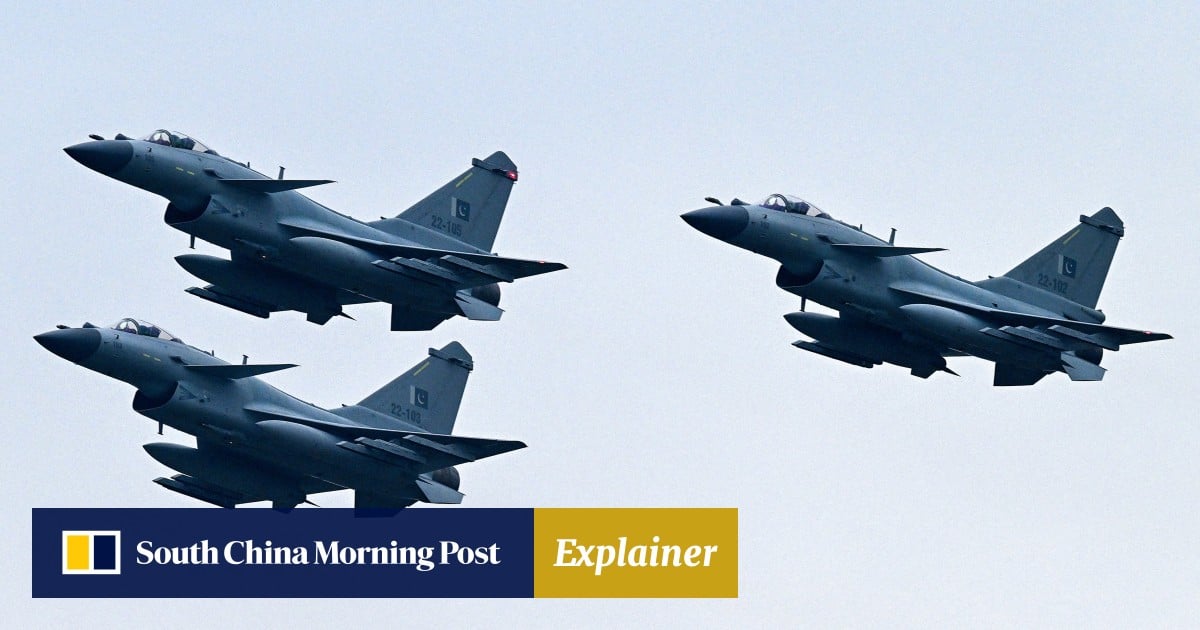
PAF J-10CE News, Updates and Discussion

Status
Not open for further replies.
China on the other hand has reached parity with the US when it comes to 5th and 6th gen tech, so you could call China a 'master' in those fields.
As per Yankesama's latest podcast, PLAAF is writing the new outline and rdy to embrace the sixth gen, eyeing contact/engagement range 300-500KM, and even beyond.
Really looking forward for future cooperation between two airforce, not sure if Shaheen joint exercise is still a go this year, that would be interesting.
 
A Chinese real estate developer (Poly Real Estate) even purchased the J-10 to use as a display for real estate sales. The French could go and buy a house and the manager of this company would inevitably be willing to let them inspect this airplane up close.
The Poly Group is itself an arms trader. The presence of weapons in its companies is not surprising. However, there is no information to prove that it is an intact and genuine fighter jet.

There are a number of companies in China that make high-fidelity 1:1 display models of fighter jets. They even refurbish some old real fighter parts and use them in their display models.
The science museum in my city has many of these high precision models. Ordinary visitors can't tell the real ones from the fake ones.

Some of China's decommissioned fighters (including demonstrators used for testing) can be made available to organizations for public static displays after technical processing (removal of combat functions and classified information components).

We never know when the political winds shift and the F-16s get a decent upgrade in short order, as well as Pakistan being invited back into the western training circuit. Exposing the PAF to stealth fighters like the F-22, F-35 and advanced drones.

The F-16 is more about keeping a foot in the western tech room.
I don't see the value in upgrading the F-16s at PAF.

In the current international situation, no one can provide F-16 upgrades to PAF for free.

Based on common sense, if PAF upgrades the F-16 (to or near F-16V standards), it will be a huge expense.

For reference: unit prices for upgrading F-16s in various countries
USAF: about 10 million dollars
Taiwan Air Force: about $32 million
Argentina: about 39 million dollars
The exact cost depends on the scope of the upgrade and the level of the upgrade.

All the more reason to improve the JF-17’s electrical supply with a more powerful engine, so we can upgrade the fleet with the Block 3’s radar and get full use of it, as well as add an IRST for passive detection (and being cured by the AWACS) until the right time to use its own radar.
The RD-93 engine generates less power (a common problem with Russian engines). This results in a very limited avionics system for the JF-17B3. I'm not sure about the RD-93MA.

The radar of JF-17B3, KLJ-7A, is very powerful and uses more electrical power. Using the RD-93 to power the KLJ-7A is very strenuous. It would have a hard time supporting longer radar runtimes at full power. Also, it limits the JF-17B3 from carrying more electronics.

The WS-21 engine follows the same technical path as the RD-93, but the details and materials are quite different. It is a very desirable alternative. However, the WS-21 engine is more expensive, it is very much more expensive than the RD-93 engine. ------ The J-35 foreign trade version uses all WS-21 engines. So, it certainly has enough power generation.

I have been wondering if the 4.5 gen rafale got taken down with so much ease by our aircraft---then what gen would the JF17 BLK3 & J10 CE's would rank at---???
A 4.75 Gen or a 4.99 Gen---?
The biggest contributor to winning this air battle was the air warfare system platform behind it. J-10CE/JF-17B3+PL-15E.These are just the surface parts of this massive system. There are more and more powerful things hidden behind the scenes and they have not surfaced.

Objectively speaking, as far as fighter jets alone are concerned, the Rafale is a good fighter, and it is on a par with the J-10CE. In terms of overall performance, the Rafale is better than the J-10CE.

The root cause of India's air war losses is the chaotic and outdated air combat command system. In other words, they can't win this air battle even with F-22/F-35 and will lose to J-10CE as well.

Or, let me put it another way.
If we make some modifications to the PAF's F-7PG to make it support PL-15E, and a two-way datalink. Then, guided by other equipment (ground radar or AEW&C), it would be equally capable of launching a PL-15E in the same position to shoot down an IAF Rafale.
But we can't say that this F-7PG is much more advanced than Rafale . Right?
 
Last edited:
this is just false, Pakistan had BVR prior to PL-15 not only in the form of SD-10 but also AIM-120C before that. PAF's foundation and BVR training was done by USAF. Based on our greater combat experience and exposure to western exercises, we have provided invaluable feedback to China, both during exercises and for design and configuration of J-10CE and J-35 (FC-31 was initially rejected by PAF)

China on the other hand has reached parity with the US when it comes to 5th and 6th gen tech, so you could call China a 'master' in those fields.
This account from the Chinese might interest you
 

Attachments

PL15/PL15E has two unique features, other countries don't have yet or are under development (AIM260).

PL15 has dual pulse. Cruising during middle course, acceleration again when the embedded seeker locks on target at the final stage.

PL15 has an AESA seeker, can operate in low detection mode, approaching without triggering the warning system.

The seeker may need to be modified or changed soon. The Indians have the seekers and other chips, we used shooting down their birds. They’ll probably be the same components just modified. Hopefully it’s not too much of a hassle.
The Pl-15s shot into India did not have AESA seekers, rather slotted array (aka PESA).

The images of the seeker debri has been thoroughly analysed by ex-professionals.

This is a good thing, since AESA seeker is still a secret.

Finally, the Rafale that fell in Bathinda, was clearly trying to avoid being hit in the last seconds. If it were an AESA seeker going pitbull, we would expect it to have LPI characteristics, meaning truly: "didnt see what hit me".

@MastanKhan
 
The Poly Group is itself an arms trader. The presence of weapons in its companies is not surprising. However, there is no information to prove that it is an intact and genuine fighter jet.

There are a number of companies in China that make high-fidelity 1:1 display models of fighter jets. They even refurbish some old real fighter parts and use them in their display models.
The science museum in my city has many of these high precision models. Ordinary visitors can't tell the real ones from the fake ones.

Some of China's decommissioned fighters (including demonstrators used for testing) can be made available to organizations for public static displays after technical processing (removal of combat functions and classified information components).


I don't see the value in upgrading the F-16s at PAF.

In the current international situation, no one can provide F-16 upgrades to PAF for free.

Based on common sense, if PAF upgrades the F-16 (to or near F-16V standards), it will be a huge expense.

For reference: unit prices for upgrading F-16s in various countries
USAF: about 10 million dollars
Taiwan Air Force: about $32 million
Argentina: about 39 million dollars
The exact cost depends on the scope of the upgrade and the level of the upgrade.


The RD-93 engine generates less power (a common problem with Russian engines). This results in a very limited avionics system for the JF-17B3. I'm not sure about the RD-93MA.

The radar of JF-17B3, KLJ-7A, is very powerful and uses more electrical power. Using the RD-93 to power the KLJ-7A is very strenuous. It would have a hard time supporting longer radar runtimes at full power. Also, it limits the JF-17B3 from carrying more electronics.

The WS-21 engine follows the same technical path as the RD-93, but the details and materials are quite different. It is a very desirable alternative. However, the WS-21 engine is more expensive, it is very much more expensive than the RD-93 engine. ------ The J-35 foreign trade version uses all WS-21 engines. So, it certainly has enough power generation.


The biggest contributor to winning this air battle was the air warfare system platform behind it. J-10CE/JF-17B3+PL-15E.These are just the surface parts of this massive system. There are more and more powerful things hidden behind the scenes and they have not surfaced.

Objectively speaking, as far as fighter jets alone are concerned, the Rafale is a good fighter, and it is on a par with the J-10CE. In terms of overall performance, the Rafale is better than the J-10CE.

The root cause of India's air war losses is the chaotic and outdated air combat command system. In other words, they can't win this air battle even with F-22/F-35 and will lose to J-10CE as well.

Or, let me put it another way.
If we make some modifications to the PAF's F-7PG to make it support PL-15E, and a two-way datalink. Then, guided by other equipment (ground radar or AEW&C), it would be equally capable of launching a PL-15E in the same position to shoot down an IAF Rafale.
But we can't say that this F-7PG is much more advanced than Rafale . Right?
In the next air skirmish, 2 to 5 years down the road, all PAF Jf-17s will be firing Pl-15s acting as the shooter, the spotter will be a different platform (expect integration of more sensors - either AEWs or Radar Drones). The SD-10s will be converted to point defence SAMs.
 
".....The Rafale uses a RBE2-AA AESA radar, which has an antenna of about 600mm (23.6 inches) in diameter and can scan an area of 140 degrees with a detection range of about 200km (124 miles).

The J-10C radar’s type has not been officially disclosed, but it is known to have a diameter of more than 700mm (27.6 inches).

This means it has a much bigger surface and more radiating array units than the Rafale, which is designed to operate on aircraft carriers as well as from bases on land, limiting the size of the radar it can house."


1747222733316.png


To view this content we will need your consent to set third party cookies.
For more detailed information, see our cookies page.
 
".....The Rafale uses a RBE2-AA AESA radar, which has an antenna of about 600mm (23.6 inches) in diameter and can scan an area of 140 degrees with a detection range of about 200km (124 miles).

The J-10C radar’s type has not been officially disclosed, but it is known to have a diameter of more than 700mm (27.6 inches).

This means it has a much bigger surface and more radiating array units than the Rafale, which is designed to operate on aircraft carriers as well as from bases on land, limiting the size of the radar it can house."


View attachment 120653


To view this content we will need your consent to set third party cookies.
For more detailed information, see our cookies page.


I do wonder how many(if any) PAF fighter jets switched on their own radars during that aerial battle ? Given the datalinks available and mass of AEW&C capability, i suspect not many.

Also - the PAF Erieye platform did well to track over 125 jets in the air at that time! Erieye is properly battled tested now, alongside a whole suite of their platforms both Pakistani, Chinese and Swedish!
 
As per Yankesama's latest podcast, PLAAF is writing the new outline and rdy to embrace the sixth gen, eyeing contact/engagement range 300-500KM, and even beyond.
Really looking forward for future cooperation between two airforce, not sure if Shaheen joint exercise is still a go this year, that would be interesting.
Where can I keep up with Yankeesama's content and how often does Chinese military media talk of PAF? 🤔

I'm wondering if China would let PAF fly against the J-20 in their J-10Cs...
 
The Pakistan Air Force's BVR was taught by China. Before the PL15 was equipped to Pakistan, the Pakistan Air Force did not have BVR.In the annual China-Pakistan military exercises, Chinese masters are teaching their apprentices.
Pakistan operated AMRAAM missiles in its F-16 and even operated PL-12 (SD-10) before the PL-15 so this is incorrect.

The PAF has a strong history of combat with USAF foundations, it's wrong to say that it was built by the Chinese. Even the Chinese learnt a lot from the PAF.

But one place where you're right is that in recent Shaheen exercises with the PLAAF, China taught a lot of good lessons to PAF, because China has been developing its air doctrine aggressively like a science, and this helped update PAFs doctrine in the modern age.
 
this is just false, Pakistan had BVR prior to PL-15 not only in the form of SD-10 but also AIM-120C before that. PAF's foundation and BVR training was done by USAF. Based on our greater combat experience and exposure to western exercises, we have provided invaluable feedback to China, both during exercises and for design and configuration of J-10CE and J-35 (FC-31 was initially rejected by PAF)

China on the other hand has reached parity with the US when it comes to 5th and 6th gen tech, so you could call China a 'master' in those fields.
Design was heavily Chinese inspired I wouldn't say design.

But ergonomics and early quality standards were set by PAF pilots who were stationed in China and gave very long lists of improvements to Chinese aircraft corporations.

The ease of use, human interpretation, and minimum capabilities of early systems were based on PAF experience with western systems, both Americna and European.

Unfortunately many Chinese users don't want to accept this fact but I understand, it feels like we are trying to claim their hardwork when it was all Chinese knowhow and industrial backbone that made it possible.
 
Clearly the #PakistanAirForce showed us what huge Chinese military support can do with the use of their satellites and a great fighter/missile combo. But don't forget the Swedish #SaabErieye flavouring, with a massive handful of Pakistani courage and tactical superiority.

@Alan Warnes on X
 
Where can I keep up with Yankeesama's content
He is a guest writer for the military channel of a Chinese media website (www.guancha.cn). Tip: This is an unofficial website.
Here is his column: https://www.guancha.cn/yangji
His posts here are generally more serious.
He is also active on other Chinese social media platforms. But I can't remember his account number, you'll need to check for yourself.
These are all in Chinese. I don't know if you can read them. If you come across some “secret words” that can't be correctly translated by translation software, you can post them to the PDF platform. We can help you decipher the real meaning of these “secret words”.

Special Tip:
In China's fledgling Internet days, there were many specialized military forums and communities. These were places where a large number of real professionals were active. Due to the lack of some self-discipline at that time, people often openly discussed detailed information about military weapons on the Internet. Some of these researchers even directly posted weapons R&D test data and papers on the Internet, leading to a large number of leaks.

After that, China enacted relevant laws and restrictions and, at the same time, closed down almost all specialized military forums and communities in China.

Now 99% of the well-known figures in the military field who are active on the Internet are “pseudo-experts” who rely on “click bait” to make money.
Less than 1% of them are real professionals. However, even though they know a lot of things, they do not dare to say them directly. Often, they will at best hint at it or describe it in vague terms. For those whose mother tongue is not Chinese, it is impossible to understand what they want to express.

how often does Chinese military media talk of PAF?
There are people on Weibo who have been following military developments in South Asian countries for a long time. They translate English messages from South Asian countries into Chinese and post them on the Weibo platform.

I'm wondering if China would let PAF fly against the J-20 in their J-10Cs...
The J-20 is now substantially more public. Their participation in joint training with the PAF depends on mission requirements. Theoretically, it is no longer subject to the secrecy factor.

But I think PLAAF sending J-16D for joint training will help PAF's warfighting capability more.
 
Last edited:
".....The Rafale uses a RBE2-AA AESA radar, which has an antenna of about 600mm (23.6 inches) in diameter and can scan an area of 140 degrees with a detection range of about 200km (124 miles).

The J-10C radar’s type has not been officially disclosed, but it is known to have a diameter of more than 700mm (27.6 inches).

This means it has a much bigger surface and more radiating array units than the Rafale, which is designed to operate on aircraft carriers as well as from bases on land, limiting the size of the radar it can house."


View attachment 120653


To view this content we will need your consent to set third party cookies.
For more detailed information, see our cookies page.

If true, GIDS be giddy-up.
 
Status
Not open for further replies.

Users who are viewing this thread

Back
Top