
Pakistani Dragon
Elite Member


What do the serial numbers "205" and "206" represent and how can we tell that they are to be exported?View attachment 132167
J-10CE Sr No 205 and 206 for a export customer
Follow along with the video below to see how to install our site as a web app on your home screen.
Note: This feature may not be available in some browsers.
What do the serial numbers "205" and "206" represent and how can we tell that they are to be exported?View attachment 132167
J-10CE Sr No 205 and 206 for a export customer

J-10CE is for export only. Numbers are production numbers perhapsWhat do the serial numbers "205" and "206" represent and how can we tell that they are to be exported?

You may not be well aware of the production process of fighter jets.@Oscar @Quwa @MastanKhan @arslank01 @Waz @Windjammer @Panzerkiel @Bilal
The potential availability of the J-10CE production line presents a strategic opportunity for Pakistan to acquire this capability as a comprehensive package. Pakistan should prioritize securing this deal, whether through financing arrangements or other means (gurday bhaijnay parhay ya koyi local mineral mine ki deal kar kay karna parhay karlo..sorry zyadaa jazbaati ho gaya hun?), as it is critical for bolstering its defense industry. By acquiring the production line, Pakistan could manufacture over 200 J-10CE aircraft domestically (humaray apnay fleet kay liye), incorporating its own modifications to meet specific operational requirements. Furthermore, with China's consent and potential collaboration, Pakistan could explore exporting these aircraft to other nations, generating economic benefits and strengthening defense ties. This move aligns with Pakistan's long-term goals of enhancing self-reliance in defense manufacturing and expanding its role in the global arms market.

But we should not stop at 36 J-10CE? Atleast we should double that number before CAC closes its assembly and air frame production. What if we get 36 J-10 CE and later wanted more where CAC assembly line is shut?You may not be well aware of the production process of fighter jets.
The main cost of the J-10CE fighter is the subsystems (radar and avionics, engines, cockpit systems, etc). It's fighter airframe doesn't have a high proportion of the cost. Also, most of the subsystems of the J-10CE fighter do not belong to CAC, or even to its parent company AVIC. e.g. the engine belongs to AECC, the radar belongs to CETC ......
If CAC closes the production line for the J-10 series of fighters, it's really only closing the final assembly line. Its production line for fighter airframe components would not be shut down, but converted to producing other components. The cost change for PAC to introduce the assembly line for the J-10CE is only related to the last step of the work (final assembly). This Its actual impact on costs is actually very small.
Of course, the PAC can utilize the machinery and equipment of the JF-17's parts production line, and after making some modest modifications and upgrades, it can produce airframe parts for the J-10CE (and may need to bring in some of the machinery and equipment as well). But this will affect the production of JF-17. Of course, PAC could shut down the JF-17 program and switch to J-10CE production.
But, raw materials for airframe manufacturing and other subsystems for fighter jets are still completely dependent on imports.
Based on actual productivity, this approach may cause it to be more expensive than buying complete J-10CEs directly from CAC. You need to know. paf has used the oversized percentage loan method when purchasing the 20x J-10CE ...... 200x J-10CE is not something PAF can afford.
PLAAF has over 300 J-10Cs. they can be quickly converted to J-10CEs. meanwhile, CAC's parts production line, although converted to produce other fighter parts, can always continue to produce parts for the J-10CEs if needed.But we should not stop at 36 J-10CE? Atleast we should double that number before CAC closes its assembly and air frame production. What if we get 36 J-10 CE and later wanted more where CAC assembly line is shut?

In my view, if the Chengdu Aerospace Corporation (CAC) intends to completely shut down the J-10CE production line, than in this case Pakistan should seize this opportunity to persuade them to transfer the entire production facility to Pakistan. This strategic acquisition would enable Pakistan to manufacture J-10CE aircraft domestically, meeting its own defense requirements while positioning the country to fulfill potential export orders. For example, if Iran secures a contract with China for 150–200 J-10CE aircraft, Pakistan could handle production on China’s behalf, leveraging the transferred facility. This would generate significant economic benefits, enhance technical expertise, and advance Pakistan’s defense manufacturing capabilities.
Similarly, Pakistan should pursue the transfer of the JF-17 Block 3 production line. By consolidating manufacturing capabilities for both aircraft types, Pakistan could produce them domestically in quantities tailored to its needs, enabling the retirement of all legacy aircraft in its fleet. This would modernize the Pakistan Air Force while allowing the country to retain profits from export orders facilitated through China. With China’s apparent waning interest in these programs, this presents a critical opportunity. Many countries are seeking 4.5 or 4.5+ generation light-to-medium fighter jets, and centralizing production in Pakistan would bolster its defense export potential, drive economic growth, and strengthen its standing in the global arms market.
GAIC is not so miserable now...cac needs to focus on J-20 production, so they don't want the line. So CAC gave this production line to GAIC whose main business is sugarcane harvesters, ropeway gondolas, sanitation vehicles ......
What I meant was how can you tell from the photos that they're J-10CE and not J-10C?J-10CE is for export only. Numbers are production numbers perhaps
PLAAF stops buying any new J-10Cs as early as 2024, so all new J-10Cs are export versions.What I meant was how can you tell from the photos that they're J-10CE and not J-10C?
There are some significant differences between the J-10C and J-10CE in appearance. We can clearly distinguish them through these features.What I meant was how can you tell from the photos that they're J-10CE and not J-10C?
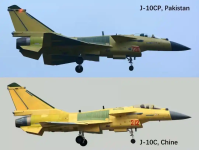
As reportedWhat I meant was how can you tell from the photos that they're J-10CE and not J-10C?
PLA j10c have a satcom dish behind the canopy and a datalink antenna before the vertical tail root. CE don't have those, instead there's a Beidu antenna replacing the sitcom dish and no datalink antenna before the tail root.What I meant was how can you tell from the photos that they're J-10CE and not J-10C?


There are some significant differences between the J-10C and J-10CE in appearance. We can clearly distinguish them through these features.
1. The antenna on the back of the fighter. The J-10C has one more antenna than the J-10CE.
2. The formation signal light under the cockpit. There is a clear difference between the two.
View attachment 132434


