gusto
Trusted Member


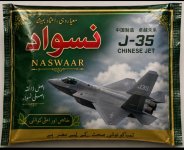
Delivery by the end of this year. They are coming, get ready.
@Pakistan Space Agency
you got another, update your list please.
by the way, hell of a work man. how did you do that?
Follow along with the video below to see how to install our site as a web app on your home screen.
Note: This feature may not be available in some browsers.
Delivery by the end of this year. They are coming, get ready.

If Pakistan wanted to build aircraft engines, it would build them like it built the atom bomb.
Aircraft engines is not considered some critical tech that Pakistan must have for it's own survival. It's availability is out there. It's just economics.
Luckily, Pakistan has never been in a situation where it has had half of squadron of fighter aircraft without engines in them.
View attachment 204660

Where there's a will, there's a way, buddy. Every nation has it's priorities.I dont believe so. You're comparing apples and banana's.
A nuclear weapon is merely a small insulated box with a perfectly timed 'dance' of neutrons. The chemistry does most of the work. There are small nuclear weapons, and larger ones. The creativity that goes into their engineering and their intended use is somewhat classified- and ancient so to speak.
The jet engines are a different story. Their engineering has to withstand the test of time. How loud they can get, on wing time, how far it can take the aircraft, metallurgy, MPD cycles, power production etc. It is much more complex and requires sustained innovation. Heck, US has barely improved their WMDs and its delivery platforms- minute mans.
An analogy for you-Atomic weapon is; study for an year for CSS- you crack it- you become an officer- you make it. You climb ladder here and there. Sure. You 'let' 196 countries build it- half of them can and might.
Manufacturing jet engine is like studying for medicine. Years of study to perfect that angle of the titanium blade, years of study to finally blend in that composite structure that can sustain 5000+ hours of sub-sonic \ super sonic flight without causing rupture.
Pakistan cannot replicate a toyota's 2GR-FE V6 engine at the level of OEM reliability for instance.
These are different games.
Who is telling you that Pakistan cannot replicate Toyota V6 engines? Not having seen one does not mean there is a capability gap. However, making a 100kn engine with AB is a different science altogether. Looking at history, if Pakistan as a nation gets to it, it will be in production in 10 years. This is not an emotional statement but is based on technical know-how and available technology. Making a jet engine is a costly and time-consuming endeavor, but not an impossible one. As technology spreads, jet engine technology is going to become more available in years to come.I dont believe so. You're comparing apples and banana's.
A nuclear weapon is merely a small insulated box with a perfectly timed 'dance' of neutrons. The chemistry does most of the work. There are small nuclear weapons, and larger ones. The creativity that goes into their engineering and their intended use is somewhat classified- and ancient so to speak.
The jet engines are a different story. Their engineering has to withstand the test of time. How loud they can get, on wing time, how far it can take the aircraft, metallurgy, MPD cycles, power production etc. It is much more complex and requires sustained innovation. Heck, US has barely improved their WMDs and its delivery platforms- minute mans.
An analogy for you-Atomic weapon is; study for an year for CSS- you crack it- you become an officer- you make it. You climb ladder here and there. Sure. You 'let' 196 countries build it- half of them can and might.
Manufacturing jet engine is like studying for medicine. Years of study to perfect that angle of the titanium blade, years of study to finally blend in that composite structure that can sustain 5000+ hours of sub-sonic \ super sonic flight without causing rupture.
Pakistan cannot replicate a toyota's 2GR-FE V6 engine at the level of OEM reliability for instance.
These are different games.

Well… it wouldn’t be inaccurate to assume that I couldn’t exactly not say that it is or isn’t almost partially incorrect to claim I don’t know when the J‑35s will enter service or land in Pakistan.Delivery by the end of this year. They are coming, get ready.
The amount of JF-17 jets produced is carefully determined by Pakistan because the engine is provided by Russia, which can be issue if Russia feels paranoid about any Pakistani activity. So the production of JF-17 will stay within a certain amount until the engine is completely replaced by the Chinese or the Pakistani made one.The greatest strategic advantage of the MDP for Pakistan is that it enables the country to expand its effective military capacity without proportionally increasing the financial burden of acquiring, maintaining, and sustaining those assets at home.
At present, there are around 18 JF-17s stationed in Saudi Arabia. Over time, that number could potentially increase to 30–40 PAF aircraft. Beyond combat aviation, the partnership could eventually encompass integrated air defense systems, AEW&C aircraft, MLRS, armored formations, and other high-value military capabilities.
In practical terms, this allows Pakistan to increase its available military capital while sharing the costs of procurement, maintenance, infrastructure, and training with a strategic partner. This is particularly valuable for a country facing persistent fiscal constraints, as it improves force availability without requiring a proportional increase in the domestic defense budget.
Another important benefit is strategic depth. By dispersing a portion of its military assets overseas, Pakistan reduces the concentration of critical capabilities within its own territory. In the event of a prolonged conflict with India, if domestically based assets become overstretched, some overseas-deployed platforms could, in principle, be redeployed to reinforce operational requirements. Naturally, this would depend on the political circumstances at the time and the provisions of any bilateral defense agreement. Nevertheless, maintaining part of the force outside Pakistan provides additional strategic flexibility that would otherwise not exist.
The next logical step is to expand this cooperation beyond operational deployments and into defense industrial integration. Pakistan should encourage organizations such as HIT, PAC, KSEW, GIDS, and other defense manufacturers to establish production, maintenance, repair, and overhaul (MRO) facilities in Saudi Arabia. This would create geographically distributed production capacity that enhances supply-chain resilience and wartime sustainability for both countries.
Reciprocally, Saudi Arabia should be encouraged to invest in strategic petroleum reserves, downstream industries, and selected defense manufacturing facilities in Pakistan. Such cross-investments would strengthen the resilience of both economies and defense sectors against regional instability, supply-chain disruptions, or potential blockades.
Pakistan should also avoid viewing the partnership solely through the lens of attracting Saudi investment into existing Pakistani products. A more ambitious approach would be to pursue genuine joint ventures, combining Pakistan's defense engineering expertise with Saudi companies' significantly greater access to global capital, advanced technologies, research institutions, and international supply chains. This model would accelerate technology transfer, improve manufacturing capabilities, and create products that are competitive in third-country markets.
As this ecosystem matures, the relationship would evolve beyond a traditional buyer-seller arrangement into a deeply integrated strategic-industrial partnership. Such interdependence would not only strengthen the defense capabilities of both countries but would also make Pakistan a more attractive destination for investment from other Gulf states and international defense companies seeking to participate in a resilient regional industrial base.
Producing 18 to 20 odd 4+ gen plans per year is not low in number for country like pakistan ... come on man ... Russian engine delivery is paced according to pakistan production needs and scale not vise versa. Russians are very committed to their contracts specially with CN involved in giving guarantees. This is not the case with across the border engine issues.The amount of JF-17 jets produced is carefully determined by Pakistan because the engine is provided by Russia, which can be issue if Russia feels paranoid about any Pakistani activity. So the production of JF-17 will stay within a certain amount until the engine is completely replaced by the Chinese or the Pakistani made one.
Until then the JF-17 will continue at a steady, but low in numbers, pace.
Besides, you have common thieves, shop lifters, criminals, rapists, drug dealers and druggies planted in high offices in Pakistan pretending to be leaders. It is a miracle things have not been worse than they are currently. We should all collectively thank the Almighty Allay and repent our sins.
Producing 18 to 20 odd 4+ gen plans per year is not low in number for country like pakistan ... come on man ... Russian engine delivery is paced according to pakistan production needs and scale not vise versa. Russians are very committed to their contracts specially with CN involved in giving guarantees. This is not the case with across the border engine issues.

Do you have the metallurgical industry to produce single crystal blades ?the production of JF-17 will stay within a certain amount until the engine is completely replaced by the Chinese or the Pakistani made one
and the point is?No it is the other way around. The Russians sell it to China and China provides them to Pakistan.
The Russians are imperialist in their own way. If it wasn't for China buying these first, the Russians would never supply these to Pakistan in the current numbers.

The Pakistani elite steal way more than 100 J-10C worth from the Pakistani national treasure and natural resources, not to mention all that money lost due to mismanagement.
Only Allah knows but from what I am feeling, Pakistan might end up buying more F-16s. I'd rather Pakistan buy more J-10C jets.But they all perform fajr ki namaz before doing it, so makes it halal for them.
Anyways back to topic, PAF will need atleast 75 as a back up to the 75 odd F16's.
and the point is?
Do you have the metallurgical industry to produce single crystal blades ?