Navigation
Install the app
How to install the app on iOS
Follow along with the video below to see how to install our site as a web app on your home screen.
Note: This feature may not be available in some browsers.
More options
Style variation
You are using an out of date browser. It may not display this or other websites correctly.
You should upgrade or use an alternative browser.
You should upgrade or use an alternative browser.
PAF Special Purpose Assets - News, Discussions & Updates
- Thread starter CSAW
- Start date
More options
Who Replied?

White Privilege
Registered Member
Jammers are offensive platforms. They don't do defensive patrol duties, AWACS do.We need 3 Bombadier jets minimum for one to be up 24 hours in wartime

Yasser76
Elite Member
Sure, but we will need one available 24/7 right?Jammers are offensive platforms. They don't do defensive patrol duties, AWACS do.



NGAD IS THE BEST
Elite Member

No we don't need it in peace time but only being use in war times means in offensive manners against the enemySure, but we will need one available 24/7 right?
Yasser76
Elite Member
No we don't need it in peace time but only being use in war times means in offensive manners against the enemy
I get that bit, but in wartime one is not sufficient to provide a combat capability
NGAD IS THE BEST
Elite Member
You're right but according to various sources here we upgraded our old Falcon 20 fleet with latest Chinese jamming technologies, so we can gradually replace them with this latest jamming platformI get that bit, but in wartime one is not sufficient to provide a combat capability


FOOLS_NIGHTMARE
Elite Member
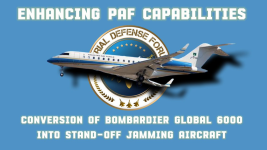
PAF is planning to convert its Bombardier Global 6000 into a stand-off jamming (SOJ) aircraft to better equip itself for future incursions inside the Indian Air Space. The significance of this upgrade is underscored by the IAFs past limitations in EW, notably highlighted during 2019 dogfight with PAF. This forthcoming conversion project demonstrates PAF's offensive capabilities.Conversion of the aircraft will be achieved with help from Turkish Aerospace Industries (TAI). PAF will utilize TAI for Aselsan HAVSOJ suite. Aselsan HAVASOJ is equipped for three core EW missions: radar jamming, communications jamming, and electronic intelligence (ELINT).For radar jamming, the HAVASOJ uses transceivers to jam enemy radars by recording their transmission frequencies and re-transmitting them using the same signal. The HAVASOJ is equipped with digital radar frequency memory (DRFM) systems to help achieve this capability.In the ELINT role, the HAVASOJ would monitor an area for all enemy radar and communications transmissions. It will record that information in a ‘threat library,’ which would later feed electronic countermeasures (ECM) tasks, namely radar and communications jamming.

CSAW
Trusted Member

- Thread starter
- #86

" In a System of systems - The Bombardier Global 6000 platform converted
Asset shall perform ELINT, SIGINT, counter-intelligence ops and enemy radar/communications jamming capabilities across long distances supporting AWACS, Ground based EW Systems & Strike Assets .
In ELINT Mode can monitor an area for all enemy radar and communications transmissions. It will record that information in a ‘threat library,’ which would later feed electronic countermeasures (ECM) tasks, namely radar and communications jamming. Equipped with digital radar frequency memory (DRFM) systems"



Pakistan-Turkey Team Up Against India – Ankara To Help Convert PAF’s Bombardier Global 6000 Into A Jamming Aircraft
Keeping pace with the Indian Air Force’s (IAF) modernization through the acquisition of French Rafales and indigenous Light Combat Aircraft (LCA) Tejas MK1A, the Pakistan Air Force (PAF) is gearing up to convert its lone Bombardier Global 6000 into a stand-off jamming (SOJ) aircraft with help...
 www.eurasiantimes.com
Last edited:
CSAW
Trusted Member
- Thread starter
- #87
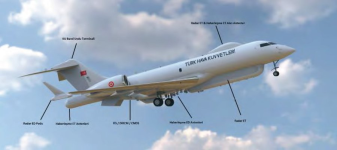
PAF Next Gen Airborne SOJ Asset may eventually be an Aselsan converted Bombardier Global 6000

Remote Electronic Detection and Electronic Attack Capability Acquisition Project on Air Platform (HAVASOJ) – GÖLGE Program
Remote Electronic Support and Electronic Attack (ED/ET) Capability Acquisition Project on the Air Platform (HAVASOJ) – In offensive air operations against threat countries, it is an integrated system integrated into the air platform for the purpose of listening to, confusing or deceiving all kinds of radar and communication facilities of the enemy without entering the threat zone. is the system.
The systems, whose critical mission system components will be designed and produced entirely with domestic resources, are integrated onto the aircraft in various ways. The HAVASOJ aircraft to be used during air operations will be able to perform coordinated missions with the ground support center at high altitudes for a long time. The aircraft will have the ability to detect and jam target elements from a long distance and will also be able to detect and eliminate radar and missile threats.
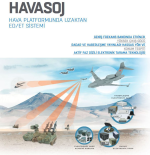
HAVASOJ – Remote Ed/Et System on Aerial Platform
Stand-Off Jammer Aircraft

Remote Electronic Detection and Electronic Attack Capability Acquisition Project on Air Platform (HAVASOJ) – GÖLGE Program
Remote Electronic Support and Electronic Attack (ED/ET) Capability Acquisition Project on the Air Platform (HAVASOJ) – In offensive air operations against threat countries, it is an integrated system integrated into the air platform for the purpose of listening to, confusing or deceiving all kinds of radar and communication facilities of the enemy without entering the threat zone. is the system.
The systems, whose critical mission system components will be designed and produced entirely with domestic resources, are integrated onto the aircraft in various ways. The HAVASOJ aircraft to be used during air operations will be able to perform coordinated missions with the ground support center at high altitudes for a long time. The aircraft will have the ability to detect and jam target elements from a long distance and will also be able to detect and eliminate radar and missile threats.
HAVASOJ – Remote Ed/Et System on Aerial Platform
Stand-Off Jammer Aircraft
- Effectiveness in Wide Frequency Band
- High Output Power
- Radar and Communication Broadcasts Precise Direction and Position Detection
- Active Phased Array Electronic Scanning Technology
- By neutralizing the enemy air defense system, it ensures effective Air Force operations in the event of an attack.
- It has the ability to detect and jam target elements from a long distance.
- Critical mission system components are designed and produced entirely with domestic facilities.
- RADAR Electronic Support / Electronic Attack Subsystem
- Communication Electronic Support / Electronic Attack Subsystem
- Self-Protection Subsystem
- Effectiveness in wide frequency band
- High output power
- RADAR and Communication broadcasts for precise direction and position determination
- Active Phased Array Electronic Scanning Technology
- Effective against frequency hopping, DSSS signals, data links
- Ability to stay in the air for long periods of time at high altitude
- Real-time mission execution in coordination with the Ground Support Center
- Ability to detect RADAR and missile threats and take countermeasures
Last edited:
CSAW
Trusted Member
- Thread starter
- #89
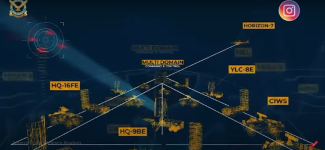
Horizon-7
PAF has begun designating its Erieye AEW&C as the ‘Horizon-7’.
PAF operates seven to nine Erieye systems, with the latest unit being inducted as recently as January 2024.
With the Saab 2000 as its aircraft platform, the Erieye is an S-band active electronically scanned array (AESA) radar with a range of 450 km. It also has five onboard mission operator consoles for managing connected air and surface assets for air-to-air and air-to-surface maneuvers.
Being an airborne radar system, the Erieye also gives the PAF with over-the-horizon (OTH) coverage, which it can leverage to monitor the airspace of its neighbours, especially India and Iran.
It appears that the PAF is standardizing its AEW&C fleet on the Erieye. Moreover, its latest unit – i.e., 23-058 – exhibited some different hardware compared to the PAF’s preceding Erieye units. This unit is unlikely to be the Erieye-ER, but it may have updates similar to Brazil’s E-99M, which is an upgraded Erieye system. That said, the PAF may seek the Erieye-ER in the future, but as an offensively oriented asset that can support its long-range strike wings.

 quwa.org
PAF has begun designating its Erieye AEW&C as the ‘Horizon-7’.
PAF operates seven to nine Erieye systems, with the latest unit being inducted as recently as January 2024.
With the Saab 2000 as its aircraft platform, the Erieye is an S-band active electronically scanned array (AESA) radar with a range of 450 km. It also has five onboard mission operator consoles for managing connected air and surface assets for air-to-air and air-to-surface maneuvers.
Being an airborne radar system, the Erieye also gives the PAF with over-the-horizon (OTH) coverage, which it can leverage to monitor the airspace of its neighbours, especially India and Iran.
It appears that the PAF is standardizing its AEW&C fleet on the Erieye. Moreover, its latest unit – i.e., 23-058 – exhibited some different hardware compared to the PAF’s preceding Erieye units. This unit is unlikely to be the Erieye-ER, but it may have updates similar to Brazil’s E-99M, which is an upgraded Erieye system. That said, the PAF may seek the Erieye-ER in the future, but as an offensively oriented asset that can support its long-range strike wings.
Report: Pakistan’s Air Warfare Plans for the Decade - Quwa
Pakistan's air warfare plans for the rest of the 2020s aim to achieve area-denial and the ability to sustain large-scale air operations.
quwa.org
CSAW
Trusted Member
- Thread starter
- #90
" Integrated electronic warfare (EW) systems have emerged as essential and effective assets that operate in the background of most military operations.
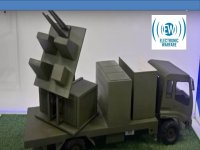
The rise of drones has led to the modernization of EW systems to such an extent that now most combat EW (CEW) systems retain a sub-C-UAS capability in addition to traditional jamming roles, such as those of communications.
Pakistan, which had often remained shy from adopting EW at a large scale, seems to be building upon a significant domestic capability to locally produce and use a large portfolio of integrated communications intelligence (COMINT) EW systems.
In the past, foreign original equipment manufacturers (OEM) – notably Rohde & Schwarz (R&S), Siemens (now under Hensoldt), and Elettronica Group (ELT) – dominated Pakistan’s EW landscape, the trend now appears to be shifting towards domestic EW solutions. Three domestic manufacturers are Pakistan’s EW drivers: the National Radio and Telecommunication Corporation (NRTC), the Defence Science and Technology Organization (DESTO), and the National Aerospace Science and Technology Park (NASTP).
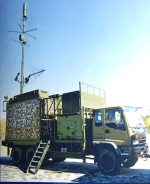
NRTC’s COMINT EW system is designed to detect, locate and jam communications falling across VHF, UHF, and SHF ranges located in a congested radio frequency (RF) environment. The system adopts purpose-built antennas that enable it to pick up weak signals. The system is split into ESM, ECM and command-and control (C2) vehicles. The system has communications link range of 30 km.
The C2 vehicle part of the COMINT EW system creates a ‘Communication Order of Battle’ using data collected from various DF sensors and acts as higher-level node for ECM and ESM sub-systems. The C2 system also has an inbuilt geo-fencing ability when linked with geographic information system (GIS) platforms.
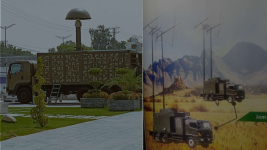
PAF efforts to enhance its ground-based electronic warfare (EW) capabilities have progressed significantly over the past three years.
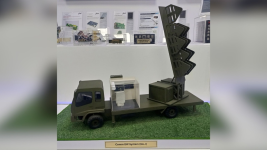
C-EW program is among the PAF’s flagship initiatives. With it, the PAF is aiming to develop a locally matured communications intelligence (COMINT) EW system (EWS).
At the 2024 International Defence Exhibition and Seminar (IDEAS 2024), the PAF’s National Aerospace Science and Technology Park (NASTP) showcased what appeared to be a significantly upgraded variant of a previous land-based C-EW system.
The original system was heavily reliant on technology developed by Defence Science and Technology Organization (DESTO), with the main difference being the integration of a trailer-mounted advanced multi-band jammer
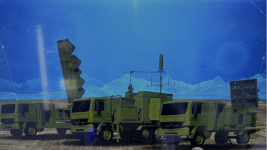
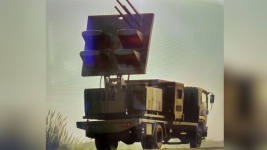
The new upgraded system not only retains the original electronic support measures (ESM) system’s passive detection and direction-finding module (mounted on an Isuzu 6×6 platform) but it also adds two new and distinct electronic countermeasure (ECM) jammers, designated EA-I and EA-II. These jammers feature multi-band arrays (mounted on Isuzu 4×4 trucks), thereby eliminating the need for trailers.
The 4×4 ECM trucks are self-sufficient, equipped with onboard power generation systems, thus enhancing their operational flexibility. While detailed specifications regarding the range of the system remain undisclosed, it is likely designed as a mid-range EWS solution.
upgraded C-EW system is mainly designed to target and jam three types of critical communication signals
QUWA
The rise of drones has led to the modernization of EW systems to such an extent that now most combat EW (CEW) systems retain a sub-C-UAS capability in addition to traditional jamming roles, such as those of communications.
Pakistan, which had often remained shy from adopting EW at a large scale, seems to be building upon a significant domestic capability to locally produce and use a large portfolio of integrated communications intelligence (COMINT) EW systems.
In the past, foreign original equipment manufacturers (OEM) – notably Rohde & Schwarz (R&S), Siemens (now under Hensoldt), and Elettronica Group (ELT) – dominated Pakistan’s EW landscape, the trend now appears to be shifting towards domestic EW solutions. Three domestic manufacturers are Pakistan’s EW drivers: the National Radio and Telecommunication Corporation (NRTC), the Defence Science and Technology Organization (DESTO), and the National Aerospace Science and Technology Park (NASTP).
National Radio and Telecommunication Corporation (NRTC)
Of NRTC’s publicly revealed EW capabilities, COMINT and SIGINT systems form the core of its offerings. These include the COMINT – i.e., electronic support measures (ESM) plus electronic countermeasures (ECM) system (ESM + ECM) – and a lighter mobile direction finding (DF) ESM system.NRTC COMINT EW System
NRTC’s COMINT EW system is designed to detect, locate and jam communications falling across VHF, UHF, and SHF ranges located in a congested radio frequency (RF) environment. The system adopts purpose-built antennas that enable it to pick up weak signals. The system is split into ESM, ECM and command-and control (C2) vehicles. The system has communications link range of 30 km.
The C2 vehicle part of the COMINT EW system creates a ‘Communication Order of Battle’ using data collected from various DF sensors and acts as higher-level node for ECM and ESM sub-systems. The C2 system also has an inbuilt geo-fencing ability when linked with geographic information system (GIS) platforms.
PAF efforts to enhance its ground-based electronic warfare (EW) capabilities have progressed significantly over the past three years.
C-EW program is among the PAF’s flagship initiatives. With it, the PAF is aiming to develop a locally matured communications intelligence (COMINT) EW system (EWS).
At the 2024 International Defence Exhibition and Seminar (IDEAS 2024), the PAF’s National Aerospace Science and Technology Park (NASTP) showcased what appeared to be a significantly upgraded variant of a previous land-based C-EW system.
The original system was heavily reliant on technology developed by Defence Science and Technology Organization (DESTO), with the main difference being the integration of a trailer-mounted advanced multi-band jammer
The new upgraded system not only retains the original electronic support measures (ESM) system’s passive detection and direction-finding module (mounted on an Isuzu 6×6 platform) but it also adds two new and distinct electronic countermeasure (ECM) jammers, designated EA-I and EA-II. These jammers feature multi-band arrays (mounted on Isuzu 4×4 trucks), thereby eliminating the need for trailers.
The 4×4 ECM trucks are self-sufficient, equipped with onboard power generation systems, thus enhancing their operational flexibility. While detailed specifications regarding the range of the system remain undisclosed, it is likely designed as a mid-range EWS solution.
upgraded C-EW system is mainly designed to target and jam three types of critical communication signals
- Data-link exchanges between airborne aircraft.
- Data-links between airborne platforms and ground-based command-and-control (C2) or ground exploitation states (GES), such as RecceLite GES.
- GPS/GNSS signals, effectively denying positioning and navigation capabilities to airborne assets, such as drones and, potentially, stand-off range weapons (SOW)."
QUWA
Users who are viewing this thread
Total: 1 (members: 0, guests: 1)
Pakistan Defence Latest
-
 Federal cabinet gives nod to imposition of emergency in KP; summary sent to president (11 Viewers)
- Latest: Distant_Observer
-
-
-
-
Somalia Reportedly Agrees to Acquire Pakistan’s JF-17 Fighter Jets (1 Viewer)
- Latest: Pakistan First
Country Watch Latest


Latest Posts
-
-

-

-
Makkah Defence Alliance: Turkey, Saudi Arabia, and Pakistan, news & updates (43 Viewers)
- Latest: Blain2
-
 Kylian Mbappe apologises after ‘dictator’ comment angers Chinese fans (12 Viewers)
- Latest: Thinking_Hard