Pakistan-Afghanistan border crossing - Activities / News

Trade, power plans linked to Kabul ending terror support

The Newspaper's Staff Reporter
November 22, 2025

1763814486920.png

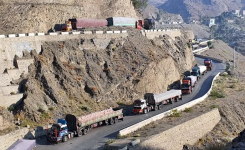
A LARGE number of trucks loaded with goods stand in a queue as they await the reopening of the Pak-Afghan Torkham border, in Landi Kotal.—PPI/File

• FO says Islamabad understands ‘economic pain’ caused by closures but security threat ‘existential’
• Can’t let ‘our people be killed indiscriminately’
• Scheduling of planned Turkish delegation’s visit in connection with Pak-Afghan conflict still awaited

ISLAMABAD: The Foreign Office (FO) on Friday said that the resumption of trade with Afghanistan depended on the Taliban regime ending cross-border terrorism, and also linked the fate of key regional energy projects to Kabul halting its support for terrorist groups.

“The onus of delay in the reopening of the border crossings rests with the Afghan Taliban regime,” Foreign Office (FO) spokesperson Tahir Hussain Andrabi said at a weekly media briefing.

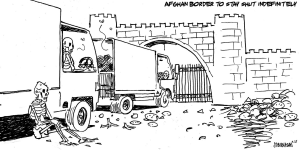
Pakistan and Afghanistan’s bilateral trade, estimated at $1.6 billion to $1.8bn in 2023-24, with key border gateways like Torkham and Chaman handling most of the traffic, has been suspended since mid-October, following deadly clashes between Pakistani forces and Taliban fighters.

This suspension is estimated to be costing Afghan traders an estimated $2.5 million a day.
 
To view this content we will need your consent to set third party cookies.
For more detailed information, see our cookies page.
 
To view this content we will need your consent to set third party cookies.
For more detailed information, see our cookies page.
 

Rs4.4trn losses prompt Afghan border closure: officials


Pakistani officials insist the move is not a reaction to political tensions but a calculated, long-term strategy against illicit trade, drug trafficking

Nuzhat Nazar
November 23, 2025

ISLAMABAD: The closure of Pakistan’s Afghan border on October 11 was prompted by massive economic losses — over PKR 3.4 trillion yearly from smuggling, plus nearly PKR 1 trillion in illegal backflow of Afghan transit goods. Pakistani officials insist the move is not a reaction to political tensions but a calculated, long-term strategy to dismantle an illicit trade corridor long linked to narcotics trafficking, illegal weapons movement, and militant infiltration.

Authorities point out that only those routes were closed that had become the primary channels for smuggling, drug trafficking, and cross-border terrorism. The decision, they argue, reinforces national security, strengthens economic sovereignty, and helps restore state control over key trade arteries.

While Pakistan remains largely unaffected, Afghanistan is facing the harshest economic consequences. The closure has already caused more than USD 200 million in losses, with USD45 million stemming from Torkham alone in just one month. Over 5,000 trucks have been stranded at border points, while Afghan fruits and seasonal produce spoiled as they awaited entry into Pakistani markets.

Transport timelines have doubled or tripled; goods that previously reached Afghanistan via Karachi in 3-4 days now take 6-8 days through Iran, and over 30 days through Central Asian routes. The cost of shipments via Iran has surged by 50–60 percent, adding nearly USD2,500 per container.
 
The crisis has exposed Afghanistan’s overwhelming dependence on Pakistan, with 70–80 percent of its trade reliant on Pakistani ports and road networks. More than half of Afghanistan’s medicines also transit through Pakistan. Analysts say Afghanistan’s fragile economy is ill-equipped to absorb the increased costs, delays, and risks associated with alternative routes.

Inside Afghanistan, the impact has been socially disruptive as well. With smuggling halted, over 200,000 people linked to illegal trade, backflow operations, and under-invoicing networks have reportedly lost their income sources. Pakistani officials argue that breaking these networks will curb the movement of illegal arms, narcotics, and militant financing in the long run.

In contrast, the trade freeze has had almost no effect on everyday life in Pakistan. Afghan-origin goods entering through smuggling channels were largely luxury items rather than essential commodities. With Pakistan maintaining secure trade through CPEC and direct land links with China, authorities foresee no disruption to vital supply chains.

Policymakers believe Pakistan will begin to see long-term gains over the next 5–10 years, including improved border security, reduced economic leakages, and a more regulated cross-border trade environment. At the same time, the shift may push Afghanistan to diversify its trade beyond eastern provinces such as Paktia and engage more with Iran and Central Asia —potentially fostering greater inclusivity in its economic structure.

Analysts conclude that Afghanistan’s leadership now faces a critical decision: either continue providing space to militant groups or work jointly with Pakistan to restore stability and pursue shared economic progress.

Copyright Business Recorder, 2025
 
To view this content we will need your consent to set third party cookies.
For more detailed information, see our cookies page.
 

UN aid consignments cleared for Afghanistan

Mubarak Zeb Khan
December 4, 2025

1764850979316.png

ISLAMABAD: After nearly two months of halted cross-border cargo movement, the Pakistani government has begun clearing humanitarian consignments for Afghanistan, marking the first controlled reopening of transit trade since routine trade was suspended in October.

The government has completely suspended customs clearance for both exports and imports, along with Afghan Transit Trade (ATT) cargos, at major border crossings — including Torkham, Ghulam Khan, Kharlachi, and Angoor Adda — effective October 12, and at the Chaman border from October 15.

An official letter was issued to the Federal Board of Revenue (FBR) and the Directorate General of Transit Trade to initiate the movement of consignments belonging to three United Nations agencies through the border crossings at Chaman and Torkham.

In the first phase, a total of 143 containers of humanitarian goods will be allowed for clearance at Chaman and Torkham. The breakdown shows that the containers include 67 containers of food assistance from the World Food Programme (WFP), 74 containers of supplies for children from Unicef, and two containers of healthcare and family support items from UNFPA.

Officials confirmed that the decision followed instructions issued by the foreign ministry after consultations with the UN resident coordinator in Pakistan.
 
According to letter, the cargo movement will proceed in three stages: the first covers food shipments, the second covers medicine and medical equipment, and the third covers items for education services. More consignments are expected to follow once agencies provide updated requirements.

It further stated that the Directorate General of Transit Trade and FBR were requested to undertake the necessary actions for the clearance and onward transportation of the mentioned containers via Chaman and Torkham, as originally manifested under the Afghanistan-Pakistan Transit Trade Agreement and ATT rules.

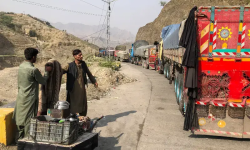
Truck drivers and customs workers in Chaman and Torkham had faced long periods without cargo activity, with hundreds of vehicles parked along the routes during the closure.

Officials said the reopening applied only to humanitarian ATT cargos and did not signal the restoration of routine trade. Senior officials added that the remaining UN cargo lists would be shared in stages once documentation was verified.

In terms of transit cargo, approximately 495 vehicles are queued for border crossing at Torkham and Chaman. Of these, the majority — 412 vehicles — are stranded at Chaman, while the remaining 83 are held up at Torkham, the announcement added.

In the fiscal year 2024–25, Pakistan recorded transit trade imports valued at $1.012 billion, comprising a total of 42,959 containers.
 
1765632088822.png


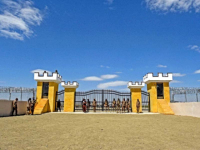
Frontier Corps security personnel guard the newly inaugurated Badini Trade Terminal Gateway in Balochistan. PHOTO: AFP
 

Users who are viewing this thread

Pakistan Defence Latest

Country Watch Latest

Back
Top