Pakistan-Afghanistan border crossing - Activities / News

Afghanistan under this farce Taliban regime is a serious thorn in the side of regional nations and a serious security threat.

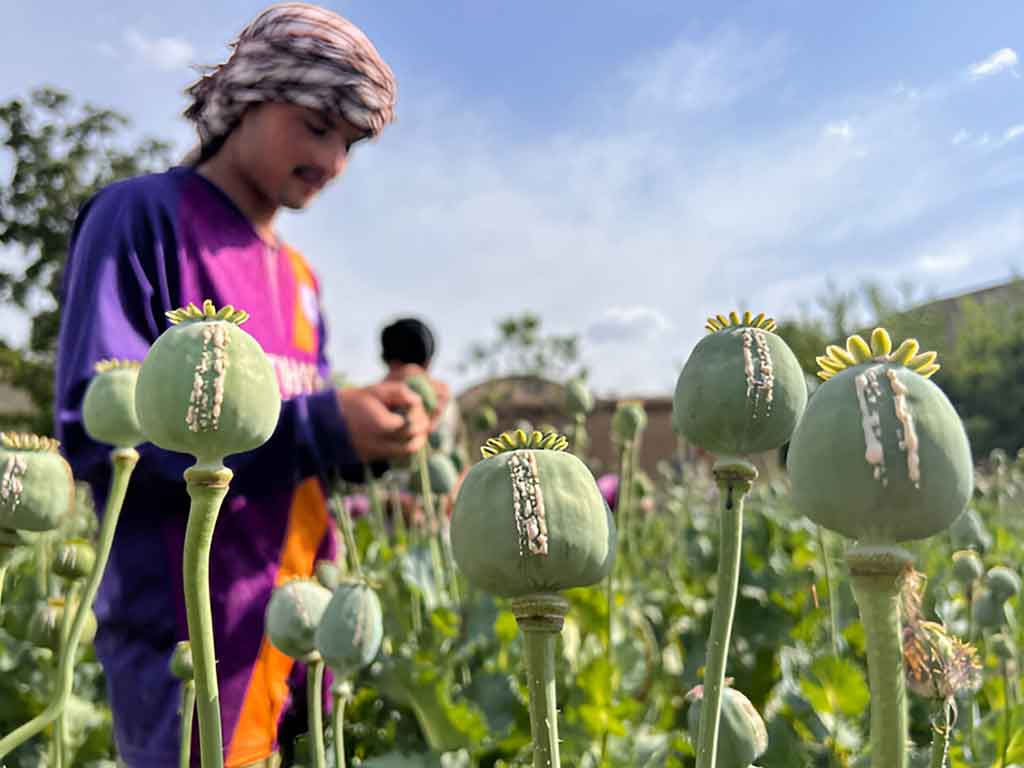
The Ephedra plant has been identified as an excellent source of ephedrine and pseudoephedrine, both of which can be chemically reduced to form the illicit drug methamphetamine also known as Meth of ICE in Pakistan.
Ephedra being harvested in Afghanistan:
View attachment 150498

Empty bottles of cold medicine - Afghanistan:
View attachment 150499

Meth lab in Afghanistan producing Meth at a wholesale level:
View attachment 150500

Meth/ICE being packed and shipped in Bahramchar, Afghanistan 2.16 KM from the Pakistan border:
View attachment 150501
View attachment 150502
View attachment 150497

Pakistan must first and foremost safeguard its own national interest and the safety and welfare of its citizens. The meth trade funds not only organised crime but both domestic and cross-border terrorism.

It is therefore in Pakistan's national interest to hold the Afghan Taliban accountable and counter this disgusting trade.
What are you talking about, Afghan Taliban has completely banned Drug production, and this is not Drugs... its Halal Drugs straight from bait-ul-meth with full blessing of our Khalifa-e-Waqt whoever is in charge of Afghan Taliban right now...
 
an unprecedented increase in poppy cultivation in Balochistan: it is the largest yet least populated province of Pakistan, which borders Afghanistan and Iran. Poppy fields now occupy up to 70% of farmland in Duki and Gulistan and over 8,100 hectares of poppy have been detected through high-resolution satellite images. Crucially, these areas were virtually poppy-free before the Taliban’s return to power. According to Alcis, this data suggests that, for the first time, opium cultivation in Pakistan next year could come to surpass that of Afghanistan.


By September 2025, authorities in Balochistan proudly announced that more than 36,000 hectares of land had been cleared of poppy cultivation. Yet beneath the surface of this so-called success story lies a darker truth. Despite relentless operations by the Anti-Narcotics Force, Levies, Frontier Corps, and Police, poppy fields continue to reappear like a shadow economy thriving on displacement, survival, and demand.

Satellite imagery in June 2025 confirmed 8,100 hectares of cultivation concentrated in Duki and Killa Abdullah alone. Afghan farmers often rent land from local Baloch landowners or enter sharecropping deals, spreading the practice deeper into local society.

 
Post #14 is an excellent example why I lose my mind every time someone mentions DEA and their "war" against the poppy producers in Afghanistan. It was a joke. Make everyone back home feel good meanwhile the next valley over was an even bigger field that was left untouched and of course this.
100% agree with you on this. Pak did some great work with DEA between 2004-2010, we even had some DEA agents embedded as advisors with our Anti Narcotics Force for a while under the ICITAP.
1759275935104.png
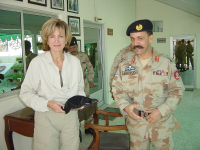
DEA Administrator Karen Tandy receiving Unit Ballcap from Commandant Pishin Scouts - Colonel Masud.

Mr. Chuck Bennett Senior LE advisor to Pakistan Under US DOJ ICITAP was a great ambassador for his nation, a real professional and a very humble man:
1759275831497.png
Contributed greatly to Law Enforcement capacity development and information exchange between the US and Pakistan during his tenure here.
---
1759276151406.png
---

Sadly such good work is often overshadowed by political nonsense.
 
To view this content we will need your consent to set third party cookies.
For more detailed information, see our cookies page.
 
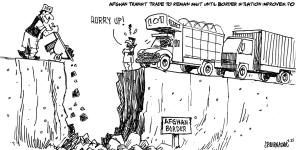
Pakistan has suspended Afghan transit trade for an indefinite period, canceling all previously issued gate passes.

This significant decision was made in light of recent Pak-Afghan border tensions and security concerns.

The Afghan government had requested the resumption of trade with Pakistan during the ceasefire, particularly the reopening of the Torkham border, but Pakistan adopted a firm stance, stating clearly that the restoration of trade is not possible until a complete and permanent resolution of border and other issues.

Following Pakistan's recent effective retaliatory airstrikes, the Taliban government requested a ceasefire, and a temporary ceasefire is currently in place.

1760613729022.png
 
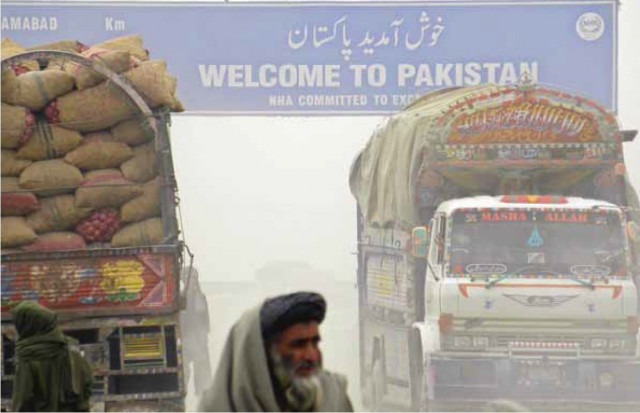
Ongoing border tensions between Pakistan and Afghanistan have brought all forms of bilateral and transit trade to a standstill since Sunday, October 12, causing severe economic losses on both sides and leaving thousands of trucks stranded along the main crossings.

According to security sources, the suspension followed an exchange of fire late on the night between October 11 and 12, when Afghan forces allegedly opened unprovoked fire on Pakistani border troops. Pakistani forces responded robustly, triggering heightened tensions along the entire frontier from Chitral to Balochistan. As a result, all four major trade gateways, Torkham, Kharlachi, Ghulam Khan, and Chaman, were closed indefinitely.

The closure has paralyzed cross-border trade and halted the Afghan transit trade, dealing a blow worth billions of rupees to both economies.

Fresh data from the Federal Board of Revenue (FBR) for fiscal year 202425 highlights the scale of the disruption. Annually, Pakistan imports goods worth $66.328 million from Afghanistan through the Torkham crossing and exports goods valued at $62.766 million.

Through the Ghulam Khan route, imports average $80.109 million and exports $33.240 million per year. The Kharlachi crossing accounts for imports of $30.38 million and exports of $27.32 million, while trade through the Chaman gateway includes imports of $80.289 million and exports of $265.06 million annually.

Collectively, Pakistan's four main border points with Afghanistan handle average annual imports worth $566.766 million and exports totalling $1.504 billion, contributing significantly to the national exchequer. FBR data shows that bilateral trade generates an estimated Rs46.867 billion annually in customs duties alone.
 
To view this content we will need your consent to set third party cookies.
For more detailed information, see our cookies page.
 

Pakistan resumes Afghan transit trade after 10-day suspension​


Transit trade resumes on First In, First Out (FIFO) basis after clearing backlog

Ehtesham Mufti
October 23, 2025


tribune


Pakistan has resumed Afghan transit trade on a phased basis after a 10-day suspension, following the “immediate ceasefire” agreement reached with the Taliban government in Doha, Qatar.

Around 300 vehicles that had been stranded at various locations are now being cleared, beginning with operations via the Chaman border crossing.

According to a detailed notification issued by the Directorate of Transit Trade (Customs), the cargo operations will be completed in three stages. The directive states that all regular transit trade activities will resume on a “first in, first out” basis once the existing backlog is cleared.

In the first phase, nine vehicles that were turned back when the Friendship Gate was closed will be reweighed and rescanned. Any discrepancies will lead to a full inspection.

The second phase will cover 74 vehicles that were returned from the NLC Border Terminal Yard. These will also undergo reweighing and scanning, with complete checks if inconsistencies are found.

The third phase involves clearing 217 vehicles currently parked in the halting yard, which will then be allowed to cross the border into Afghanistan.

The directive adds that photographs of all returning or halted vehicles will be taken and archived at the Friendship Gate to ensure transparency and proper documentation.

Officials said the resumption of transit trade is expected to provide relief to traders, transporters and cargo operators who suffered heavy losses during the border closure. They added that security checks and inspection procedures have been further tightened to prevent smuggling and illegal trade.

The Chaman border remains Pakistan’s most significant land trade route with Afghanistan, handling dozens of trucks and consignments daily. Authorities hope that the phased reopening will restore smooth cross-border trade and strengthen economic ties between the two countries.

Pakistani officials said on October 11 that Pakistan had closed crossings along the 2,600-km (1,600-mile) border with Afghanistan. The two main border crossings with Afghanistan, at Torkham and Chaman, and at least three minor crossings, at Kharlachi, Angoor Adda and Ghulam Khan, were closed, local officials said.

On October 19, Pakistan and Afghanistan agreed to an immediate ceasefire during talks in Qatar. The two sides agreed to meet on October 25 in Istanbul to discuss "detailed matters."

The Chaman border is considered the most important land trade route between Pakistan and Afghanistan, through which dozens of trucks and cargo consignments move daily between the two countries. The restoration of transit trade is expected to revive cross-border commercial activity and improve bilateral trade relations.
 

Pakistan partially restores Afghan transit trade​


Around 300 vehicles stranded at various points for around two weeks

Ehtesham Mufti
October 24, 2025


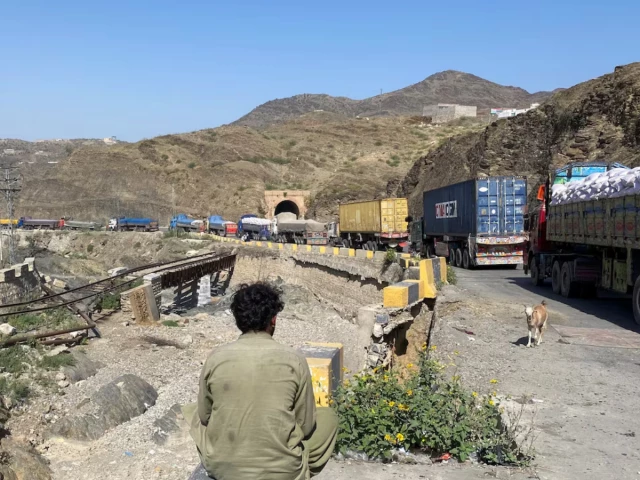
a man sits next to trucks parked at the torkham border crossing after pakistan closed border crossings with afghanistan following exchanges of fire between the forces of the two countries in torkham pakistan october 12 2025 photo reuters


A man sits next to trucks parked at the Torkham border crossing, after Pakistan closed border crossings with Afghanistan, following exchanges of fire between the forces of the two countries, in Torkham, Pakistan, October 12, 2025 Photo: Reuters

KARACHI: Pakistan on Thursday partially restored the Afghan Transit Trade after a 10-day suspension caused by intense clashes between Pakistan and the Afghan Taliban. Around 300 vehicles had been stranded at various points for around two weeks. Transit trade operations would initially be resumed via the Chaman border.

A detailed notification has been issued by the Directorate of Transit Trade (Customs), according to which the cargo operations will be completed in three phases. The notification states that all routine transit trade operations will resume on a "First In, First Out (FIFO)" basis after the clearance of the backlog.

In the first phase, the nine vehicles that were sent back due to the closure of the border at Friendship Gate will be cleared. These vehicles will be re-weighed and re-scanned, and in case of any discrepancies, they will undergo 100% examination.

In the second phase, the 74 vehicles that were returned from the NLC Border Terminal Yard will be processed. These vehicles will also be re-weighed and re-scanned, and any differences found will lead to a complete inspection.

In the third phase, the 217 vehicles currently stationed at the halting yard will be cleared and allowed to cross the border.
 
The notification further states that photographs of the movement of all returned or detained vehicles will be taken at the Friendship Gate and preserved in record to ensure transparency and proper documentation.

The restoration of transit trade is expected to provide relief to traders, transporters, and cargo operators who suffered heavy losses during the border closure.

According to officials, security and inspection measures have been further tightened in the resumed trade operations to prevent smuggling and any kind of illegal trade.

The Chaman border is considered the most important land trade route between Pakistan and Afghanistan, through which dozens of trucks and cargo consignments move daily between the two countries.

The resumption of transit trade is expected not only to restore smooth border trade but also improve commercial relations between the two neighbouring nations.

Afghan forces on October 12 opened unprovoked fire at multiple locations along the border in Khyber-Pakhtunkhwa (K-P) and Balochistan provinces. The Pakistan Army responded swiftly and forcefully and its retaliatory action resulted in the death of 200 Taliban and TTP operatives.

On October 18, the two neighbours agreed to an immediate ceasefire during talks in Doha. Both countries agreed to stop fighting and work toward "lasting peace and stability" in talks mediated by Qatar and Turkey, the ministry said.
 

No transit trade at Chaman, but repatriation continues


Mubarak Zeb Khan | Saleem Shahid
October 25, 2025

1761391312599.png

This file photo show the Friendship Gate on the Pakistan-Afghan border. — Dawn

QUETTA/ ISLAMABAD: The Pakistan-Afghanistan border continued to remain closed for all kinds of trade activities on Friday, due to persistent security concerns amid tensions with neighbouring Afghanistan.

Officials denied reports that Islamabad had partially opened the border crossing at Chaman for Afghan transit trade. Even pedestrians are not allowed to cross the border from both sides, they added.

“The border has been closed for the last 12 days and not opened for any commercial activities so far, including transit trade,” a senior customs official told Dawn.

The official added that there were very few transit trade trucks parked at the Chaman crossing.

The district administration officials also said that they have not yet received any instructions from the authorities from Islamabad about the opening of the border.

The border opens for a very limited time for Afghan refugees, who were reaching Chaman from different areas of Balochistan and Karachi, to return to their home country.

Officials said only vehicles repatriating the household goods of Afghan refugees and returning to their country via the Chaman border were allowed to travel through the border.

However, traders hope that the situation would be relaxed after a meeting between officials from Pakistan and Afghanistan in Istanbul today.
 
‘Customs staff ready’

Separately, the FBR announced that customs staffers are stationed at border points and ready to resume the clearance process as soon as it reopens and the situation returns to normal.

The announcement from the tax department follows the build-up of over 1,000 trucks loaded with transit cargo, export consignments, and imported goods at the border stations with Afghanistan.

The disruption stems from the suspension of customs clearance for both exports and imports at major border crossings — Torkham, Ghulam Khan, Kharlachi, and Angoor Adda — effective Oct 12, and at the Chaman border from Oct 15.

An official announcement of the FBR said that bilateral trade between Pakistan and Afghanistan is temporarily halted due to security concerns at the border customs stations

Before the suspension of bilateral trade took effect, customs officials successfully processed and cleared 363 import vehicles at Torkham, Ghulam Khan, Kharlachi, and Angoor Adda crossings, falling under the jurisdiction of Northern region of Appraisement.

At Torkham, clearance of 23 import vehicles remains pending due to the failure of importers to file goods declarations. The vehicles are carrying non-perishable items such as fabric, paint, peanuts, and pulses.

Customs authorities are expected to process the consignments promptly once the required declarations are submitted by the respective importers or their clearing agents.

With respect to exports, 255 vehicles remain parked inside the Torkham terminal due to the ongoing border closure, while around 200 more are stranded along the Jamrud–Landi Kotal road. Meanwhile, no import vehicles are pending clearance at the Ghulam Khan, Kharlachi, and Angoor Adda border stations.

Customs clearance operations at the Chaman Border Customs Station have remained suspended since Oct 15.

As a result, five import vehicles and 23 export consignments are currently awaiting processing. Notably, the exporters have opted not to dray off their consignments, choosing instead to wait for the resumption of cross-border trade.

In terms of transit cargo, approximately 495 vehicles are queued for border crossing at Torkham and Chaman. Of these, the majority — 412 vehicles — are stranded at Chaman, while the remaining 83 are held up at Torkham, the announcement added.

Published in Dawn, October 25th, 2025
 

Durand Line crossings closure causes $200 million loss in 24 days​


by The Frontier Post

Durand-Line-crossings-closure-causes-200-million-loss-in-24-days-810x486.jpg


KABUL (Ariana News): The closure of the Durand Line crossings has led to an estimated loss of $200 million within just 24 days, disrupting not only bilateral trade but also Pakistan’s commercial links with Central Asian states. Officials report that the blockade has cost millions of dollars in daily losses since it began in mid-October.

According to an official source, the crossings were shut on October 11 following clashes between the two sides. The closure of all eight crossing points stranded thousands of traders and left goods worth millions of dollars stuck on both sides. Perishable items began to spoil as the impasse continued, prompting traders and business groups to call for urgent dialogue.

From October 12 to October 31, the first 20 days of the closure caused more than $50 million in direct losses, the source told The Nation. By early November, the total losses were estimated near $200 million, as Afghanistan typically imports around $150 million worth of goods from Pakistan each month while exporting about $60 million, The Nation reported.

The shutdown also halted Pakistan’s exports to Central Asian countries, compounding the economic impact. Traders reported daily losses worth millions, with long queues of trucks carrying hundreds of tons of perishable goods waiting at the Durand Line. Around 20,000 to 25,000 workers were affected, while more than 1,000 trucks remained stranded at Karachi port.

The disruption also hit Afghan farmers hard. Agricultural prices plummeted, with a 10-kg box of grapes dropping from 4,500 Pakistani rupees to just 120–140 Afghanis, resulting in further financial strain on growers.

Investor sentiment showed signs of recovery once Pakistan and Afghanistan extended their ceasefire. On October 31, Pakistan’s KSE-100 Index surged by 3.13% (4,898 points) amid optimism that both sides would maintain peace and establish a monitoring mechanism to prevent further disruptions.

Earlier, on October 15, Pakistan had also suspended the processing of Afghan transit consignments to prevent congestion at crossing points, as 584 transit vehicles were already parked or en route toward the Durand Line.

Official data further reveals that Pakistan-Afghanistan bilateral trade declined by 6% to $475 million during the first quarter (July–September) of FY2025–26, compared to $502 million in the same period of FY2024–25. On a year-on-year basis, bilateral trade also dropped 13% in September 2025, down to $177 million from $204 million in September 2024.
 

Users who are viewing this thread

Back
Top