Pakistan Afghanistan Relations

Pakistan-Afghanistan talks​

Soon after the clashes on Oct 11, a temporary ceasefire was called on Oct 15, after the two sides came together to engage in dialogue in Doha.

Following the Doha talks, a temporary ceasefire continued to prevent border hostilities while the two sides committed to reconvene in Istanbul to work on mechanisms for lasting peace and stability between the two countries.

On Oct 25, the second round of talks between the two sides began in the Turkish capital. But, Information Minister Attaullah Tarar announced in a post on X on Oct 29 that the talks “failed to bring about any workable solution”.

However, mediators Turkiye and Qatar intervened and managed to salvage the dialogue process with an Oct 31 joint statement released by Turkiye stating that “further modalities of the implementation will be discussed and decided” during a principal-level meeting in Istanbul on November 6.

But on November 7, after the third round of talks, Defence Minister Khawaja said that talks addressing cross-border terrorism were “over” and “entered an indefinite phase” as negotiators failed to bridge deep differences between the two sides.

Following the failure of the talks, the Afghan Taliban suspended trade ties with Pakistan. Pakistan had already closed its border for trade soon after the clashes.
 

Afghan Taliban must decide between Pakistan and TTP, says CDF Munir

  • Says Pakistan is peaceful, but anyone testing its resolve will face consequences
BR Web Desk
December 8, 2025

Pakistan’s newly appointed Chief of Defence Forces (CDF) Field Marshal Syed Asim Munir on Monday addressed officers of the Army, Navy, and Air Force, sending a clear message to the Afghan Taliban regime, state-run PTV reported.

“The Taliban have no option but to choose between fomenting unrest abroad or maintaining peaceful relations with Pakistan,” he said.

The warning comes days after an exchange of gunfire and shelling was reported at a major Pakistan-Afghanistan border crossing, which, according to the Afghan side, killed four civilians and one soldier, AFP reported.


The local hospital authorities on the Pakistani side said a few people sustained minor injuries due to these clashes.

The latest flare-up of fighting between the two countries came despite a ceasefire since deadly clashes in October.

During his address at the newly established Defence Forces Headquarters, the CDF called the creation of the HQ a historic step to strengthen coordination among the three services.

He emphasized that while high command will be unified, each branch will retain its operational autonomy, ensuring both efficiency and flexibility in multi-domain operations.

Field Marshal Munir emphasized that while Pakistan remains a peaceful nation, any attempt to challenge its sovereignty will meet a swift and decisive response. He also issued a stern warning to India, stating that Pakistan’s response to any aggression will be faster and more forceful in the future.
 

Afghan Taliban say doors open for talks to resolve issues

Our Correspondent
December 26, 2025

1766839282859.png

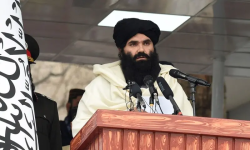
Acting Afghan Interior Minister Sirajuddin Haqqani speaks to new Afghan police recruits during a graduation ceremony at the police academy in Kabul. — AFP

In an apparent attempt to offer an olive branch to Pakistan, the interim Afghan Taliban regime’s interior minister, Sirajuddin Haqqani, on Friday said that his country was not a threat to any state and that it was ready to address misunderstandings.

Speaking at the graduation ceremony at the Kabul Police Academy, Haqqani announced that the doors for negotiations were open.

He said that his government continues to adhere to the commitments made under the Doha Agreement, not allowing Afghanistan’s soil to be used against any country, the Afghan Taliban’s official media reported.
 
Despite earlier promises and the commitments made in the Doha Agreement, cross-border infiltration and attacks by militants continue in Pakistan.

Haqqani said that Afghanistan posed no threat to any country or region and that the Taliban leadership continued to strive to find ways for reasonable and durable solutions to end mistrust and misunderstanding of the international community. “The doors for negotiations to resolve current issues are not closed,“ he said.

Although Haqqani did not mention Pakistan by name, he appeared to refer to Pakistan’s long-standing demand from Kabul to rein in the outlawed Tehreek-i-Taliban Pakistan (TTP).

Relations between the two neighbours are strained following border skirmishes, which led to the closure of borders between the two countries since October 11, 2025.

Attempts by Turkiye and the UAE to broker an agreement between the two sides failed to break the ice, with Pakistan accusing Afghanistan of refusing to give a written undertaking to control the TTP, whose fighters, it says, continue to infiltrate through its 2600-km-long porous borders to launch attacks inside the country.

The remarks by Haqqani are significant in that the TTP owes its allegiance to him and has been operating from areas in Afghanistan that have been under his control since long.

It was precisely for this reason that Haqqani’s younger brother, Anas Haqqani, was part of the Afghan Taliban team negotiating with their Pakistani counterparts in Qatar and Turkiye.
 
To view this content we will need your consent to set third party cookies.
For more detailed information, see our cookies page.
 

Pakistan worst-hit by Taliban takeover of Kabul: International Crisis Group


Amin Ahmed
January 9, 2026
https://whatsapp.com/channel/0029VaMc238IiRov8okfYy3n
ISLAMABAD: The International Crisis Group (ICG) says Pakistan is the worst-affected country by the Taliban’s 2021 takeover of Afghanistan, noting that even though a ceasefire holds for now, Islamabad is likely to strike again if militant violence persists.

The Brussels-based independent and non-profit think tank, founded by prominent statesmen, says in a new report that relations between the two countries have tanked, mainly because of the Afghan Taliban’s refusal to crack down on the Tehreek-i-Taliban Pakistan (TTP).

Since 2022, violence in Pakistan has spiralled. In 2025 alone, militants killed more than 600 Pakistani soldiers and police, mostly in Khyber Pakhtunkhwa and Balochistan, the two provinces bordering Afghanistan.

Islamabad blames the banned TTP for these attacks, along with Baloch insurgent groups, which it believes with evidence, are backed by arch-rival India.


Brussels-based think tank says Islamabad may strike Afghanistan again if militant attacks continue

“UN monitors assert that the TTP enjoys Taliban support, but the Taliban publicly deny that Pakistani militants are even in Afghanistan and say Islamabad provoked what they paint as homegrown violence,” according to the report.

On its western flank, after 11 Pakistani military personnel were martyred in a TTP attack on Oct 8, Islamabad conducted cross-border airstrikes, including its first-ever strike on Kabul, ostensibly targeting TTP chief Noor Wali Mehsud.

Afghanistan retaliated with attacks on Pakistani military installations. Continued fighting claimed military and civilian lives on both sides.

The report cautions that Islamabad is likely to lash out again if it traces another strike back to Afghanistan.

The Taliban regime is badly outgunned, but its retaliation could still be lethal. Kabul claims to have missiles that can reach Pakistani cities, the use of which would likely provoke an even stronger Pakistani response.

South Asia

In South Asia, however, Islamabad’s foreign relations are far more fraught. After short wars in 2025 with both Afghanistan and India, another major attack by militants could upend the precarious calm that prevails between Pakistan and its two neighbours.

The report lists 10 conflicts to watch in 2026: Afghanistan-Pakistan, Myanmar, Israel and the United States versus Iran, Israel-Palestine, Syria, Ukraine, Mali and Burkina Faso, Ethiopia-Eritrea, Sudan, and Venezuela.

The report says the world was careening into a dangerous new era well before Donald Trump’s return to the White House. Thus far, his second term has done less to slow things down than to put a foot on the gas. The year 2025 was a bloody one, and 2026 promises little better.
 
‘Trump effect’

Less predictable has been President Trump, whose first year back in the White House has turned world politics and international crisis management on their heads. Trump returned to power pledging to bring peace to a world ablaze. He has put himself centre stage in many wars and trouble spots.

Trump has brought fresh attention to peacemaking after years in which diplomatic efforts to end conflicts had been flailing.

But Trump has not calmed the global turmoil he decried on the campaign trail. In some cases, he has made it worse.

His deals, often built on other countries’ diplomacy, have brought respite to some battlefields but delivered no lasting peace anywhere.

Trump’s deal-making aims to bring US power to bear, whether in Gaza, by leveraging Israel’s dependency on Washington, or elsewhere, mostly by threatening tariffs or dangling business opportunities.

Trump’s bargaining must be set against the dearth of peace deals that preceded his return to power as well as the lack of progress in places where he does not engage.

European leaders, for example, focused on the existential peril they see on their doorstep, have less bandwidth for peacemaking elsewhere, the report says.
 

Govt allows re-export of transit cargo

Mubarak Zeb Khan
January 14, 2026

1768415124744.png

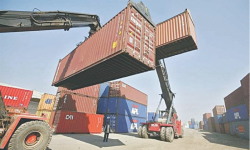
Of the stranded containers, around 3,000 originate from Malaysia and contain palm oil intended for edible use in Afghanistan.—Reuters/file
https://whatsapp.com/channel/0029VaMc238IiRov8okfYy3n
ISLAMABAD: The government has allowed the re-export of transit cargo stuck at Pakistani ports to save Afghan importers from rising demurrage charges.

At a time when there is no indication that the border with Afghanistan will reopen soon, importers engaged in Afghan Transit Trade (ATT) have requested that the Ministry of Commerce grant a one-time waiver for the re-export of over 6,500 containers stuck at Karachi ports, as they are incurring rising demurrage charges.

The need for re-export arose after the border crossing between Pakistan and Afghanistan was closed on Oct 11, 2025 leading to a near-complete halt of bilateral trade and movement of transit cargo.

Pakistan-Afghanistan relations have deteriorated amid tensions over the banned Tehreek-i-Taliban Pakistan (TTP). After successive rounds, Pakistan declared the talks effectively over on Nov 7, after which Afghanistan suspended trade ties. Pakistan had already closed its border following the October clashes.


Over 6,500 containers stuck at Karachi ports since closure of Pak-Afghan border in October
 
The largest number of stranded containers — approximately 3,000 — originates from Malaysia and contains palm oil intended for edible use in Afghanistan. “We have already issued letters to most palm oil importers to re-export their containers,” the official said. But he declined to specify the exact number of palm oil containers approved for re-export.

Re-export is subject to approval from the Ministry of Commerce on a case-by-case basis.

A customs official told Dawn that the number of containers stranded at the Chaman and Torkham borders was not big, ranging between 600 and 700.

Instead, the bulk of transit cargo was stuck at the two ports in Karachi.
 

Envoys’ plea to Islamabad​

The cargos, sourced mostly from China and Vietnam, are currently stranded at Karachi, the official said. He added that the ambassadors of these countries had approached the government to seek approval for re-export.

Following these consultations, the government has decided to allow all importers to re-export their cargo from Karachi.

This move offers Afghan importers an opportunity to use alternative ports or routes to transport their goods to the Afghan market.

This decision, according to the official, will allow importers to use other ports for the transportation of their goods to Afghanistan.

On Dec 3, Islamabad allowed clearing of consignments imported on humanitarian grounds. In the first phase, 143 containers carrying such goods were given permission for transit at Chaman and Torkham.

A breakdown shows that 67 of the containers carried assistance from the World Food Programme, 74 were loaded with supplies for children donated by Unicef, and two containers had healthcare and family support items from another UN agency.

According to the customs official, since the Taliban government has barred the entry of these containers, none had crossed the border for the past three months.
 
The volume of Afghan imports transiting through Pakistan has declined sharply over the past two years falling to $2.4 billion in FY24 from $6.7bn in FY23, and dropping further to $1.01bn in FY25.

With the current suspension of trade, industry estimates suggest the figure could slip below the $1bn mark during the current fiscal, deepening the shift in Afghanistan’s import routes and suppliers.
 

‘They forced us’: PM Shehbaz says Pak-Afghan trade blockade result of Kabul’s inaction against terrorists

News Desk
January 20, 2026

1768910474734.png

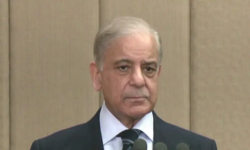
Prime Minister Shehbaz Sharif addresses an event in Islamabad on Jan 20, 2026. — DawnNewsTV

Prime Minister Shehbaz Sharif on Tuesday said Pakistan was “forced” to halt all trade with Afghanistan due to Kabul’s inaction against terrorists operating from its soil.

The Pak-Afghan border has been closed for trade since mid-October 2025, when border clashes erupted. Successive rounds of talks on counter-terrorism mechanisms failed to produce a workable solution despite mediation by Turkiye and Qatar.

“There is a complete blockade of Pak-Afghan trade. It should not have been there, but they forced us,” the premier said while addressing a national workshop event in Islamabad.

“This time, it must be decided whether Afghanistan wants to live peacefully or not […] They are our brothers and sisters. If the interim Afghan government does not have an interest in this (peace with Pakistan), they should at least have mercy on its people and not oppress them.”

“Rest assured, we will keep trying our best,” the prime minister added.

While trade data shows that the border closure has hit Afghanistan far harder than Pakistan, exporters and the business community have raised concerns over the losses being faced by them.
 
Last edited:
“It is our neighbouring country, we have to live forever […] what is good for Afghanistan is good for Pakistan, and vice versa,” the prime minister remarked.

He called it unfortunate that the past and the incumbent Afghan governments “did not cherish the hospitality” offered by Pakistan.

The premier added that while international aid was received for the four million Afghan refugees in Pakistan, the country also had to use its own resources.

He further said that Pakistan did no favour to the Afghan people but fulfilled its responsibilities.

“But the way they are paying us back is very upsetting,” the prime minister added.

PM Shehbaz noted that the 2020 Doha Accords were “very clear” in stating that Afghanistan will rein in terrorist activity in the country and will not allow any terrorist to operate from their territory.

Recalling ministers’ various meetings held with Afghan leaders, the premier lamented, “But they did not adhere to a single one of our recommendations.”
 

The Cost of Non-Interdependence Between Pakistan and Afghanistan​


Abrar Turi
January 27, 2026


The ongoing closure of the Pakistan-Afghanistan border, triggered by escalating violence in 2025, has inflicted deep economic and strategic wounds on both sides of the Durand Line. What Islamabad frames as a necessary security posture has quickly revealed itself as a self-inflicted economic constraint and a strategic miscalculation. In a region where geography dictates cooperation, not conflict, there is no sustainable alternative to managed interdependence.

Pakistan’s decision to shut major crossing points such as Torkham, Chaman, Kharlachi and Ghulam Khan was meant to curb terrorism allegedly facilitated from Afghan soil. Pakistan’s $566 million imports and $1.5 billion exports are generating approximately Rs. 47 billion in customs duties annually. Initial weeks of closure put economic losses of nearly $200 million, with daily cost of nearly $1 million for both, Pakistan and Afghanistan.

Indeed, recent data suggest a 17 percent decrease in terrorist attacks in Pakistan following tightened border controls, indicating some immediate security effects. But such tactical gains are fragile and come at a strategic cost that far outweighs short-term statistics. Pakistan should not rely on these numbers because if we look at the Taliban’s Insurgency during the President Ghani period and harsh weather conditions, they used the same tactics which they called as “Winter break”.

This was used as an opportunity to prepare themselves for the upcoming “Spring operations”, as they are very good at buying time. So for the sustainable solution, Pakistan and Afghanistan must think of the economic interdependence.
 
Pakistan has long marketed itself as a bridge between South Asia and Central Asia. Its territory forms a crucial corridor for trade and transit, connecting landlocked Central Asian republics to wider global markets. By severing formal trade routes to Afghanistan, Islamabad undermines its own long-term vision of becoming a regional transit hub.

Investors and traders alike thrive on predictability; a closed border signals volatility and risk. If Pakistan cannot guarantee the continuity of these routes, global capital will hesitate to commit to regional connectivity projects that hinge on such links.

The economic fallout is already visible. Bilateral trade flows have shrunk, with long-hailed trade routes left dormant and thousands of cargo trucks stranded. Agricultural exports from Afghanistan — including fruits and dry fruits for which Pakistan once provided a market and onward access to global consumers — now face prolonged delays and spoilage.

Market disruption has pushed prices of essential goods upwards on both sides, eroding consumer purchasing power and dampening economic activity in towns that once prospered from cross-border commerce.
 

Users who are viewing this thread

Latest Posts

Back
Top