Pakistan Agriculture News / Discussions

Pakistan joins International Olive Council, showcases rapidly expanding olive sector

  • “Farm-to-fork” value chain has been established, says minister
BR Web Desk
June 30, 2026

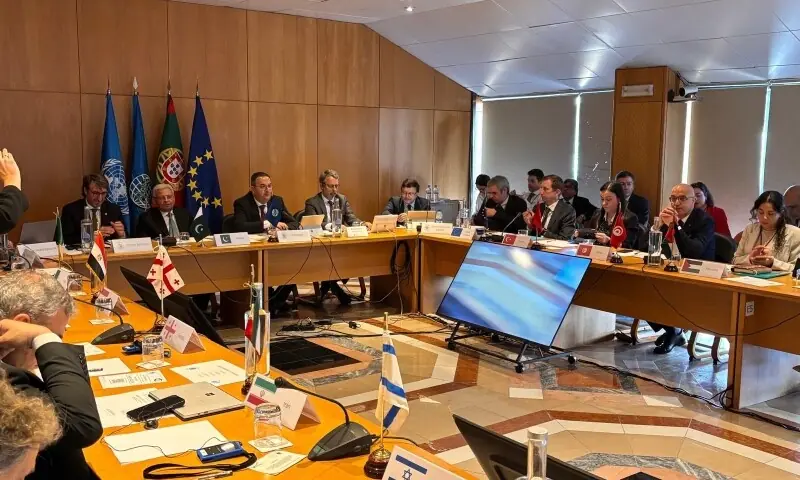
Pakistan has taken its seat for the first time as a Permanent Member of the International Olive Council at the 123rd Session held in Lisbon, Portugal.

Federal Minister for National Food Security & Research Rana Tanveer Hussain led the Pakistan delegation to attend the UN International Olive Council (IOC) meeting. The minister was accompanied by Ambassador of Pakistan to Portugal Aisha Farooqui, the Ministry of Foreign Affairs (MoFA) stated.

Following Pakistan’s membership of the International Olive Council in May 2026, Pakistan was invited to take its seat at the 123rd meeting of the Council, together with 27 other olive oil producing nations.

The MoFA said Pakistan was warmly welcomed to the IOC by the executive director, the chairman of IOC and by all the member countries.

The minister for national food security and research in his statement thanked the IOC and reaffirmed Pakistan’s commitment to take forward the objectives and goals of the IOC.

Tanveer briefed the council members on Pakistan’s growing olive sector with over seven million olive trees cultivated across 55,669 acres and olive clusters expanding across the country.
 

Pakistan becomes permanent member of International Olive Council


Pakistan has become a permanent member of the International Olive Council (IOC) for the first time, the Foreign Office (FO) said on Monday.

According to the FO, Pakistan assumed its seat during the IOC’s 123rd session held in Lisbon, Portugal, which was attended by 27 olive-producing countries.

A Pakistani delegation, led by Federal Minister for National Food Security and Research Rana Tanveer Hussain, represented the country at the meeting.

The minister briefed council members on Pakistan’s rapidly expanding olive sector and highlighted the country’s efforts to promote sustainable olive production in the context of climate change, according to the FO statement.


Pakistan also reaffirmed its commitment to playing a positive and constructive role in the global olive sector and to further strengthening its presence in the international olive market.

The minister was accompanied by Pakistan’s ambassador to Portugal, Aisha Farooqui, according to a statement from the embassy.


During the session, Pakistan highlighted key developments in its olive sector, including the plantation of more than seven million olive trees across the country.

Officials said olive cultivation is currently underway on 55,669 acres of land, with olive clusters expanding rapidly.

The FO said Pakistan has established a complete “farm-to-table” value chain in the sector, along with 51 operational olive oil extraction units.

It added that modern processing facilities, nurseries and meteorological stations have been set up, along with four laboratories developed in line with IOC standards.

The country has also achieved self-sufficiency in the local production of certified olive saplings, while Pakistani olive oil has gained international recognition, the statement added.

Established in 1959, the IOC serves as an intergovernmental organisation that promotes sustainable and responsible development of the olive sector. It represents countries accounting for more than 94 per cent of global olive oil production.
 
Punjab Chief Minister Maryam Nawaz recently approved the Thal Transformation Programme as part of a major province-wide push to modernize agriculture and uplift rural economies.

The initiative is specifically designed to tackle the agricultural challenges in the arid, underdeveloped Thal region by improving water management and introducing high-value crops.

Here are the key components of the program:
  • Water Management: The construction of 1,000 water storage ponds and localized irrigation schemes. Since Thal is a desert region, capturing and efficiently managing water is the most critical step toward making the land viable for consistent farming.
  • Horticulture Expansion: The plantation of orange orchards across 10,000 to 11,000 acres. By shifting focus toward high-yield horticulture, the government aims to significantly improve the livelihoods of local farmers who have historically struggled with traditional crop yields in the sandy terrain.

The Broader Agricultural Context​

The Thal Transformation Programme is rolling out alongside several other major agricultural reforms in Punjab designed to empower farmers and boost overall yield, including:

  • The Kissan Card: Distributing targeted subsidies to farmers (with a goal of reaching one million cards by late 2026), heavily focused on fertilizer purchases.
  • Green Tractor Scheme: Delivering tens of thousands of tractors with a subsidy of Rs. 1 million per unit.
  • Smog Reduction: Providing thousands of "Super Seeders" to farmers to discourage the burning of crop residue, which is a primary driver of winter smog in the region.
  • Model Agri Malls: The design and establishment of 10 state-of-the-art agricultural malls to give farmers centralized access to modern advisory services and equipment.
 

Users who are viewing this thread

Back
Top