Pakistan Agriculture News / Discussions

Pakistan joins International Olive Council, showcases rapidly expanding olive sector

  • “Farm-to-fork” value chain has been established, says minister
BR Web Desk
June 30, 2026

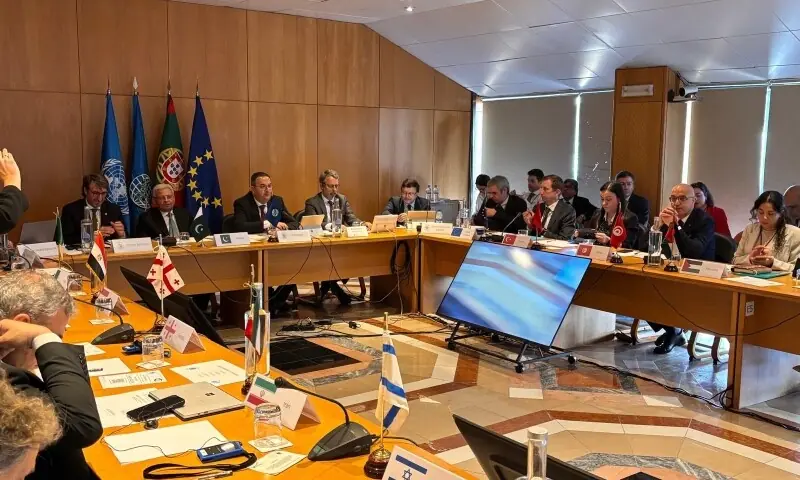
Pakistan has taken its seat for the first time as a Permanent Member of the International Olive Council at the 123rd Session held in Lisbon, Portugal.

Federal Minister for National Food Security & Research Rana Tanveer Hussain led the Pakistan delegation to attend the UN International Olive Council (IOC) meeting. The minister was accompanied by Ambassador of Pakistan to Portugal Aisha Farooqui, the Ministry of Foreign Affairs (MoFA) stated.

Following Pakistan’s membership of the International Olive Council in May 2026, Pakistan was invited to take its seat at the 123rd meeting of the Council, together with 27 other olive oil producing nations.

The MoFA said Pakistan was warmly welcomed to the IOC by the executive director, the chairman of IOC and by all the member countries.

The minister for national food security and research in his statement thanked the IOC and reaffirmed Pakistan’s commitment to take forward the objectives and goals of the IOC.

Tanveer briefed the council members on Pakistan’s growing olive sector with over seven million olive trees cultivated across 55,669 acres and olive clusters expanding across the country.
 

Pakistan becomes permanent member of International Olive Council


Pakistan has become a permanent member of the International Olive Council (IOC) for the first time, the Foreign Office (FO) said on Monday.

According to the FO, Pakistan assumed its seat during the IOC’s 123rd session held in Lisbon, Portugal, which was attended by 27 olive-producing countries.

A Pakistani delegation, led by Federal Minister for National Food Security and Research Rana Tanveer Hussain, represented the country at the meeting.

The minister briefed council members on Pakistan’s rapidly expanding olive sector and highlighted the country’s efforts to promote sustainable olive production in the context of climate change, according to the FO statement.


Pakistan also reaffirmed its commitment to playing a positive and constructive role in the global olive sector and to further strengthening its presence in the international olive market.

The minister was accompanied by Pakistan’s ambassador to Portugal, Aisha Farooqui, according to a statement from the embassy.


During the session, Pakistan highlighted key developments in its olive sector, including the plantation of more than seven million olive trees across the country.

Officials said olive cultivation is currently underway on 55,669 acres of land, with olive clusters expanding rapidly.

The FO said Pakistan has established a complete “farm-to-table” value chain in the sector, along with 51 operational olive oil extraction units.

It added that modern processing facilities, nurseries and meteorological stations have been set up, along with four laboratories developed in line with IOC standards.

The country has also achieved self-sufficiency in the local production of certified olive saplings, while Pakistani olive oil has gained international recognition, the statement added.

Established in 1959, the IOC serves as an intergovernmental organisation that promotes sustainable and responsible development of the olive sector. It represents countries accounting for more than 94 per cent of global olive oil production.
 
Punjab Chief Minister Maryam Nawaz recently approved the Thal Transformation Programme as part of a major province-wide push to modernize agriculture and uplift rural economies.

The initiative is specifically designed to tackle the agricultural challenges in the arid, underdeveloped Thal region by improving water management and introducing high-value crops.

Here are the key components of the program:
  • Water Management: The construction of 1,000 water storage ponds and localized irrigation schemes. Since Thal is a desert region, capturing and efficiently managing water is the most critical step toward making the land viable for consistent farming.
  • Horticulture Expansion: The plantation of orange orchards across 10,000 to 11,000 acres. By shifting focus toward high-yield horticulture, the government aims to significantly improve the livelihoods of local farmers who have historically struggled with traditional crop yields in the sandy terrain.

The Broader Agricultural Context​

The Thal Transformation Programme is rolling out alongside several other major agricultural reforms in Punjab designed to empower farmers and boost overall yield, including:

  • The Kissan Card: Distributing targeted subsidies to farmers (with a goal of reaching one million cards by late 2026), heavily focused on fertilizer purchases.
  • Green Tractor Scheme: Delivering tens of thousands of tractors with a subsidy of Rs. 1 million per unit.
  • Smog Reduction: Providing thousands of "Super Seeders" to farmers to discourage the burning of crop residue, which is a primary driver of winter smog in the region.
  • Model Agri Malls: The design and establishment of 10 state-of-the-art agricultural malls to give farmers centralized access to modern advisory services and equipment.
 

Pakistan publishes its agriculture census, revealing the federation beneath our fields

Pakistan's latest Agricultural Census reveals shrinking farms, a shift from canals to private groundwater not only bringing shift in agriculture but an emancipation from state, a solar revolution in the fields, an interprovincial food economy, and livestock growth that has far outpaced crop acreage.

Bilal Gilani
July 15, 2026

The state’s desire to count is never entirely innocent. British India turned censuses, land records and irrigation maps into technologies of rule: enumeration made people and property legible, while the canal colonies linked land settlement, water allocation and revenue to a powerful bureaucracy.

Pakistan inherited that administrative apparatus. Yet the same numbers that can help a state extract can also help citizens see what is changing and demand a response.

The Agricultural Census 2024 deserves to be read in that critical but constructive spirit. It is Pakistan’s seventh agricultural census and the first to combine agriculture, livestock and farm machinery in one digital exercise.

This 2024 census is the first to combine agriculture, livestock and farm machinery in one digital exercise

Fieldwork was carried out in two phases between September 2024 and February 2025. It was sample-based rather than a literal count of every farm. (This was a different approach from work done before 2010 and from that of methods used by many countries, and therefore, its results merit more scrutiny).

Selected mouzas and urban blocks were surveyed, while exceptionally large land holdings were included with certainty. Tablets, GIS mapping and real-time monitoring were used to produce district-level estimates. The numbers are therefore not sacred, but they are the most systematic national picture available.
 

More farms, smaller farms, and arguably lesser productivity

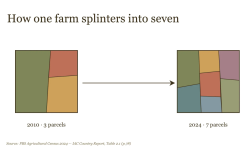
The most alarming finding is the continued fragmentation of land. Pakistan had 8.26 million farms in 2010; it now has 11.1 million, an increase of 34 per cent. Farm area grew by only 12 per cent, so average farm size fell from 6.4 to 5.3 acres. More strikingly, the number of fragmented farms rose from 2.83 million to 4.98 million, while the average number of separate pieces within a fragmented holding increased from three to seven.

Fragmentation is not a neutral statistic. Scattered parcels raise the time and cost of ploughing, irrigating and guarding a holding; they shrink the returns to levelling land, laying watercourses or investing in a tubewell that would pay off on a single consolidated field; they multiply boundary disputes between neighbours; and they push machinery, which needs scale to be worth renting or owning, further out of reach for smallholders. A farm split into seven pieces is not simply smaller. It is harder to farm well.
 
Inheritance is central to this story. After each generation, land titles are divided among heirs and the operational holding is often divided with them. Women are still frequently denied their lawful shares, so Pakistan manages to combine fragmentation with gender injustice. The answer cannot be to weaken inheritance rights. It is to separate ownership from operation.

Families should be able to retain distinct legal titles and income shares while cultivating adjoining parcels as one unit. Producer cooperatives, family farm companies, machinery pools, digital lease markets and voluntary land exchanges can create scale without dispossession. Government can provide cadastral maps, low-cost lease registration, model contracts and quick dispute resolution. Women heirs must be recorded as members, paid directly and given enforceable exit rights. Pakistan does not necessarily need fewer owners; it needs institutions that allow small owners to farm together.

1784196420529.png

The average fragmented holding was carved from three scattered parcels into seven between the 2010 and 2024 censuses — a 133% rise in pieces per farm.
 

From canal command to groundwater autonomy

The second transformation is taking place below the soil. Total irrigated area rose from about 34.1 million acres in 2010 to 45.9 million in 2024. Canal-only irrigation did increase, from 12.3 to 14.5 million acres, but it lost relative importance: its share of irrigated land fell from roughly 36 to 32 per cent. Land using both canals and tubewells slipped from 13.9 to 13.5 million acres. Tubewell-only irrigation, meanwhile, more than doubled from 6.1 to 14.1 million acres, raising its share from about 18 to 31 per cent.

This is not a story of canals disappearing. It is a shift in the centre of gravity from publicly coordinated surface water to privately controlled groundwater. The number of tubewells and lift pumps rose from 0.93 million in 2004 to 1.83 million in 2024.

It is a shift in the centre of gravity from publicly coordinated surface water to privately controlled groundwater.
 
The more striking shift is in what powers them. Solar barely registered as a power source for tubewells in 2004.

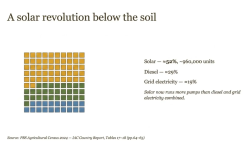
Today it runs an estimated 960,000 of the country’s 1.83 million tubewells and lift pumps—roughly half the entire stock, and more than diesel and electricity combined. Diesel-powered units have fallen as fuel costs rose; grid electricity remains a minority option, constrained by an unreliable and expensive supply.

In the space of two census rounds, solar has gone from a rounding error to the single largest power source irrigating Pakistan’s farms. This is one of the most consequential technology shifts in the recent history of Pakistani agriculture, and it has had almost no sustained political or policy conversation attached to it—no coordinated financing programme, no groundwater-metering requirement tied to the subsidy-free upfront cost that made it attractive, no basin-level plan for what happens when pumping is limited only by sunlight rather than by fuel budgets.
 
1784196695323.png

Each square is one in a hundred of Pakistan’s 1.83 million tubewells and lift pumps, by power source.

The social meaning is as important as the engineering. The colonial canal system created remarkable agricultural production, but it also made access to water dependent on settlement policy, official schedules, irrigation officials and upstream users. The tubewell gives a farmer greater command over timing. It is a limited emancipation from the state and from the collective discipline of the watercourse.

Solar power strengthens that autonomy by replacing a recurring diesel or electricity bill with an upfront investment. Would this mean stronger rural classes or sub classes and their relative bargaining terms with urban classes? These are consequences that require more detailed study.

Each square is Pakistan’s irrigated land, split by source. Private tubewells (red) nearly doubled their share — from 18% to 31% — as surface canals lost ground.
But private freedom can create a public crisis.

A farmer who pumps groundwater receives the immediate benefit, while the falling water table, salinity and declining aquifer quality are shared by neighbours and future generations. Solar makes each additional hour of pumping appear almost costless.

The transition therefore demands much more research: Where are water tables falling fastest? How much pumping is replenished? Who can afford deeper wells? How are groundwater and river flows connected?
 

The federation on the fruit cart

The census also offers a more hopeful way of seeing the federation. Pakistan’s unity is usually discussed through constitutions, dynasties and political threats. Yet its deeper roots may lie in grain sacks, milk tankers and fruit crates moving across provincial borders.

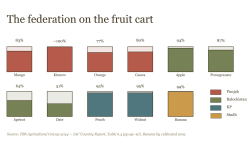
The tree counts show extraordinary specialisation. Punjab contains about 83 per cent of Pakistan’s mango trees, virtually all its kinnow trees and 77 per cent of its orange and malta trees. Balochistan has 94 per cent of the apple trees, 87 per cent of the pomegranate trees and about half the date trees.

Khyber Pakhtunkhwa has approximately 95 per cent of the peach trees and 95 per cent of the walnut trees.

Sindh accounts for about 38 per cent of the date trees and remains the second major home of mangoes—and it is the undisputed home of banana, growing 99 per cent of the national crop by cultivated area, the most complete specialisation of any province in any crop in this census.

1784197169922.png
Each square is one fruit; the shaded portion is the leading province’s share of the national tree count. No province grows the whole basket.

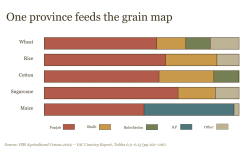
The grain economy is similarly connected. Punjab accounts for about 58 per cent of wheat area, 62 per cent of rice, 59 per cent of cotton and 69 per cent of sugarcane.

But Sindh supplies 26 per cent of rice area and 28 per cent of cotton; Balochistan contributes 13 per cent of wheat and cotton area; and Khyber Pakhtunkhwa produces almost half the country’s maize area.
 
1784197223686.png

The crop map is less evenly distributed than the fruit map. Punjab leads wheat, rice, cotton, sugarcane and maize alike, with Sindh a consistent second and Khyber Pakhtunkhwa a close rival only in maize.

That concentration cuts both ways. It gives Punjab outsized weight in national food security, and it means a bad Punjab season — a flood, a heatwave, a canal-supply shortfall — is a national event rather than a provincial one in a way that fruit-tree specialisation, spread across four provinces, is not.

Inside that crop map sits a genuine alarm. Cotton area fell from 9.23 million acres in 2010 to 6.51 million in 2024, a drop of 29 per cent, even as the country’s total cropped area grew by 22 per cent over the same period.

Cotton’s own share of the national cropped area collapsed from roughly 14 per cent to under 8 per cent. Pakistan’s textile sector, still the country’s largest export earner, was built on a domestic cotton base.

A raw-material supply shrinking this fast while the mills it feeds keep expanding is not a sustainable arrangement; it points toward Pakistan becoming a structurally larger importer of raw cotton, spending scarce foreign exchange on a crop the country was once a major grower of.
 

Users who are viewing this thread

Pakistan Defence Latest

Country Watch Latest

Latest Posts

Back
Top