Pakistan Agriculture News / Discussions

Elite Boer Goat Genetics Brought from US to Boost Pakistan’s Mutton Output​

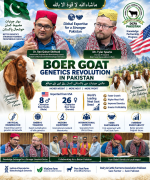
KARACHI: In a major push toward modernization and breed improvement in the country's livestock industry, a consignment of 34 elite, champion-bloodline Boer goats has been imported from the United States to kick-start a nationwide genetic enhancement and reproductive biotechnology programme.

The initiative, aimed at addressing low meat yields and inefficient breeding practices in Pakistan's mutton sector, was highlighted during a reception hosted at the central office of the Dairy & Cattle Farmers Association Pakistan (DCFA Pakistan).

A delegation comprising renowned livestock genetics and reproductive biotechnology specialist Dr. Rao Qaisar Shehzad, Dr. Mubeen, and US geneticist Tyler Sparks visited the DCFA headquarters, where leadership presented them with traditional Sindhi topis, ajraks, and honorary shields recognizing their work in breed development.

Shifting from Headcount to Genetic Merit​

The imported herd consists of 8 bucks and 26 does selected from top-tier American bloodlines. Globally recognized as the benchmark breed for commercial meat production, Boer goats are valued for their rapid growth rates, heavy muscling, strong frame conformation, and superior carcass yield compared to conventional local breeds.

However, industry experts emphasized that the project’s significance extends far beyond the arrival of 34 head of breeding stock. The core objective is mass multiplication through assisted reproductive technologies (ART), bypassing the slow pace of natural mating cycles.

Under the programme, the Institute of Reproductive Biotechnology & Genomics (IRBG), in collaboration with VitaGene Farm, will utilize:

  • Cryopreserved semen production for widespread artificial insemination (AI)
  • In-vitro embryo production and multi-ovulation embryo transfer (MOET)
  • Genomic selection and performance recording to ensure bloodline integrity

Commercial Rollout & International Expertise​

To ensure scientific advancements translate into tangible commercial gains, the initiative has signed its first private-sector operational partnership with Pure Goat Farm. The partnership will act as a commercial testbed to integrate structured reproductive technology into standard production herds.

Technical cooperation has also been enlisted from specialists across the United States and China, equipping domestic laboratories with modern embryology tools and cryopreservation equipment. Dr. Shehzad, who previously collaborated on large-scale embryo transfer programmes with Chinese agricultural institutions, noted that rapid multiplication is the only viable method to democratize high-value genetics.

"Natural service restricts an elite buck or doe to a fraction of its potential impact. Through semen freezing and embryo transfer, single champion lineages can transform thousands of animals in just a few breeding cycles."

Reaching the Smallholder​

Officials from DCFA Pakistan noted that while demonstration hubs and corporate farms will lead early adoption, the broader economic payoff depends entirely on outreach to small and medium-scale pastoralists, who manage the overwhelming majority of Pakistan's small ruminant population.

The association underscored that genetic gains must be paired with foundational husbandry improvements:

  • Balanced feed formulations and nutrient profiling
  • Standardized biosecurity and herd vaccination schedules
  • Pedigree and performance tracking databases
  • Capacity-building workshops for local farmers
DCFA Pakistan urged policymakers and livestock stakeholders to abandon traditional policies focused solely on animal headcounts, advocating instead for an output-driven strategy rooted in science, data, and performance breeding to ensure food security and enhance rural livelihoods.

1790230686518.png
 

Elite Boer Goat Genetics Brought from US to Boost Pakistan’s Mutton Output​

KARACHI: In a major push toward modernization and breed improvement in the country's livestock industry, a consignment of 34 elite, champion-bloodline Boer goats has been imported from the United States to kick-start a nationwide genetic enhancement and reproductive biotechnology programme.

The initiative, aimed at addressing low meat yields and inefficient breeding practices in Pakistan's mutton sector, was highlighted during a reception hosted at the central office of the Dairy & Cattle Farmers Association Pakistan (DCFA Pakistan).

A delegation comprising renowned livestock genetics and reproductive biotechnology specialist Dr. Rao Qaisar Shehzad, Dr. Mubeen, and US geneticist Tyler Sparks visited the DCFA headquarters, where leadership presented them with traditional Sindhi topis, ajraks, and honorary shields recognizing their work in breed development.

Shifting from Headcount to Genetic Merit​

The imported herd consists of 8 bucks and 26 does selected from top-tier American bloodlines. Globally recognized as the benchmark breed for commercial meat production, Boer goats are valued for their rapid growth rates, heavy muscling, strong frame conformation, and superior carcass yield compared to conventional local breeds.

However, industry experts emphasized that the project’s significance extends far beyond the arrival of 34 head of breeding stock. The core objective is mass multiplication through assisted reproductive technologies (ART), bypassing the slow pace of natural mating cycles.

Under the programme, the Institute of Reproductive Biotechnology & Genomics (IRBG), in collaboration with VitaGene Farm, will utilize:

  • Cryopreserved semen production for widespread artificial insemination (AI)
  • In-vitro embryo production and multi-ovulation embryo transfer (MOET)
  • Genomic selection and performance recording to ensure bloodline integrity

Commercial Rollout & International Expertise​

To ensure scientific advancements translate into tangible commercial gains, the initiative has signed its first private-sector operational partnership with Pure Goat Farm. The partnership will act as a commercial testbed to integrate structured reproductive technology into standard production herds.

Technical cooperation has also been enlisted from specialists across the United States and China, equipping domestic laboratories with modern embryology tools and cryopreservation equipment. Dr. Shehzad, who previously collaborated on large-scale embryo transfer programmes with Chinese agricultural institutions, noted that rapid multiplication is the only viable method to democratize high-value genetics.


Reaching the Smallholder​

Officials from DCFA Pakistan noted that while demonstration hubs and corporate farms will lead early adoption, the broader economic payoff depends entirely on outreach to small and medium-scale pastoralists, who manage the overwhelming majority of Pakistan's small ruminant population.

The association underscored that genetic gains must be paired with foundational husbandry improvements:

  • Balanced feed formulations and nutrient profiling
  • Standardized biosecurity and herd vaccination schedules
  • Pedigree and performance tracking databases
  • Capacity-building workshops for local farmers
DCFA Pakistan urged policymakers and livestock stakeholders to abandon traditional policies focused solely on animal headcounts, advocating instead for an output-driven strategy rooted in science, data, and performance breeding to ensure food security and enhance rural livelihoods.

View attachment 216642

This and brahman will make Pakistan livestock super power in 10 years. The meat/milk production can be doubled with same headcount.
 
Shifting Gears: How Local Manufacturing of Pivot Irrigation is Greening Pakistan’s Deserts

ISLAMABAD:
For decades, the vision of transforming Pakistan’s vast, arid wastelands into productive agricultural hubs has been stymied by a steep barrier to entry: the exorbitant cost of imported technology. Now, an unexpected player is helping to bridge that gap, signaling a major shift in the country's approach to corporate farming and water conservation.

Heavy Industries Taxila (HIT), traditionally known for defense manufacturing, has successfully ventured into the production of Center Pivot Irrigation Systems (CPIS). Driven by the imperatives of the Special Investment Facilitation Council (SIFC) and the Green Pakistan Initiative (GPI), this move aims to provide domestic alternatives to expensive American and European irrigation hardware.

The transition comes at a critical time. With climate change threatening traditional water supplies and the agricultural sector consuming over 80% of the country's freshwater, high-efficiency irrigation is no longer optional. However, importing massive steel spans and control systems from the US, Spain, or China has become increasingly unviable for local farmers due to fluctuating USD-to-PKR exchange rates, heavy international freight costs, and the removal of certain sales tax exemptions.

Historically, setting up an imported fixed pivot system could cost upwards of Rs. 400,000 to Rs. 500,000 per acre, deterring large-scale adoption. By manufacturing these systems domestically, the capital expenditure drops significantly, with smaller towable systems estimated to cost closer to Rs. 212,000 per acre.

The Bahawalpur Pilot and Mass Production

The viability of local manufacturing was recently proven through a successful 50-acre pilot installation in Bahawalpur. Designed to withstand the harsh, sandy terrain and extreme summer temperatures of the Cholistan region, the HIT-manufactured pivot demonstrated that indigenous engineering could meet international agricultural standards.

Following the success of the pilot, HIT has commenced the mass production of 50 complete CPIS units. These machines are engineered with 90% indigenous parts, including heavy-duty, fully galvanized steel pipes and truss rods designed for a 15-to-20-year lifespan. Currently, only highly specialized components like drive motors and gearboxes are imported, though efforts are actively underway to achieve 100% indigenization.

Securing the Supply Chain


Beyond the initial financial savings, the most significant advantage of local manufacturing lies in maintenance and supply chain security. In the scorching heat of July, a mechanical failure on an imported pivot can spell disaster. Waiting four weeks for a replacement control panel or gearbox to clear customs often results in total crop failure in arid zones.

To counter this, HIT has established "quick reaction joint teams." With parts manufactured in Taxila, replacement spans and technical support can be dispatched instantly, minimizing downtime. Furthermore, the local units are specifically engineered to accommodate Pakistan’s unique grid voltage fluctuations and are increasingly being paired with solar-hybrid energy systems.

Fueling the Corporate Farming Boom

This localization of technology is a cornerstone for the Green Pakistan Initiative, which seeks to lease minimum parcels of 1,000 acres of uncultivated land to corporate investors. Agribusinesses, such as Samsons Farms, are already utilizing center pivots to cultivate thousands of acres of high-yield Rhodes grass and other crops in desert regions for both domestic livestock and lucrative export markets in the Middle East.

By removing the foreign exchange drain associated with heavy agricultural machinery, local manufacturing is proving to be a critical catalyst. It not only supports import substitution but also equips Pakistan with the scalable tools necessary to reclaim its deserts, boost export revenues, and secure its national food supply in an increasingly water-scarce future.
 

Users who are viewing this thread

Back
Top