The STRATCOM Bureau
@OSPSF
Jul 27
Apologies in advance for a significantly longer response, meant to address a common misconception where most people judge the capability-addition of weapons on individual specifications rather than on reliability in assigned mission sets, availability, or the total/combined effect of its role in a larger operational strategy.
Short answer: We do have a larger conventional bomb than this for over twenty years years now. Ask the Indian Army base in Narian, Rajauri, IIOJK. They would know.
Now for the Longer Answer:
Larger size is not always a better missile, more speed doesn’t make one fighter jet better than the next. Ideally, every individual military assesses and decides on a unique munitions mix according to their own specific requirements and threat spectrum both laterally and vertically as well as operational domain and conventionality of the target enemy force. For example, Central African states mostly have their entire air forces comprised of attack helicopters, serving their needs quite well.
In their point of view, their old Russian gunships serve them better in their daily operational requirements of rapid, localised close air support (CAS)+COIN ops, as compared to giving them a cost-draining, stealth-focused, maintenance-heavy F-35.
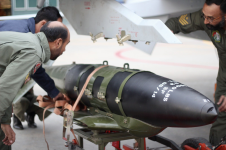
Pakistan has a larger air-dropped munition than this one in active service, and has already used it in combat twice and successfully and that to against a hostile nuclear-armed state.
The AWC-NESCOM H-4 SOW, with a loadout weight on launch aircraft slightly over 1,200 kilograms or 2,650 lbs, and a Stand Off Weapon (SOW) range of 130 kilometres.
The Turkish GAZAP bomb is lighter/smaller at 970 kilograms or 2,000 pounds.
More Important to understand that these two are different bombs for different roles:
The GAZAP small-ranged, thermobaric bomb dispersing small fragmentation blasts, designed for a maximum area-wide damage to an undefended and open space.
Pakistan’s H-4 SOW, on the other hand, is a radar-evading, active-guided heavy glide bomb with terminally control capability via television guidance (TGM) or an active IIR seeker, designed for the long-ranged, surgical destruction of a hardened/reinforced, high-value target
It can be launched at a significant stand-off distance from the target location, maximising survivability even striking in and through fiercely-contested or heavily-saturated airspace.
Think of the ideal design role to be a high-value strike launching behind heavily-defended enemy territory and a contested airspace with layered air defence and target a single, mission-critical, hardened/reinforced target inside a military base having several similar targets via terminal piloted guidance.
The Pakistan Air Force prioritises precision airstrikes and assured, accurate hits on critical targets/nodes to build a combined, maximum effective operational damage to the enemy.
We do not have an operational requirement or a realistic set of such open area targets with reasonable military-use to justify an air-slugged heavy munition with zero control on collateral damages once detonation begins.
PAF also has air dropped cluster-munitions for anti-personnel/armour clearance area clearance but that is meant for war-fighting conventional forces of a near-pear adversary.
For maximum area damage to lightly-armoured targets/unprotected enemy assets in unreinforced structures, launched outside of enemy borders, we can utilise long-ranged guided rocket artillery, glide and cruise missiles.
For a larger, base-wide denial and strike operation we could use a combination of loitering munitions, very long ranged guided rockets and missiles, JDAM waves, anti-runway bombs, a specifically-calculated number of long-range glide bombs, air-launched precision-strike cruise missiles with combinations of blast-fragmentation, penetration, and pre-fragmentation warheads, and of course combinations of mobile tactical ballistic missiles and hypersonic, air-launched missiles.