Zoya Nazir Published January 4, 2026
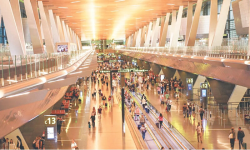
Hamad International Airport, Doha | Qatar Tribune
I am an airport person — not because I travel often, but because I love their peculiar atmosphere: the sense of transition, the emotion of crossing borders. Yet I have come to recognise another dimension: airports often capture the essence of the society that built them.
Earlier in October, I booked my flight from Berlin to Karachi after completing my postgraduation in Germany. This was not my first time travelling the Berlin-Doha-Karachi route and, like every time, I looked forward to my three-hour layover at the Hamad International Airport in Doha, Qatar.
HOMECOMING REALITIES
When I landed at the airport of my home city after a 12-hour journey, I was overcome with nostalgia for a few seconds, as Karachi is the city where I spent my early childhood.
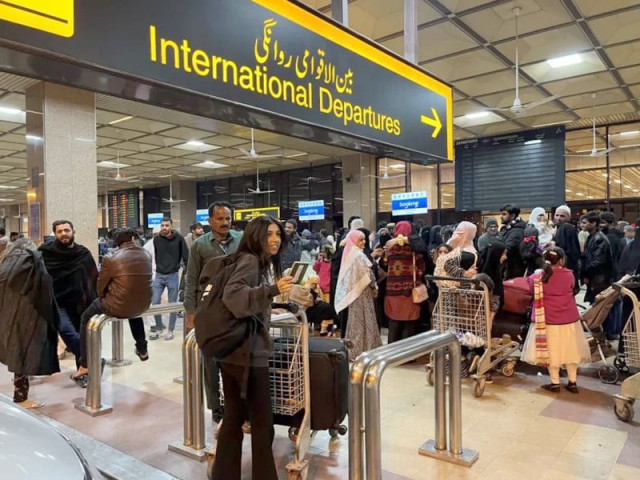
But as my nostalgia faded, I felt the contrast between Karachi airport and any other international airport, including those of Doha and Berlin. The infrastructure was dated and the stores felt like relics of a bygone era. I saw my suitcase after nearly an hour of waiting, although there were only three flights at 7am on a Saturday.
Why does the transport hub of Pakistan’s largest city feel frozen in time? What has prevented its renovation or the construction of a contemporary facility? Jinnah Airport, which opened in 1992, has remained unchanged since its founding. It is, in many ways, a microcosm of Karachi itself: perpetually stuck between what it actually is and what it struggles to become.
Major governance challenges dominate Karachi’s urban landscape, where crumbling infrastructure frequently results in life-threatening accidents. Unchecked projects are often abandoned with little consequence. A clear blame rests on the shoulders of negligent authorities, but it is no less true that the general public in Karachi also suffers from an almost criminal lack of civic sense.
Yet for all its flaws, Karachi is a city whose capacity to receive, absorb and sustain people from all walks of life is remarkable. Home to at least 21 million people, Karachi has, for generations, accepted people from across Pakistan. Punjabis, Pakhtuns, Sindhis, Baloch, Mohajirs, and Bengalis have all found their way here to seek opportunity, refuge, or simply to survive, and the city has given them space to build lives, however precarious.
much said about the need for Pakistan to have an international-standard airport, there is a story to be told about the new Islamabad airport, too. When it was opened in 2018, the Islamabad International Airport, described as ‘world-class’ and ‘state-of-the-art’, was a celebration for Pakistanis.
After years of unpleasant experiences at the former Benazir Bhutto International Airport, the consensus was that Islamabad deserves a transportation facility that offers, at the very least, a positive first impression of the capital city.
Admittedly, the new airport is a significant step up from its predecessor; it is much larger, better-designed and more efficient. Yet one cannot help but notice the substandard quality of construction and other characteristics that fall short of qualifying it as a truly ‘world-class’ airport. The roofs have a tendency to leak when it rains and the elevators accommodate barely four passengers.








 PTI Murad Saeed in Afghanistan, was 'controlling KP govt' from there: Rana Sanaullah (1 Viewer)


 Makkah Defence Alliance: Turkey, Saudi Arabia, and Pakistan, news & updates (29 Viewers)