Pakistan Budget for FY 2026-27

To view this content we will need your consent to set third party cookies.
For more detailed information, see our cookies page.


It's Good That Now People Are Discussing The Ludicrous Situation Which The 18th Amendment Brought Us In. While The Federal Government Transferred Massive Resources, Many Expenditures Remained With It Which Makes No Logic At All.
The Lifeline Power Subsidy, TDS,BISP,PSDP The Works.

It Is Only Rational That After Giving uch Massive Funds To The Provinces The Provinces Should Fund Their Own Motorways and Mega Projects.But Such Was Not The Case Since Peoples Party Wanted To Start It's Flagship BISP On Federal Level and Nawaz Sharif Wanted To Build Motorways On Federal Tab.

Thus The Federal Government Remained In A State Of Perpetual Default
 
The legislation permits companies to lay optic fiber cables free of cost across any government-owned land and housing societies.

This aligns with the National Fiberisation Plan, advanced by the Pakistan Telecommunication Authority and the Ministry of IT and Telecommunication, to support 5G and emerging digital services.

During the fiscal year, the PTA also approved the adoption of Wi-Fi 7 in the 6 GHz band, positioning Pakistan among the leading Asia-Pacific nations to formally adopt the next-generation technology.

The upgrade promises higher throughput and ultra-low latency for advanced applications like 8K streaming and industrial automation.

Pakistan also bolstered its international connectivity. The country’s network currently relies on six submarine cable systems and one terrestrial cable, providing a total installed capacity of 17.7 terabits per second. Four high-capacity submarine cables — AFRICA-1, SMW-6, 2AFRICA and the Makran Gulf Gateway — are planned for future integration.

Domestically, local manufacturing thrived amid heavy duties on imported handsets. Pakistan produced 161.6 million mobile handsets up to March 2026. This included 67 million smartphones, accounting for 71.6pc of total production and reflecting a rapid decline in feature phone demand as 4G services expand.
 

ECONOMIC SURVEY 2026-27: Record provincial surplus masks deeper fault lines

Zaki Abbas
June 12, 2026

ISLAMABAD: Provincial fiscal operations provided significant support to the federal government in improving the overall fiscal situation in the outgoing year.

“The dedicated efforts at the provincial level for effective resource mobilisation and prudent expenditure management triggered higher growth in provincial revenues relative to expenditures,” the Economic Survey of Pakistan 2025-26 acknowledged.

All four provinces collectively achieved the highest-ever surplus of Rs1,636.1 billion in July-March, compared to Rs1 trillion last year. Provincial revenue increased by 12.9pc during the same period.

Sajid Amin Javed, Deputy Executive Director at SDPI, said the Centre was “fair” to urge provinces to share fiscal responsibility, but should lead by example by broadening its own tax net.

He noted that since the federal government cannot constitutionally compel provinces to relinquish their NFC share, it has resorted to a “moral language of shared responsibility.”

He stressed that the fiscal relationship between Centre and provinces must be reciprocal. Given that provincial tax collection remains well below par, he recommended revamping the NFC formula to incentivise revenue generation and reduce the weight of population as a distribution criterion.

He further cautioned that the current freeze on NFC funds is a temporary measure, and that a lasting solution must be discussed at the 11th NFC meeting.
 

Squeezing tax from easy targets

Mubarak Zeb Khan
June 12, 2026

ISLAMABAD: The federal government’s demand that provinces share the burden of the Federal Board of Revenue (FBR) collection shortfalls underscores an unsustainable fiscal strategy. The honest answer is that it is mostly political economy, not administrative incapacity, analysts say. There are some structural issues as well, but political economy remains at the heart of the problem.

The Pakistan Economic Survey FY26 lists reforms ranging from digitalisation to enforcement that have yielded some gains; the larger question remains whether these measures can bridge the revenue gap without revisiting structural imbalances. Answering this question requires political will rather than wholly blaming the implementation organisation.

The retail sector, despite its 17.8 per cent share in GDP, remains largely outside the tax net due to political considerations. At the same time, the petroleum sector, valued at Rs6-7 trillion, also lies outside the tax ambit, even as the federal government aims to collect nearly Rs1.5tr through the petroleum development levy (PDL) in FY26. For FY27, the target for PDL is projected at Rs1.7tr, alongside expectations that provinces will give up between Rs1.3tr and Rs1.7tr to cover FBR shortfalls.
 
Without entering into technicalities, this effectively means that the federal government will withhold approximately Rs3tr from the provinces over and above the National Finance Commission award, without formally amending the accord.

Retail and petroleum sectors remain largely untaxed; fiscal targets are increasingly met through levies and provincial surpluses

This raises a fundamental question: is this a sustainable solution to the revenue collection problem, or merely a short-term measure to meet debt-servicing and defence spending requirements under the International Monetary Fund (IMF) programme?

Dr Ali Hasanain, associate professor of economics at Lums, said successive governments, this one included, have repeatedly announced retail registration schemes, and they keep collapsing at the same point. Traders are an organised, politically connected constituency that every ruling coalition needs, while the salaried class is not.
 

Literacy rate improves by 2pc, but education spending falls in 2025

Kashif Abbasi
June 12, 2026

ISLAMABAD: The literacy rate for individuals aged 10 and above in Pakistan rose from 61 to 63 per cent, while spending on education faced a decline, according to Economic Survey 2025-26.

It stated that male literacy was 73pc and female at 54pc, reflecting a gradual progress and narrowing gender gap.

Urban areas continued to have higher literacy rates with a total of 74 per cent (81 per cent for males and 68 per cent for females), while rural areas had a lower rate of 55 per cent (67 per cent for males and 44 per cent for females).

Rural female literacy showed the most significant improvement. Punjab recorded the highest literacy rate at 68 per cent, followed by Sindh and Khyber Pakhtunkhwa, both at 58 per cent. Balochistan had the lowest rate at 49 per cent.

The urban–rural divide persisted with urban Punjab at 78 per cent and rural Sindh at 39 per cent. Overall, the data highlighted steady but uneven progress with rural female literacy playing a key role in the observed improvements, despite continuing regional and gender disparities.
 
Expenditure

The survey stated that education expenditure stood at Rs962 billion during the financial year 2025 compared to Rs1251.06 billion in the previous year. Expenditure in year 2024-25 remained 0.8pc of GDP while in year 2022-23 it was recorded at 1.5pc of GDP. In 2021-22, it was 1.7pc of GDP, showing a constant decline.

In the year 2020-21, education expenditure was recorded at 1.4pc of GDP, while it was 1.9pc of GDP in 2019-20.

Meanwhile, the survey highlighted the issue of out-of-school children (OOSC), stating that OOSC in Pakistan had declined from 38 per cent in 2023 (male: 35 per cent, female: 42 per cent) to 28 per cent in 2025 (male: 25 per cent, female: 31 per cent), demonstrating significant progress across all provinces particularly in Balochistan where the proportion decreased from 69 per cent to 45 per cent, followed by Sindh (47 per cent to 39 per cent), Punjab (32 per cent to 21 per cent), and Khyber Pakhtunkhwa (30 per cent to 28 per cent).

Highlighting the issue of missing facilities, the report said around 65 per cent of schools in the country had access to electricity though there were disparities among provinces. Punjab and ICT have higher access, while Balochistan reports substantially lower coverage and therefore requires focused attention.

Punjab and ICT also lead in the percentage of primary schools with water facilities, while Balochistan and AJK face challenges with only 23 per cent coverage. Toilet access in schools varies widely among provinces. Pakistan shows moderate access to boundary walls in schools with Punjab, Khyber Pakhtunkhwa and ICT at the forefront.

As schools progress to higher levels, the availability of electricity, drinking water, toilets and boundary walls improves.
 
“Education is the foundation of a better future for every child and a strong society. Pakistan’s large youth bulge can be transformed into a productive resource through effective investment in education.

However, this requires improved access to quality and equity across all levels of education. In the face of demographic changes, technological advancements and governance challenges, education remains a vital tool for social stability and sustainable development.

Recognising its importance, the government continues to prioritise the education sector through policy reforms and targeted investments,” read the report.
 

ECONOMIC SURVEY 2025-26: 2025 floods hit agriculture hardest with Rs430bn losses

Ahmad Fraz Khan
June 12, 2026

LAHORE: The devastating floods of 2025 caused losses amounting to Rs822bn, claimed 1,039 lives, and displaced more than four million people, according to the Economic Survey 2025-26 released on Thursday.

The unprecedented disaster dealt a severe blow to the economy, forcing policymakers to revise the country’s real GDP growth target downward from the originally projected 4.2 per cent to a range of 3.5 to 3.9 per cent.

Describing the calamity as a “major downside driver to Pakistan’s economic growth,” the survey highlighted the enormous human and economic costs of the historic monsoon season.

The floods were triggered by highly unusual rainfall between July and September 2025. National average rainfall reached 172.8mm, 23pc higher than the normal level of 140.9mm.
 
The disaster caused Rs822bn losses across the country, displaced 4m people

The crisis reached its peak in late August when accelerated glacier melt, combined with heavy monsoon rains, led to the rare simultaneous flooding of the Sutlej, Ravi and Chenab rivers. The resulting compound floods wreaked havoc across Punjab, which suffered the greatest impact.

Punjab alone incurred losses of Rs631bn– more than 76pc of the nationwide damages – and accounted for 77pc of all deaths and displacements caused by the disaster.

According to the survey, infrastructure losses across the country totaled Rs307bn. Damages included Rs187bn to road networks, Rs91bn in housing losses, and more than Rs28bn in losses to bridges, water infrastructure and energy systems. In all, 229,763 houses were either severely damaged or completely destroyed.
 

Analysis:

BUDGET 2026-27:

Budget battles: who really shapes country’s finances?

Fatima S Attarwala
June 11, 2026

THE budget is a tug-of-war between different interest groups. On one hand, there is explicit lobbying by various business groups and industry bodies that commission reports, hold events and engage policymakers.

These organisations, explains Dr Ali Hasanain, associate professor of economics at Lums, also meet political party leaders and bureaucrats in both formal and private settings to communicate their concerns and policy preferences.

This is broadly in line with how businesses operate globally. For example, US President Donald Trump’s top backer in the last election was investor Timothy Mellon, who gave $150 million to Make America Great Again, Inc., followed by Elon Musk, who gave $118.6m.

But while lobbying and formal influence exist everywhere, the distribution of power is far less orderly in Pakistan. No single player is all-powerful, though wealth is concentrated in relatively few hands. Instead, policy becomes outcome of fragmented pressure from multiple directions.
 
The big boss may be IMF, but Pakistan remains a sovereign nation, not a subject of the Fund

In Pakistan’s case, this fragmentation is further constrained by an external anchor: the IMF. Under successive programmes, Pakistan is required to meet a long list of targets. Yet within those constraints, governments tend to follow the path of least resistance, typically raising taxes on those already in the tax net rather than expanding it.

This tendency is reinforced by a deeper structural weakness: the lack of strong feasibility studies for projects. Plans are often undertaken without adequately accounting for inefficiencies, bureaucratic incompetence, weak political leadership and changing political equations, he says.
 
‘Noise’ from lobbies

On the one hand, there are concentrated lobbies; on the other, there is the politics of visibility, the ‘noise makers’.

Take retailers and wholesalers, for instance. They remain among the country’s most undertaxed sectors and have repeatedly been identified by the IMF as areas requiring reform. Yet, even the latest small trader scheme is less a tax reform than a negotiated settlement.


“Combined together, they can make a lot more noise than your typical person” and therefore can remain broadly outside the tax net, points out Ammar Habib Khan, assistant professor of practice at IBA, Karachi.

He cites solar net metering as another classic example of the power of noise. “There are only about 400,000 net-metering users, but they can make so much noise that the government finds it difficult to make a reasonable decision,” he says.

“Globally, the transition from net metering to net billing is fairly standard. However, policymakers struggle to make that decision because many of the people affected are wealthy, influential and belong to powerful families.”

This creates a second-order distortion in the process: not just who has formal access to power, but who can raise the political cost of change.
 
The IMF influence equation

Pakistan’s role on the global chessboard is defined by more than just its GDP.

The nuclear-armed state shares borders with Afghanistan, India, Iran and China while also close to Russia and key Gulf chokepoints. It is one the most densely populated countries, and an important part of the Muslim world.

The United States is the largest single member of the IMF, with the highest financial contribution and voting power.

The Fund has a lending capacity of roughly $1 trillion. By comparison, what the US economy produces in about a week — roughly $570 billion — exceeds Pakistan’s annual GDP of approximately $452bn.

Against that backdrop, a $7bn IMF programme, staggered over three years and repayable with interest, is small in financial terms but significant in terms of influence. It is a low-cost, high-leverage exposure to a strategically important state.

The big boss may be the IMF, but Pakistan remains a sovereign nation, not a subject of the Fund. As a lender of last resort, the IMF steps in when a country faces a severe financial crisis.
 

Economy grows 3.7pc in FY26 — fastest in four years, but short of target

News Desk
June 11, 2026

1781263632005.png

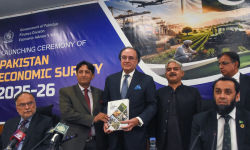
Pakistan Finance Minister Muhammad Aurangzeb, along with Secretary of Finance Imdadullah Bosal and Chief Economist Imtiaz Ahmed, shows a copy of the economic survey of fiscal year 2025/2026, during a news conference in Islamabad, Pakistan on June 11, 2026. — Reuters

The government unveiled the Pakistan Economic Survey (PES) for FY2025-26 on Thursday, according to which GDP growth was recorded at 3.7pc in the outgoing fiscal year.

This is higher than last year’s growth of 3.18pc but falls short of its target of 4.2pc.


Economic survey highlights

  • GDP growth recorded at 3.7pc, up from 3.18pc last year
  • Agriculture sector posts growth of 2.89pc
  • Industrial sector expands by 3.51pc, driven by a 6.1pc rebound in large scale manufacturing
  • Services sector records 4.09pc growth
  • Per capita income increases to $1,901 from $1,751 last year
  • Fiscal deficit narrows to 0.7pc of GDP (July-MarchFY26), down from 2.6pc in the same period last year
  • Primary surplus strengthens to 3.2pc of GDP
  • CPI Inflation averages 6.2pc (July-April FY26)
  • Workers’ remittances reach $30.3bn
 

Users who are viewing this thread

Pakistan Defence Latest

Back
Top